I Built an AI Shopping Assistant That Actually Sells
Most AI shopping assistants are useless chatbots. Here's how I built one that handles 400+ inquiries/month with real inventory integration.
By Mike Hodgen
I spent six months watching chatbot after chatbot fail at the most basic ecommerce task: helping someone buy something.
The pattern was always the same. Customer asks if we have a sequin crop top in medium. Bot responds with "I'd be happy to help! Please visit our crop tops collection page." Customer leaves. Sale lost.
I decided to build an AI shopping assistant that actually works. Not a glorified search bar. Not an FAQ retrieval system. A real conversational commerce tool that can check inventory, access order history, add items to cart, and close sales.
The results: 400+ inquiries per month, 4.7/5 customer satisfaction score, and actual conversions. Here's how I built it.
Why Most AI Shopping Assistants Fail at Commerce
Most ecommerce chatbots are powered by the same broken premise: if we feed the AI our product catalog and some FAQ documents, it'll magically help customers shop.
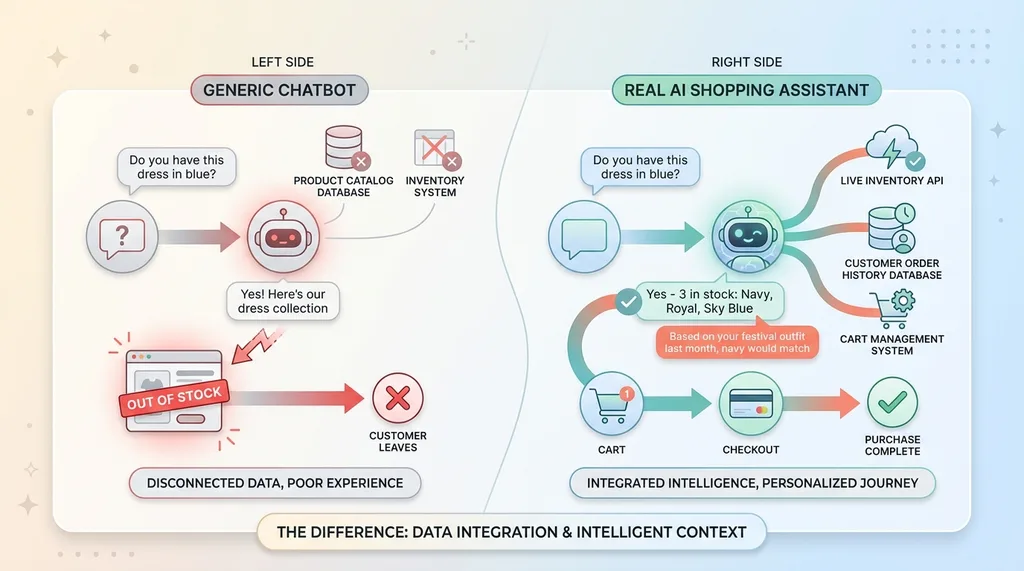 Generic Chatbot vs Real AI Shopping Assistant
It doesn't work. I know because I tried it first.
Three Fatal Flaws of Generic Chatbots
The first fatal flaw: they can't see what's actually in stock. Customer asks "do you have this dress in blue?" Bot searches the product catalog, finds a blue dress, says yes. Customer clicks through to purchase. Out of stock. The AI shopping assistant just lied because it has no connection to inventory systems.
Second flaw: zero context about the customer. Someone who bought from you three times before gets treated the same as a first-time visitor. No order history. No purchase patterns. No ability to say "based on the festival outfit you ordered last month, you might like this new collection."
Third flaw: they can't actually complete transactions. Most chatbots can recommend products all day long. But when it's time to add something to cart, apply a discount code, or initiate checkout? "Please click here to continue shopping." The conversation dies right at the moment of purchase.
These aren't AI shopping assistants. They're content retrieval systems with commerce theater grafted on top.
What 'Actually Sells' Really Means
Let me define success upfront, because most chatbot vendors sure won't.
Our assistant handles 400+ customer inquiries per month. Not "chat sessions initiated" or "messages sent" — actual substantive conversations where someone asks product questions, gets recommendations, or needs help with an order.
The customer satisfaction score sits at 4.7 out of 5. We survey every interaction. People rate the experience after the conversation ends, not some fake "was this helpful?" prompt that everyone ignores.
And conversions: the assistant directly facilitates purchases. I can trace specific orders back to assistant conversations. The midnight shopper who had a sizing question. The international customer who needed to confirm shipping to Australia. The festival-goer who asked for outfit recommendations and ended up buying three pieces.
That's what "actually sells" means. Not engagement metrics. Not deflection rates. Real commerce outcomes.
The difference comes down to one thing: integration with real store systems. Our AI shopping assistant isn't reading a product database. It's querying live inventory, pulling actual order records, and modifying real shopping carts. It's connected to the same systems our human customer service team uses.
System Architecture: Real Store Data in Real Time
There are three data integrations that separate a real AI shopping assistant from FAQ theater.
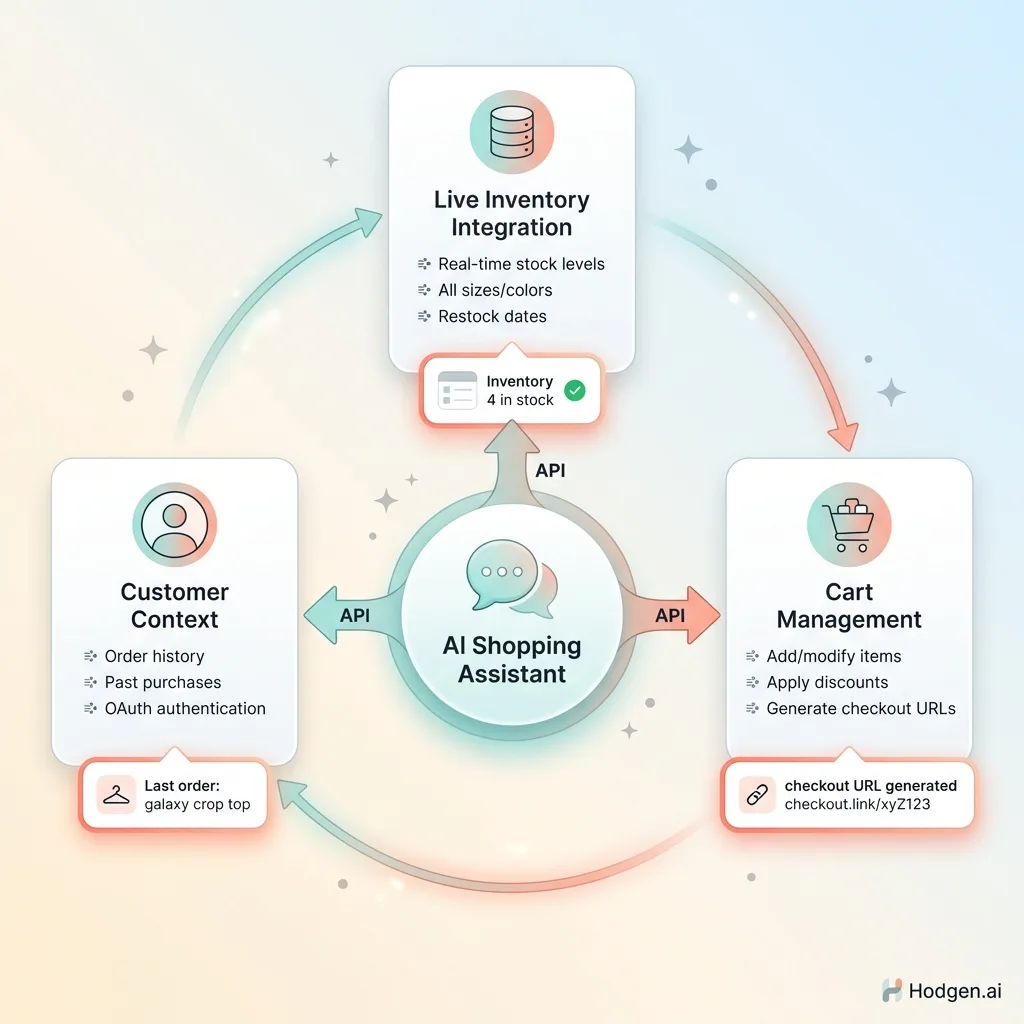 Three Critical System Integrations
Live Inventory Integration
The assistant can see current stock levels for every product, in every size, in every color. Not the product catalog — the actual inventory system.
When someone asks "do you have holographic hot pants in large?", the assistant queries inventory and responds with real data: "Yes, we have 4 in stock. Silver holographic and pink holographic. Which color would you prefer?"
When something's out of stock, the assistant knows the restock date. "We're out of medium right now, but we're getting more on Friday. Want me to add a large to your cart, or would you rather wait for the restock?"
This requires a direct connection to whatever system manages your inventory. For us, that's Shopify. The assistant authenticates via OAuth and queries inventory status in real time. The technical implementation is straightforward. The hard part is keeping inventory data clean enough that the AI can trust it.
Customer Context and Order History
When a returning customer starts a conversation, the assistant can see their order history. Not just "you're a customer" — specific past purchases, dates, order values, shipping addresses.
This enables genuinely useful interactions. Someone asks "where's my order?" The assistant looks up their most recent purchase, checks shipping status, and responds with tracking information. No account login required. No copying and pasting order numbers.
Or product recommendations based on actual behavior. "You ordered the galaxy print crop top last month — we just launched matching shorts in the same print. Want to see them?"
This is sensitive data, so authentication matters. We use the same OAuth flow that would let a customer access their account dashboard. The assistant can only see what the customer could see themselves. But within that boundary, it has full context.
Cart Management and Checkout
The assistant can add items to cart, modify quantities, apply discount codes, and generate checkout links. The conversation doesn't have to leave the chat interface to become a purchase.
"I'll add the medium black sequin crop top to your cart. You mentioned you're going to EDC — we have 20% off festival outfits this week with code EDC2024. I applied it for you. Your total is $38.40. Ready to check out?"
Then the assistant generates a unique checkout URL that prefills the cart and preserves the discount. Customer clicks, enters payment info, done. The entire journey from product question to purchase completion happens in one conversation thread.
This is conversational commerce. Not a chatbot directing people to browse elsewhere. A shopping experience that happens through natural conversation.
The contrast is stark. Generic chatbot: "Here's a link to our crop tops collection." Our AI shopping assistant: "Yes, we have 3 mediums in stock — navy blue, hot pink, and silver. Based on your question about sparkly options, I'd recommend the silver. It has holographic sequins that catch the light. Want me to add it to your cart?"
One is content retrieval. The other is selling.
Conversational Commerce Flow: Browse to Checkout
The best ecommerce interactions feel like talking to a knowledgeable store associate. You describe what you want. They ask clarifying questions. They show you options. They handle objections. You buy.
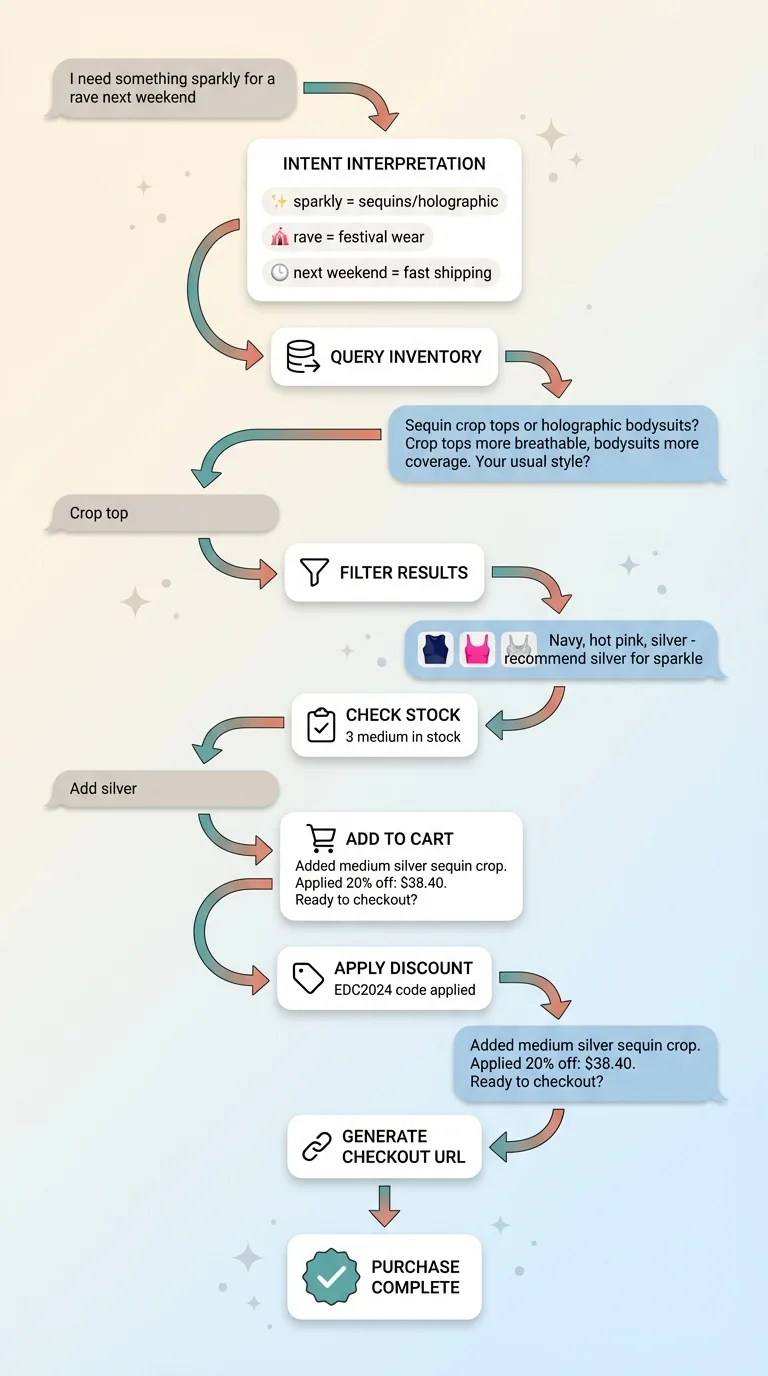 Conversational Commerce Customer Journey
That's the experience I built.
Natural Language Search
Customer: "I need something sparkly for a rave next weekend."
The assistant interprets intent. Sparkly = sequins or holographic materials. Rave = festival wear category. Next weekend = needs fast shipping.
It queries products matching those criteria and responds: "For rave sparkle, I'd suggest either sequin crop tops or holographic bodysuits. The crop tops are more breathable if it's hot. Bodysuits give more coverage. What's your usual style?"
Customer: "Probably crop top."
Now the assistant narrows the search. It filters for sequin and holographic crop tops, checks inventory for available sizes, and prioritizes items that can ship fast enough to arrive by next weekend.
"Great choice. I've got two options that ship today: the Silver Holographic Crop Top ($42, sizes S-L in stock) and the Rainbow Sequin Crop Top ($38, only M and L left). Both would arrive by Thursday. Want to see product photos?"
The customer picks one, the assistant adds it to cart, and the conversation continues naturally. No page redirects. No broken flow. The entire interaction happens in one thread.
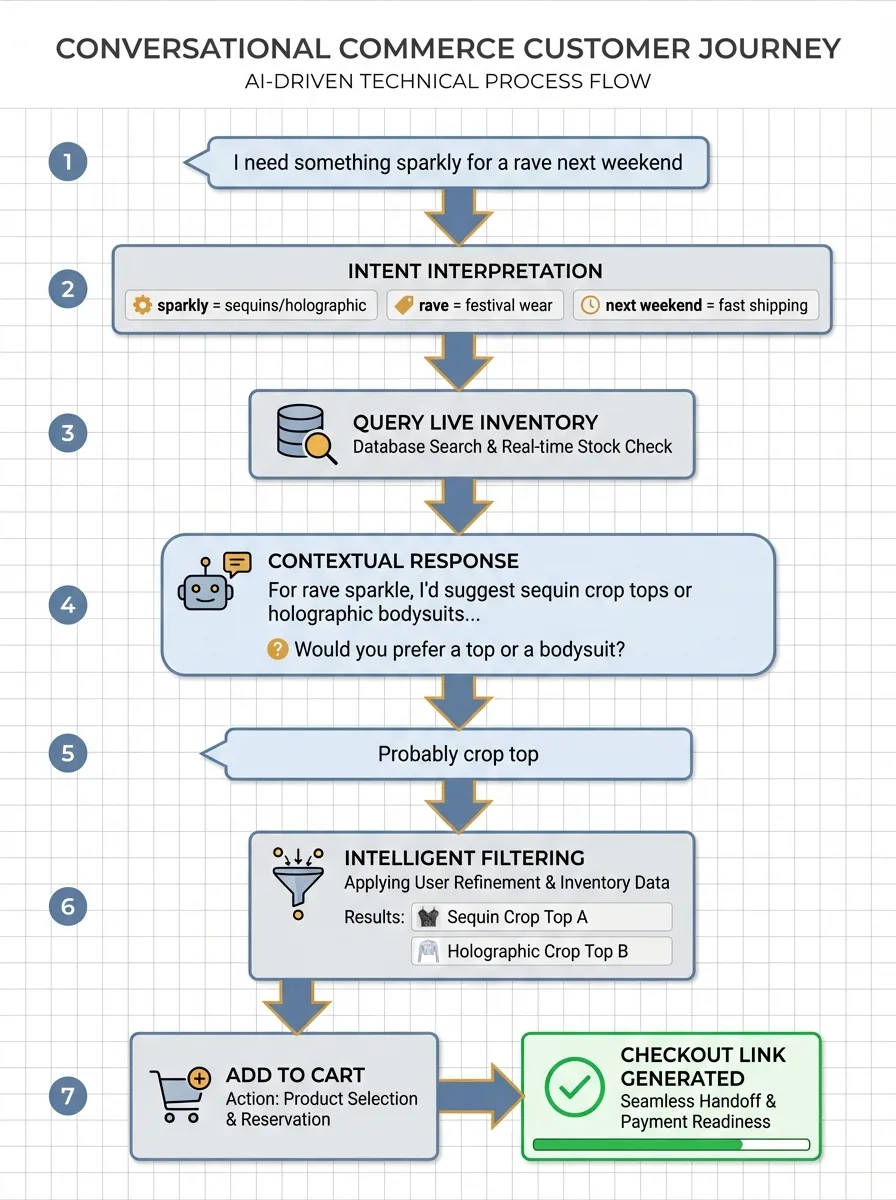 AI-Driven Conversational Commerce Process Flow
Handling Objections in Real Time
The assistant doesn't just recommend products — it handles the back-and-forth that actually leads to purchases.
Customer: "That's a bit more than I wanted to spend."
The assistant can respond intelligently because it knows about active promotions and the customer's context: "We actually have a festival bundle deal right now — buy any two festival pieces and get 15% off. If you're looking for a matching bottom, I could find something that brings your per-item cost down."
This is where most chatbots fall apart. They can recommend products, but the moment a customer pushes back or asks a follow-up, the bot either repeats itself or bails to a human. Our assistant handles price objections, sizing questions, shipping concerns, and style comparisons because it has access to the data needed to give real answers.
Sizing is a common one. "I'm usually a medium but your stuff runs small, right?" The assistant can reference our size guide, check the specific product's fit notes, and even look at the customer's past orders: "Your last order was a medium in the Neon Mesh Top and you didn't return it, so medium should work here too. This crop top has a similar relaxed fit."
That's the kind of personalized response that closes sales. A human associate would do the same thing — check past purchases, reference the size guide, give a confident recommendation. The AI does it in two seconds instead of five minutes of digging through order history.
Smart Escalation: Knowing When to Hand Off
The single most important feature of our AI shopping assistant isn't what it can do. It's knowing what it shouldn't try to do.
Not every customer interaction should be handled by AI. Complaints about damaged products need human empathy. Complex return situations need human judgment. A customer who's clearly frustrated needs a real person, not a bot trying to optimize their experience.
We built escalation logic around three triggers.
First: sentiment detection. If the customer's tone shifts negative — frustrated language, repeated questions, all caps — the assistant recognizes it and offers to connect them with a team member. "I want to make sure you get the best help on this. Let me connect you with someone from our team who can sort this out right away."
Second: complexity thresholds. Some requests are just too nuanced for AI. Multi-order returns, custom sizing for events, wholesale inquiries, anything involving a modification to a past order. The assistant doesn't try to wing it. It collects the relevant details, summarizes the situation, and passes everything to a human agent so the customer doesn't have to repeat themselves.
Third: explicit requests. If someone says "I want to talk to a person," the assistant connects them immediately. No "but first, can I help you with..." No deflection. Respecting that request instantly actually improves satisfaction scores because customers feel heard rather than trapped in a bot loop.
The escalation handoff includes full conversation context. The human agent sees everything — what the customer asked, what the assistant recommended, what products were discussed, what's currently in the cart. The customer doesn't start over. They pick up right where they left off.
This matters more than most people think. Bad escalation — the kind where you repeat your problem three times to three different people — destroys trust. Clean escalation, where the human already knows your situation, actually builds it. Customers tell us the handoff feels seamless.
About 15% of conversations escalate to humans. That ratio feels right. Much lower and the AI is probably handling things it shouldn't. Much higher and the AI isn't pulling its weight.
Two Voice Modes: Matching the Moment
We run the assistant in two distinct voice modes depending on the context.
Shopping mode is warm, enthusiastic, and slightly casual. It matches the energy of someone browsing festival outfits. "Oh, that would look amazing for EDC. Want to see it in neon pink too?" This mode is tuned for discovery and excitement. It asks follow-up questions, suggests complementary items, and keeps the conversation moving toward a purchase.
Support mode is calm, efficient, and precise. When someone asks "where's my order?" they don't want enthusiasm — they want information. "Your order #4821 shipped yesterday via USPS Priority. Tracking number is 9400111..." This mode is tuned for resolution. Short answers, relevant data, minimal conversation.
The assistant switches between modes automatically based on the customer's intent. Product questions and browsing trigger shopping mode. Order status, returns, and complaints trigger support mode. If the conversation shifts — someone starts by asking about an order and then asks about new arrivals — the voice shifts with it.
This distinction sounds subtle but the impact on satisfaction scores is significant. Early versions of the assistant used one voice for everything. The shopping voice felt inappropriate when someone was worried about a late package. The support voice killed the vibe when someone was having fun browsing. Matching tone to context is something good human associates do naturally. Teaching the AI to do it required deliberate prompt engineering and a lot of testing.
Results: Measuring What Matters
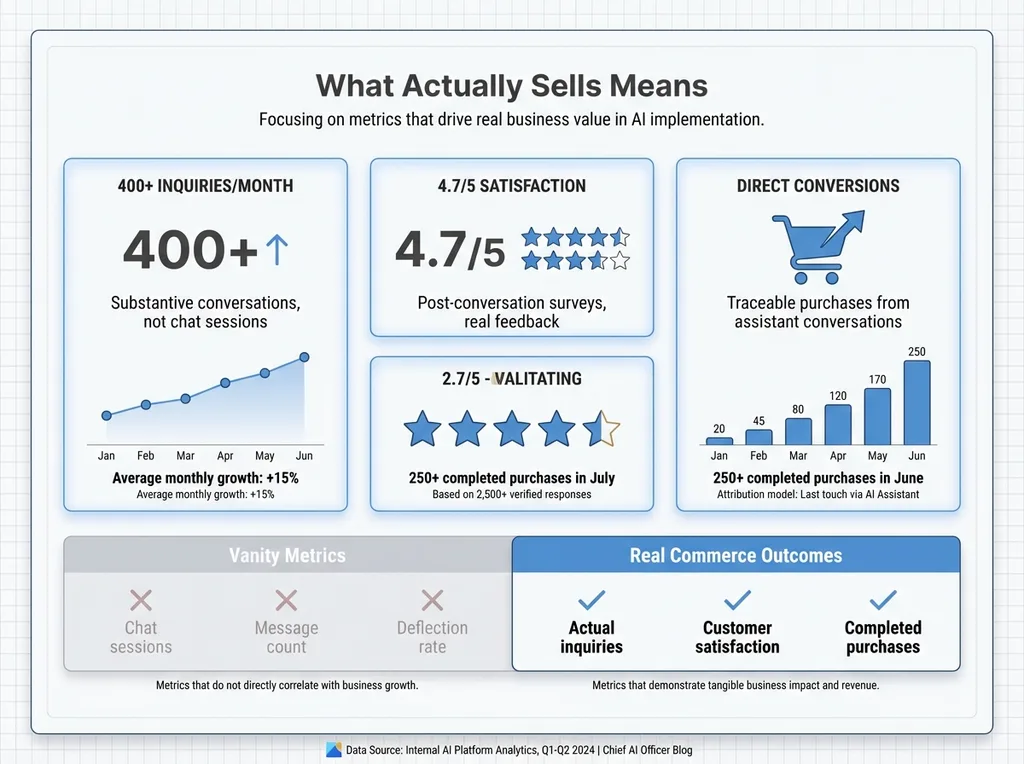
Most AI chatbot vendors report metrics designed to make themselves look good. Chat sessions initiated. Messages sent. Deflection rate. These numbers tell you nothing about whether the tool is actually helping your business.
 Real Commerce Outcomes vs Vanity Metrics
We track three metrics that actually matter.
Substantive inquiries handled: 400+ per month. These are real conversations where the assistant provides value — answering product questions, giving recommendations, processing order lookups, facilitating purchases. We don't count "Hi" / "How can I help you?" exchanges that go nowhere.
Customer satisfaction: 4.7/5 from post-conversation surveys. Every interaction gets a follow-up rating request after the conversation ends. Not the in-chat "was this helpful?" that everyone clicks yes on to make the popup go away. Actual feedback from customers who've had time to reflect on the experience.
Direct conversions: We can trace specific purchases back to assistant conversations using attribution that follows the checkout link generation. The midnight shopper at 2 AM who wouldn't have called customer service. The international buyer who needed shipping confirmation before committing. The customer who came in for one item and left with three because the assistant suggested a matching set.
The numbers that impress me most aren't the totals — it's the growth trend. Monthly inquiries are up 15% month over month as customers learn the assistant is actually useful. Repeat usage is high. People come back specifically to chat because they had a good experience last time. That's the signal that matters. Not engagement metrics. Earned trust.
What I'd Build Differently
Six months in, there are things I'd change if I started over.
I'd invest more in the policy layer upfront. The AI needs to know your return policy, shipping timelines, discount rules, and product care instructions cold. We spent the first two months patching policy gaps as customers exposed them. "Can I return this if I wore it once?" The assistant didn't know because we hadn't documented the worn-item return policy explicitly. Build your policy documentation before you build the bot.
I'd also start with support mode first, not shopping mode. Support interactions are more structured, easier to test, and the success criteria are clearer. Either the customer got their tracking number or they didn't. Shopping mode — with its open-ended recommendations and subjective style matching — is harder to get right. Start where the edges are well-defined.
The biggest lesson: AI shopping assistants are 20% AI and 80% systems integration. The language model is the easy part. Connecting it to real inventory data, order systems, and cart management — and keeping those connections reliable and fast — is where the actual work lives. If your ecommerce stack is messy, clean it up before you add AI on top.
Your Store Probably Has the Same Problem
Every ecommerce business I talk to has some version of this problem. Customers have questions at 11 PM. International shoppers need help in different time zones. Sizing questions go unanswered and turn into returns. Simple product inquiries that should lead to sales instead lead to bounces.
The technology to fix this exists now. The question is whether you build it right — with real system integrations and thoughtful escalation — or bolt on another FAQ chatbot and wonder why nothing changed.
If you're running an ecommerce business and wondering whether conversational commerce could work for you, let's talk. I do free 30-minute discovery calls where we look at your specific setup — your platform, your product catalog, your customer service bottlenecks — and figure out whether an AI-powered approach makes sense.
Book a discovery call and I'll walk you through what it would take for your store. No pitch deck, no sales team — just a real conversation about your operations.
Get AI insights for business leaders
Practical AI strategy from someone who built the systems — not just studied them. No spam, no fluff.
Hodgen.AI
Ready to automate your growth?
Book a free 30-minute strategy call with Hodgen.AI.
Book a Strategy Call