Chief AI Officer vs AI Consultant: What Actually Works
Fractional Chief AI Officer, consultant, or hire in-house? Here's what actually works based on revenue, team size, and AI maturity.
By Mike Hodgen
I got three pitches in one week last month. All promising to "transform my business with AI."
First pitch: consulting firm, beautiful deck, 90-day roadmap, $75K price tag. They'd analyze everything, document opportunities, recommend vendors. Then leave.
Second pitch: recruiter with a "unicorn" AI leader candidate. $220K base, plus equity, plus the 4-month search timeline, plus the risk they'd quit after six months.
Third pitch: someone offering "fractional Chief AI Officer" services. Sounded like consultant-lite. Pay monthly, get some part-time attention, maybe some results.
Here's what nobody told me: the decision isn't really about budget. It's about what stage your company is at, whether you need strategy or execution, and how fast you need to ship.
I've built 15+ AI systems at my DTC fashion brand and helped other companies deploy AI. I've seen companies waste $100K on consulting decks that never get implemented. I've watched bad hires burn 18 months and $300K before admitting it didn't work.
The term "fractional chief ai officer" gets thrown around, but most people using it are actually selling consulting hours. What I do as an embedded Chief AI Officer is fundamentally different. I own both strategy and execution. I write the code. I ship the systems. I train your team.
Let me break down the three real options, when each one works, and how to know which model fits your business right now.
The Three Ways to Get AI Leadership (And Why Most Companies Choose Wrong)
Most CEOs I talk to are in the same boat. Board members ask about AI strategy. Competitors announce AI-powered features. The team wants to experiment but nobody knows where to start.
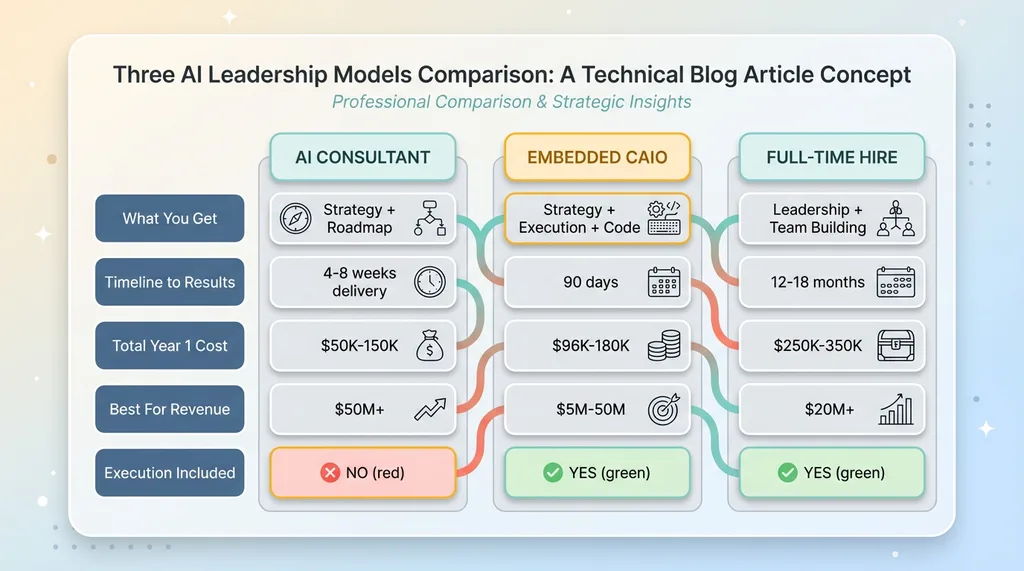 Three AI Leadership Models Comparison
You have three real options for AI leadership:
Option 1: Hire an AI consultant. They analyze your business, build a roadmap, recommend tools. You get strategy documents and vendor comparisons. Then they leave and you figure out execution.
Option 2: Hire a full-time AI leader. Recruiting takes 3-6 months. You'll pay $150K-250K in salary plus benefits. They'll need 3-6 months to get productive. You're betting $300K+ in year one that you hired right.
Option 3: Bring in an embedded Chief AI Officer. This isn't fractional hours or part-time attention. It's executive leadership who owns AI strategy and execution, builds systems with your team, and stays accountable for results.
The wrong choice costs you 6-12 months and six figures. The right choice puts AI systems in production within 90 days.
Here's how to decide.
Option 1: The AI Consultant (Strategy Decks, Then You Execute)
What you actually get
AI consultants deliver analysis and recommendations. They interview your team, map your processes, identify AI opportunities. You get a roadmap document, vendor recommendations, maybe some ROI projections.
Good consultants charge $50K-150K depending on scope. You'll spend 4-8 weeks in discovery meetings. At the end, you have a plan.
What you don't get: execution. They're not writing code. They're not building systems. They're not training your team to maintain what gets built. That's your job after they leave.
When this works
This model works for large companies with existing tech teams. If you're doing $50M+ in revenue and have engineering resources, a consultant can provide direction while your team executes.
It also works if you genuinely just need strategy. Maybe you're evaluating a build-vs-buy decision for an AI-powered product feature. A consultant can analyze the landscape and help you decide.
Or you're dealing with a specific technical decision, like choosing between RAG architectures or fine-tuning approaches. Bringing in specialized expertise for a focused question makes sense.
When this fails
I've seen this fail repeatedly for companies under $20M revenue. They pay $75K for a beautiful roadmap. It sits on a shelf for six months because nobody owns execution.
One company I talked to spent $80K on an AI strategy from a top-tier firm. The deck was impressive. Identified 12 high-value opportunities. Recommended specific vendors and tools.
Eighteen months later, they'd implemented exactly zero AI systems. Why? Their tech team was already at capacity. The operations team didn't know how to translate strategy into requirements. Nobody owned it.
The consultant model fails when you need a builder, not a strategist. If your team can't execute the plan, the plan is worthless.
It also fails when AI moves faster than the consulting engagement. I've seen roadmaps recommend tools that were obsolete by the time the deck was delivered. Claude released a major update, Gemini dropped pricing, someone launched a better solution.
Most SMBs don't need more strategy. They need someone who will actually build and ship.
Option 2: Hire a Full-Time AI Lead (The $200K+ Commitment)
What it takes to hire well
Finding good AI talent is hard. The job market is flooded with people who took a Coursera class and added "AI Engineer" to their LinkedIn. Actually skilled AI leaders who can own strategy and execution are rare.
You're looking for someone who understands business context, not just technical capabilities. They need to prioritize based on ROI, not what's technically interesting. They should have shipped production AI systems, not just experimented in notebooks.
The recruiting timeline is 3-6 months if you're lucky. Good candidates have multiple offers. You're competing with tech companies paying $300K+ in total comp.
The real annual cost
Let's do the math on a mid-level AI leader hire:
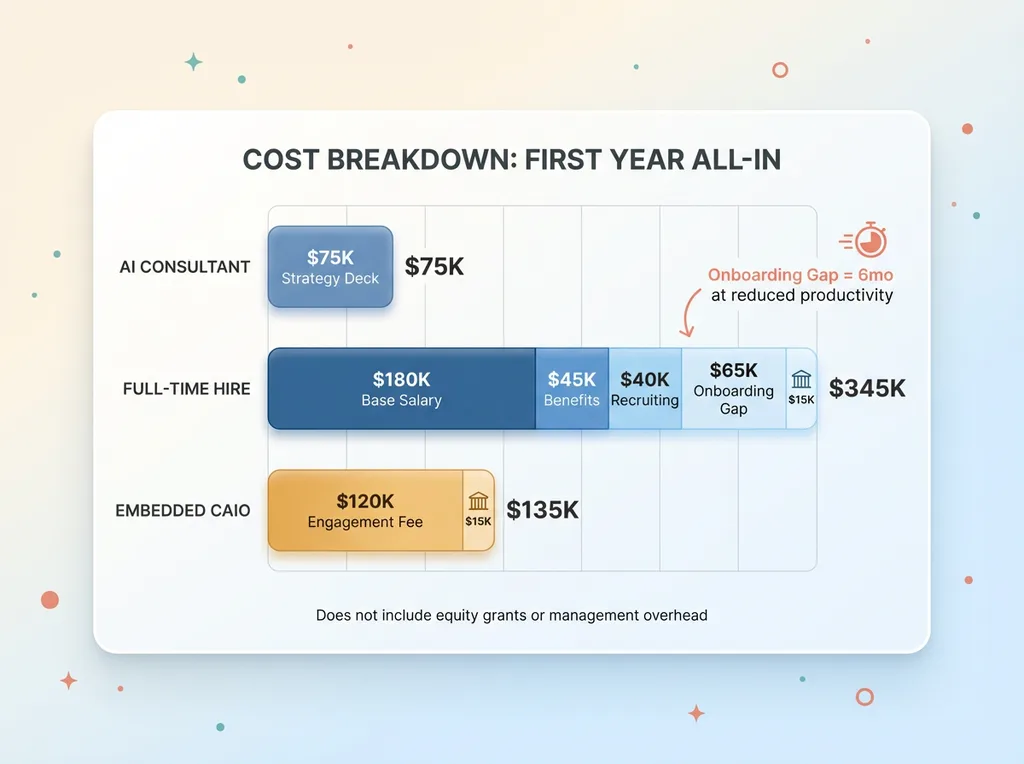 Cost Breakdown: First Year All-In
Base salary: $150K-200K depending on market and experience. Senior leaders command $200K-250K+.
Benefits and payroll taxes: Add 25-30%. That's another $40K-60K annually.
Recruiting fees: 20-25% of first-year salary if you use a recruiter. That's $30K-50K upfront.
Onboarding time: 3-6 months to full productivity. During that time, you're paying full salary with limited output.
Management overhead: This person needs a manager. Either you're spending CEO time on it, or you're paying someone else to manage them.
Infrastructure costs: Laptop, software licenses, API credits, tools. Another $10K-15K annually.
Equity: Depending on stage, you might need to grant 0.25-1% equity to attract good talent.
All-in first year cost: $250K-350K for a mid-senior hire. And that assumes they work out.
When you're ready for this
You should hire full-time AI leadership when you're ready to build a multi-person AI team. If AI is core to your product strategy and you plan to have 3-5 people focused on it within 18 months, hire the leader first.
You're also ready when you're past $20M revenue and have stable tech infrastructure. You can absorb the hiring timeline, the cost, and the risk of a bad fit.
At the brand, we're at $8M revenue with a lean team. Hiring a full-time AI leader would have meant 6 months recruiting, 6 months onboarding, and $300K+ in year-one costs. Instead, I embedded as Chief AI Officer (while staying CEO) and shipped 15 AI systems with the team we already had.
Here's the honest take: if you're doing $50M+ revenue and AI is strategic to your product, hire full-time. Build the team. Own the capability.
If you're under $20M, you're probably paying for overhead you don't need yet. You need results fast, not a hiring process.
Option 3: Embedded Chief AI Officer (Executive Role, Not Fractional Hours)
How the embedded model actually works
The term "fractional chief ai officer" creates confusion. It implies part-time hours or consultant-style attention. That's not what I do.
When I work with a company as their Chief AI Officer, I'm embedded. I have an executive seat at the table. I own AI strategy and execution completely. I'm accountable for results, not billable hours.
I join leadership meetings. I make architectural decisions. I write the actual code that runs your AI systems. I train your team to maintain and extend what we build.
At my DTC fashion brand, I built this from the inside. Product creation pipeline, SEO automation, dynamic pricing engine, customer service augmentation, content generation. Twenty-nine AI-powered automation modes in production.
That's 564+ products dynamically priced by AI using a 4-tier ABC classification system I built. That's 313 blog articles managed with AI-assisted SEO. That's 22,000+ lines of custom Python in the AI toolkit.
We went from 3-4 hours to create and launch a new product down to 20 minutes. That's 3,000+ hours saved annually. Revenue per employee increased 38%. Manual operations time dropped 42%.
That didn't happen because someone gave me a strategy deck. It happened because I owned it completely and shipped the systems.
What you get that consultants don't deliver
When you work with me as your embedded Chief AI Officer, here's what actually gets built:
Custom AI systems in production. Not recommendations. Not roadmaps. Actual code running actual business processes. I build multi-LLM architectures optimized for cost—Claude for content, Gemini for images, custom chaining to minimize API spend.
Team training and documentation. Your team learns to maintain and extend the systems. I document everything. When our engagement ends, you're not dependent on me.
Ongoing optimization. AI moves fast. I monitor costs, tune prompts, migrate to better models when they drop, fix issues before they impact the business.
Executive perspective. I've run a company. I understand P&L, margins, operational leverage. I prioritize AI projects based on ROI, not what's technically cool.
Speed. We ship production systems in 90 days, not 12 months. Because I'm writing code, not coordinating vendors.
The difference between fractional and embedded
"Fractional" implies you're getting a slice of someone's attention. Billed hours. Part-time commitment.
Embedded means I'm fully integrated with your company. I'm at leadership meetings. Your team Slacks me directly. I'm making decisions in real-time, not scheduling consulting calls.
The financial model is different too. Typical embedded Chief AI Officer engagements run $8K-15K per month depending on scope and company size. Not $200K+ for a full-time hire. Not $50K-80K for a consultant deck that maybe gets implemented.
You get executive AI leadership and hands-on execution at a fraction of the cost of hiring full-time. And you get results within 90 days instead of waiting through a 6-month hiring process.
This model works for companies between $1M-50M revenue who need AI leadership now, not next year. You need someone who owns both strategy and execution. You want systems in production, not strategy on a shelf.
If that's where you are, understand what a Chief AI Officer actually does and how it's fundamentally different from consulting or fractional part-time help.
The Real Decision Matrix: Revenue, Maturity, and Speed
Here's how to think about which model fits your business stage.
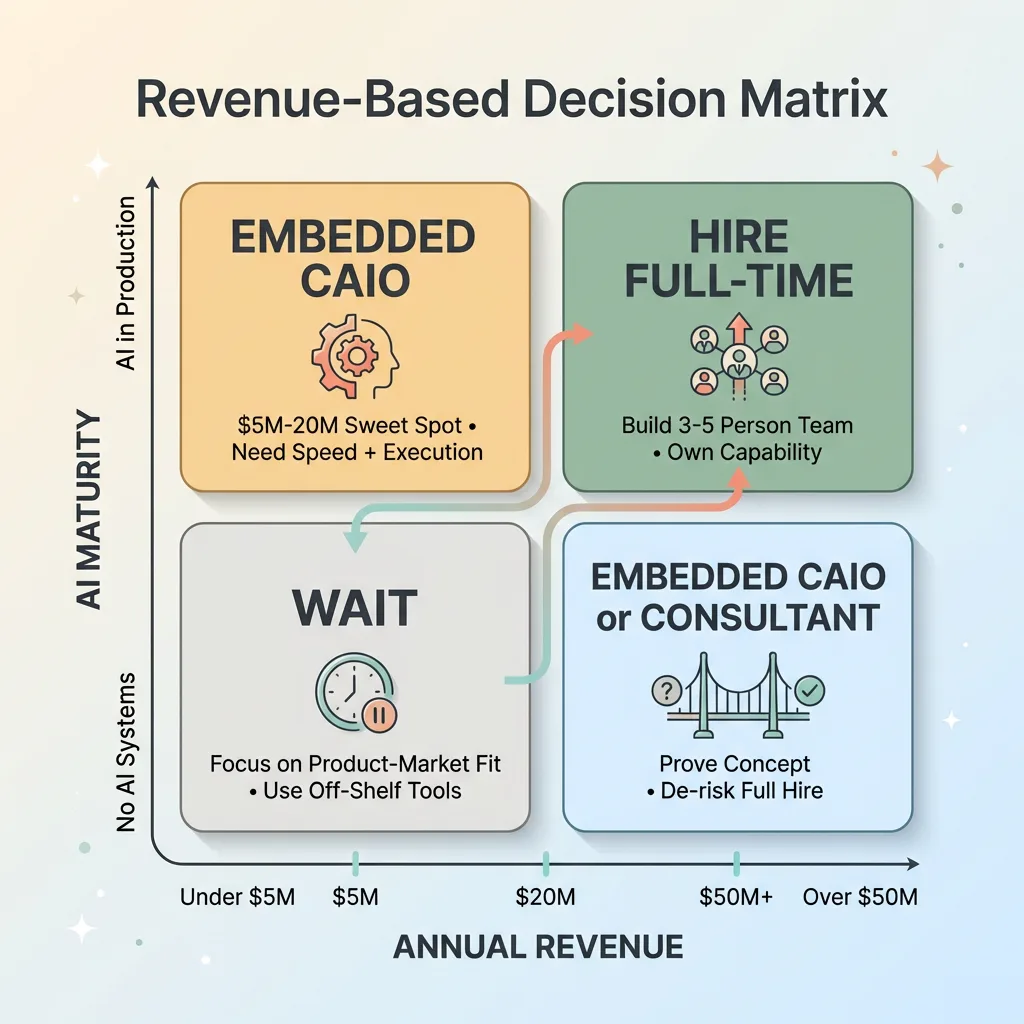 Revenue-Based Decision Matrix
If you're under $5M revenue
Be honest: you're probably too early for dedicated AI leadership unless AI is literally your product.
At this stage, you need product-market fit, not AI optimization. Focus on building something people want to buy. Use off-the-shelf AI tools where they make sense—ChatGPT for content, Clay for lead gen, basic automation.
Exception: if your product is AI-powered (you're building an AI SaaS tool, for example), then yes, hire AI talent. But that's product development, not operational AI.
If you're $5M-20M revenue
This is the sweet spot for the embedded Chief AI Officer model.
You're big enough that operational efficiency matters. Saving 3,000 hours annually translates directly to margin expansion or revenue capacity. But you're not big enough to absorb the $300K+ cost and 12-month timeline of hiring full-time AI leadership.
You need someone who can join leadership, understand your business model, identify high-ROI opportunities, and ship systems fast. You can't afford consultant delays or the risk of a bad hire.
At the brand, we were $6M revenue when we started deploying serious AI. The embedded model (with me as both CEO and Chief AI Officer) let us move fast without hiring overhead. Revenue per employee jumped 38% in a year.
If you're $20M-50M revenue
You have options. Embedded Chief AI Officer works if you want to move fast and prove ROI before committing to a full team. Or you can start building in-house capability if you have 12-18 months and budget for it.
Your decision depends on AI maturity. If you've never deployed AI systems, you need a builder first. Embedded CAIO proves what works, then you hire full-time to scale it.
If you already have AI in production and need to scale the team, hire full-time leadership. You're past the experimentation phase.
If you're $50M+ revenue
If AI is strategic to your product or operations, hire full-time. Build a 3-5 person team. Own the capability.
If you're exploring AI but not fully committed yet, embedded Chief AI Officer works as a proof-of-concept. I ship production systems in 90 days. If it works, you've de-risked the decision to build a full team. If it doesn't, you learned fast without the cost of a bad hire.
Also consider your existing tech team. If you have strong engineering and just need AI strategy direction, a consultant might work. If your tech team is at capacity or doesn't exist, you need someone who builds.
What Bad AI Leadership Costs You (Beyond the Invoice)
The direct costs are obvious. You pay a consultant $75K and get a deck. You pay a recruiter and burn six months hiring. You pay an embedded CAIO monthly and get systems in production.
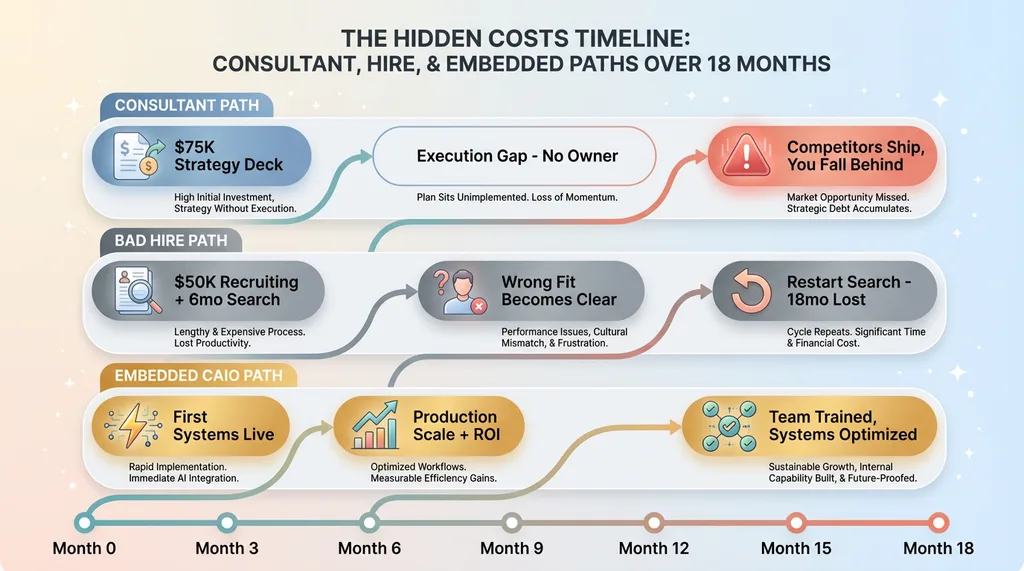 Hidden Costs Timeline
The hidden costs matter more.
Consultant route delays: Six to twelve months while you figure out execution. Your competitors ship AI features in that time. Your team gets frustrated that nothing happens despite the big strategy project. Opportunity cost of not having AI operational.
Bad hire costs: Six months recruiting. Six months learning the person doesn't fit. Severance costs. Restart the search. You've lost 18 months and $300K+ before you have someone productive. Meanwhile, competitors shipped.
No leadership costs: Your team builds random AI experiments. No cohesive strategy. Everyone spins up their own AI tools. You're paying for ChatGPT Plus, Claude Pro, Gemini, Midjourney—multiply that by team size. Technical debt piles up. No one architected a cost-efficient approach.
I talked to one company that spent $40K in OpenAI API costs over 90 days. Zero production systems. Just experiments. Why? No one designed a multi-LLM architecture to optimize costs. They were hitting GPT-4 for everything, including tasks that Gemini Flash handles at 1/10th the price.
At the brand, our multi-LLM approach cut AI costs 60% while increasing output. That architecture exists because someone owned it strategically. Without that, we'd have bled cash on expensive API calls.
The real cost is velocity. While you're figuring out AI leadership, competitors are shipping. We saw 38% revenue per employee gains after deploying AI systems. That's the upside you're missing while you wait.
Every month without AI leadership in place is a month of lost operational leverage. If you're doing $10M revenue, a 10% margin improvement is $1M annually. That's real money.
How to Know Which Model Fits Your Business Right Now
Here's the practical framework to decide.
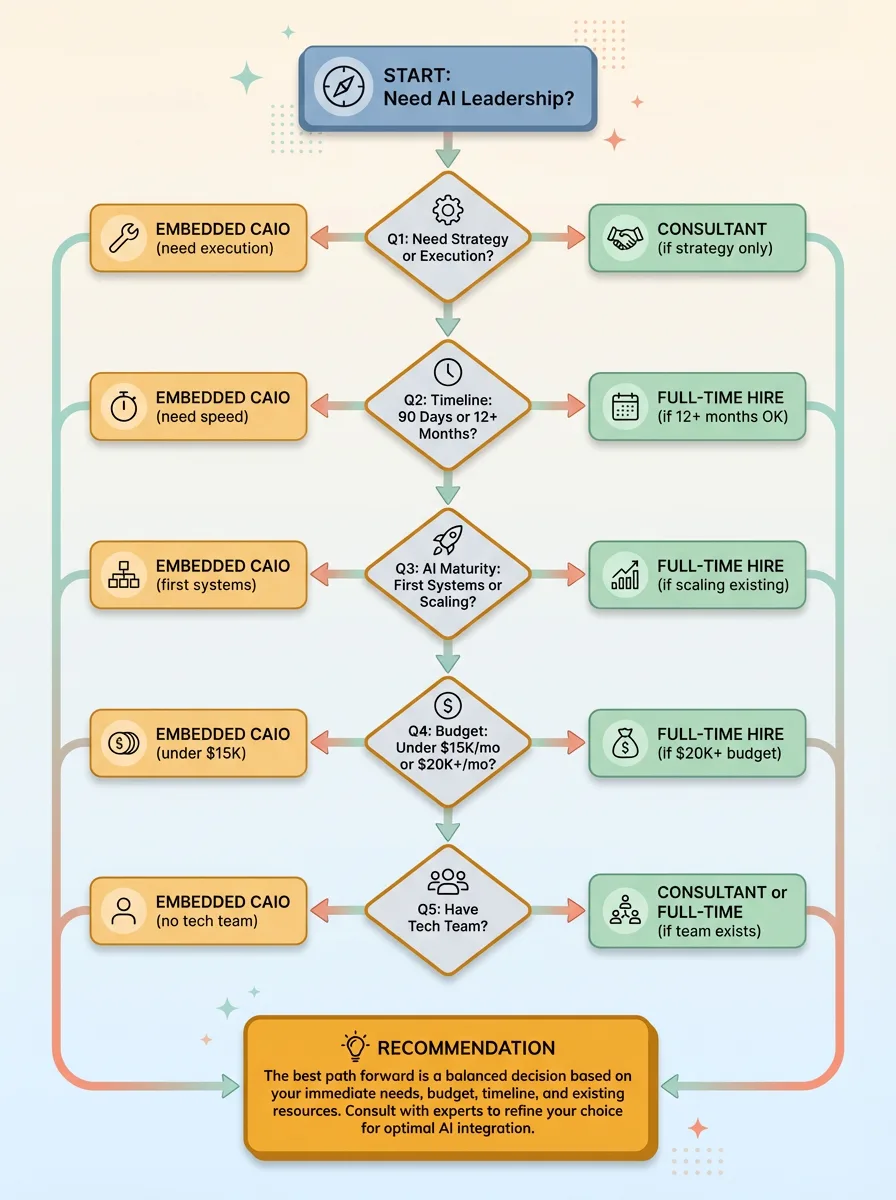 Five-Question Decision Framework
Question 1: Do you need strategy or execution?
If you genuinely just need direction—analyzing build-vs-buy, evaluating vendors, documenting opportunities—a consultant can work. If you need systems actually running in production, you need embedded Chief AI Officer or full-time hire.
Question 2: What's your timeline?
If 12+ months to results is acceptable, hire full-time. You'll spend 3-6 months recruiting, 3-6 months getting them productive, then start seeing output.
If you need AI systems in production within 90 days, embedded Chief AI Officer is built for speed. I've shipped production systems in 6-8 weeks when priorities are clear.
Question 3: What's your AI maturity?
If you've never deployed AI, you need someone who builds. Consultants leave you with a plan you can't execute. Embedded CAIO ships the first systems, proves ROI, then you decide what's next.
If you already have AI in production and need optimization, any model can work. You have context. You know what good looks like.
Question 4: What's your budget?
Under $15K/month: embedded Chief AI Officer is your realistic option. Full-time hire costs $20K+ monthly all-in. Consultant fees might fit but won't give you execution.
Over $20K/month: consider hiring full-time if you're ready to build a team. Otherwise embedded CAIO gives you executive leadership and execution without hiring overhead.
Question 5: Do you have a tech team?
If yes, consultant or full-time can work. Your team can execute consultant recommendations or support a full-time AI lead.
If no, embedded Chief AI Officer bridges that gap. I write code, manage vendors, build systems without needing a tech team beneath me.
Here's the clear signal: if you're $5M-50M revenue, need someone who owns both strategy and execution, and want AI systems in production within 90 days, the embedded Chief AI Officer model is built for you.
I work with companies who are serious about deploying AI, not experimenting with it. If that's where you are, let's talk about what it looks like to work together.
Ready to Deploy AI Systems, Not Just Strategy?
I work with a small number of companies at a time as their embedded Chief AI Officer. Not consulting hours. Not part-time attention. I own AI strategy and execution completely, ship production systems with your team, and stay accountable for results.
If you're serious about getting AI systems in production within 90 days, apply to work together. I review every application personally. If it's a fit, we'll get on a call and map out what makes sense for your business.
Get AI insights for business leaders
Practical AI strategy from someone who built the systems — not just studied them. No spam, no fluff.
Hodgen.AI
Ready to automate your growth?
Book a free 30-minute strategy call with Hodgen.AI.
Book a Strategy Call