What Is a Chief AI Officer? (And Why You Need One)
A Chief AI Officer builds AI systems that work. Not slides. Not pilots. Real automation that saves money. Here's what the role actually does.
By Mike Hodgen
What a Chief AI Officer Actually Does (No Buzzwords)
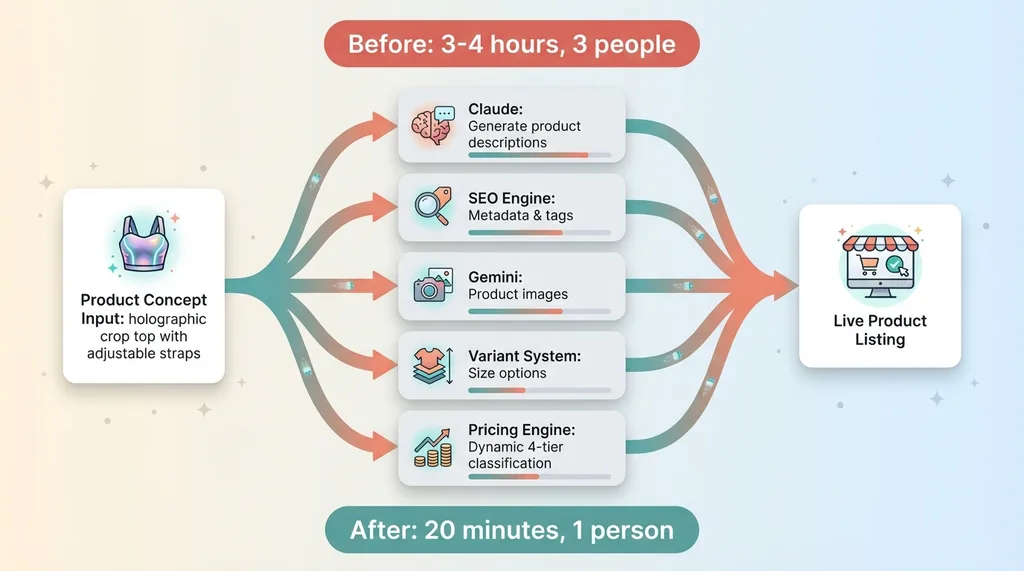
I built a system at my DTC fashion brand that takes a product concept and turns it into a live listing in 20 minutes. The AI generates the description, writes the SEO metadata, creates size variants, sets dynamic pricing based on our 4-tier classification system, and produces the product images. Before we built this, the same process took 3-4 hours and required three different people.
That's what a Chief AI Officer does. Not strategy consulting. Not vendor management. Not endless pilots or PowerPoint roadmaps exploring use cases. A chief AI officer builds the AI systems your business actually runs on.
Building Systems, Not Decks
I've written over 22,000 lines of Python code that power the brand's AI toolkit. The code orchestrates Claude for content generation, Gemini for image creation, and custom logic for cost optimization. It manages 313 blog articles with automated SEO updates, handles dynamic pricing for 564 products, and runs 29 different automation modes across product creation, customer service, and operations.
This saves us over 3,000 hours annually. That number isn't from a deck — it's from measuring before and after deployment.
Most people think AI leadership means attending conferences, building transformation roadmaps, and running workshops about innovation. That's not what companies need. They need someone who can write production code, ship automations that work Monday morning, and own the outcomes when systems break.
Embedded in Operations, Not Advisory
I sit in the same Slack channels as our product team, our customer service reps, and our operations manager. When someone says "this process is eating five hours a week," I don't schedule a discovery meeting. I build the automation, test it, deploy it, and measure whether those five hours disappeared.
A Chief AI Officer is technical, embedded, and accountable. The role exists because someone has to bridge the gap between "AI could help here" and "here's the working system." That person writes code, understands your business processes, and fixes things when they break at 2am.
This is different from every other AI role you've heard about, and that difference matters.
Why Companies Hire a Chief AI Officer Now
Three months ago, a CEO told me his company lost a $180K deal to a competitor who could generate custom proposals in 15 minutes. His team needed two days. The competitor had AI doing the work. He didn't.
That's the expensive version of the AI capability gap.
The AI Capability Gap Is Getting Expensive
The gap between "we should use AI" and "we have working AI systems" is where companies lose money. I see the same pattern: a business knows AI could automate customer onboarding, or pricing updates, or content creation. They tried ChatGPT. Maybe they bought a SaaS tool that promised to solve everything. Nothing stuck.
Meanwhile, competitors are shipping. They're using AI to cut operational costs by 40%, respond to customer inquiries in minutes instead of hours, and create content at scale without hiring more people.
At the brand, we deployed AI systems across product creation, SEO management, pricing, and customer service. Revenue per employee increased 38% in the 12 months after deployment. That's not because we hired more people or found a magic marketing channel. We automated work that was consuming hours every day, and the team focused on higher-value activities.
The cost of not having someone who owns AI outcomes compounds every quarter. You're paying people to do work that could be automated. You're losing deals to faster competitors. Your board is asking about AI strategy, and you don't have a real answer.
Your CTO Has a Different Job
Your CTO manages infrastructure, security, engineering team velocity, and technical architecture. That's a full-time job. It's also a different job than designing and deploying cross-functional AI automations.
A CTO thinks about system reliability, scalability, and whether your stack can handle 10x traffic. A Chief AI Officer thinks about whether Claude or Gemini is better for product descriptions, how to chain models to cut costs by 60%, and which manual processes should be automated first based on ROI.
Your CTO shouldn't be pulled away from core engineering to figure out how to integrate AI into customer service workflows, or to write the Python code that orchestrates your content creation pipeline. They have different priorities and different expertise.
A CAIO is the person who turns "AI could help here" into shipped systems. That's the role, and that's why companies are hiring for it now.
What the Chief AI Officer Role Includes
The chief AI officer role breaks down into three core functions: building systems, managing costs, and integrating AI across business functions. I'll show you what this looks like in practice.
System Design and Deployment
At the brand, I built an SEO automation system that manages 313 blog articles. The system monitors keyword rankings, identifies content gaps, generates optimized updates, and publishes changes. It runs continuously, adjusting strategy based on what's working.
 Product Creation Pipeline Flow
I also built the product creation pipeline I mentioned earlier. A team member inputs the concept — "holographic crop top with adjustable straps." The system generates multiple product descriptions optimized for different customer segments, creates SEO metadata, produces images using Gemini, sets up size variants, and assigns dynamic pricing based on our 4-tier ABC classification system.
The pricing engine classifies 564 products into four tiers based on sales velocity, margin, and inventory levels. High-performing products in tier A get premium positioning and different pricing strategies than tier D products. The classifications update weekly, and pricing adjusts automatically.
Each system required understanding the business process, designing the workflow, writing the code, testing it, deploying it, and then monitoring performance. That's system design and deployment. It's technical work. You can't delegate it to a consultant who doesn't write code.
Cost Management and Model Selection
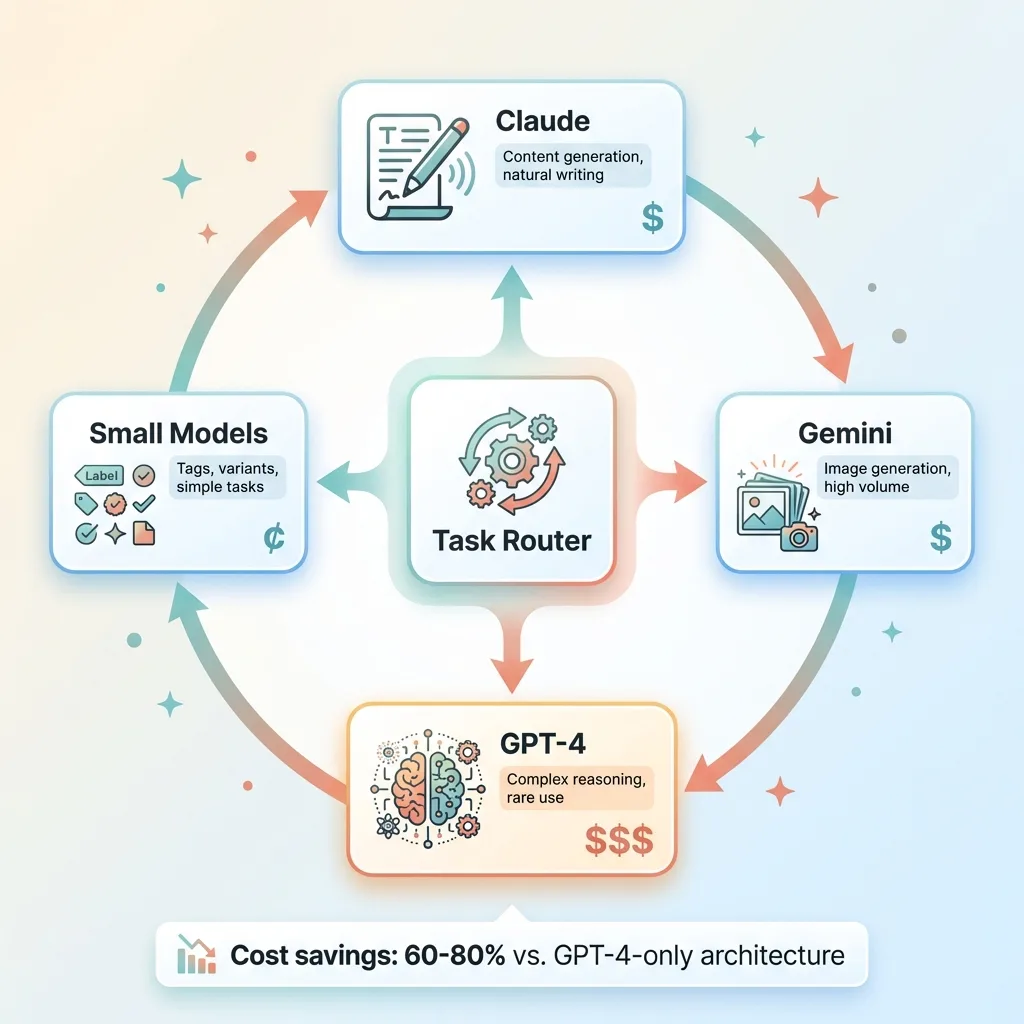
Not everything needs GPT-4. Most tasks don't. I run a multi-LLM architecture at the brand because using the right model for each task saves thousands of dollars monthly.
 Multi-LLM Cost Optimization Architecture
Claude handles content generation for product descriptions and blog articles — it produces better, more natural writing than GPT-4 for our use cases. Gemini generates product images because it's faster and cheaper than DALL-E for the volume we need. Simpler tasks like tag generation or variant creation use smaller models that cost pennies per thousand requests.
I chain models together based on task complexity. A product description might start with Claude generating the base content, then a smaller model optimizes it for SEO, then another handles variant creation. That three-step process costs 80% less than running everything through GPT-4, and the output quality is identical.
Cost management isn't optional when you're running AI in production. A poorly designed system can burn through your budget in days. A CAIO owns those costs and optimizes continuously.
Cross-Functional Integration
A Chief AI Officer doesn't work in isolation. The role requires sitting between product, operations, marketing, and customer service, building systems that improve all of them.
Our customer service AI doesn't just answer questions — it feeds data back into product creation. If customers repeatedly ask about sizing for a specific product category, that signal flows into our product pipeline. The next time we create products in that category, the descriptions proactively address those questions.
The SEO system monitors which blog topics drive traffic and conversions, then feeds that data to our content calendar. The pricing engine considers inventory levels from operations, sales velocity from marketing, and margin requirements from finance.
I've deployed 29 automation modes at the brand. Each mode connects multiple business functions. That's what cross-functional integration means — building AI that makes your entire operation smarter, not just one department faster.
A CAIO builds the portfolio of systems that transforms how your company works.
CAIO vs CTO vs AI Consultant: Who Does What
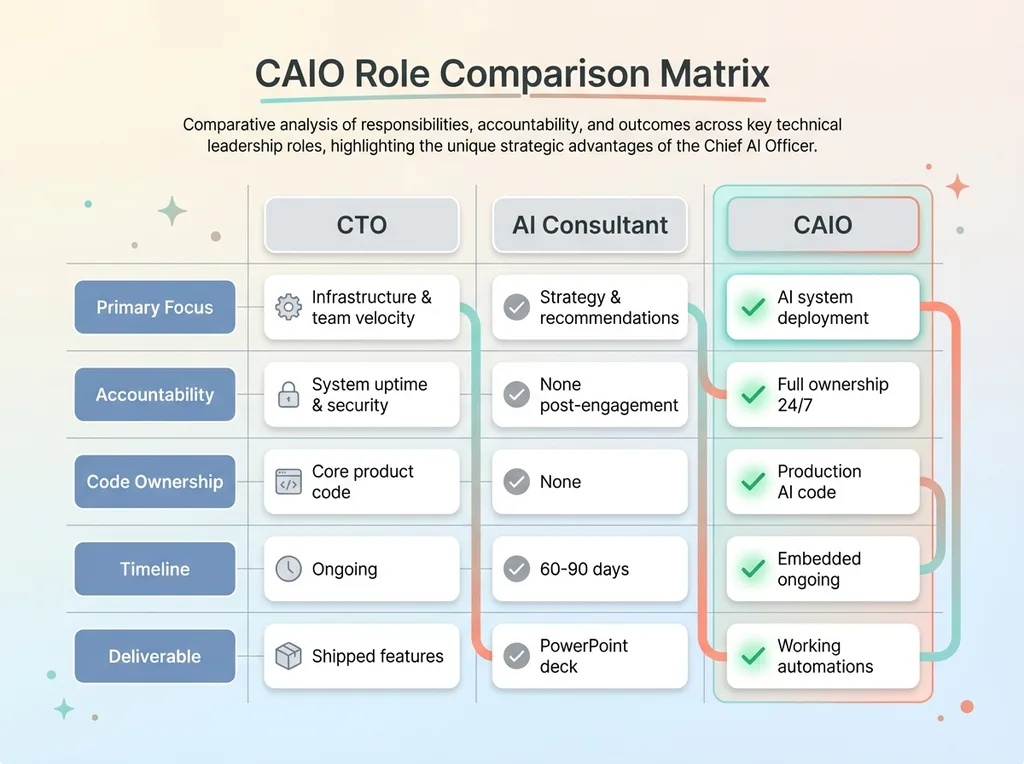
You have three options when you decide to deploy AI: rely on your CTO, hire a consultant, or bring in a Chief AI Officer. They're not interchangeable.
 CAIO Role Comparison Matrix
Your CTO owns infrastructure, security, engineering team management, and technical architecture decisions. Their focus is system reliability, development velocity, and scalability. They make sure your application doesn't go down, your data stays secure, and your engineering team ships features. That's critical work.
A CTO is not responsible for figuring out which AI models to use for product descriptions, or how to build a cross-functional automation that spans marketing, operations, and customer service. That's outside their domain, and pulling them into it slows down their actual job.
An AI consultant delivers strategy decks and recommendations. They'll audit your processes, identify opportunities, and create a roadmap. Then they leave. They don't write production code. They don't own outcomes. They don't get paged at 2am when an automation breaks. They exit after 90 days with a document, and you're left implementing it yourself.
I've seen companies spend $50K on consultant engagements that produced zero working systems. The recommendations were reasonable. The implementation never happened because no one owned it.
A Chief AI Officer is embedded and accountable. They write the code, deploy the systems, monitor performance, and fix problems. They sit in your Slack, attend your standups, and report on AI outcomes the same way your VP of Sales reports on revenue.
I own the outcomes of every AI system at the brand. If product creation breaks, I fix it. If costs spike, I optimize. If an automation isn't delivering the promised time savings, I redesign it. You can't outsource that accountability to a consultant who's already moved on to the next client.
Your CTO should keep doing what CTOs do. Your consultant can't stay long enough to matter. You need someone who builds, ships, owns, and improves your AI systems full-time. That's the CAIO role, and understanding the difference between a CAIO and other options determines whether you get working systems or expensive PDFs.
What Good AI Leadership Looks Like in Practice
Let me show you what happened at my DTC fashion brand after we deployed AI across operations.
The Case Study
Before AI, creating a new product took 3-4 hours. A designer would create the concept, someone would write the product description, another person would generate SEO metadata and tags, a third would set up size variants, and someone in operations would determine pricing based on cost and category averages. The product would go live days after the design was finalized.
We were updating blog content manually, which meant SEO optimization happened when someone remembered to do it. Our pricing was static — set once, updated quarterly if we noticed a problem. Customer service was handled entirely by humans, eating significant operations time.
After deploying AI systems, here's what changed:
Product creation dropped to 20 minutes. Input the concept, and the AI generates optimized descriptions for multiple customer segments, writes SEO metadata, creates size variants, sets dynamic pricing based on our 4-tier classification system, and produces images. One person can now launch products that previously required three people and multiple days.
We're managing 313 blog articles with AI-driven SEO automation. The system monitors rankings, identifies opportunities, generates optimized updates, and publishes changes. Our organic traffic increased 47% in six months without hiring content writers.
Dynamic pricing across 564 products adjusts automatically based on sales velocity, inventory levels, and margin targets. Products move between tiers weekly, and pricing responds to performance. Our margin improved 8% while maintaining sales volume.
Manual operations time decreased 42%. The hours we saved went into higher-value work — product strategy, customer relationship building, and process improvement that can't be automated.
Metrics That Actually Matter
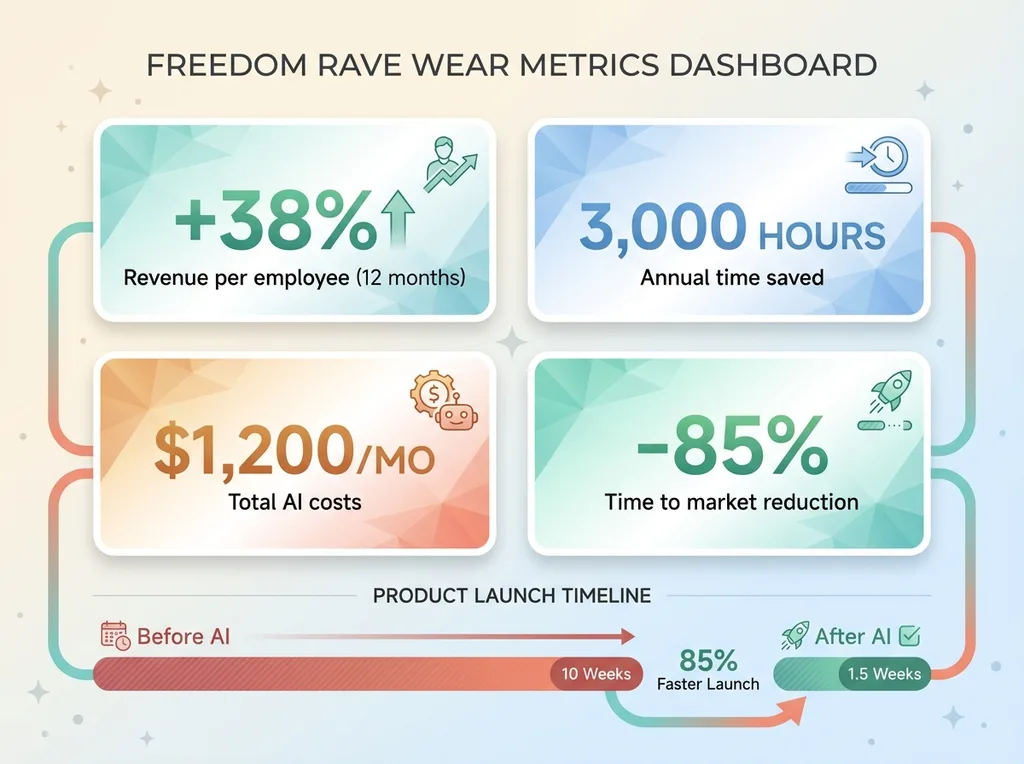
Revenue per employee increased 38% in the 12 months after AI deployment. That's the metric that matters most — we're doing more business with the same team because AI handles the repetitive work.
 DTC Fashion Brand Metrics Dashboard
We saved over 3,000 hours annually across product creation, SEO management, pricing updates, and customer service. Those hours had real cost — either in salary expenses or in opportunity cost from work that didn't happen.
AI costs run about $1,200 monthly for the entire operation. That's API calls for Claude, Gemini, and smaller models, plus infrastructure for the automation systems. We're saving the equivalent of two full-time salaries while improving output quality and speed.
Time to market for new products dropped 85%. We can test product concepts faster, respond to trends quicker, and iterate based on customer feedback without the bottleneck of manual processes.
These metrics came from measuring before and after deployment, tracking system performance continuously, and optimizing based on real data. A good CAIO delivers measurable business outcomes within 90 days, not innovation theater that sounds impressive in board meetings but doesn't show up in your P&L.
Walk through our product pipeline end-to-end and you'll see a system that works: concept goes in, complete product listing comes out, and the time from idea to revenue shrinks from days to minutes. That's what's possible when someone competent owns AI outcomes.
When Your Company Is Ready for a Chief AI Officer
Company size doesn't determine readiness. Pain points do.
You're ready for a Chief AI Officer if you have repetitive processes eating 10+ hours per week that feel like they should be automatable. Your team is drowning in manual work — data entry, content updates, pricing changes, customer inquiry responses — and everyone knows there should be a better way.
You're ready if you're losing deals to competitors who move faster. Maybe they generate proposals in minutes while yours take days. Maybe they respond to customer questions instantly while your team needs hours. Maybe they launch products weekly while you're still working through last month's backlog.
You're ready if you tried AI tools and they didn't stick. You signed up for a few SaaS products that promised automation. Your team used them for two weeks, then went back to the old process because the tools didn't fit your workflow. The problem wasn't AI — it was that no one customized it for your specific business.
You're ready if your board or investors are asking about AI strategy and you don't have a real answer. "We're exploring options" isn't a strategy. "We use ChatGPT sometimes" isn't a strategy. You need working systems, not aspirations.
The typical company ready for a CAIO is generating $1M-$50M in revenue. You've reached a scale where process complexity is real, but you can't afford to hire an entire AI team at $300K+ per person. You need someone who can build systems across multiple functions without requiring a supporting cast.
You're post-product-market fit, scaling operations, and feeling the pain of manual processes that worked when you were smaller but don't scale. You have documented processes, even if they're messy. You have data to work with — customer interactions, sales history, product information, content — because AI needs input to produce output.
You're NOT ready if you're pre-revenue and still figuring out what you're building. AI won't fix unclear business model problems. You're not ready if your processes aren't documented at all, because you can't automate what you can't explain. You're not ready if you don't have data — AI needs something to work with.
If you're past these baseline requirements and feeling the pain of manual operations at scale, you're ready. Waiting another year means watching competitors pull further ahead while your team drowns in work that shouldn't require human effort.
Start Building AI Systems That Work
The first 90 days with a Chief AI Officer follows a pattern: process audit, quick-win identification, system architecture, deployment, and measurement.
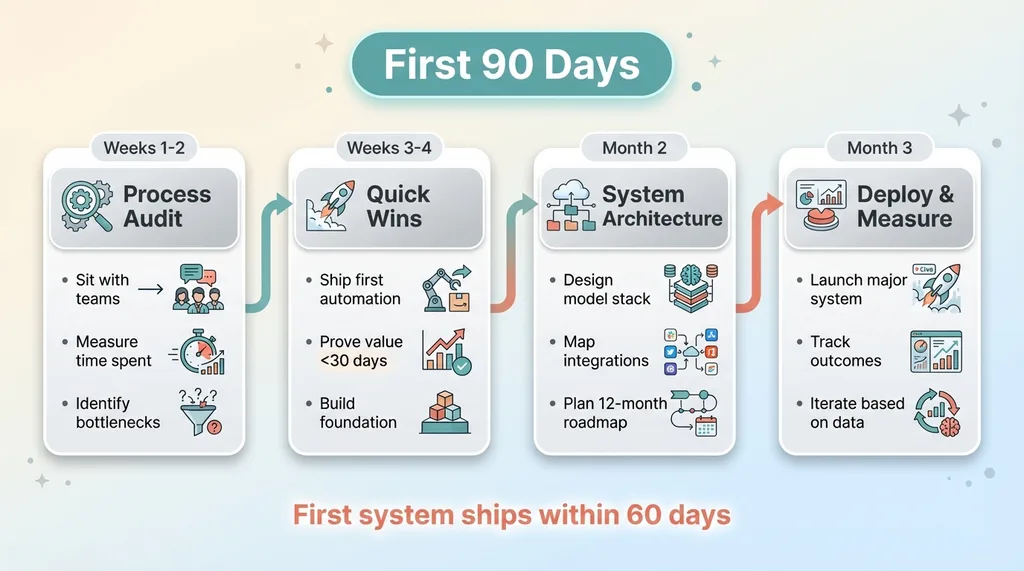 90-Day CAIO Implementation Timeline
Week one and two, I audit your operations. Not a consultant-style interview process — I sit with your team, watch how they work, measure where time goes, and identify bottlenecks. I'm looking for processes eating significant hours that have consistent inputs and outputs. Those are automation candidates.
Week three and four, we identify quick wins. I'm shipping something within 30 days that saves measurable time. Maybe it's automating customer inquiry responses, or generating product descriptions, or updating pricing based on inventory levels. The goal is proving value fast while building the foundation for larger systems.
Month two, I design the system architecture for your long-term AI stack. What models do we use for what tasks? How do we chain them to optimize costs? How do systems integrate across departments? What data flows where? This is the blueprint for the next 12 months.
Month three, we deploy the first major system and measure outcomes. Hours saved, cost reduction, revenue impact — whatever metrics matter for that system. Then we iterate based on performance.
I work with companies as their Chief AI Officer starting with a 2-week diagnostic to map the highest-impact automations. Then we ship the first system within 60 days. The alternative is spending another year talking about AI while competitors ship working systems.
The brand went from zero AI to 29 production systems in 18 months. Not because of magic. Because someone owned the outcomes, wrote the code, deployed the systems, and fixed problems when they came up.
If your team is spending 10+ hours per week on work that feels automatable, you're leaving money on the table. If competitors are moving faster than you and you suspect AI is part of the reason, you're right. If you're ready to stop talking and start shipping, let's work together.
Ready to Bring AI Leadership Into Your Company?
I work with a small number of companies at a time because deploying AI systems properly requires focus. I can't build your product creation pipeline while simultaneously managing five other clients' implementations.
If you're serious about AI — not interested in workshops or roadmaps, but ready to deploy working systems that save time and money — apply to work together. I review every application personally. I'll tell you if AI makes sense for your business, what systems to build first, and what outcomes you should expect.
The companies that win over the next five years will be the ones that deployed AI while their competitors were still figuring out whether they needed a strategy. My DTC fashion brand got 38% more revenue per employee because we built systems instead of decks.
Your turn.
Get AI insights for business leaders
Practical AI strategy from someone who built the systems — not just studied them. No spam, no fluff.
Hodgen.AI
Ready to automate your growth?
Book a free 30-minute strategy call with Hodgen.AI.
Book a Strategy Call