Free SaaS Business Model: Beat the Incumbent
How a free SaaS business model beats an entrenched incumbent. Give the operating system away, charge the consumer side, and turn every account into distribution.
By Mike Hodgen
Why You Lose When You Compete on Features
A few months back I looked at a martial-arts academy operating system trying to break into a market owned by an entrenched European incumbent. The incumbent had been at it for years. They charged every gym a monthly fee, then took a cut of every member payment that flowed through their system. Localized payments in a dozen countries. Franchise relationships locked in. Years of feature depth nobody had time to rebuild.
The founder's instinct was the one almost everyone has. Match the features. Ship faster. Find the gaps in the incumbent's product and fill them.
That is a losing game, and here is why.
The incumbent's structural advantages
When a competitor has distribution and switching costs, feature parity does not move the needle. The gym already runs payroll, billing, scheduling, and member payments through the incumbent. Ripping that out is painful even if your product is better. The incumbent does not need to win the feature comparison. They just need the switch to be annoying enough that nobody bothers.
That is the wall. Years of payment integration, franchise capture, and the simple inertia of "it already works."
Feature parity is the wrong scoreboard
Most founders default to a feature war because it feels like progress. You ship something, you check a box, you tell yourself you are closing the gap. It looks like motion.
But you are playing their game on their field. Even if you reach parity, you have given the customer no reason to absorb the pain of switching. Same features, same price structure, plus migration headaches. Why would anyone move?
The win against an entrenched incumbent is almost never functional. It is structural. You have to change the shape of the deal, not the length of the feature list. That is the whole point of what comes next.
The Objection That Kills the Deal
Here is the number-one objection that kills the deal, every time, before the product demo even matters:
"This costs me money on top of what I already pay, and you take a cut of my members."
Gym owners run thin margins. A martial-arts academy is not a high-flying SaaS company. It is a small business with rent, instructors, mats, and a member base that churns. Every new platform lands as a new line item on a P&L that is already tight.
And the incumbent has trained them to expect exactly this. Pay a monthly fee. Give up a percentage of member revenue that flows through the system. That is the mental model the entire vertical operates under. So when you show up with a better product, the owner is not hearing "better." They are hearing "another expense, plus they want a slice of my members' money too."
No feature list overcomes that. I have watched founders pile on capability thinking the value will eventually outweigh the cost in the buyer's head. It does not work that way. A structural objection needs a structural answer.
You cannot justify the cost. You have to remove it.
That sounds obvious when you say it out loud, but it is the move almost nobody makes, because it means giving up the revenue line that every incumbent in the space has built their company on. Which is exactly why it works. The thing that feels impossible to you is structurally impossible for them. Hold that thought.
The Structural Move: Free OS, Paid Consumer Side
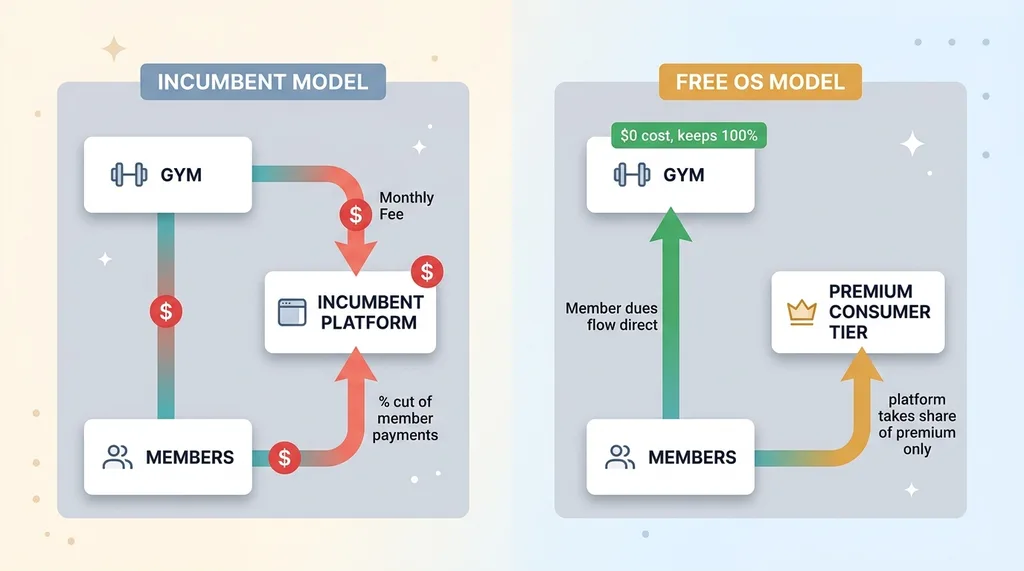
Here is the free SaaS business model that beats the incumbent: the gym pays nothing, ever, and keeps 100% of its existing member revenue. The operating system is free to the business forever. No monthly fee. No cut of member payments. Zero.
 Incumbent model vs Free OS model money flow
You do not make money on the business side at all. You make money on the consumer side.
I broke down the full mechanics of this in give the operating system away free, but here is the core of it.
The gym pays $0 and keeps 100% of its revenue
The platform never sits between the gym and its members for the gym's core revenue. Member dues, class packages, the money that keeps the lights on, that flows the way it always has, straight to the gym. You do not intermediate it, you do not skim it, you do not touch it.
This kills the cost objection in a single move. There is no line item to add to the P&L because there is no cost. The owner cannot object to a price that does not exist. The whole conversation that used to end deals just disappears.
Members pay for the premium tier the gym attaches
So where does the money come from? The consumer side.
Members opt into a premium content tier that the gym attaches to its offering. In the martial-arts case, that is a video technique library, a structured curriculum, progress tracking, belt-test prep, whatever the vertical actually values. The member pays for that tier directly. The platform takes a share of the premium subscription only.
Consumer side monetization becomes the entire engine. The gym's money stays the gym's money. Your revenue comes from a new layer of value that did not exist before, sold to a different buyer than the one who keeps rejecting your pricing.
The gym gets a better product for free. The member gets content they want. You earn on the slice you created instead of the slice you took. Nobody loses the thing they were protecting.
Every Signed Account Becomes a Distribution Channel
Here is the second-order win, and it is bigger than the first.
 Distribution channel pricing market size flip
Because the gym pays nothing, signing them is easy. There is no budget approval, no procurement, no comparing your monthly fee to the incumbent's. The pitch is "this is free and better." Sales cycles that used to take months collapse.
And once a gym is signed, it becomes a distribution channel for the consumer subscription.
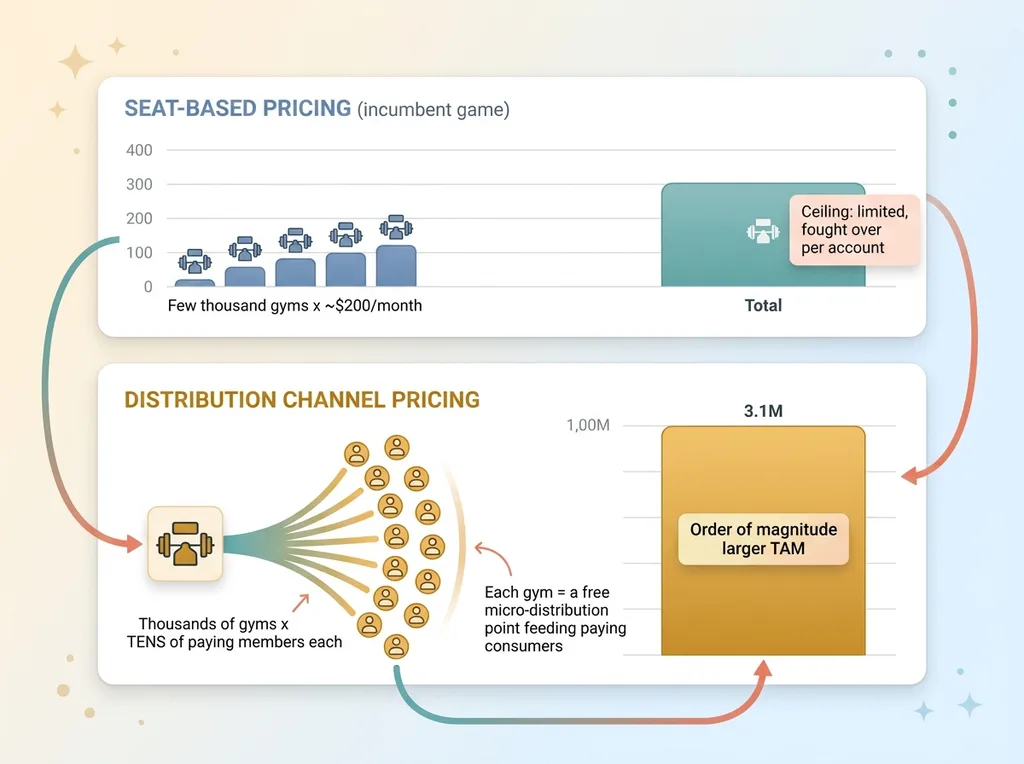
Think about the math. Charging gyms a monthly fee, your addressable market is the number of gyms times whatever you can extract from each one. A few thousand accounts paying a couple hundred a month. That is your ceiling, and you fight the incumbent for every one of them.
Flip it. Each gym brings tens of members. Some fraction of those members convert to the premium tier. Now your addressable market is thousands of gyms times tens of paying members each. That is an order of magnitude larger than seat-based pricing, and you are not even competing for the same dollar the incumbent fights over.
This is distribution channel pricing reframed. You are not selling software seats to businesses. You are acquiring a network of micro-distribution points, each one feeding paying consumers into your funnel.
The best part is the incentive alignment. The gym wants to push the premium tier because it makes their academy look more professional and keeps members engaged. They do your customer acquisition for you, for free, because it is in their interest. Every signed account is a salesperson you do not pay.
The consumer side is the engine. The gyms are the distribution. And the gyms volunteer for the job because the operating system cost them nothing to begin with.
Why the Incumbent Structurally Can't Copy You
This is the part that makes the model defensible, and it has nothing to do with technology.
Their model assumes intermediating gym-to-member money
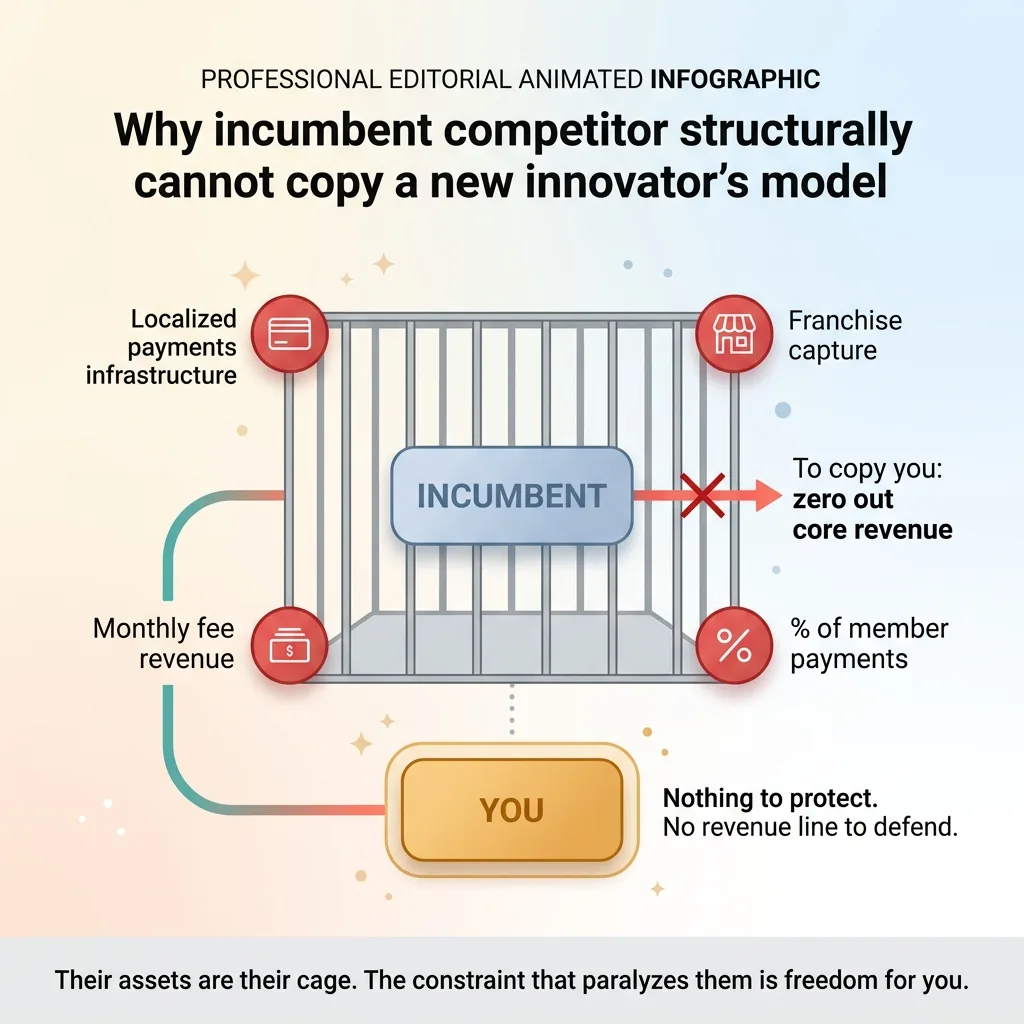
The incumbent's entire business is built on two revenue lines: a fee from the gym, plus a percentage of member payments flowing through their system. Their localized payments infrastructure, their franchise relationships, all of it exists to capture and intermediate that money flow.
To copy your model, they would have to stop taking the fee and stop skimming the payments. They would have to zero out the revenue that currently funds their entire company.
The innovator's dilemma in pricing
This is the innovator's dilemma, applied to business model instead of technology.
 Why the incumbent structurally cannot copy the model (innovator's dilemma)
A profitable incumbent cannot walk into a board meeting and say, "We are going to make our core product free and give up the percentage we take on every member payment, to chase a consumer subscription tier that does not exist yet." The board would fire them. The existing revenue is real, it is on the books, it funds salaries and shareholders. The consumer tier is a hypothesis.
Their assets are also their cage. Localized payments and franchise capture are exactly what lock them into the old structure. The more successful they are at the current model, the more impossible it is to abandon it.
You can do what they cannot, because you have nothing to protect. No revenue line to defend, no board demanding you preserve it. The constraint that paralyzes them is freedom for you.
Honest caveat, because this only works under one condition. The consumer-side value has to be real. Members have to actually want the premium tier and actually pay for it. If the content is thin and the attach rate is low, then free-to-the-gym is just free, full stop. No cost objection, sure, but also no upside. The structural advantage is real only if the consumer monetization closes. Which brings me to the uncomfortable part.
What Has to Be True for This to Work
I am not going to pretend this is a magic move. Free-to-the-business models fail all the time, usually because the paid side never materializes. Here is what actually has to be true.
 What has to be true for the model to work (conditions checklist)
The consumer tier needs genuine standalone value
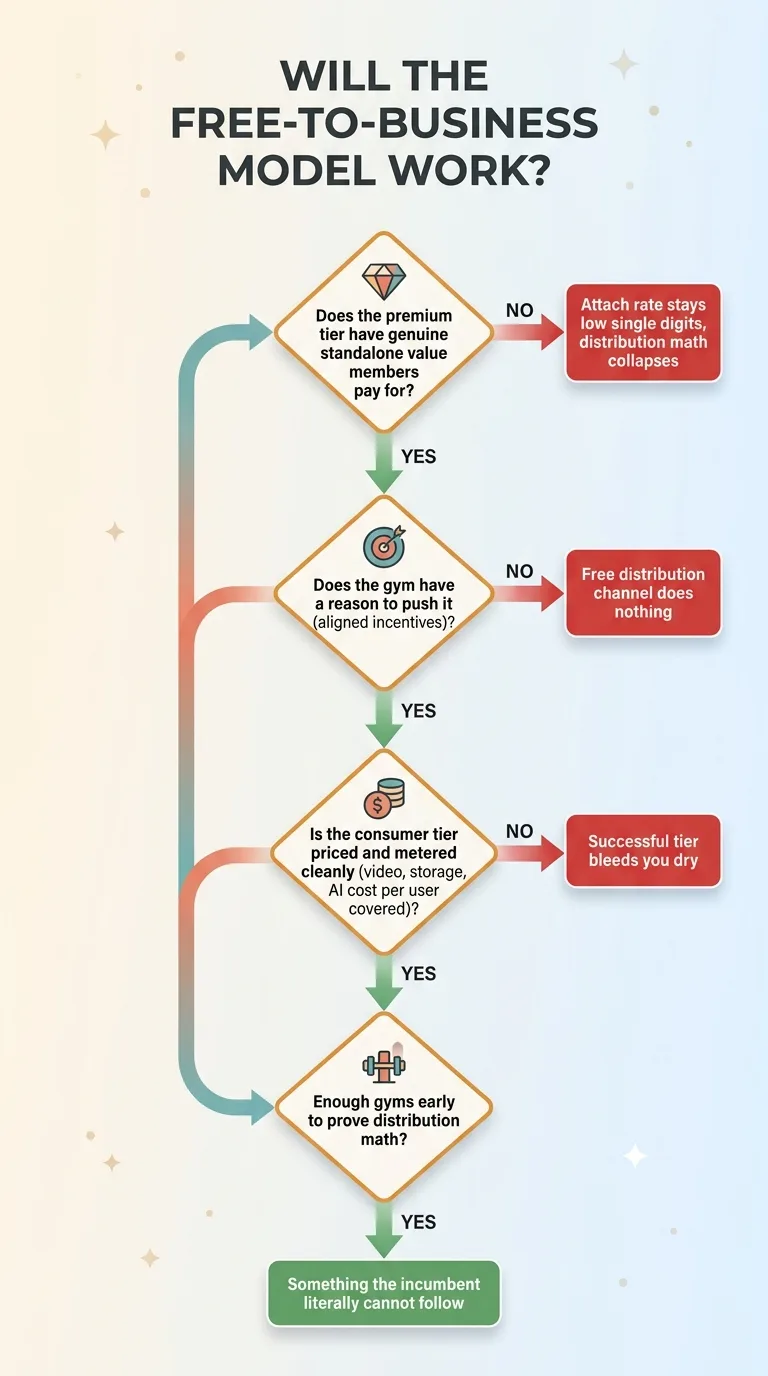
The premium tier has to deliver value a member would pay for even partly outside the gym context. If it is just a thin wrapper, the attach rate stays in the low single digits and your distribution math collapses. A technique library people genuinely study at home, progress tracking they check between classes, content with real depth. That is the bar. If you cannot clear it, the whole structure is hollow.
The gym also needs a reason to push it. Align the incentives. Maybe a small share flows back to the gym, or maybe it just makes their academy stickier and reduces churn. Either way, the owner has to want to promote it, or your free distribution channel does nothing.
Pricing and metering the premium side
You also need clean pricing and metering so you do not lose money serving the consumer tier. Video delivery, storage, and any AI features all carry real cost per user. If you are not metering it properly, a successful premium tier can still bleed you dry. I wrote about how I handle this in how I price AI SaaS by the credit, because the unit economics matter more than the headline price.
And you need enough gyms early to prove the distribution math actually works. This is where competing against an entrenched vendor gets tactical. You do not have to win the whole market on day one. You stage the build-vs-buy decision and earn ground over time, proving the model in a beachhead before you scale.
The honest version of vertical SaaS pricing strategy is this: the free-to-the-business structure only beats the incumbent if the consumer-tier unit economics close. Get that wrong and you have built a charity. Get it right and you have built something the incumbent literally cannot follow.
Find the Money Flow the Incumbent Can't Give Up
The lesson here is bigger than martial-arts gyms.
In any vertical with an entrenched incumbent, the question is not "what features are they missing." It is "where does their money come from, and can I earn somewhere they structurally cannot follow."
That is the real work. Not building more product. Mapping the money flow, finding the revenue line the incumbent depends on, and designing your business so you make money in a place their own P&L forbids them to go. The defensibility is not in your code. It is in the structure of the deal.
I do this kind of structural thinking when I build, not just when I advise. The interesting move is almost never the next feature. It is the pricing structure the incumbent cannot copy without setting fire to their own revenue.
If you are staring at an entrenched competitor and your plan is to out-feature them, that is the conversation worth having before you write another line of code. Come talk through your own structural play and let's map where the money actually flows.
Thinking about AI for your business?
If this resonated, let's have a conversation. I do free 30-minute discovery calls where we look at your operations and find where AI could actually move the needle, no slides, no pitch.
Get AI insights for business leaders
Practical AI strategy from someone who built the systems — not just studied them. No spam, no fluff.
Hodgen.AI
Ready to automate your growth?
Book a free 30-minute strategy call with Hodgen.AI.
Book a Strategy Call