What AI Replaces in Small Business: A Group Chat
AI replacing spreadsheets in small business isn't beating slick software. It's replacing one person's memory and a group text. Here's how old industries really run.
By Mike Hodgen
The Software You're Competing With Is a Group Text
When a CEO tells me they want to replace a process with AI, they usually picture something dramatic. Ripping out a clunky legacy platform. Migrating off some 20-year-old system that everyone hates. Replacing slick software with smarter software.
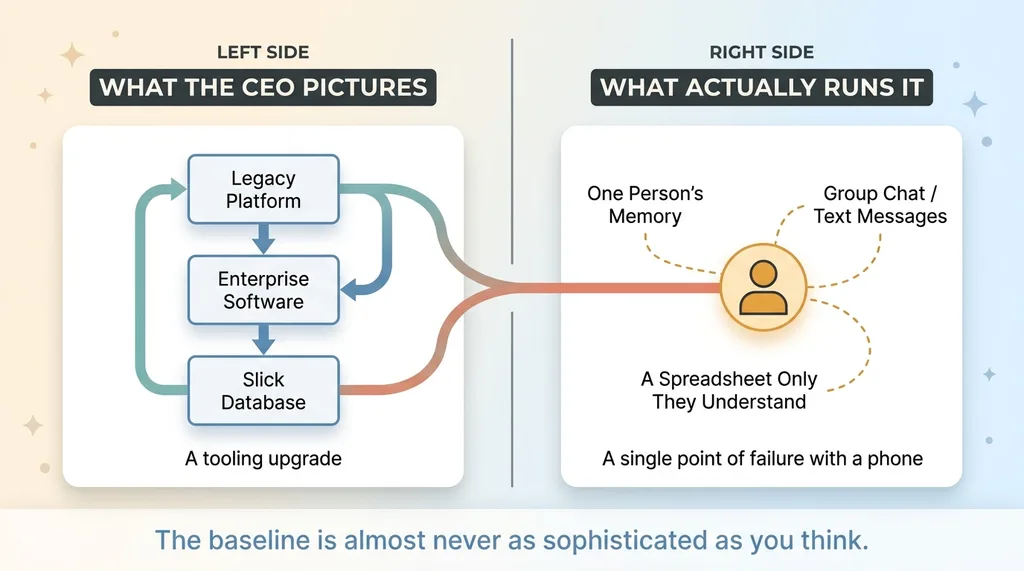 The Real Baseline: What CEOs Imagine vs What Actually Runs the Business
Here is what I actually find when I look under the hood at most small and mid-sized companies: the "system" is one person's memory, a group chat, and a spreadsheet that only that one person fully understands.
That is the real baseline. Not bad software. The absence of software altogether, papered over by a human who happens to remember everything. AI replacing spreadsheets in small business sounds like a tooling upgrade. It is not. It is replacing a single point of failure who carries a phone.
I am going to walk you through three companies I worked with this year. I am keeping them anonymous, so I will describe them by industry only: a security-guard staffing company, a personal-injury law firm, and a small California employer. Different businesses, different problems, same disease.
The thesis is simple. Before you can build the AI-native version of anything, you have to see what the actual baseline is. And the baseline is almost never as sophisticated as the CEO thinks it is.
I have learned to assume the worst. Not because these owners are bad operators, but because the thing holding the operation together is invisible until you go looking for it. It lives in someone's head. It travels through text messages. It works fine right up until that person is overloaded, out sick, or gone.
The biggest risk in these companies is not that their software is outdated. It is that their most critical process has no record at all. When you see how old industries actually run, you stop looking for the system to replace. You start looking for the person who is the system.
Guard Staffing: One Overloaded Person Texting People One by One
How it runs today
The security-guard staffing company had one ops manager doing the work of four people. This person owned HR. They owned payroll. They ran the compliance audits. And they were also responsible for shift coverage across multiple client sites.
When a post opened up, here is how it got filled. The ops manager pulled up a mental list of guards, opened their texts, and started messaging people one by one. "Can you cover the Tuesday overnight at the north gate?" Wait for a reply. No answer. Text the next person.
There was no central view of who was available. No view of who was qualified for which site, since different posts have different requirements. No view of which posts were short until the gap was almost on top of them.
The system of record was a spreadsheet plus a string of text messages on one phone.
Where it breaks
It breaks the moment something moves faster than one person can text.
A shortfall at a client gate would get caught hours late, because nobody had a live view of staffing against required posts. By the time the ops manager realized the Saturday shift was uncovered, it was Saturday morning and the guard pool had already made other plans.
The mistakes compound, too. The same overloaded person running coverage is also running payroll. So a scheduling scramble at 6 a.m. means payroll attention slips somewhere else. One human, three critical jobs, and no system catching the handoffs.
This is the real competitor. Not some enterprise workforce-scheduling platform. The thing I had to beat was a tired person with a spreadsheet and a thumb cramp. That is what manual operations actually look like in this industry, and it is far more common than the slick legacy systems people imagine.
Law-Firm Intake: Leads Scored in Someone's Head
The after-hours voicemail problem
The personal-injury law firm had a different flavor of the same problem. Leads came in three ways: a phone call, a web form, or a referral. Ad hoc, no pattern.
Qualification happened in someone's head. The intake person would talk to a caller, make a judgment about whether it was a real case, and either move it forward or let it drop. Nothing was written down about why.
Then there were the after-hours calls. A potential client with a serious injury calls at 7 p.m. on a Friday. Goes to voicemail. They do not leave a message. They call the next firm on their Google search, and that firm picks up.
The case walks. So does the fee.
Inconsistent qualification
Even during business hours, qualification was inconsistent. There was no script. The same type of case might get screened differently depending on who answered and what kind of day they were having.
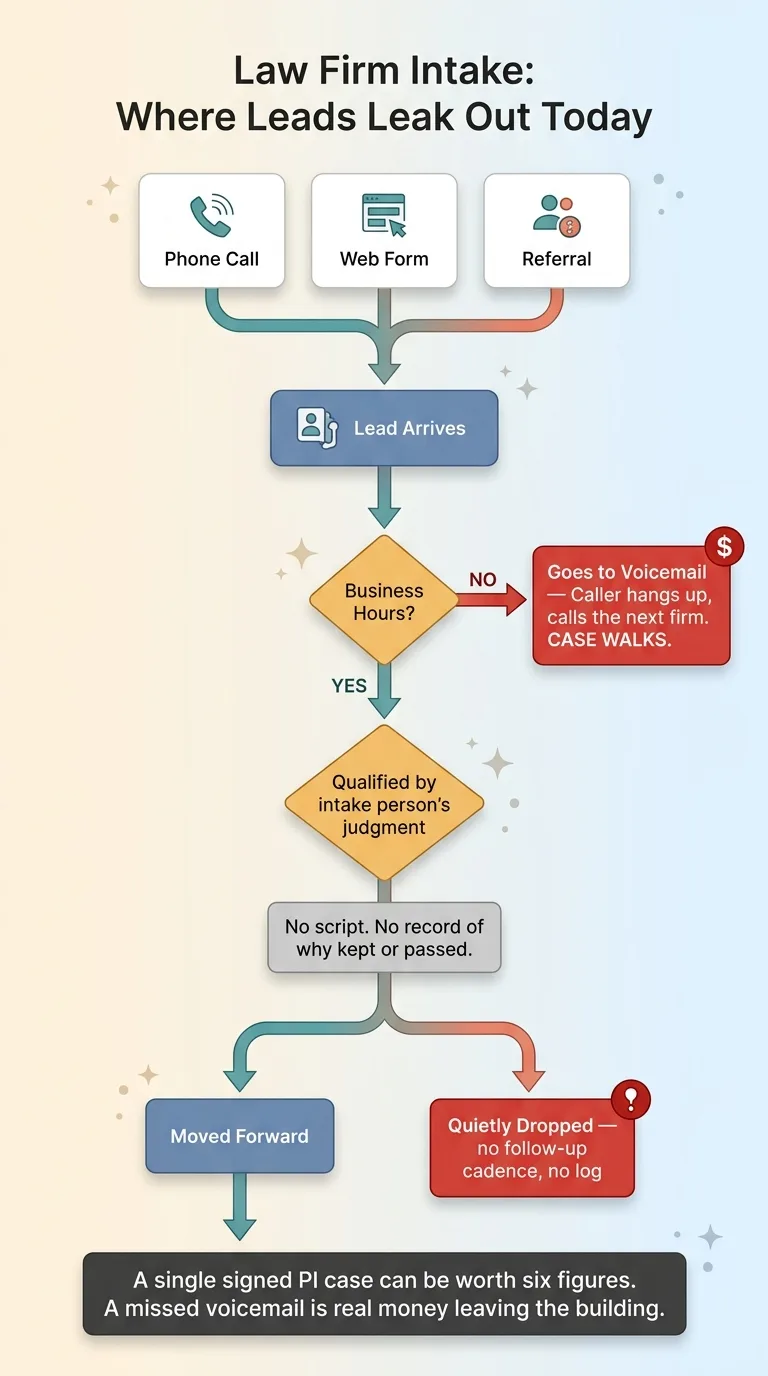 Law Firm Intake: Where Leads Leak Out Today
No record of why a lead was passed on. No follow-up cadence for the ones that were promising but not ready to sign today. The "CRM" was the intake person's judgment on a given afternoon.
I will not quote a specific number for this firm, because I keep client details anonymous. But you do not need the exact figure to feel the cost. In personal-injury work, a single signed case can be worth six figures in fees. A voicemail that nobody returns is not a missed call. It is real money leaving the building.
The owner thought they had an intake process. What they had was a person making good calls most of the time, with zero record of the calls they missed. You cannot improve what you cannot see, and they could not see any of it.
Small-Employer Compliance: No Audit Trail Until the Penalty Arrives
The small California employer had the most dangerous version of all, because nothing looked wrong until it suddenly did.
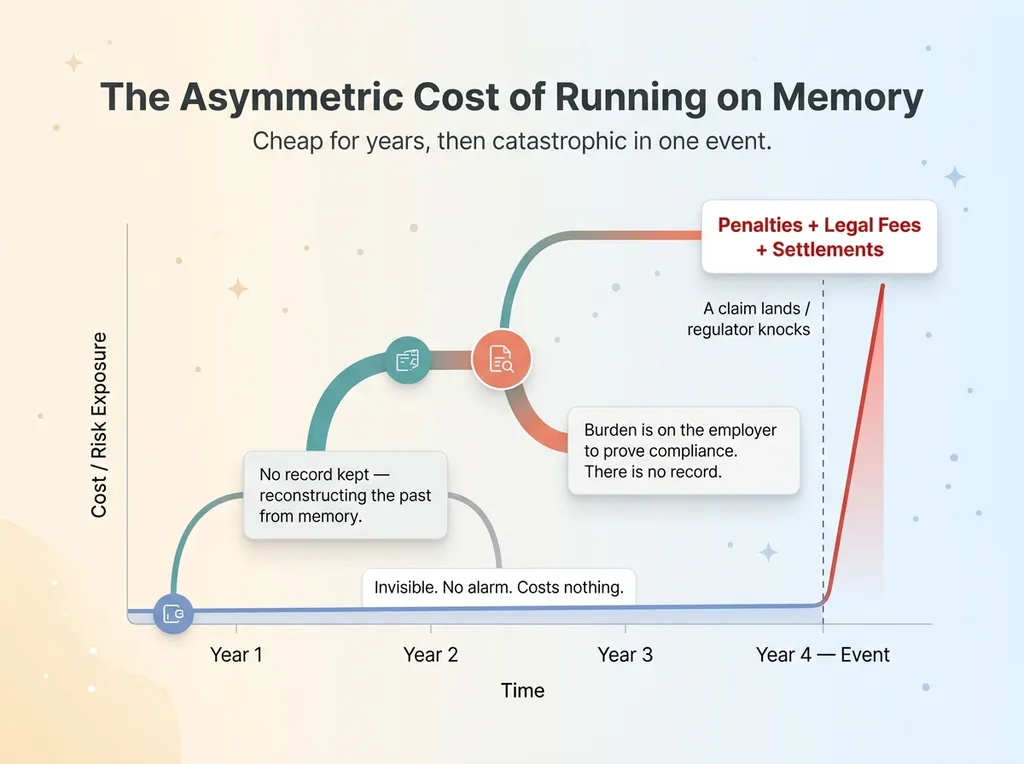 Asymmetric Cost of Running on Memory (Compliance)
There was no compliance documentation. Not bad documentation. None. Meal-break records did not exist in any retrievable form. Training completion was not logged. Acknowledgments were not captured. Scheduling history lived in memory and a few scattered files.
For years, this was fine. The business ran. Nobody asked for anything.
Then a claim lands. An employee files something, or a regulator comes knocking, and suddenly the owner needs to produce records going back months or years. Records that were never kept.
So they do the only thing they can. They reconstruct the past from memory and a folder of half-organized files. In a California compliance dispute, "I'm pretty sure we gave everyone their breaks" is not a defense. The burden is on the employer to show the record, and there is no record.
This is what makes it the most dangerous version of running on memory. The cost is asymmetric. It is invisible for years, costing nothing, generating no alarm. Then one event arrives and the bill is catastrophic. Penalties, legal fees, settlements.
The baseline here was not bad software. It was the absence of any record at all. California's regulatory exposure is real and specific, and this owner had built a business that was structurally unable to prove it was compliant, even if it actually was.
That is the cruelest part. They might have been doing everything right. They just had no way to prove it.
The Pattern: Memory and Messages, Not Software
Three different industries. Staffing, legal, general employment. Three completely different problems on the surface.
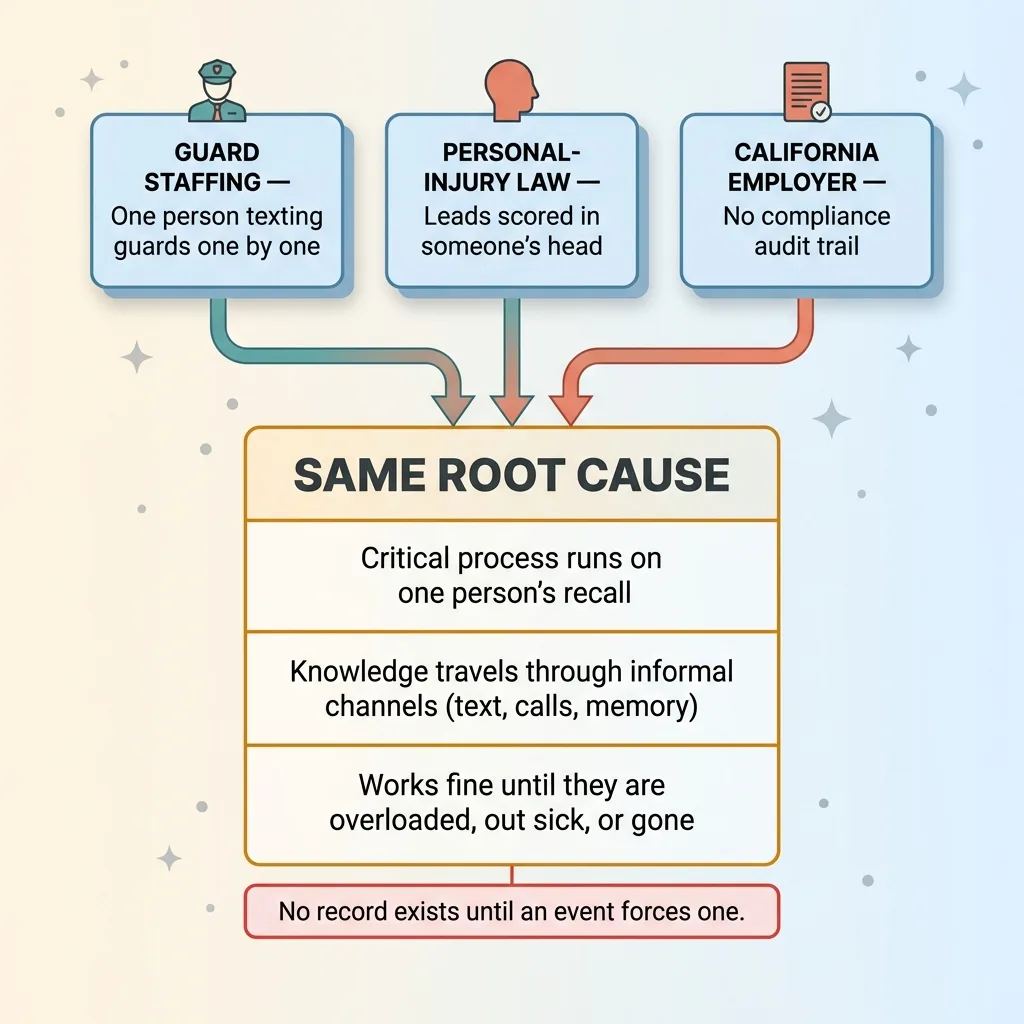 The Shared Pattern Across Three Industries
Underneath, the exact same thing.
A critical process running on one person's recall plus an informal channel. Text messages. Phone calls. A head-count someone carries in their mind. It works, genuinely works, until that person is overloaded, out sick, or quits. Or until an event forces them to produce a record they never kept.
I see this everywhere. This is not a coincidence across three clients. It is the pattern across six regulated industries this year. The "system" almost never turns out to be the system you would design on a whiteboard. It is whatever the most capable person quietly built around themselves to survive.
This is exactly why you have to listen before you build anything. If you map the org chart instead of the group chat, you start at the wrong end of the problem. The org chart tells you who reports to whom. The group chat tells you where the business actually lives.
Here is the buyer doubt I have to address directly, because most CEOs genuinely do not believe it about their own company: a huge chunk of your operation probably depends on one person's memory, and you do not know which part.
You think you have processes. You have people. Good people who have absorbed the process into their heads so completely that it looks like a system from the outside. Take that person out for two weeks and you find out fast how much was written down.
The move from manual to automated operations does not start with picking software. It starts with finding the memory.
What the AI-Native Version Actually Changes
From memory to a system of record
The fix is less exciting than people expect, and that is the point.
For the guard staffing company: a single system of record for posts, qualifications, and availability. Who is certified for which site, who is working, where the gaps are. Live, not in someone's head. The ops manager stops being the database.
For the law firm: a consistent qualification flow that captures every lead the moment it arrives. After-hours calls do not hit dead air. Every lead gets logged, including why it was kept or passed, so the firm finally has a record of the decisions it has been making blind.
For the California employer: an audit trail that builds automatically as work happens. The meal-break record, the training acknowledgment, the schedule history. The record exists before anyone asks for it, instead of being reconstructed in a panic after a penalty notice.
None of that is glamorous. It is plumbing. But the plumbing is the whole win.
From hoping to deterministic alerting
Here is the split that matters, and where people get AI wrong.
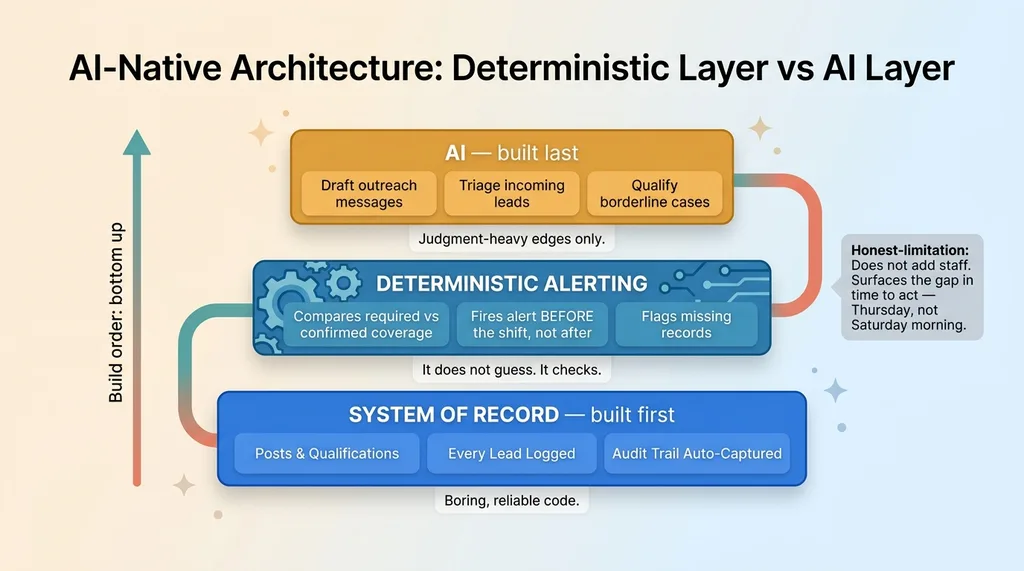 AI-Native Architecture: Deterministic Layer vs AI Layer
The system of record and the alerting are deterministic. Boring, reliable code. The staffing system does not "think" a shift is short. It compares required posts against confirmed coverage and fires an alert before the shift, not after. The compliance system does not guess whether a record was captured. It captures it or it flags that it did not.
AI handles the judgment-heavy edges. Drafting the outreach message to fill a post. Triaging an incoming lead. Helping qualify a borderline case. That is where models earn their keep.
AI is the last thing you build, not the first. The system of record comes first. The AI sits on top once the reliable layer underneath actually exists.
And I will be honest about the limit. This does not magically add staff. It will not conjure a guard out of thin air to cover a gap. What it does is surface the gap in time for a human to act. The win is not "AI fixes everything." The win is "you find out on Thursday instead of Saturday morning."
Before You Buy or Build Anything, See How You Actually Run
The first job is not picking a tool. It is mapping where your operation runs on one person's memory and a group chat.
Until you know that, every software decision is guesswork. You will buy a platform to solve a problem you have not actually located, and six months later the same critical knowledge will still live in the same person's head, just with a more expensive login screen attached.
I do this by sitting with the people doing the work, not by reading the org chart. The org chart lies. The person filling shifts at 6 a.m. and the person fielding the after-hours call tell the truth.
I am not going to promise you that AI transforms your business. That sentence means nothing. What I will promise is narrow and real: we replace the single point of failure with a system of record and an alert that fires on time.
If you suspect a critical part of your operation lives in one person's head, that is exactly where to look first. That is the most fragile thing you own, and you probably cannot see it from your chair.
That is the work I do. Before any tool, before any model, I see how your operation actually runs.
Thinking about AI for your business?
If this resonated, let's have a conversation. I do free 30-minute discovery calls where we look at your operations and find where AI could actually move the needle, not where it sounds impressive in a board deck.
Get AI insights for business leaders
Practical AI strategy from someone who built the systems — not just studied them. No spam, no fluff.
Hodgen.AI
Ready to automate your growth?
Book a free 30-minute strategy call with Hodgen.AI.
Book a Strategy Call