Every Failed AI Project I've Seen Started the Same Way
Here's the pattern I see over and over. A CEO reads about a tool, or a vendor sells them on one. The contract gets signed. Then everybody spends the next three months trying to find a problem that tool actually solves.
If you've been burned by a vendor who promised the world and delivered a dashboard nobody opens, you already know the feeling. You're not stupid. You bought into a story that sounded reasonable at the time.
The reason I want to explain why AI projects fail isn't to pile on. It's because the failure has a single root cause, and once you see it, you can't unsee it.
AI projects fail because they start at the wrong end. They start with technology and work backward to a problem, instead of starting with the problem and working forward to technology.
That sounds simple. It isn't. The entire vendor ecosystem is built to push you in the wrong direction, and most "AI strategies" I review are technology shopping lists dressed up in strategy language.
The numbers back this up. Most AI initiatives never reach production at all. I wrote a full breakdown of why 88% of AI projects fail if you want the data, but the short version is this: the overwhelming majority die not because the tech doesn't work, but because it was pointed at the wrong target.
There's a better way to start. It costs almost nothing and it feels almost too obvious. You listen first.
Let me show you what that actually means.
The Backward Order That Kills AI Projects
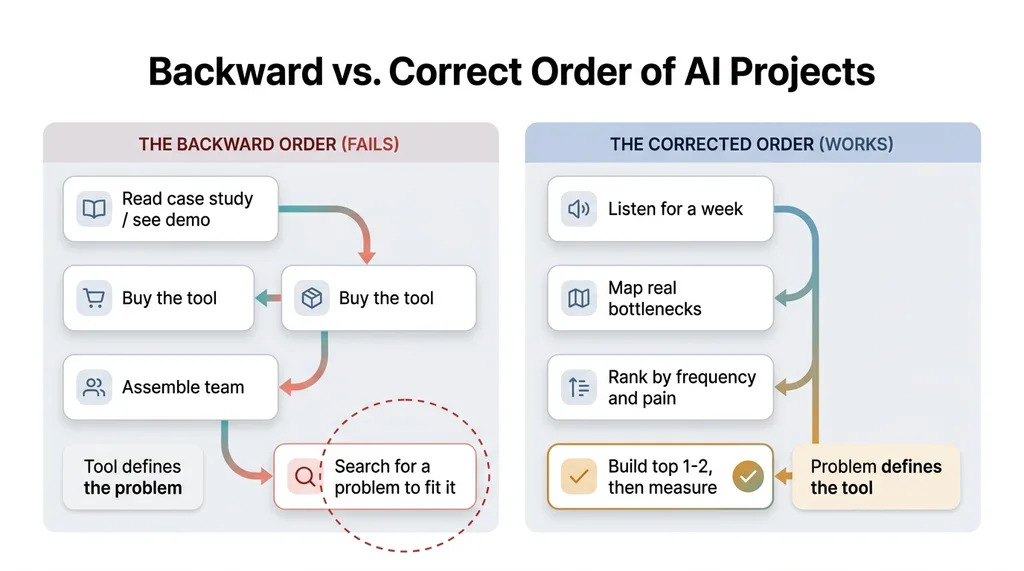 Backward vs. Correct Order of AI Projects
The tool-first trap
The typical sequence goes like this. Someone in leadership reads a case study or sees a demo. They get excited. They buy the tool. Then they assemble a team and tell them to go figure out where it fits.
Notice what just happened. The tool now defines the problem. Instead of the problem defining the solution, you're searching your business for places to shoehorn software you already paid for.
This is exactly backward. And once you've committed budget, sunk-cost bias kicks in. Nobody wants to admit the $40,000 license was a mistake, so the team keeps forcing it.
Why vendors love it (and why it fails you)
Vendors push tool-first because their incentive is to sell the tool, not to fix your operations. A vendor gets paid when you sign. Whether the thing solves your actual bottleneck is, frankly, not their problem.
I watched this play out with a mid-size services firm. They bought an AI chatbot license because a competitor had one. Then they spent four months trying to make it useful.
The whole time, their real bottleneck was a manual quoting process nobody had ever mapped. Quotes took two days because three people had to touch every one. That was the constraint costing them deals. The chatbot did nothing for it.
They spent four months and a five-figure license on a problem they didn't have, while the real one sat untouched.
I want to be fair here. The chatbot wasn't a bad tool. Plenty of those tools work fine. The order was the problem. If they'd mapped the quoting bottleneck first, they'd never have bought the chatbot, and they'd have shipped something that mattered in week one.
The tool is rarely the issue. The sequence is.
What 'Listen First' Actually Means
Observe how a business really communicates
Listen-first is exactly what it sounds like. Before I build anything, I spend roughly a week letting AI silently observe how a business actually operates.
Not how leadership thinks it operates. How it actually does.
That means looking at email volume and what those emails are about. Where conversations repeat. What questions customers and staff ask over and over. Where handoffs stall and things sit in someone's inbox for two days.
This is an ai operations audit, not a brainstorm. It produces evidence, not opinions.
Compare that to the usual approach, which is to put executives in a room and ask them what the problems are. The trouble is that executives are often wrong about their own operations, or they answer aspirationally. They tell you what they wish the problem was, or what sounds impressive in a board meeting.
Pain signals over feature wishlists
When you observe before you automate, the data tells a different story than the wishlist.
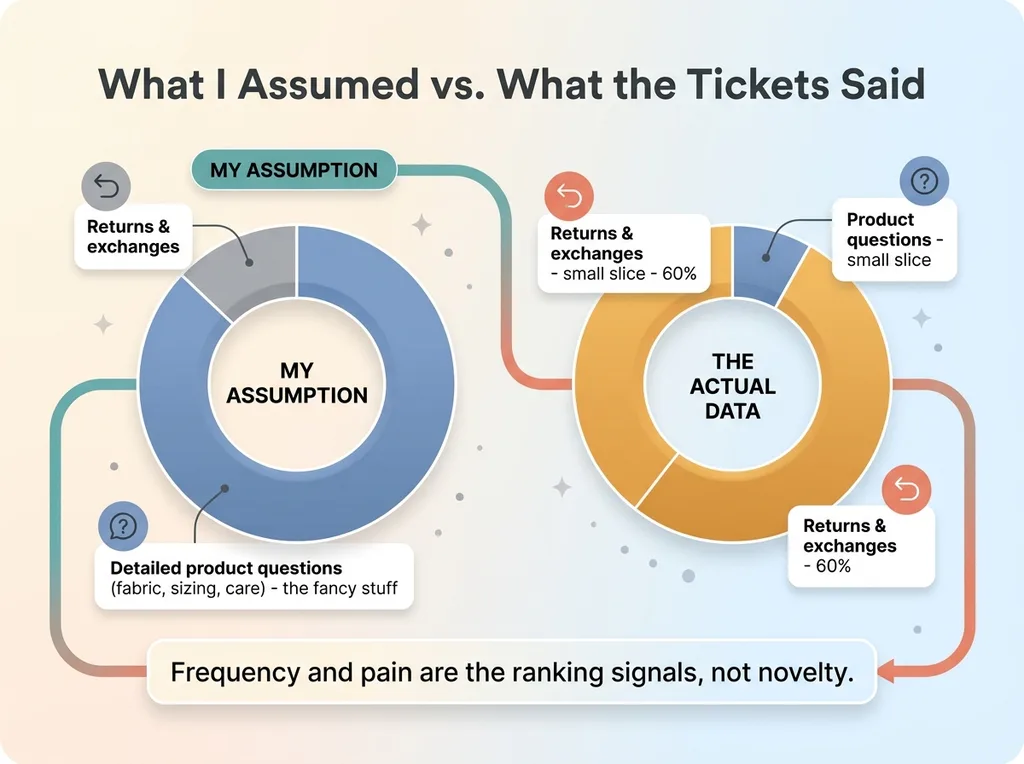 Assumption vs. Reality in Support Ticket Volume
I learned this in my own DTC fashion brand. Before I automated customer support, I assumed the hard part was answering detailed product questions. Fabric, sizing, care instructions. The fancy stuff.
So I read the actual tickets. Returns and exchanges were 60% of the volume. The "fancy" product questions I'd built my mental model around were a small slice.
If I'd automated based on my assumption, I'd have built the wrong thing and felt clever doing it. The data redirected me to where the real pain was.
This is the core of the method. Frequency and pain are the ranking signals, not novelty. The boring, repetitive, high-volume stuff is almost always where the value lives. Listening is how you find it.
Turning Observation Into a Prioritized Plan
Ranking by conversation frequency
After a week of listening, you don't have vibes. You have a ranked plan.
The logic is plain. The highest-frequency, highest-pain processes get automated first. A task done 200 times a week, with a real cost every time it goes wrong, beats a glamorous one-off that everybody loves talking about.
This sounds obvious written down. In practice, teams almost never do it, because the exciting project lobbies harder than the boring one.
Ranking by pain, not by what's easy to build
The second filter is pain, not ease of building. Sometimes the easiest thing to build is also the least useful. Ease is seductive because you can ship it fast and show progress. But shipping the wrong thing fast is still shipping the wrong thing.
Two of my own systems exist purely because the data demanded them, not because they were exciting.
The first is an email triage system that handles around 200 emails a day. Nobody dreams of building email triage. But the volume was undeniable, and every misrouted email cost time. The frequency made the decision for me.
The second was the customer support automation I mentioned. I built it around returns and exchanges, the unglamorous 60%, because that's what the tickets said.
Neither was the project I'd have picked if I'd gone with my gut. Both delivered more than the flashy ideas would have.
This is the part people miss. What I'm describing is an operations audit wearing an AI engagement's clothes. The technology question comes dead last. First you find out what actually hurts and how often. Before you spend a dollar on tooling, it's worth asking whether your business is actually ready for AI in the first place, because plenty of these problems are just broken process, and software won't fix a broken process. It'll automate the mess.
The 90-Day Falsifiable Experiment
An honest yes or no, not a growth promise
Here's the part that matters most if you've been burned before.
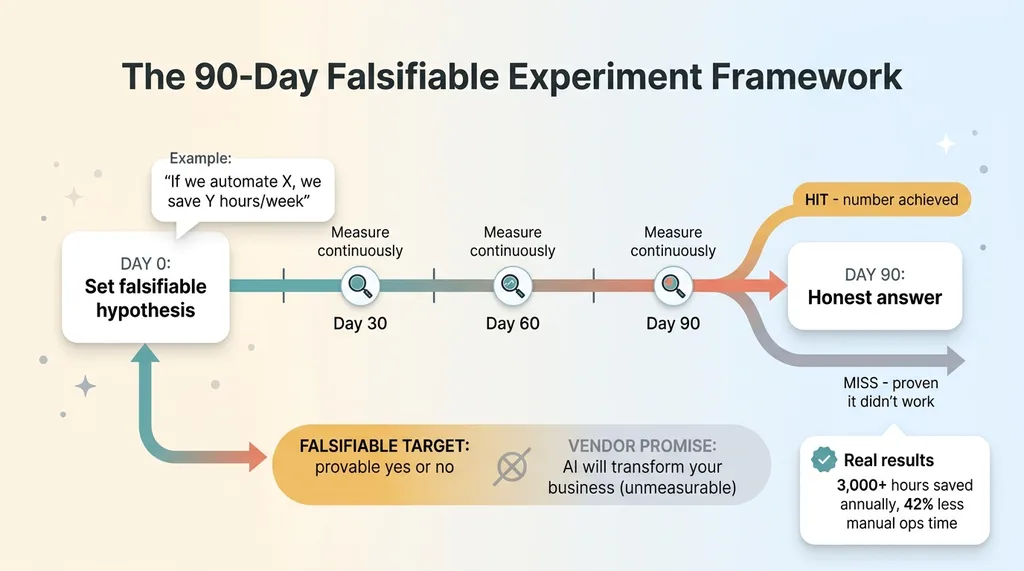 The 90-Day Falsifiable Experiment Framework
I frame engagements as a 90 day AI experiment with a falsifiable hypothesis. Something like: "If we automate X, we will save Y hours per week" or "we will cut Z errors."
Then we run it. And at the end, either it did or it didn't. No vague transformation talk. No "we're seeing great momentum." A number we agreed on up front, hit or missed.
Contrast that with the vendor who promises growth they can't tie to anything. "AI will transform your business." Transform it how? Measured against what? They never say, because if they committed to a number, you could check.
What 'falsifiable' protects you from
Falsifiable means you can prove it failed. That's not a weakness. It's the entire protection.
If a claim can't be proven wrong, it can't be proven right either. It's just a feeling. A falsifiable target means at day 90 you have an honest answer, not a renewal pitch.
The method works. My own numbers come from exactly this discipline: 3,000+ hours saved annually across my systems, and a 42% reduction in manual operations time.
But I want to be precise about where those numbers came from. They didn't come from buying good tools. They came from picking the right targets. Same tools, wrong targets, and I'd have nothing to show.
You measure it the whole way through, not just at the end. I keep an honest log of what each system actually delivers, and I wrote about tracking AI ROI with a deliverables log because measurement is the difference between a result and a story. If you can't see the savings in a spreadsheet, they probably aren't there.
What This Looks Like When It's Done Right
Let me put the whole sequence together in one pass.
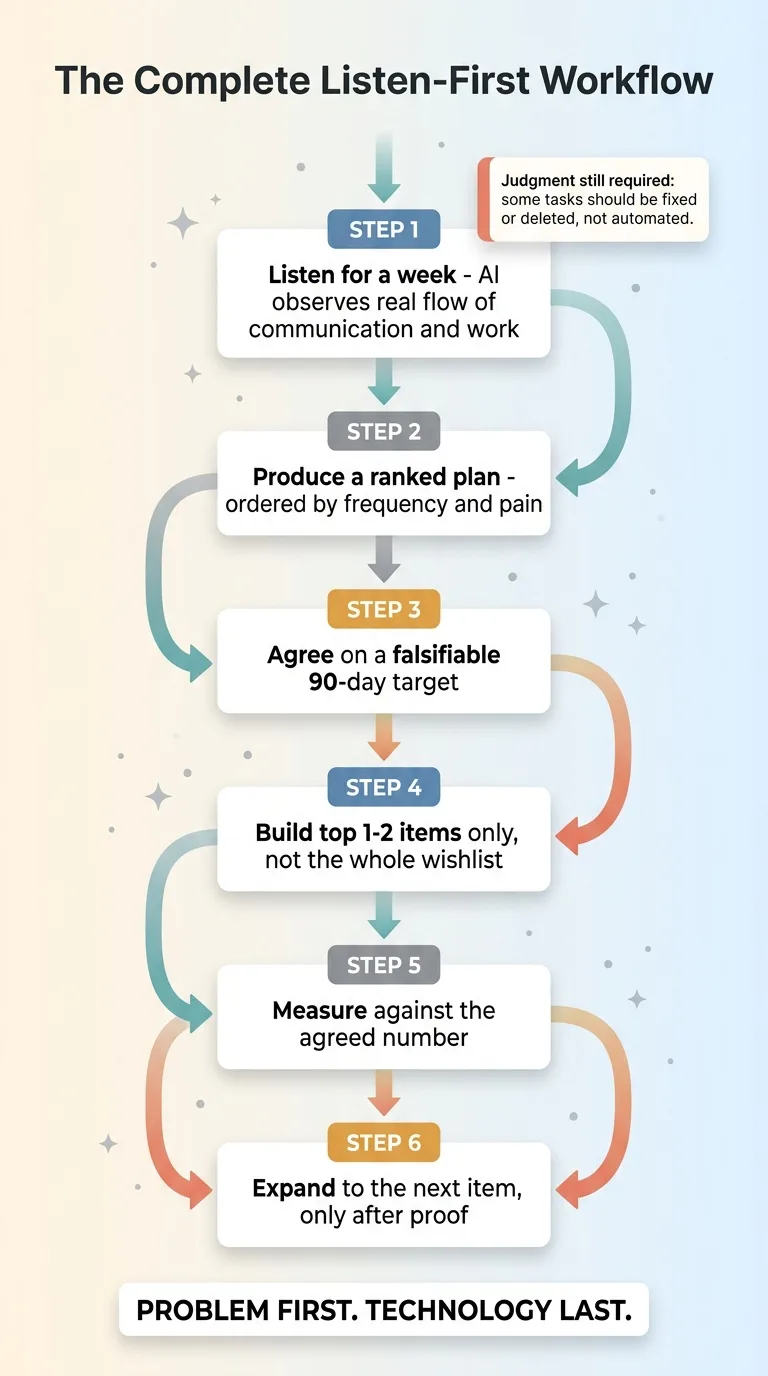 The Complete Listen-First Workflow
You listen for a week. AI observes the real flow of communication and work. Out of that comes a ranked plan, ordered by frequency and pain. You and I agree on a falsifiable 90-day target. I build the top one or two items, not the whole wishlist. We measure against the number we set. Then, and only then, we expand to the next item.
That's the corrected order. Problem first. Technology last.
Here's a contrast that shows why it matters. I worked with a professional services firm where leadership was convinced their problem was marketing. They wanted more leads, more visibility, the usual.
Listening told a different story. The real cost was buried in repetitive intake questions. Every new client triggered the same fifteen back-and-forth emails to collect the same information. It was eating hours of senior staff time every week, and it had nothing to do with marketing.
More leads would have made it worse. They'd have drowned in intake. The constraint was downstream of where they were looking.
I'll be honest about what listening can't do, because the limits matter. Observation surfaces what's frequent and painful. It does not tell you what to do about it.
You still need judgment. Some frequent, painful tasks should be automated. Others should just be fixed manually, or eliminated entirely because they shouldn't exist. The data points the flashlight. A human still has to decide what's worth building versus what's worth deleting. Anyone who tells you the data decides for itself is selling something.
Start With a Week of Listening, Not a Purchase Order
The cheapest, lowest-risk way to start any AI project is to observe before you spend.
A week of listening costs almost nothing compared to a year of paying for software you're not using. And it tells you whether the project is worth doing at all before you've committed to anything.
Here's the tell. If a vendor wants you to buy first and figure out the value later, walk away. That's the exact sequence that produced the failure you already lived through.
Remember the inversion. The project that burned you started with a tool. The fix starts with listening. Problem first, technology last, and a number at the end you can actually check.
That's how I work. Before I build anything, I observe how your business actually runs. Then I commit to a falsifiable result, and you get to hold me to it. No license you have to justify later. No transformation you can't measure.
Get the next build note.
I write up each system I build, including what broke. Subscribe to my newsletter and I'll send you the next one.