OAuth State CSRF: The Account Takeover Bug in Quick Builds
Unsigned OAuth state lets attackers stitch their account onto a victim's session. Here's how I fixed oauth state csrf account takeover in a multi-provider finance app.
By Mike Hodgen
Four Login Buttons, Four Ways to Get Robbed
I built a finance dashboard for a small business owner who wanted one screen instead of five tabs. It connects their accounting platform, their store, and two ad platforms into a single view. Revenue, ad spend, margins, all in one place. Clean.
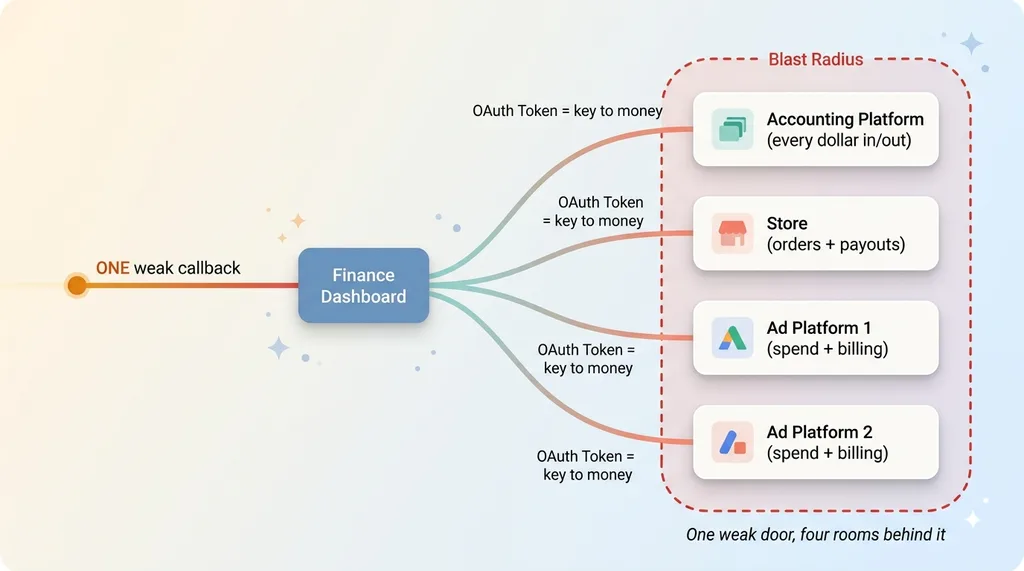 Single weak callback compromising four financial connections (blast radius)
Here is what that actually means under the hood: four OAuth callbacks. Four separate "connect your account" buttons, each one returning a token that touches a financial account. The accounting connection sees every dollar in and out. The store connection sees orders and payouts. The ad connections see spend and billing. Each token is a key to money.
Now here is the part nobody likes to hear. The lazy version of each one of those OAuth callbacks is an oauth state csrf account takeover hole. And because this single app holds four financial connections at once, one weak callback can become a door into all of them. The blast radius is not one account. It is the whole dashboard.
Quick AI-assisted builds ship this bug constantly. I see it over and over. The reason is simple: the happy path works in testing. You click connect, you approve, the token comes back, the data shows up. It looks done. The attack path, the one where someone forges the callback, never gets exercised because nobody is attacking a dashboard that two people have logged into.
This is one of the same five security holes that show up in every AI-built app. OAuth callbacks are where it bites the hardest, because the thing on the other end of the connection is a financial account.
Let me walk through exactly what an attacker does with a weak callback, and then how I close it.
What an Unsigned State Parameter Actually Lets an Attacker Do
The OAuth state parameter has one job: prove that the callback hitting your server belongs to a flow your user actually started, in their browser, in their session. It exists specifically to stop cross-site request forgery. When the callback trusts any state value, or no state, or a hardcoded one, that protection is gone.
The CSRF account-takeover flow, step by step
Here is the concrete sequence. I will keep it provider-agnostic.
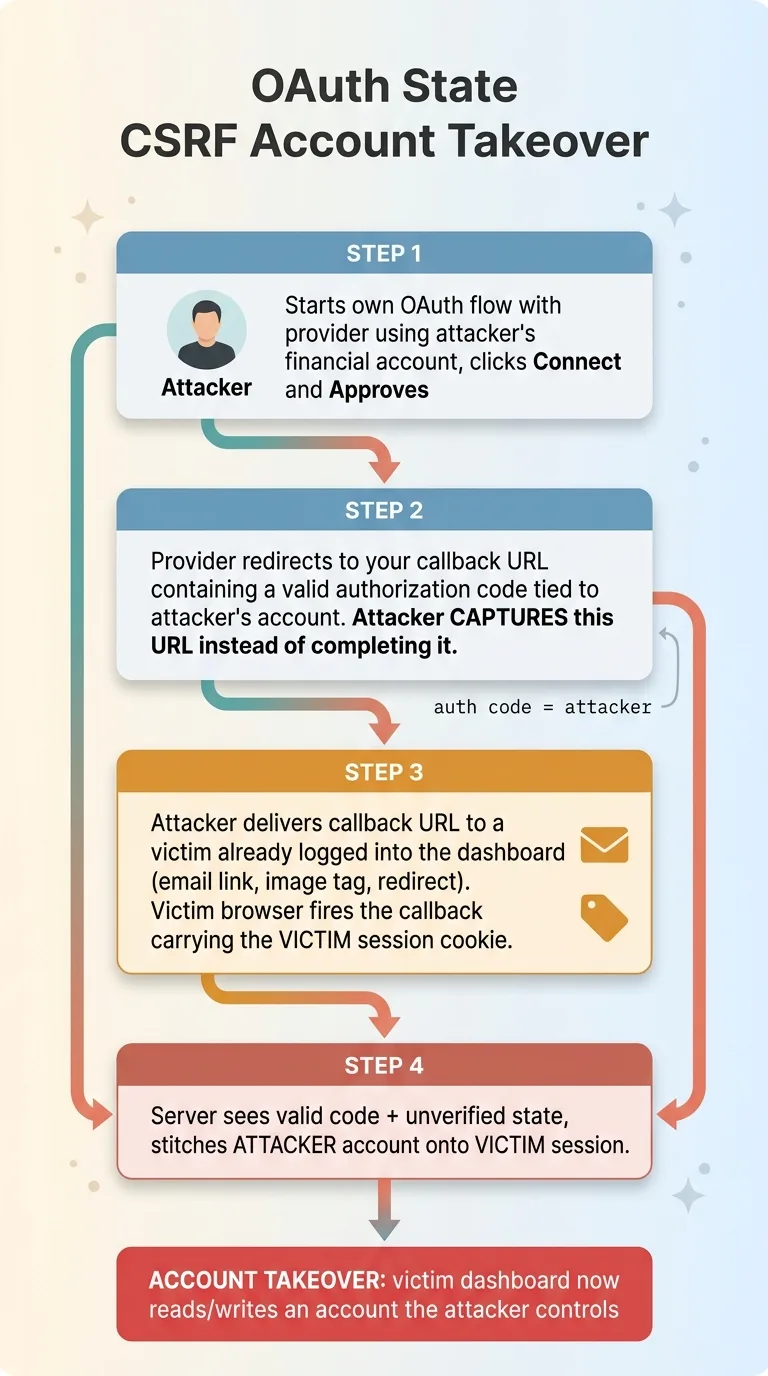 The CSRF account-takeover attack flow, step by step
- The attacker starts their own OAuth flow with the provider, using their own financial account. They click connect, approve, and the provider tries to send them to your callback.
- Instead of completing it, the attacker captures that callback URL. It contains a valid authorization code tied to the attacker's account.
- The attacker delivers that callback URL to a victim who is already logged into your dashboard. A link in an email, an image tag, a redirect. The victim's browser fires the callback against your server while carrying the victim's session cookie.
- Your callback sees a valid code, sees a state it does not actually verify, and stitches the attacker's financial account onto the victim's session.
Now the victim's dashboard is reading data from, or writing data to, an account the attacker controls. Depending on the flow direction, it cuts the other way too: the attacker's session ends up holding a token that reads the victim's data. Either outcome is an account takeover.
Why a static or missing state is the same bug
People assume the bug only exists when state is missing entirely. It does not. A static state value (the same string every time) fails identically because it is predictable and bound to nobody. A state that you generate but never check on the way back is also worthless.
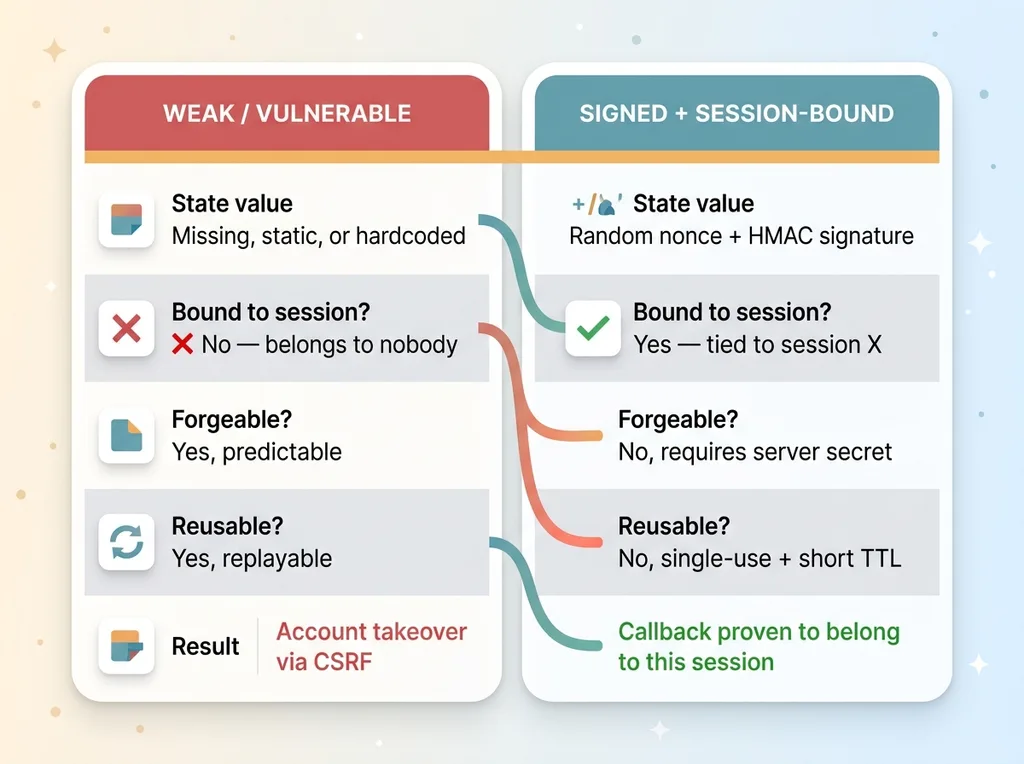 Weak state vs signed session-bound state comparison
The bug, in one sentence: the callback trusts the state without proving it originated from this user's session, in this browser. If you cannot prove that, you cannot trust the token. And if you cannot trust the token, you should not be storing it next to someone's accounting data.
The Second Hole: A Callback That Trusts the Provider's Redirect Host
There is a second untrusted input hiding in some callbacks, and the store platform is the classic example. The same pattern shows up wherever a provider hands you a host or shop identifier in the callback to tell your app which account it is dealing with.
It looks helpful. The provider says "this callback is for store-name.example-platform.com," and your code reads that, builds an API URL from it, and decides where to store the resulting token. Convenient. Also exploitable.
That host is a parameter sitting in a redirect. It is attacker-controllable. If you trust it blind, an attacker can supply a host you do not actually serve, or one that points your app at an account it has no business writing to. You end up building API calls against a domain the attacker chose, or routing storage decisions based on a value you never validated.
This is the shopify oauth host validation problem in generic terms. The provider gives you a parameter. You treat it as ground truth. It is not. It is input from the network, no different from a form field a user typed.
What makes this dangerous is the compounding. Now your callback has two untrusted inputs at once: a state you may or may not be verifying, and a host you are routing decisions off of. Get both wrong and the callback is wide open. Get state right but trust the host, and you have plugged one hole while leaving the other.
Every parameter in a callback is suspect until you prove otherwise. That is the whole mindset.
The Fix: Signed, Session-Bound State
The fix is not complicated. It is just unglamorous, which is why it gets skipped.
Generate state that's cryptographically signed and tied to the session
When the user clicks connect, before you redirect them to the provider:
- Generate a random nonce. Real randomness, not a counter, not a timestamp.
- Bind that nonce to the current session. Either store it server-side keyed to the session, or include the session identifier inside the payload you are about to sign.
- Sign the whole state value with an HMAC secret that lives only on your server. The client never sees this secret. The signature is what makes the state unforgeable.
Now the state you hand to the provider is a tamper-proof token that says "this flow belongs to session X, and here is proof I issued it."
Verify the signature AND the session before storing any token
When the callback comes back, you run three checks in order, and you do them before you exchange the authorization code for a token:
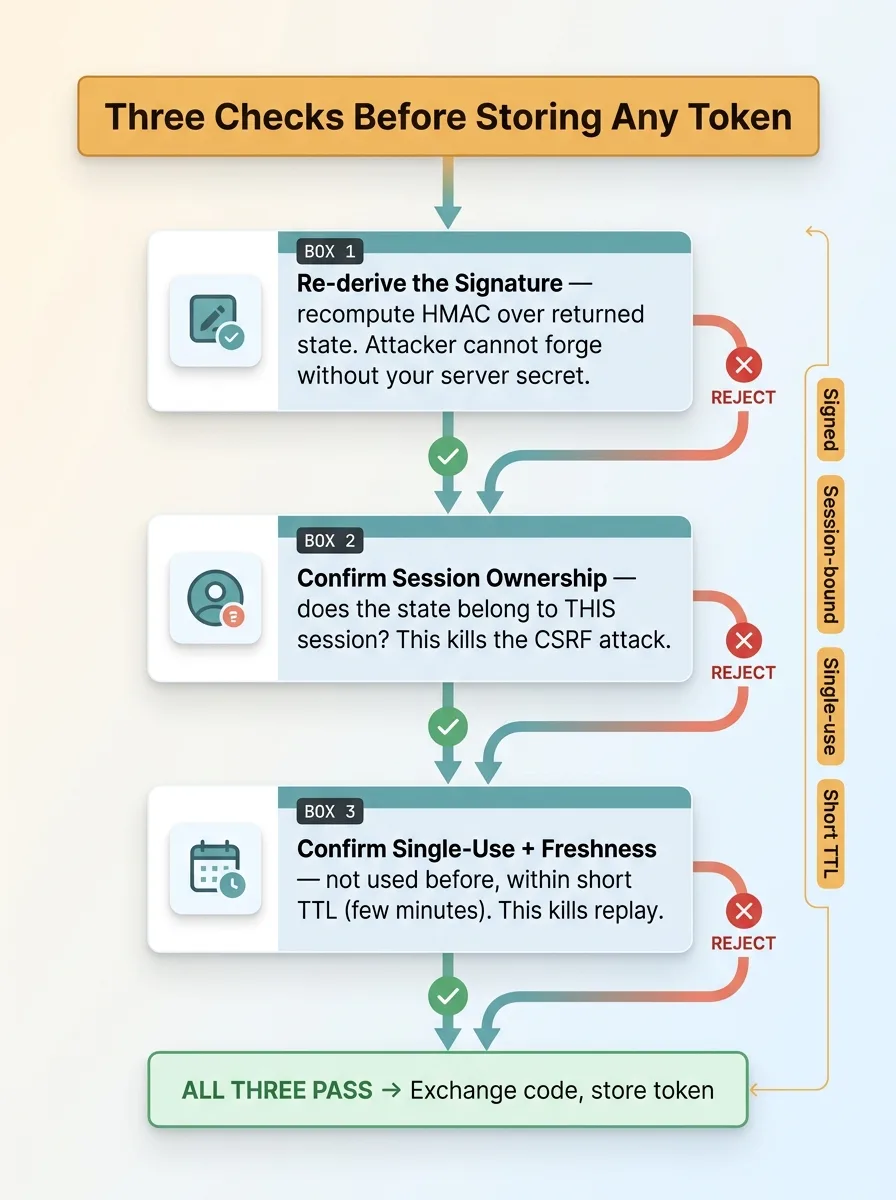 The three-check verification sequence for signed, session-bound state
- Re-derive the signature. Recompute the HMAC over the returned state. If it does not match, reject. An attacker cannot forge this without your secret.
- Confirm session ownership. Check that the state belongs to the session making this callback request. This is the step that kills the CSRF attack outright. The attacker's state was signed for the attacker's session, not the victim's.
- Confirm single-use and freshness. The state must not have been used already, and it must be within a short time-to-live. A few minutes is plenty. This kills replay.
Only after all three pass do you exchange the code and store the token.
The hard rule, stated plainly: never store an OAuth token until you have proven the callback came from a flow this exact session started. Short TTL, single-use, signature-verified, session-bound. Four properties, no exceptions.
Once you have safely stored a token, you are not done. A token sitting in plaintext in your database is the next problem. That is why you encrypt those tokens at rest before any of this is production-ready. Signed state gets the token in safely. Encryption keeps it safe once it is there.
Validating the Provider Host Against an Allowlist
The fix for the second hole is just as direct. You validate the host or shop identifier the provider hands you before you do anything with it.
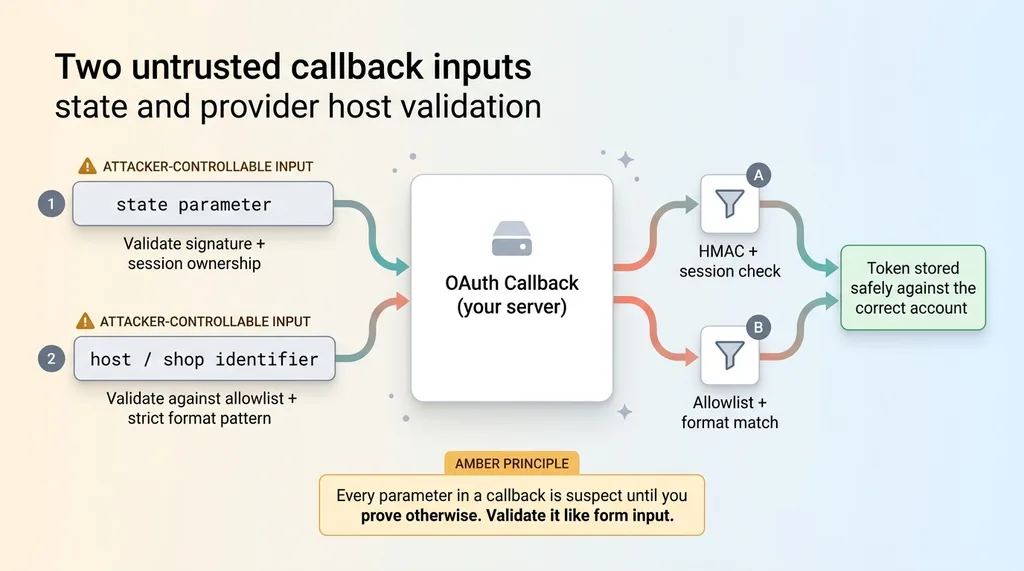 Two untrusted callback inputs: state and provider host validation
Two ways to do this, and you can use both:
- Allowlist. If you know the set of valid hosts, check the supplied value against that set. Anything not on it gets rejected before you build a single URL.
- Strict format validation. For platforms with a known domain shape (the store platform is a good example, where shop identifiers follow a fixed pattern), validate that the value matches that exact pattern. Reject anything that does not.
For most real cases you do both: confirm the format is valid, then confirm it matches the account the user is actually connecting. A well-formed host that belongs to a different account is still an attack.
The principle, in a form worth remembering: a parameter handed to you by a redirect is attacker-controllable. Validate it like form input. You would never trust a raw form field to decide which database row to write. A callback parameter deserves the same suspicion.
Tie this back to the finance dashboard. In a multi-provider app holding four financial connections, host validation is what stops an attacker from pointing your trusted callback at an account that is not theirs to touch. The callback is trusted by your own code. That trust is exactly what gets abused if you skip the check.
Why This Matters More When One App Holds Four Financial Connections
In a single-provider app, a weak callback is a bad bug. In a dashboard connecting accounting, a store, and two ad platforms, the same bug is a different category of problem, because the connections share a blast radius.
Think about what an attacker gets from compromising one callback in that dashboard. Revenue numbers. Ad spend. Margin data. And often a pivot point: a connection that exposes the others, or session control that lets them stitch a fresh connection they own. One weak door, four rooms behind it.
This is the heart of multi provider oauth security. The security bar for an app holding multiple financial tokens is genuinely higher than for a single social login button. A broken login on a recipe app is embarrassing. A broken callback on something wired into your accounting platform is a financial breach.
This is also the real doubt a technical buyer has when they hand over their accounts. Not "does the dashboard work." It works. The question is "can I trust whoever built this with a token that reads my books." That is a fair question, and it deserves a real answer.
Here is the honest part. Getting OAuth right is unglamorous. There is no demo for it. Nobody opens a dashboard and admires the session-bound state. That is exactly why quick builds skip it. The work is invisible until the day it is the only thing standing between an attacker and four financial accounts.
How I Make Sure This Never Ships
Every connect flow I build gets signed, session-bound state and host validation by default. Not as a hardening pass after launch. Not when someone files a bug. It is part of how the callback is written the first time, because retrofitting it later means auditing every place a token already landed.
Before anything I build touches a real financial account, I run a full security review across the codebase, and callback security is a fixed line item on that pass, not a thing I remember to check if I have time. I run a multi-lens security audit across every codebase for exactly this reason, so the unglamorous stuff cannot quietly slip through.
That audit is part of the security pass every AI-built app needs before it touches a paying customer. OAuth callbacks are one of the first places I look, because they are one of the first places a lazy build leaks everything.
So here is the honest framing. If you are connecting your accounting, your store, and your ad accounts to one dashboard, the OAuth callbacks are where the whole thing lives or dies. A clean happy path tells you nothing about the attack path. That gap is the kind of thing I check before a customer ever logs in, because by the time it shows up in production, the tokens are already at risk.
Ready to bring AI leadership into your company?
I work with a small number of companies at a time. If you're serious about AI, apply to work together and I'll review your application personally.
Get AI insights for business leaders
Practical AI strategy from someone who built the systems — not just studied them. No spam, no fluff.
Hodgen.AI
Ready to automate your growth?
Book a free 30-minute strategy call with Hodgen.AI.
Book a Strategy Call