What a Branding Agency Actually Charges You For
I've hired branding agencies. I've also watched founders spend money they didn't have on a process that takes longer than building the actual business. So I built an AI brand creation tool to prove that the most expensive part of starting a brand isn't expensive anymore.
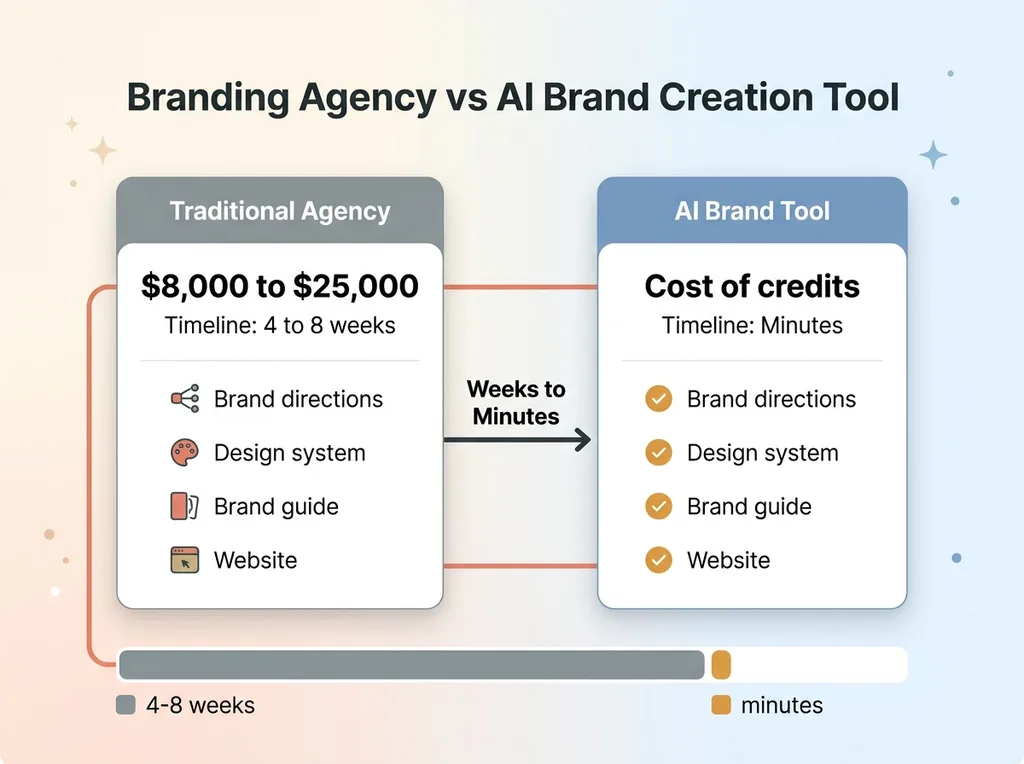 Agency cost and timeline vs AI tool
Here's what you actually pay an agency for. Four deliverables.
First, brand directions. The strategist presents a handful of distinct creative angles for who you are and how you show up.
Second, a design system. Color palette, type pairings, spacing rules, the building blocks that make everything look like it belongs together.
Third, a brand guide. The document that codifies all of it so anyone touching your brand stays on-rails.
Fourth, a website. A starter site that puts the system into the real world.
A full engagement for those four things runs $8,000 to $25,000 and takes four to eight weeks. I've seen quotes higher than that for a logo and a one-page site.
Here's my uncomfortable take after building 15+ AI systems: none of those four deliverables are mysterious craft anymore. A name, a palette, a type system, a brand guide. These are pattern-matching over thousands of examples. That is exactly what large language and image models do well.
The agency feels like craft because it's slow and it involves humans nodding thoughtfully in a conference room. But the underlying work is recognizing what good looks like across a huge corpus of references and assembling something coherent from it.
That's not magic. That's the thing AI is actually good at.
So the question I asked myself was simple. If the four deliverables are pattern-matching, why does this step still cost five figures and eat two months of a founder's runway? It shouldn't. The agency step compresses to minutes.
I built the tool to find out exactly how few minutes.
Why I Built an AI Brand Creation Tool Instead of Buying One
Founders today have two bad options. Pay the agency, or do it yourself.
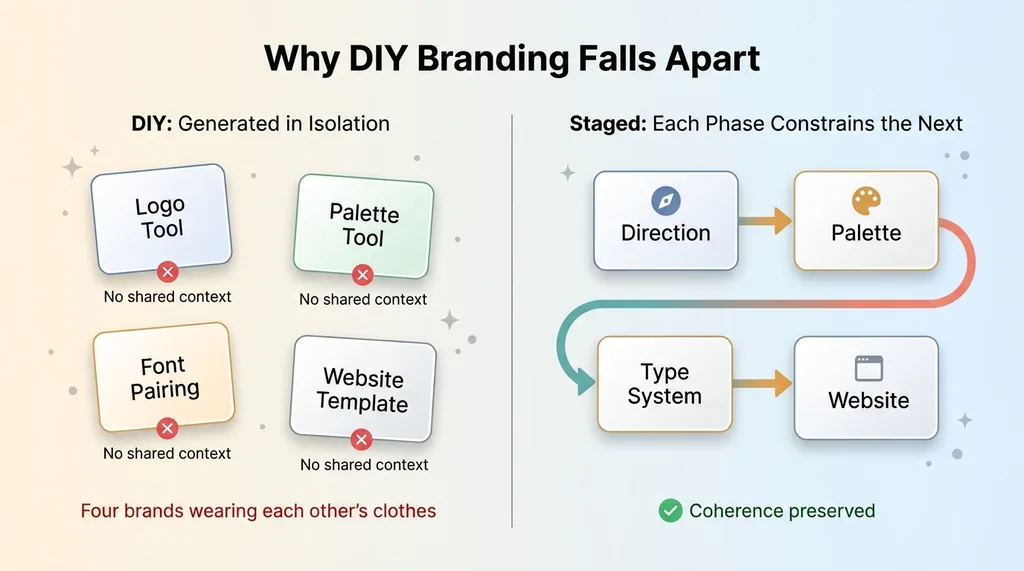 DIY isolation vs Staged constraint chain (coherence problem)
The DIY path looks cheap and ends ugly. You grab a logo from one generator, a palette from a color tool, a font pairing from a blog post, and a website template from somewhere else. Each piece looks fine alone. Together they look like four different brands wearing each other's clothes.
The reason DIY fails has a name. Coherence.
Every piece gets generated in isolation. The logo tool doesn't know about your palette. The palette tool doesn't know about your type. The template doesn't know about any of it. There's no shared context, so nothing reinforces anything else.
That's the actual insight behind my tool, and it has nothing to do with raw generation quality. The image and language models are already good enough. As I wrote in the moat moved somewhere else, generation got cheap and the value moved to how you structure it.
So the design principle became this: each phase has to constrain the next.
A single prompt to ChatGPT can hand you one brand direction. It can't fan out twelve genuinely distinct directions, let you lock one, and then derive every downstream decision from that lock. The moment you ask for everything at once, the model has too much freedom and no anchor, so it gives you mush that contradicts itself three paragraphs later.
I didn't want a tool that generated assets. I wanted a tool that made decisions in sequence, where each decision narrowed the room for the next one.
That's a staged architecture, not a clever prompt. And staging is what keeps the output coherent from the first direction all the way to the live site. The generation is the easy part. The constraint chain is the product.
The 6-Phase Pipeline, Start to Finish
The tool runs six phases. Each one feeds the next. I'll walk a generic example through it, a telehealth startup that came in with one sentence: "an app that connects patients with licensed therapists by video."
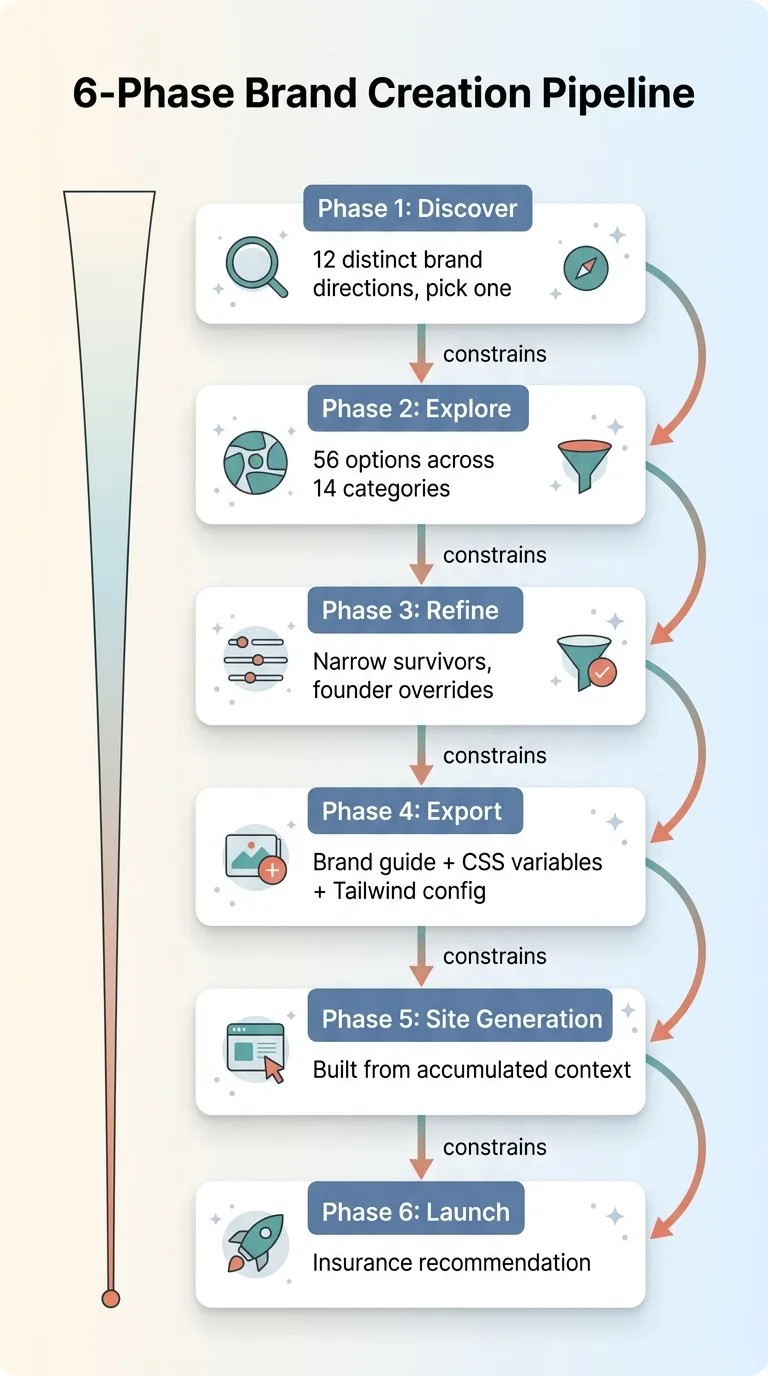 The 6-Phase Brand Creation Pipeline
Phase 1: Discover (12 directions)
You feed in that one-sentence description. The tool returns 12 genuinely distinct brand directions. Not twelve variations of the same blue-and-calm idea. One leans clinical and trustworthy. One leans warm and human. One leans modern and minimal. One leans bold and disruptive. You pick the one that fits your customer.
This is where most founders get stuck for weeks. Here it's a few minutes of reading and one decision.
Phase 2: Explore (56 options across 14 categories)
Once a direction is locked, the tool fans out 56 design options across 14 categories. Color systems, type pairings, logo concepts, iconography style, imagery treatment, layout density, and more.
The key detail: every one of those 56 options is constrained to the direction you chose. Nothing wanders off into a different aesthetic. You're choosing within a boundary, not starting over.
Phase 3: Refine
The system moves toward your picks and narrows. You're no longer choosing from wide options. You're tightening the ones that survived. This is also where a founder with a strong opinion overrides the AI. The tool proposes, you decide.
Phase 4: Export (brand guide + CSS vars + Tailwind config)
This is where it stops being a moodboard and becomes usable. The tool synthesizes a real brand guide plus actual developer artifacts. CSS variables and a Tailwind config you can drop straight into a build.
That's the part I cared about most. Most AI design system generators give you pretty pictures. This gives a developer something they can ship against.
Phase 5: Site generation
The tool generates the website from all accumulated context. Every earlier choice flows in. The locked direction, the chosen palette, the type system, the design tokens. The site isn't generated fresh from a prompt. It's built against everything the previous phases decided.
For the telehealth example, that meant the site used the exact color tokens from Export, not a new set the model invented on the spot.
Phase 6: Launch (insurance recommendation)
The last phase even recommends business insurance appropriate to the business type. A telehealth startup has different liability exposure than a coffee roaster. Small thing, but it's the kind of practical step a founder forgets in the rush to launch.
The whole point of the chain is this: each phase narrows the next. That's why a brand that started as one sentence ends as a coherent live site instead of a pile of mismatched assets.
Why Staged Constraints Beat One Big Prompt
Here's the technical argument in plain language.
One giant prompt asking for "a brand and a website" produces mush. The model has too much freedom and no anchor. It's being asked to make a hundred decisions simultaneously with nothing to ground any of them, so the decisions don't agree with each other.
Staging works because each decision becomes a hard boundary for the next phase.
Once a direction is locked in Discover, Explore literally cannot drift outside it. The search space shrinks. Once design tokens are set in Export, the Site phase builds against those tokens instead of inventing new ones. The model isn't free to wander, so it doesn't.
This is the same principle I use across my production systems. The pricing engine that handles 564+ products doesn't ask one model to "price everything well." It classifies products into tiers first, then prices within tight rules per tier. Let the AI judge, but constrain the search space hard. That's the whole game.
Now the honest limitation. The tool is excellent at coherent starting points. It is not a replacement for taste.
A founder with a strong existing vision will still want to override picks, which is exactly what the Refine phase is for. If you already know your brand should feel like a specific competitor's energy but warmer, the tool gets you 80% there and then you steer the last bit.
It's a head start, not a verdict. The coherence is the value. The final 5% of judgment that makes a brand iconic is still yours.
How Credits Meter Each Phase (And Why That Matters)
The economics matter as much as the output, so let me be direct about pricing.
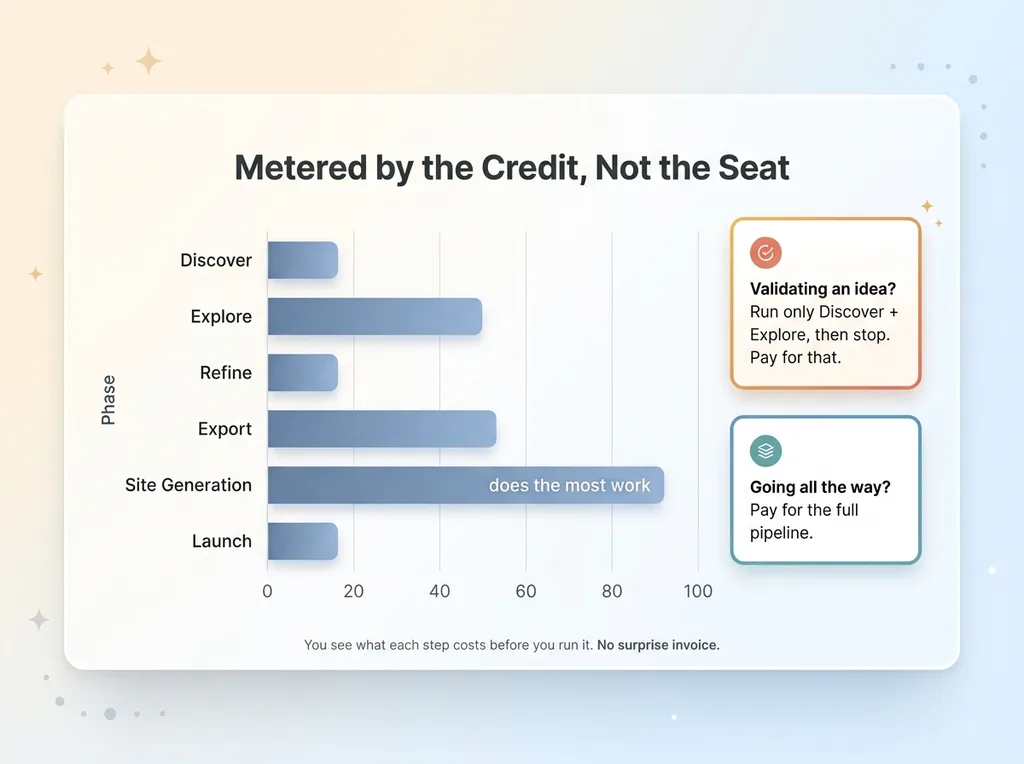 Credit metering per phase vs flat seat fee
Each phase consumes credits. Discover costs something. Explore costs something. Site generation costs more because it does more work. You pay for the primitives you actually consume.
This matters because not every founder needs the full run. Someone validating an idea might only want the twelve directions and a design system, then stop. They pay for that and walk away with what they need. Someone going all the way to a generated site and an insurance recommendation pays for the full pipeline.
There's no flat seat fee pretending every user does the same thing. The cost is tied to the actual work the system performs.
I wrote about why this model is the honest one in metered by the credit, not the seat. The short version: AI cost scales with usage, so the pricing should too. Charging a flat monthly fee for something where one user runs three phases and another runs thirty just means somebody is subsidizing somebody else.
Metering keeps it transparent. You see what each step costs before you run it. No surprise invoice, no "we'll true up at the end of the quarter."
For a tool whose whole pitch is replacing an opaque five-figure agency quote, transparent pricing isn't a nice-to-have. It's the point.
What This Replaces, and What It Doesn't
I'm going to be honest about the line here, because overpromising is how AI vendors lose trust.
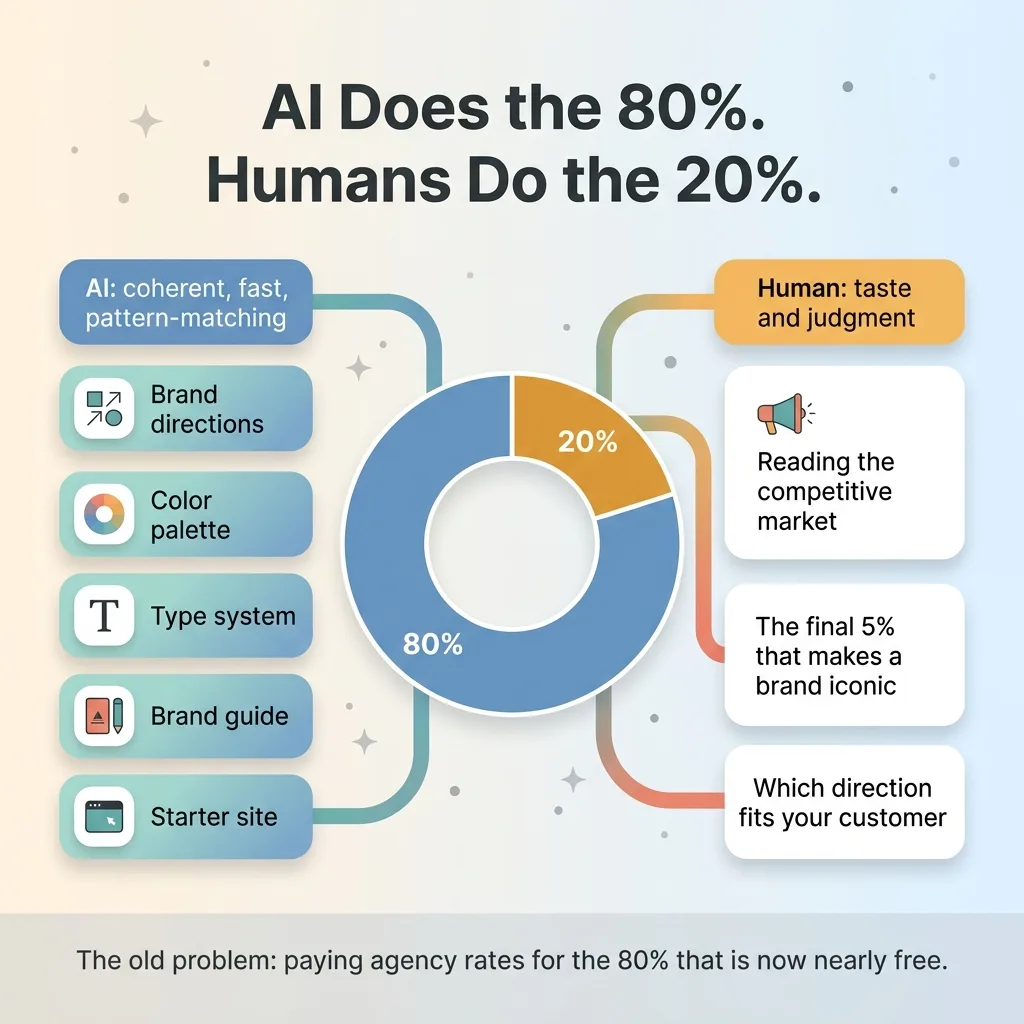 The 80/20 split: what AI replaces vs what humans still earn
What the agency step loses
The weeks-long, thousands-of-dollars first pass is gone. The part where you wait four to eight weeks and pay $8K to $25K to get a coherent name idea, a palette, a type system, a brand guide, and a starter site. That entire deliverable bundle now happens in minutes for the cost of some credits.
That's most of what a branding engagement bills for. I built this and watched it produce coherent output, so I'm not speculating. As I covered in one operator delivering what used to take a studio, one person with the right pipeline now ships what used to require a team and a timeline.
Where a human still earns the fee
A brand strategist who deeply understands your competitive market still earns their money. The tool doesn't know your three competitors all use the same shade of teal and that you should run the other way.
A designer refining the 5% that makes a brand actually iconic still earns it. AI gets you to "good and coherent." Going from good to unforgettable is human work.
And the judgment to know which of the twelve directions fits your specific customers? That's yours, or your strategist's. The tool generates the options. It can't sit in your customer's head.
So here's the honest accounting. AI does the 80% that used to get billed at agency rates. A human does the 20% that's genuinely worth paying for. The problem with the old model wasn't that the work was bad. It was that you paid agency rates for the 80% that's now nearly free.
From Weeks to Minutes Is the Real Story
The headline isn't that AI can make a logo. Plenty of tools make logos. The story is that the entire idea-to-website step now happens in the time it used to take to schedule the agency kickoff call.
Think about what that does for a founder validating an idea. You can test a brand and a real site before committing real money. You can run three different directions, put them in front of customers, and kill the two that don't land. The cost of being wrong drops to almost nothing.
That changes the decision, not just the deliverable. When branding costs $20K and six weeks, you commit to one idea and pray. When it costs an afternoon, you experiment.
This is the same compression I keep seeing everywhere. I wrote about it in the new timeline for custom software, and branding is just one more example of a slow, expensive, gated process collapsing into something you run on a Tuesday.
The pattern is what matters. Staged AI pipelines with human checkpoints. Let the AI do the wide, fast, pattern-matching work, and keep humans on the judgment calls that actually need taste. Branding is one application. The same architecture works for pricing, content, operations, and most of the expensive manual processes sitting inside your business right now.
If you're a CEO or founder staring at a slow, costly process and wondering whether AI could compress it, the answer is usually yes, but only if it's built with constraints instead of one big prompt and a prayer.
Get the next build note.
I write up each system I build, including what broke. Subscribe to my newsletter and I'll send you the next one.