You remember what custom software used to cost. If you ran a company anytime in the last fifteen years and needed an internal tool built, you remember the meeting where someone quoted you a number that made you wince, and a timeline measured in quarters. The phrase "custom software timeline" used to mean three months minimum, often six. That math is broken now, and I want to walk you through exactly why, because "days, not quarters" sounds like a lie until you understand what changed.
What custom software used to cost in time and money
The four-stage quarter
Here's the old timeline, and it was an honest one.
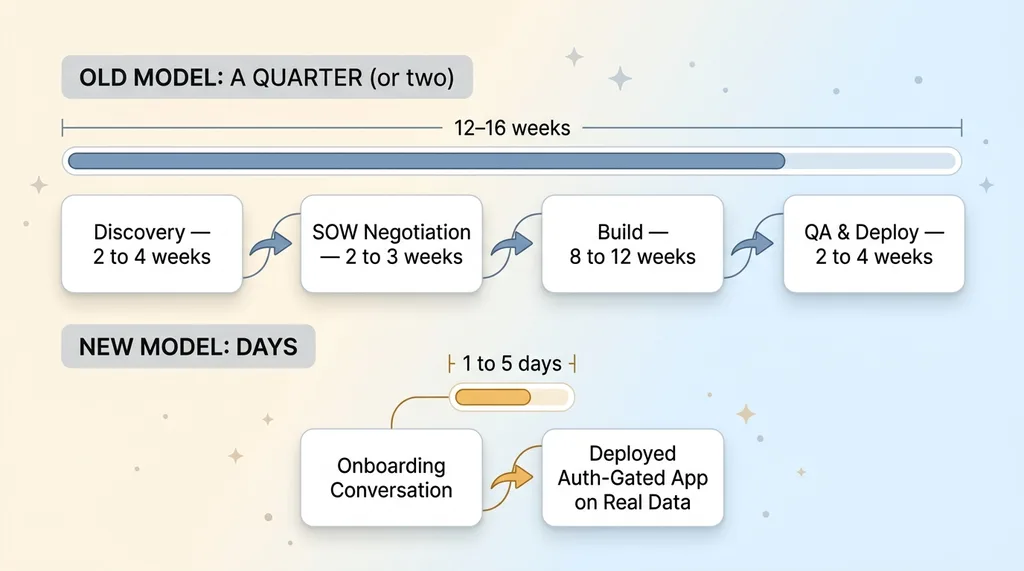 Old vs New Software Timeline Comparison
Discovery ran two to four weeks. Someone had to sit with you, understand the workflow, map the data, and write it all down. Then statement of work negotiation, another two to three weeks of scoping, pricing, and back-and-forth on what was in and out.
Then the build: eight to twelve weeks of actual development. Then QA and deployment, two to four more weeks of testing, fixing, and shipping.
Add it up and you're at roughly a quarter for a mid-complexity internal tool. Often two quarters once real life intervened.
The six-figure invoice
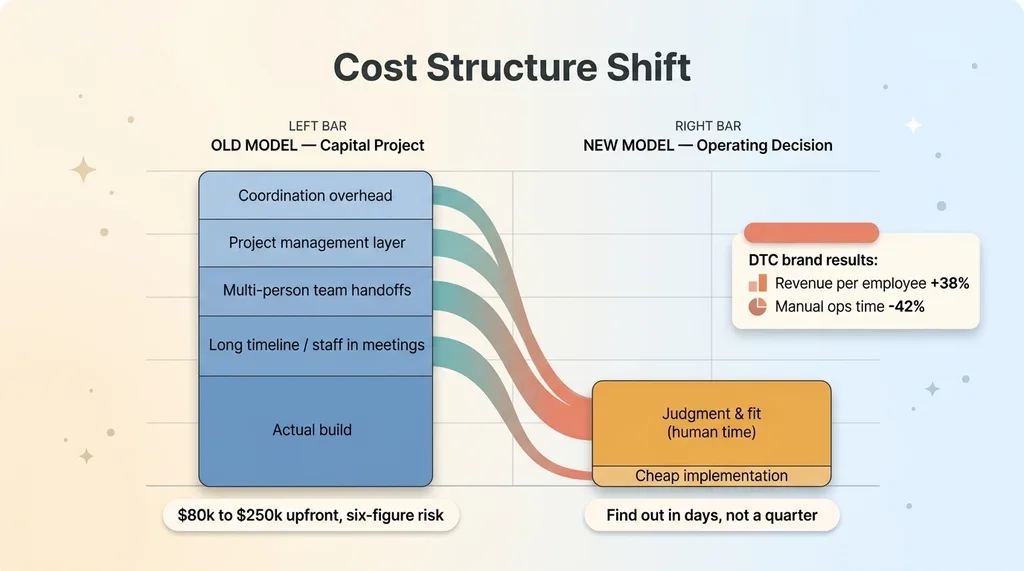
The price matched the timeline. Eighty thousand to two hundred fifty thousand dollars for an internal tool that wasn't even particularly fancy. A record management system. A custom dashboard. An approval workflow.
This wasn't waste. It wasn't incompetence or padding. That was the real cost of humans typing code line by line, and coordinating across a designer, a backend developer, a frontend developer, and someone handling deployment.
Every one of those people had to understand the others' work. Meetings, handoffs, context switching. The coordination overhead alone justified a big chunk of the bill.
It was reasonable then. It is not reasonable now, and the difference is the whole point of this article.
What "days" actually means (and what it doesn't)
The deployed, auth-gated, real-data bar
Let me define the claim precisely, because vague claims don't survive a skeptical CEO.
When I say days, I mean: from an onboarding conversation to a production app, behind authentication, running on your real data, deployed to a live URL you can actually use.
Not a Figma mockup. Not a demo with fake data. Not a single-screen toy that looks good in a screenshot. A working application your team logs into.
Concrete example. A professional services firm needed an internal tool to manage client records with role-based access, so different staff saw different things. We talked on a Monday. By the end of that week they had a working, auth-gated app loaded with their actual data.
Why this isn't a prototype
Now the honest part, because this is where people get suspicious.
Days does not mean polished forever. It does not mean zero iteration. It does not mean the app handles every edge case on day one. What you get is real and usable, and then it improves with use.
I've done this across nine unrelated industries: financial advisory, real estate, fitness, manufacturing, HR compliance, and more. The pattern holds regardless of sector, which tells me it isn't industry-specific luck. It's a structural change in how software gets built.
The seam AI removes: implementation
Why the build was always the expensive part
Here's the core of it. The compression is almost entirely in implementation. The grunt work.
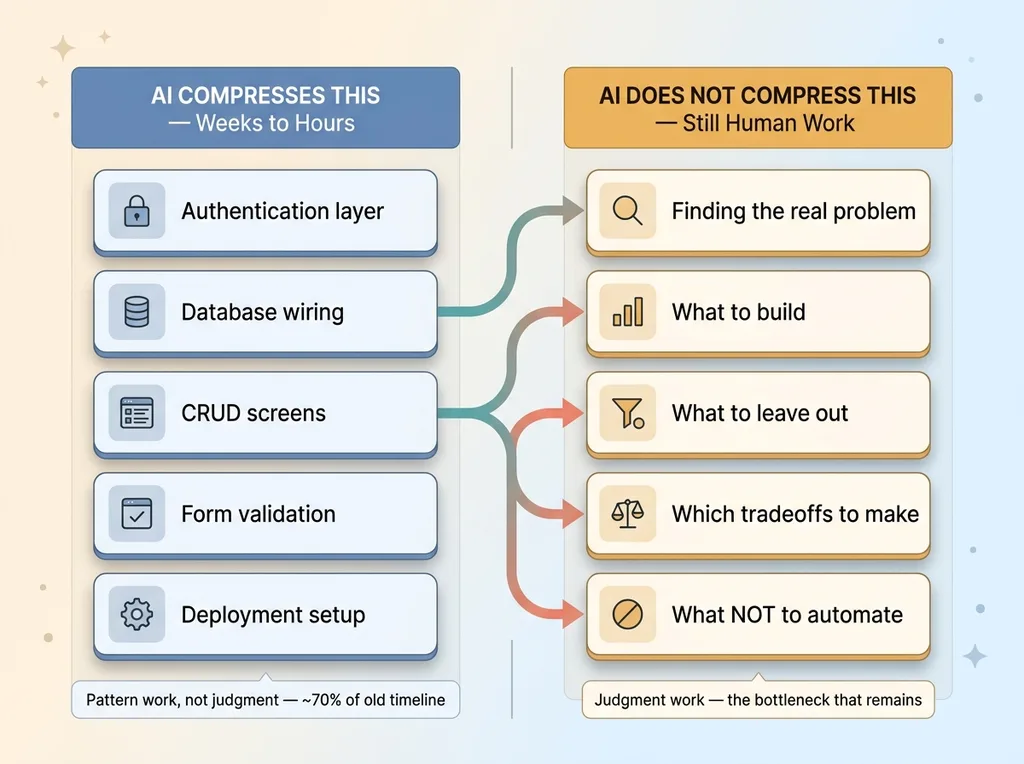
Writing the authentication layer. Wiring up the database. Building CRUD screens. Handling form validation. Setting up deployment. That was always 70% of the timeline and most of the cost, and it was the least interesting part of the job.
AI compresses this from weeks to hours, because it's pattern work, not judgment work. An auth flow has been written a million times. A database schema for client records follows known shapes. The machine is genuinely good at the parts that were always mechanical.
What 22,000 lines of Python taught me
I've written 22,000-plus lines of custom Python in my own AI toolkit, and I build production systems in single working sessions now. That's not a brag, it's evidence of the velocity shift. If you want to see what that actually looks like day to day, here's what a week of AI-first building actually looks like: real projects, real commits, in one week.
Be specific about the gap. A database schema, an auth flow, and a dozen screens that used to take a three-person team three weeks now take me a focused day or two.
The skill didn't disappear. The typing did. That distinction matters, and it's why I build the thing rather than just advise on it. The judgment is still mine; the keyboard work got automated.
The seam AI does not remove: requirements and judgment
Getting the real problem, not the stated one
Now the part that answers your real fear, which is that fast means sloppy.
 What AI Compresses vs What It Doesn't
What does not compress is figuring out what your business actually needs. Clients describe the symptom, not the problem. They tell me what they think the solution looks like, and half the time that's not the solution at all.
The onboarding conversation is where the real work lives, and it can't be rushed by any model.
Example. Someone asks me for a dashboard. They want to "see what's going on." But when we dig in, they don't need a dashboard at all. They need an alert. They don't want to log in and look at a screen; they want to be told when a number crosses a line. Build them the dashboard they asked for and you've built the wrong thing fast.
The decisions AI can't make for you
The judgment calls still take human attention. What to build. What to leave out. What tradeoffs to make. And critically, what not to automate, because some things shouldn't be.
This is exactly why I listen before I automate anything. The listening is the job now.
Here's the honest truth about how my time has shifted. I spend more of it on requirements and judgment than on code, because code stopped being the bottleneck. Speed in the build means I can afford to be slower and more careful about getting the requirements right.
That's the opposite of corner-cutting. The compression bought me room to be more thorough where it actually matters.
Why faster build actually means better software
Iteration replaces specification
This is the counterintuitive part that should kill the "sloppy" fear directly.
 Specification vs Iteration Loop
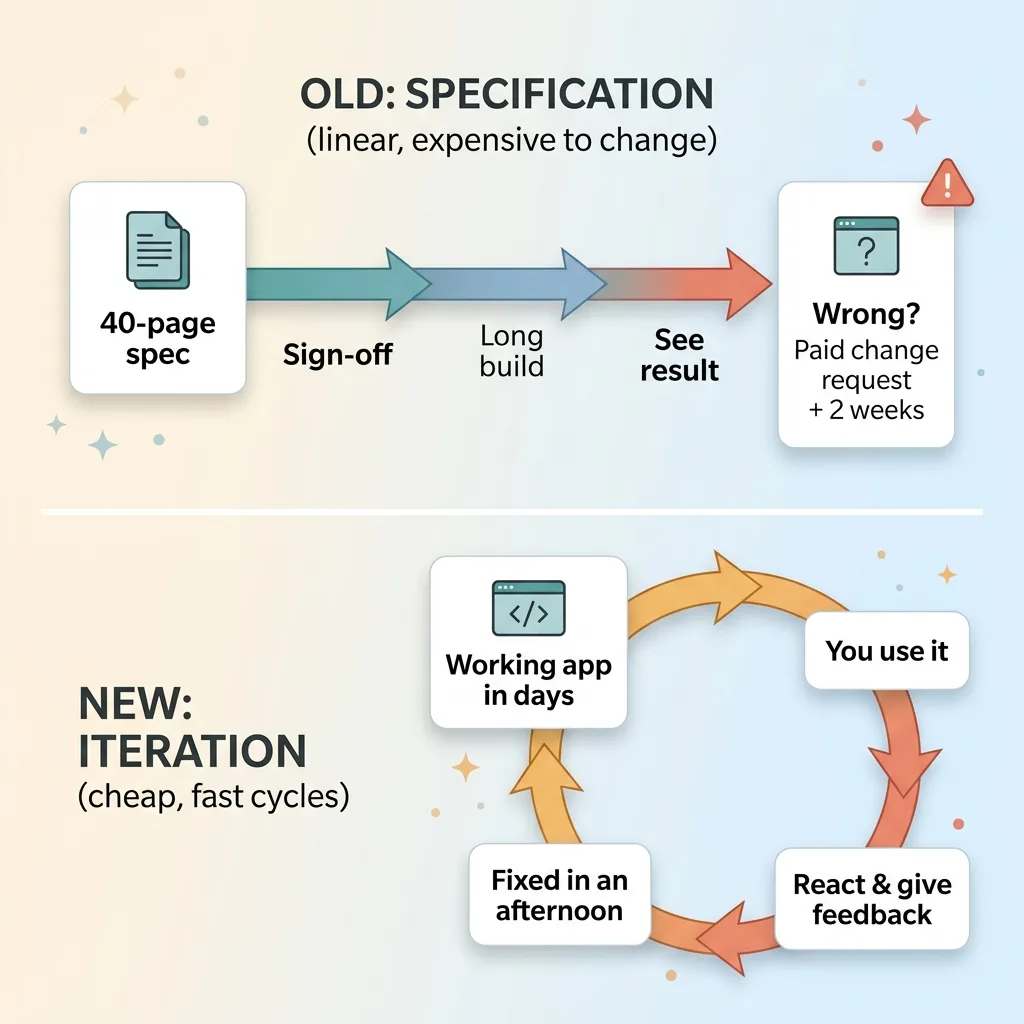
The old timeline forced everyone to lock requirements upfront because changes were ruinously expensive. You wrote a 40-page spec and prayed it was right, because by the time you saw the real thing, the budget was already spent. Change request after sign-off? More money, more weeks.
The new timeline flips this completely. You see a working version in days, you react to it, and you iterate cheaply.
Most requirements are wrong until you can click on the actual thing. People can't reliably imagine software. They can react to it instantly.
You see it working before you commit
Real example. A client wanted a particular filter on their main screen, described it carefully in conversation, and it sounded right to both of us. Once it was live and they used it for two days, it was obviously wrong. The filter they'd asked for buried the records they looked at most.
In the old model, that's a paid change request and a two-week delay. In the new one, I fixed it in an afternoon, because the build was never the expensive part to begin with.
Fast build means more cycles of real feedback, which means software that actually fits how you work. The compression of build time makes the result more responsive to reality, not less.
The new cost structure (and what it means for your budget)
From capital project to operating expense
Let me translate the timeline into money, because you're a CEO or an operator and that's the language that matters.
 Cost Structure Shift: Capital Project to Operating Decision
The old model was a capital project. A big upfront commitment to an agency or dev shop. Six figures. A long payback period and a board conversation to justify it.
The new model looks more like an operating decision. You stop paying for the coordination overhead. The project management layer. The multi-person team with all its handoffs. The long timeline that ties up your own staff in status meetings instead of running the business.
What you stop paying for
I'll be honest with you: custom software isn't free now. My time and judgment cost something, and that's where the value sits.
But the cost shifts dramatically, and so does the risk profile. You find out in days whether the thing works, not in a quarter. You're not committing six figures on a spec and hoping.
Does the math actually hold up? In my own DTC fashion brand, after deploying AI across operations, revenue per employee went up 38% and manual operations time dropped 42%. That's what happens when the grunt work disappears and your people spend time on work that needs a human. The same economics apply when I build for you. The expensive, mechanical layer got cheap, so the budget goes toward judgment and fit instead of typing.
What this changes for what you decide to build
Here's the shift that matters more than speed itself.
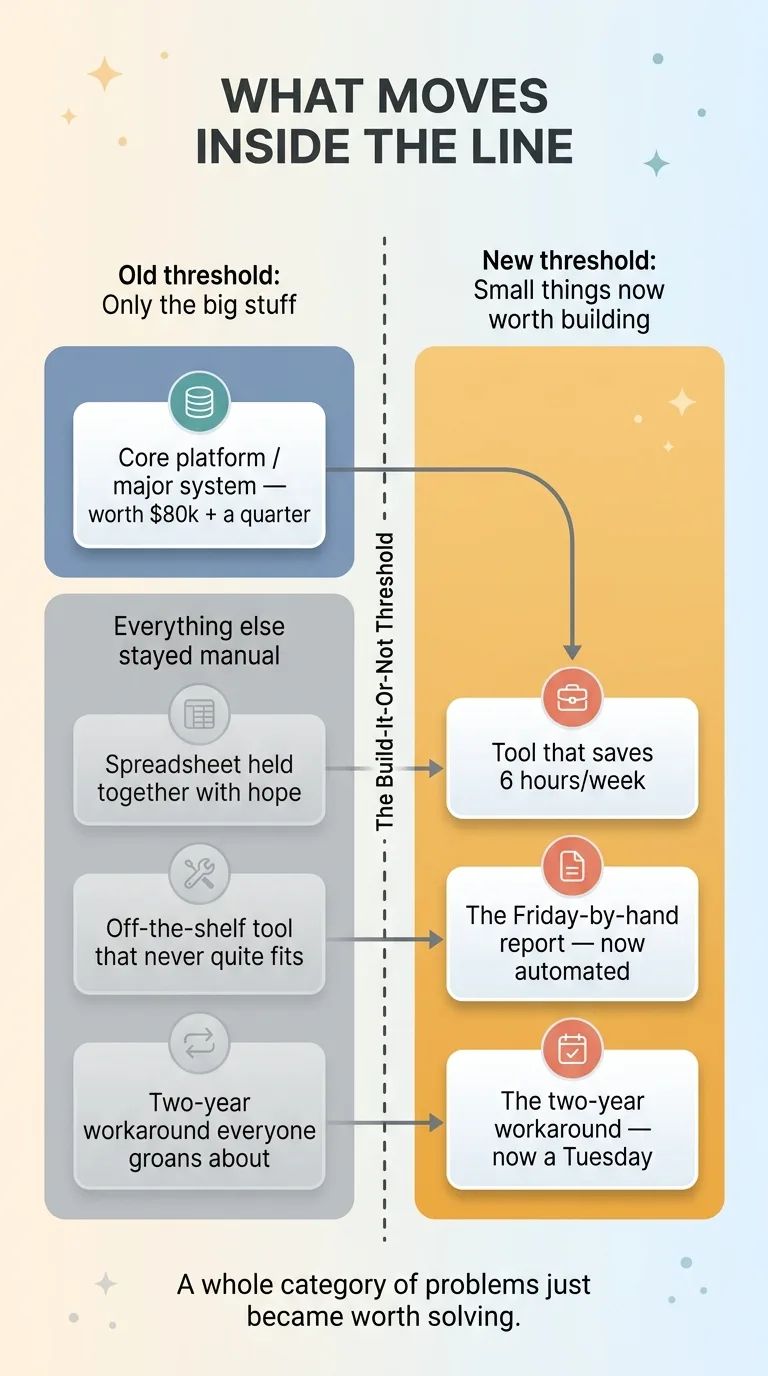 What Becomes Worth Building Now
When custom software takes a quarter and six figures, you only build the things big enough to justify it. The big platform. The core system. Everything smaller stays a manual process, a spreadsheet held together with hope, or an off-the-shelf tool that mostly fits but never quite.
That math forced you to live with workarounds. The tool that would save your ops team six hours a week wasn't worth eighty grand and three months, so you didn't build it. Fair call, at the old prices.
When custom software takes days, the calculus changes entirely.
The internal tool that saves six hours a week is now worth building. The reporting process someone does by hand every Friday is now worth automating. The thing you've been working around for two years, the one that makes everyone groan, is now a Tuesday.
That's the real change. Not just speed, but what becomes worth doing at all. A whole category of problems that used to be too small to justify custom software just moved inside the line.
Get the next build note.
I write up each system I build, including what broke. Subscribe to my newsletter and I'll send you the next one.