The Org Chart That Used to Build One Production App
A few years back, before I started building AI systems for a living, I got a quote to build a marketing site and a small companion app for my DTC fashion brand. The number was $94,000. The timeline was three and a half months.
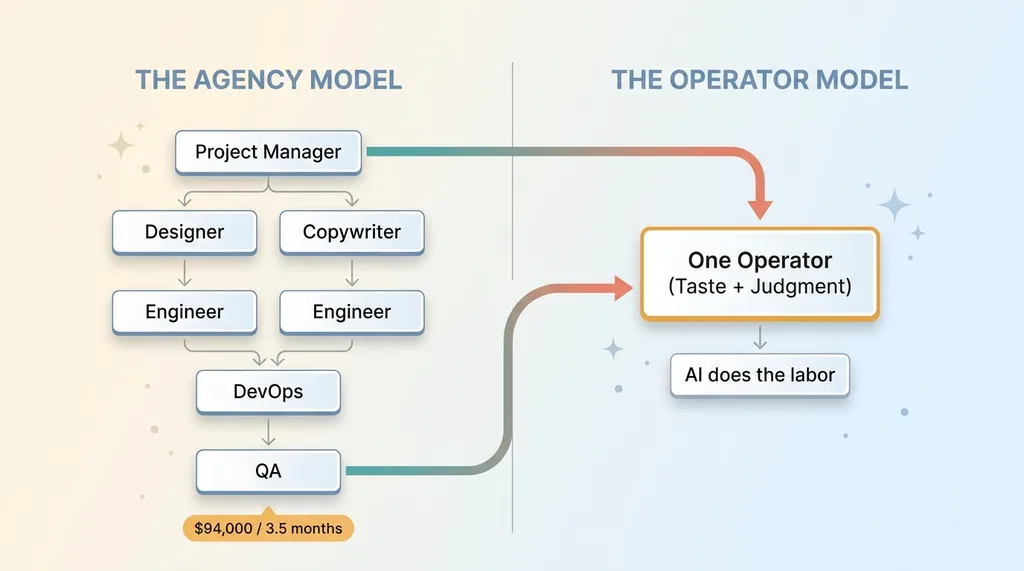 Six-Seat Agency Org Chart Collapsing Into One Operator
Here is the org chart that number was paying for: a project manager to run the calls, a designer to mock it up, two engineers to build it, a DevOps person to deploy it, a QA pass before launch, and a copywriter to fill it with words. Six or seven people, each billing their hours, each waiting on the person upstream of them.
I didn't sign. I built most of it myself over the next few weeks, and that experience is what eventually convinced me you can replace a marketing agency with AI for a large chunk of the work most agencies actually do.
That is the thesis of this article. AI collapses most of those seats into one operator. Not because the operator is a genius, but because AI does the part that used to require a warm body in a chair: the typing, the deploys, the first draft, the repetitive build work.
But I want to be honest up front, because that is what builds trust with a skeptical CEO. AI does not collapse every seat. There is one it cannot touch: judgment and taste. The decision about what is worth building, what good looks like, what to cut. That stays human. That is still my job, and it would be yours.
So the one-person agency model is real, but it is not magic. It is one operator with taste, directing AI to do the labor that used to take six people and a quarter of a year. Let me walk you through which seats actually collapse, and which one doesn't.
Walking the Seats AI Actually Collapses
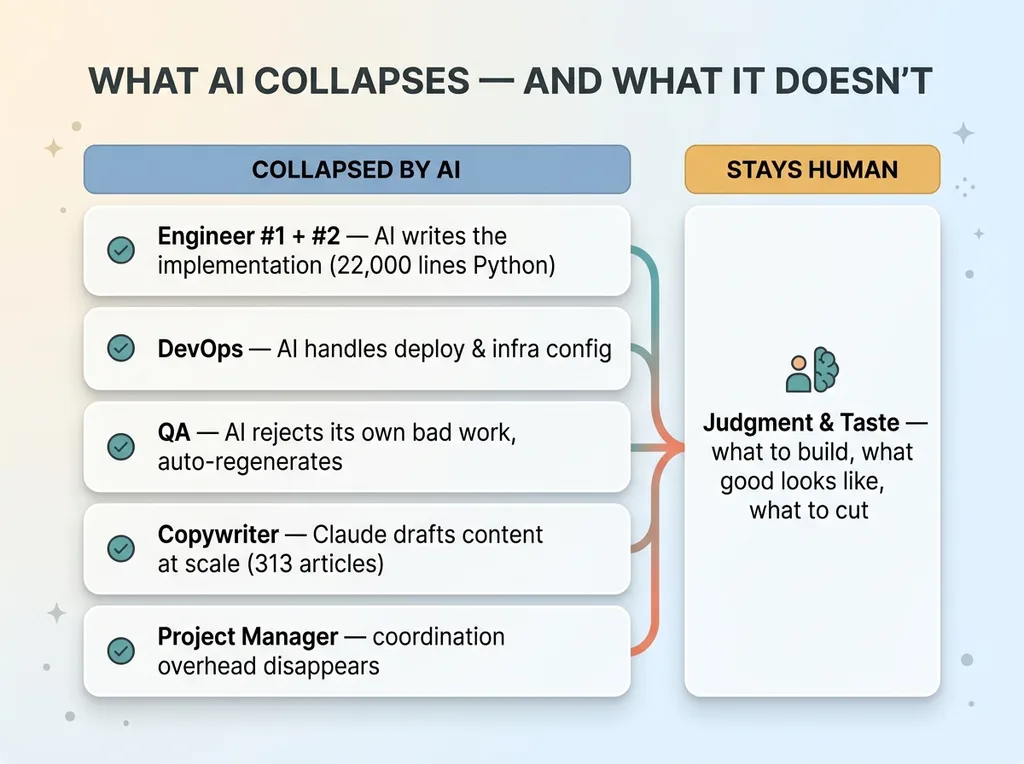 Which Seats Collapse vs Which Seat Stays Human
The two engineers and the DevOps person
This is the biggest one. AI writes the implementation now. I have over 22,000 lines of custom Python running across my own systems, and I did not type most of it by hand. I directed it, reviewed it, corrected it, and shipped it.
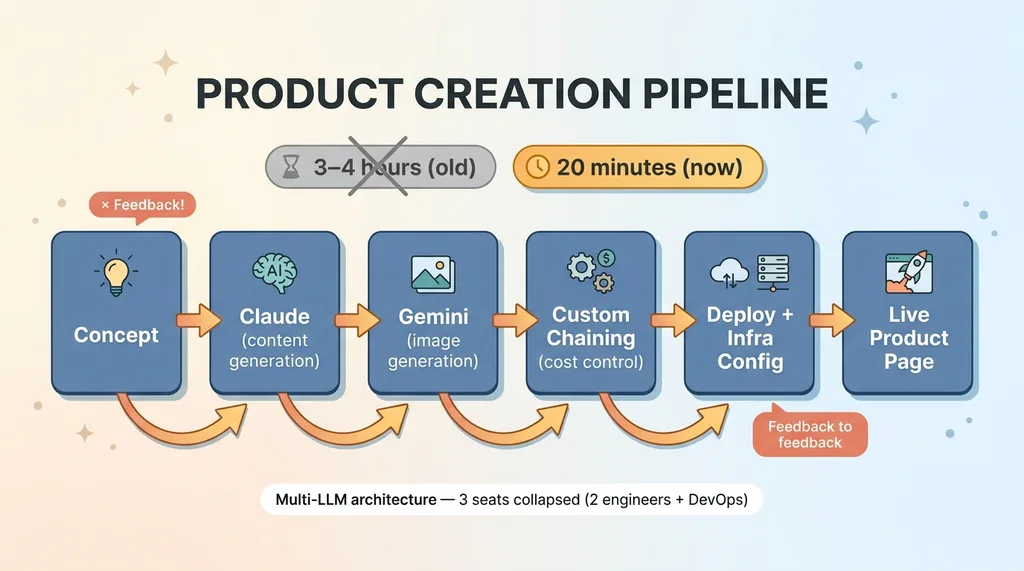 Product Creation Pipeline: 3-4 Hours to 20 Minutes
My product creation pipeline used to take three to four hours to go from concept to a live product page. Now it runs in about 20 minutes. That is a multi-LLM architecture, Claude for the content, Gemini for images, custom chaining to keep costs down, plus the deploy and infra config that a DevOps person used to own.
Three seats, collapsed. The work didn't disappear. It just stopped needing three salaries.
The QA pass
Agencies bill for QA as its own line item. A human clicks through everything before launch and catches the broken stuff.
I replaced that with discipline built into the system itself. I built an AI that rejects its own bad work. If an output fails a quality check, it doesn't ship, it gets regenerated. That is the part most people skip, and it is why a lot of AI projects look impressive in a demo and fall apart in production. Quality control has to be a step, not a hope.
The copywriter and the project manager
Claude handles content at scale. I manage 313 blog articles with AI-assisted SEO, and the first drafts come out clean enough that I am editing, not writing from a blank page.
The project manager is the sneaky one. A PM exists to coordinate six people. When one operator holds the whole picture in their head, the coordination overhead simply stops existing. No status calls. No handoff delays. No requirements getting lost between the designer and the engineer.
That is four more seats, gone. And critically, I am the one doing the building, not just advising on it with strategy slides. The implementation is the product.
The Seat AI Doesn't Touch: Judgment and Taste
Here is where I stop selling.
AI is not a designer's taste. It is not a strategist's judgment. It will happily produce something competent and wrong, and it will do it with total confidence. The operator still has to know the difference.
Real example. My pricing engine dynamically prices 564 products across a four-tier ABC classification. The AI surfaces recommendations all day long. But there are calls it gets wrong, where it wants to discount a product that I know carries the brand, or hold price on something that needs to move. I override it. The AI does the math on 564 products in seconds. I make the dozen decisions that actually matter.
Same with design direction. The AI can generate fifty variations of a layout. It cannot tell me which one feels like my brand. That is taste, and taste is a human signal you cannot prompt your way to.
And cutting features. Half of building well is deciding what not to build. AI will build anything you point it at, which means it will happily build the wrong thing faster than any human team ever could. The judgment about what is worth building is the whole job.
I have written before that AI replaced the typing, not the judgment, and I mean it literally. The skill that makes a one-person agency work is not typing speed. It is taste plus the ability to direct AI toward what good looks like. I am not a one-man agency promising to be six brilliant people. I am one person with judgment, using AI to handle the labor those six people used to do.
Why One Operator Beats the Agency on More Than Cost
Cost is the obvious win. One operator at a fraction of agency rates instead of six or seven people each billing hours. But cost is not the interesting part.
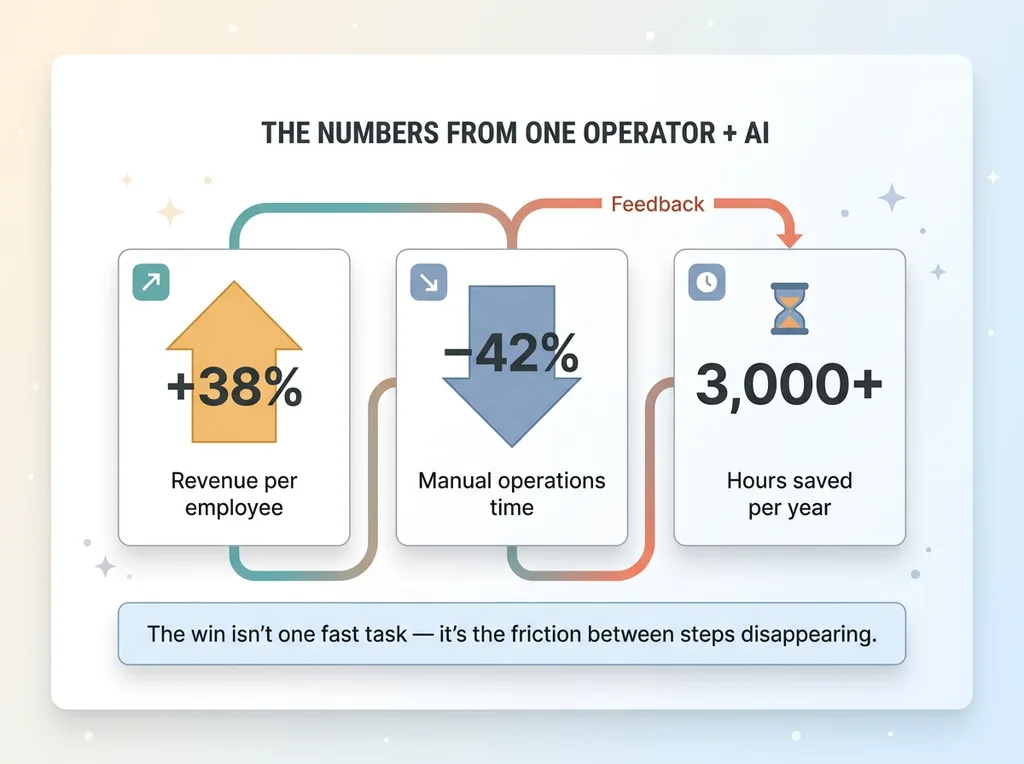 Operator Results Data, Revenue, Time, Hours Saved
The interesting part is the coordination tax. When six people build something together, a huge percentage of the budget goes to people talking to each other. Requirements get written, then misread, then clarified on a call, then half-implemented, then revised. The telephone game loses meaning at every handoff.
When one person holds the whole picture, that tax goes to zero. Decisions that used to wait for a scheduled Thursday call get made in minutes. That is where speed actually compounds, not in any single task being faster, but in the gaps between tasks disappearing.
The numbers from my own brand back this up. After deploying AI across operations, revenue per employee went up 38 percent. Manual operations time dropped 42 percent. I save over 3,000 hours a year. None of that came from one heroic automation. It came from removing the friction between steps.
For a concrete agency-replacing example: I built an AI system with 8 specialist agents running our Meta ads. Eight agents, each handling a slice of what a media buyer does, running without a human media buyer in the seat. That is a function an agency would staff and bill for monthly, running on its own.
This is the part most CEOs underestimate. They think the value is paying one salary instead of six. The real value is that the work moves at the speed of one person's decisions instead of six people's calendars.
The Hostage Problem: Why Most CEOs Got Burned
Let me address the thing you are actually worried about.
You have probably hired an agency before. They came in, set everything up, made it look great, and then you discovered you were a hostage. The accounts were in their name. The code was on their servers. The domain was registered under their account. The analytics, the ad manager, all of it sat behind their login.
The day you tried to leave, you couldn't. Nothing was in your name. Nothing was documented. The knowledge of how the whole thing worked lived in their heads, by design, because that is the business model. Lock-in dressed up as a service.
I have seen this from the inside, cleaning up after it. I have walked into client situations where the previous agency owned the keys to a business the client thought they owned. Untangling it took weeks, and some of it was simply lost.
This is the real reason CEOs are skeptical of anyone offering to replace their marketing agency with AI. They are not skeptical of AI. They are skeptical of handing the keys to one more person who might hold them hostage.
That skepticism is correct. The hostage model is everywhere, and a one-person operator could absolutely run the same playbook, arguably easier, because everything lives in one head instead of six. So the question you should ask is not "can this person build it." It is "what happens to me if I want them gone."
The Handover Checklist: How I Protect the Client Instead of Trapping Them
Here is how I run it, and it is the opposite of the hostage model on purpose.
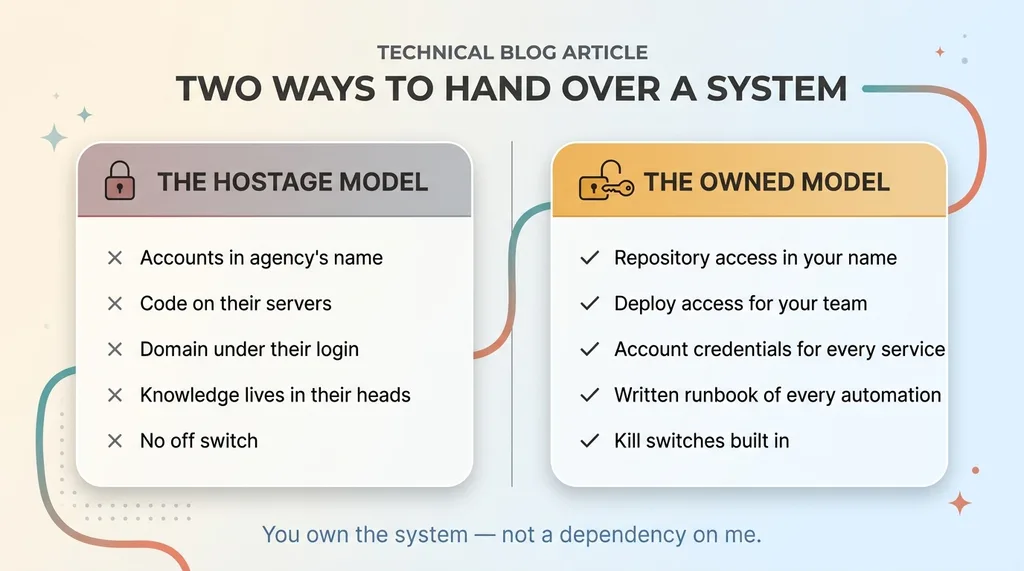 Hostage Model vs Owned-Handover Model
Everything gets built in your accounts, under your ownership, from day one. Your cloud account. Your domain registrar. Your ad manager. Your analytics. I work inside your house, not mine. There is never a moment where the thing I built lives somewhere only I can reach.
Then there is a documented handover, and it is specific:
- Repository access in your name, with the full codebase
- Deploy access so your team or your next hire can ship without me
- Account credentials for every service the system touches
- A written runbook of every automation, what it does, and how to turn it off
That last line matters more than people expect. I build kill switches into systems. If an automation starts doing something you don't like, you need to be able to pull the plug without calling me, without a ticket, without waiting. The off switch is part of the deliverable.
The whole point is that what I hand you is a system you own, not a dependency on me. If I disappeared tomorrow, you would have the code, the access, and the documentation to keep running or hand to anyone else.
A builder who protects the client reads completely differently from a one-man agency hoarding the keys. The agency model wants you locked in because lock-in is the revenue. My model wants you independent because that is the only version of this that earns a referral. I would rather you be able to fire me and choose not to.
When One Operator Is Right, And When It Isn't
I am not going to tell you this fits every situation, because it doesn't.
One operator with AI works when the work is buildable and the decision-making can be centralized. Marketing sites, internal tools, automations, pricing systems, content pipelines, ad operations. Things with a clear definition of done that one person with taste can direct AI to produce.
It is a weaker fit in two cases. First, when you genuinely need a large creative team producing high volume of human-taste-dependent work, a brand campaign with a hundred original assets, for example. AI helps there, but the bottleneck is still human judgment, and one person becomes the constraint.
Second, when your org politics require many cooks. If a project needs five stakeholders to feel ownership, a single operator will get ground down by the approval process no matter how good the work is.
That is really the build vs. buy vs. hire decision, and it is worth thinking through honestly before you commit to anything. Buy when it is commodity. Hire when you need ongoing human capacity at volume. Build with an operator when the work is specific, buildable, and you want to own the result.
If you have been burned before, here is my actual offer. We scope one thing. I build it in your accounts. You own it from day one, documentation and off switches included. If it works, we do the next thing. If it doesn't, you keep what we built and you walk, no keys held hostage.
Get the next build note.
I write up each system I build, including what broke. Subscribe to my newsletter and I'll send you the next one.