The Problem: Your Pages Got Long One Edit at a Time
I was clicking through the inner pages of a DTC brand I run in San Diego a few weeks ago, reading them the way a stranger would. And I cringed. The pages read as padded. Wishy-washy. The actual message was in there somewhere, buried under three sentences of reassurance that all said the same thing.
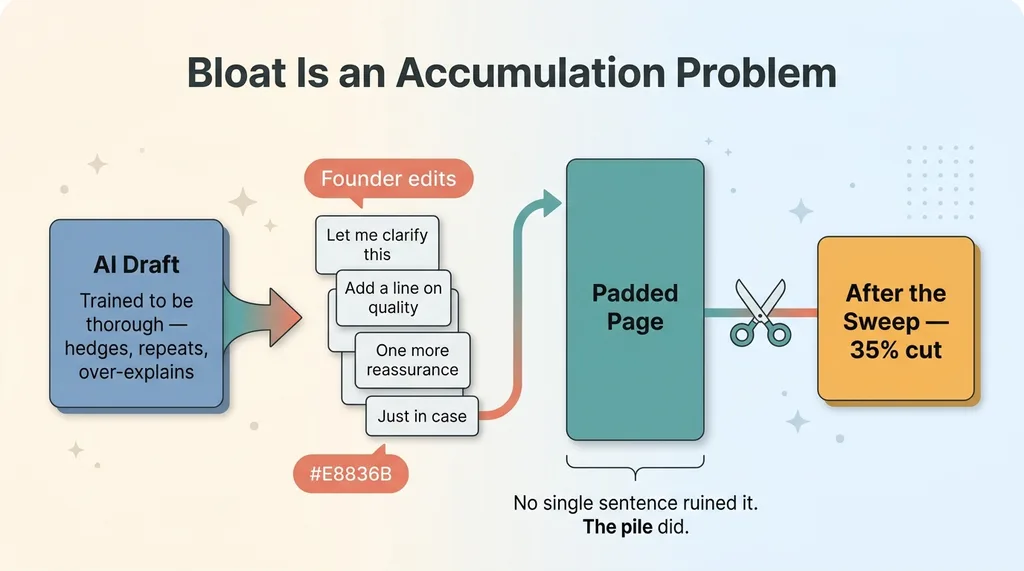 How Pages Get Bloated: The Accumulation Problem
Cutting website copy length wasn't on my to-do list that morning. But once I saw it, I couldn't unsee it. So I figured out how it happened. Turns out there are two causes, and they compound.
Why AI writes long
AI is trained to be thorough and safe. Ask it to write a landing page section and it hedges, repeats, and over-explains by default. It adds "in many cases" to protect itself. It restates the benefit a second way in case the first way wasn't clear. None of this is a bug. It's the model doing exactly what it was rewarded for in training: covering the base, leaving nothing out.
The problem is that thoroughness reads as insecurity on a marketing page.
Why founders write long
Then the human gets involved. Every revision, the founder adds one reassuring sentence because they're terrified the reader won't get it. "Let me just clarify this." "Let me add a line about quality." Each edit feels reasonable in the moment. None of them is wrong on its own.
Stack a dozen revisions on top of an AI draft that was already padded, and you get bloat. The AI drafts fast but writes long, and AI replaced the typing, not the thinking, the judgment of what to keep is still a human job.
Here's the reframe that mattered to me: bloat is not a writing problem. It's an accumulation problem. No single sentence ruined the page. The pile of them did.
What I Actually Did: A Word-Count Sweep, Not a Rewrite
I want to be precise about the constraint, because the constraint is the whole trick.
This was not a creative rewrite. I did not sit down to "improve" the pages or "sharpen the brand voice" or any of that. I gave myself one job: cut word count without losing meaning. A single deliberate editorial pass, page by page, across the inner marketing pages of the site.
I cut roughly 35% off them.
The target felt arbitrary. Cut a third. Why a third? No deep reason. But that's exactly why it works. An arbitrary-feeling number forces every sentence to defend itself. When you have to hit a word count, you stop asking "is this sentence fine?" (everything is fine) and start asking "does this sentence earn its spot?" Most don't.
This is why a pure word-count constraint beats "make it better" as an instruction. Vague goals produce vague results. "Make this page better" gives you nothing to act on. A number gives you decisions. Every sentence either survives the cut or it doesn't, and you're forced to choose.
The same logic applies whether a human or an AI writes the first draft. If anything, AI drafts need the sweep more, because they start longer. I run this pass the same way regardless of who typed it: set the target, go line by line, and make each sentence justify its existence against a hard number.
It's repeatable. That's the part I care about. This isn't a flash of inspiration you get once. It's a process you can run on any page, any time, and get a sharper result every pass.
What to Cut First: The Five Patterns That Bloat Every Page
When I went through page by page, the same five patterns showed up over and over. Learn to spot these and you can run the sweep yourself today.
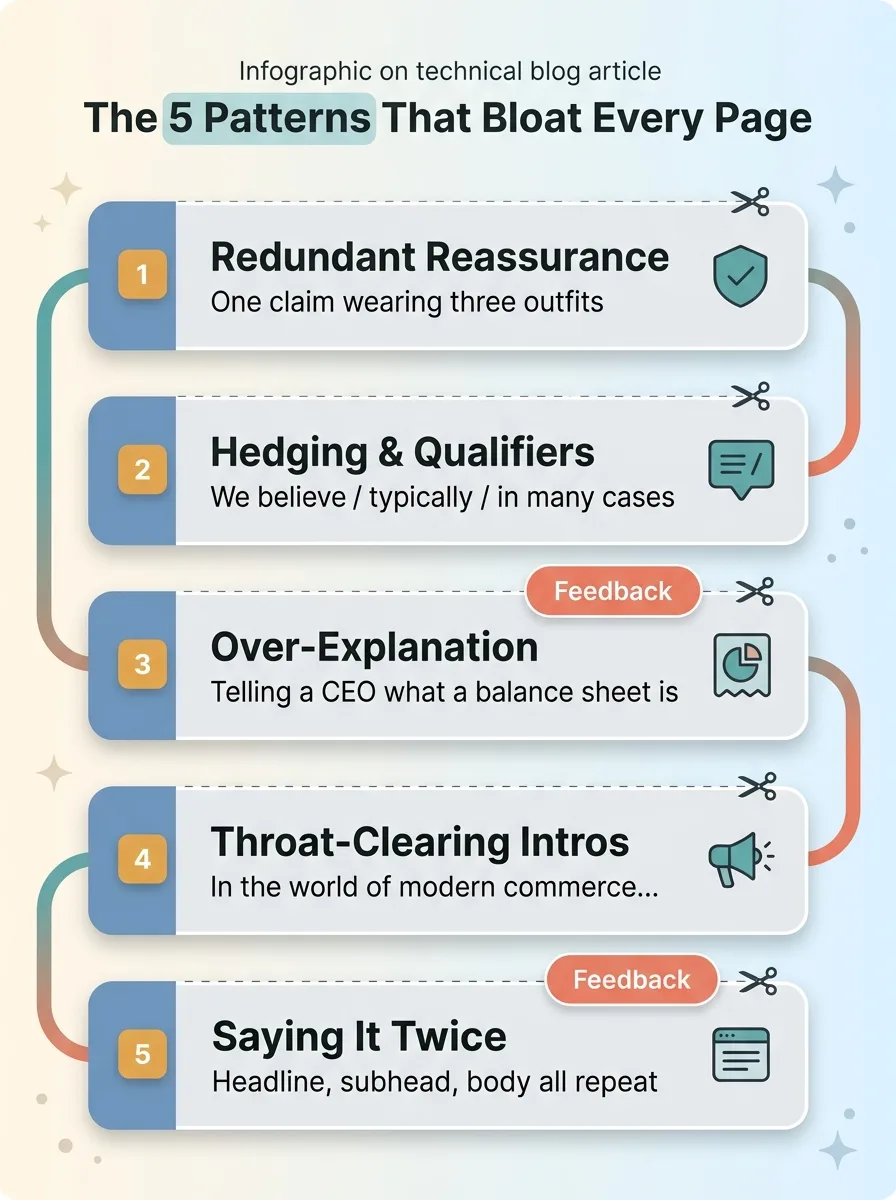 The Five Bloat Patterns to Cut First
Redundant reassurance
This is the third sentence that promises the same thing as the first. You say the product is reliable. Then you say customers trust it. Then you say it's built to last. That's one claim wearing three outfits.
The signal: if you can delete a sentence and the reader loses no new information, just loses comfort, cut it.
Hedging and qualifiers
"We believe." "In many cases." "Typically." "Often." These words feel responsible. They actually weaken the claim they're attached to. "We believe this saves you time" is weaker than "this saves you time."
The signal: scan for soft qualifiers. Each one is a place where you flinched. Delete it and see if the sentence is still true. Usually it is, and now it's stronger.
Over-explanation
This is explaining something your audience already knows. Telling a CEO what a balance sheet is. Telling a runner what a stride is. You're talking down to the exact person you want to convince.
The signal: if your reader would nod and think "yes, obviously" at a sentence, they don't need it.
Throat-clearing intros
The warm-up sentence before the real first sentence. "In the world of modern commerce, businesses face many challenges." That's a stretch. The real opening is the sentence after it.
The signal: look at the first sentence of every section. If it's setup rather than substance, delete it and start with sentence two.
Saying it twice
The same idea in the headline, then again in the subhead, then a third time in the body. The reader gets it once. The repetition just slows them down.
The signal: read the headline, subhead, and first body line as a unit. If they all carry the same idea, keep the strongest and cut the rest.
These five account for almost all the fat. The 35% I cut was mostly this, not clever rewriting. It was deletion.
Why Shorter Copy Converts the Skeptical, Time-Starved Reader
Here's the conversion logic, because tightening copy isn't a vanity exercise.
The person reading your marketing page is busy and skeptical. They've been burned before. They're scanning, not reading, looking for the one reason to keep going. Every padded sentence is a place for them to bounce.
Long copy signals insecurity. It reads like a salesperson who won't stop talking, who keeps adding reasons because they don't trust the first one landed. Tight copy reads as confidence. It says: here's the thing, I don't need to oversell it.
This is the core of conversion copywriting. The hedging language doesn't just waste space. It quantitatively undermines the claim it surrounds. "We believe our process typically delivers strong results in most cases" tells the skeptical reader you don't believe it either. "Our process cuts your delivery time in half" gives them something to react to.
Less is more web copy isn't a style preference. It's respect for the reader's time and a signal of your own conviction. When you remove the padding, what's left has to be true and clear, and the reader feels that.
Now the honest limit, because I don't want you cutting blind. Shorter is not always better. You can absolutely cut past the point of clarity, strip out a sentence that was actually carrying information, and leave the reader confused. The goal is not minimum words. The goal is maximum meaning per word.
That distinction matters. A sentence that adds information stays, even if it's long. A sentence that adds only reassurance goes, even if it's short. Word count is the forcing function, not the finish line.
The Exception: Where Length Is Actually Substance
I want to be clear about what I did not touch, because the rule is page-type-dependent and getting this wrong does real damage.
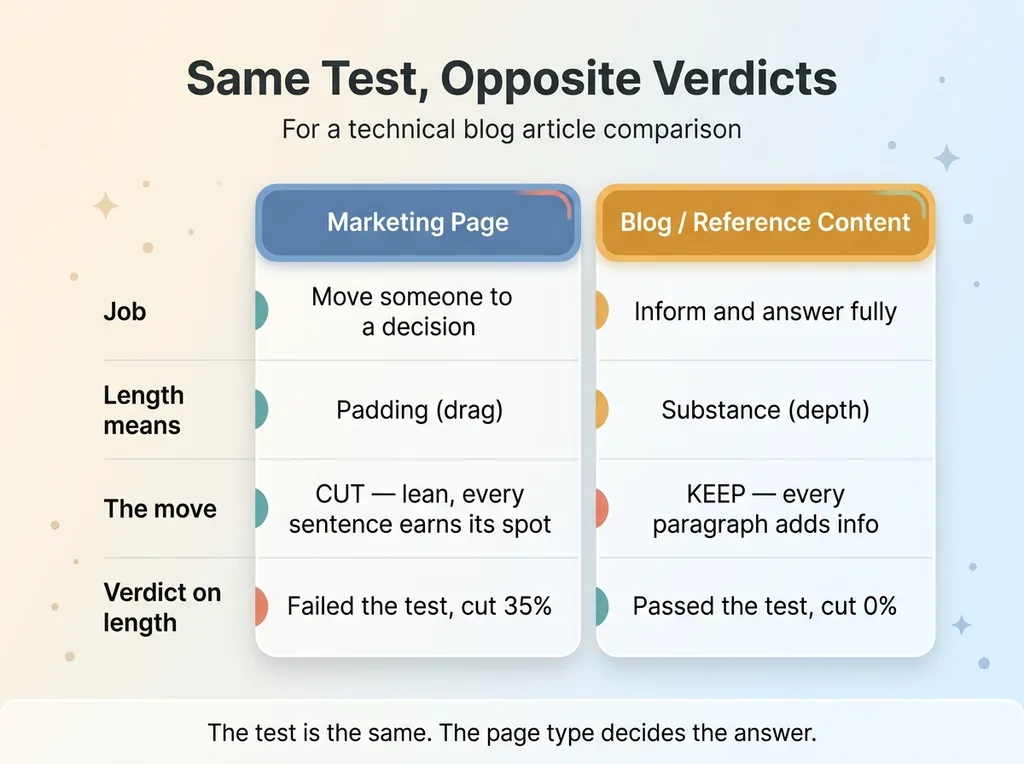 Marketing Page vs Blog Article: When to Cut, When to Keep
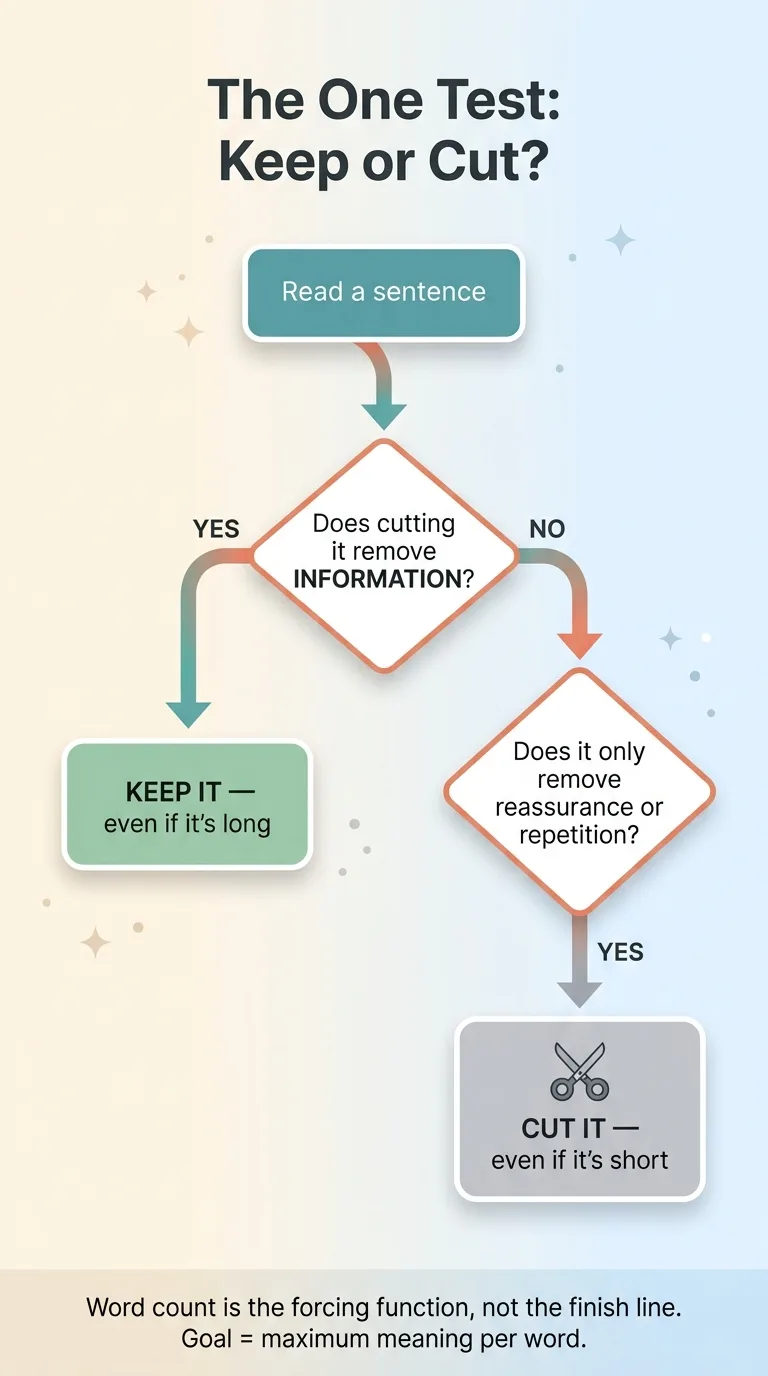 Keep-or-Cut Decision Test
I did not cut the blog articles. Not one.
On a blog article, length is the substance. Depth is the product. The reader who lands on a 2,000-word piece came looking for detail, and a short answer would fail them. I've overhauled hundreds of blog articles with AI, and the move there was the opposite of cutting. It was making sure every paragraph earned its place by adding information.
The distinction is about what the page is for.
A marketing page exists to move someone to a decision. Its job is to get a busy person to the next step with as little friction as possible. So it should be lean. Every extra sentence is drag.
Reference and education content has a different job. It exists to inform, to be thorough, to answer the question fully. It earns its length when every paragraph adds something the reader didn't have before.
So here's the test I use, and it works on any page:
If cutting a sentence removes information, keep it. If cutting it only removes reassurance or repetition, cut it.
That single test tells you whether you're on a page that should be lean or a page that's allowed to run long. The blog articles passed the test because their length was information. The marketing pages failed it because their length was padding. Same test, opposite verdicts, and that's the point.
The IQ-100 Rule: Sound Smart, Read Simple
The word-count sweep pairs with a second discipline, and I run them together now on every marketing page. I call it the IQ-100 rule: sound intelligent, read simple.
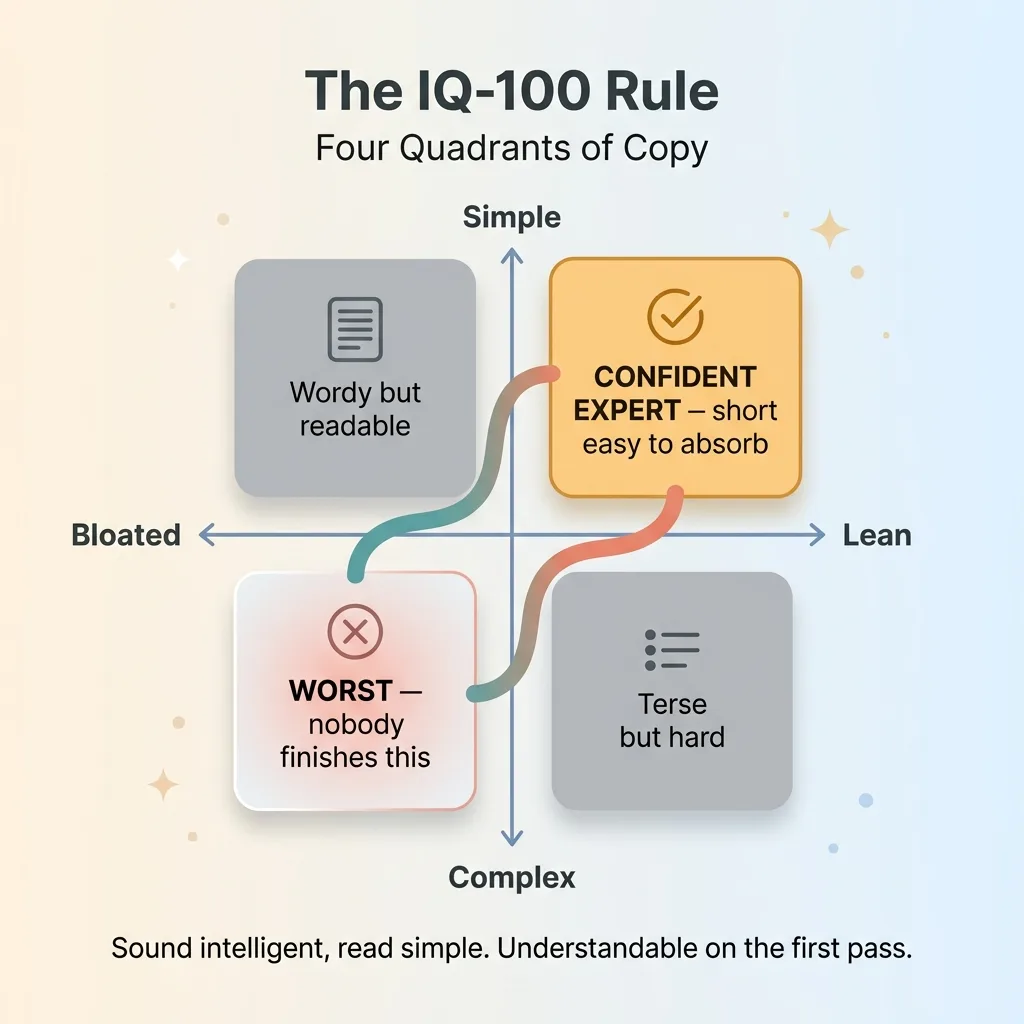 The IQ-100 Rule: Four Quadrants of Copy
The goal is to come across as the expert while writing at a level anyone can read on the first pass. Those two things feel like they're in tension. They're not. They reinforce each other.
Big words and dense sentences feel like effort, not authority. When a reader hits a complicated sentence, they don't think "this person is smart." They think "I have to slow down." And the reader who has to re-read a sentence is a reader you're losing. Every re-read is a chance to give up.
The practical guidance is boring and it works:
- Short sentences.
- Common words over impressive ones.
- One idea per sentence.
- The whole message understandable on the first pass.
That last one is the standard. Not "understandable if they concentrate." Understandable the first time, at a glance, by someone reading on their phone between meetings.
Here's the contrast that made it click for me. Bloat plus complexity is the worst possible combination. Long and hard to read. That's a page nobody finishes. Lean plus simple is the opposite. Short and easy to absorb. That reads as a confident expert who knows their stuff well enough to explain it plainly.
The smartest people I know explain hard things simply. The insecure ones hide behind jargon. Your reader knows the difference instinctively, even if they can't name it.
This is the bar I now hold every marketing page to. Cut to meaning-per-word with the sweep, then make what's left readable on the first pass. Lean and simple.
Run the Pass on Your Own Site This Week
Here's something you can do today, no tools required.
Pick one inner marketing page. Not the homepage, not a blog post. An about page, a service page, a feature page. Set a target to cut a third. Then go sentence by sentence and apply the five patterns: redundant reassurance, hedging, over-explanation, throat-clearing intros, and saying it twice.
You'll feel the page get sharper as you go. The message that was buried will surface. It's a strangely satisfying process once you start.
This is part of how I run a whole brand on AI systems. The pass scales across an entire site, and the split is exactly the one I keep coming back to: AI handles the typing, a human sets the standard for what survives the cut. The editorial judgment of what's information versus what's padding is not something you hand to a model. That's the part that takes a person who knows the business.
Get the next build note.
I write up each system I build, including what broke. Subscribe to my newsletter and I'll send you the next one.