AI Strategy vs Execution: The $99 Call AI Couldn't Make
AI strategy vs execution: the real bottleneck isn't engineering capacity, it's judgment. Here's a pricing decision AI explicitly could not make for me.
By Mike Hodgen
The Build Took 20 Minutes. The Decision Took Two Weeks.
A few months back I was building a membership product for a telehealth membership service. The idea was simple enough: a recurring subscription that gave members ongoing access to care. Two pricing models were on the table, both with tiered structures. A basic tier, a premium tier, the usual ladder.
Here's the thing. The engineering to ship either model was trivial. An afternoon, maybe less. I'd built the signup flow, the billing logic, and the database schema in the time it takes to drink a coffee. AI handled the typing. The code was never the problem.
What stalled the project for two weeks was a single judgment call AI could not make for me. Not a hard technical call. A business one. And no matter how I prompted it, the model couldn't carry the weight of that decision, because the decision lived in a place AI doesn't have access to.
This is the whole story of AI strategy vs execution in one project. When you build AI-first, code stops being the bottleneck. Strategy becomes the bottleneck. The constraint that nearly sank this product wasn't a missing feature or a bug. It was a question about what we should build, and whether one of the obvious options was actually a trap.
I write about this a lot, that AI replaced the typing, not the strategy. This project was the clearest example I've hit. AI did real, useful work here. It also walked me straight toward a decision that would have been a mistake, and it would have done it with total confidence.
What follows is a concrete example of where AI genuinely helped, and where it hit a wall it could not cross on its own. The wall is the interesting part.
What AI Actually Did Well Here
Let me be honest about where AI carried real weight, because it carried a lot.
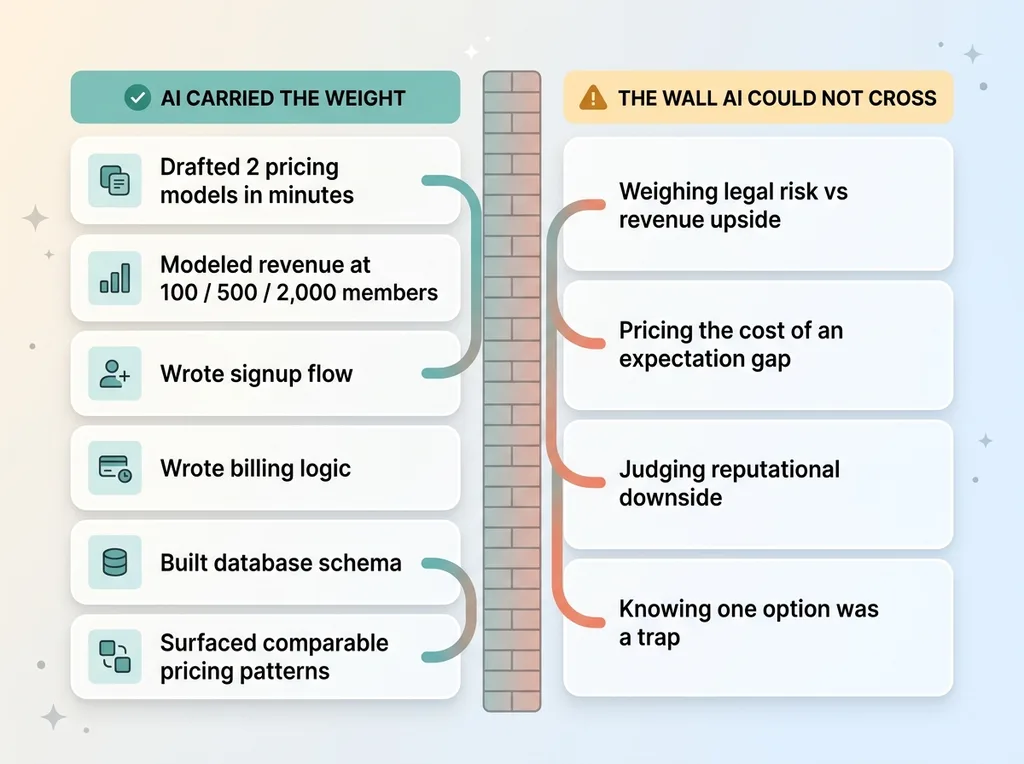 What AI did well vs the wall it could not cross
It drafted both pricing models in minutes. Not vague descriptions. Actual structures with tiers, price points, and feature breakdowns. Then it modeled the revenue math for tiered versus flat structures. Given a few assumptions about conversion and churn, it ran the scenarios and showed me what each model looked like at 100 members, 500 members, 2,000 members.
It wrote the membership signup flow. It wrote the billing logic against the payment processor. It built the database schema for members, plans, and subscription states. It surfaced comparable pricing patterns from similar subscription businesses so I wasn't pricing in a vacuum.
This is the part people get excited about, and they're right to. AI is genuinely fast and competent at execution and at running scenarios. I've seen it across my own work over and over.
My DTC fashion brand runs a pricing engine that dynamically prices 564+ products using a 4-tier ABC classification. That system makes pricing decisions while I sleep, and it works because the rules are clear and the logic is explicit. I wrote about exactly how that runs in AI manages 500+ product prices while I sleep. When the constraints are well-defined, AI pricing automation is fantastic. It's faster and more consistent than I'd ever be by hand.
So on the telehealth membership, none of the execution scared me. The scenario modeling was solid. The code was clean. If the decision had been "which of these two well-formed models makes more money," AI would have answered it cleanly and been right.
That's not where it failed. It failed on a question that looked like a pricing question but wasn't one.
The Constraint AI Could Not Reason About On Its Own
Here's the constraint, plainly.
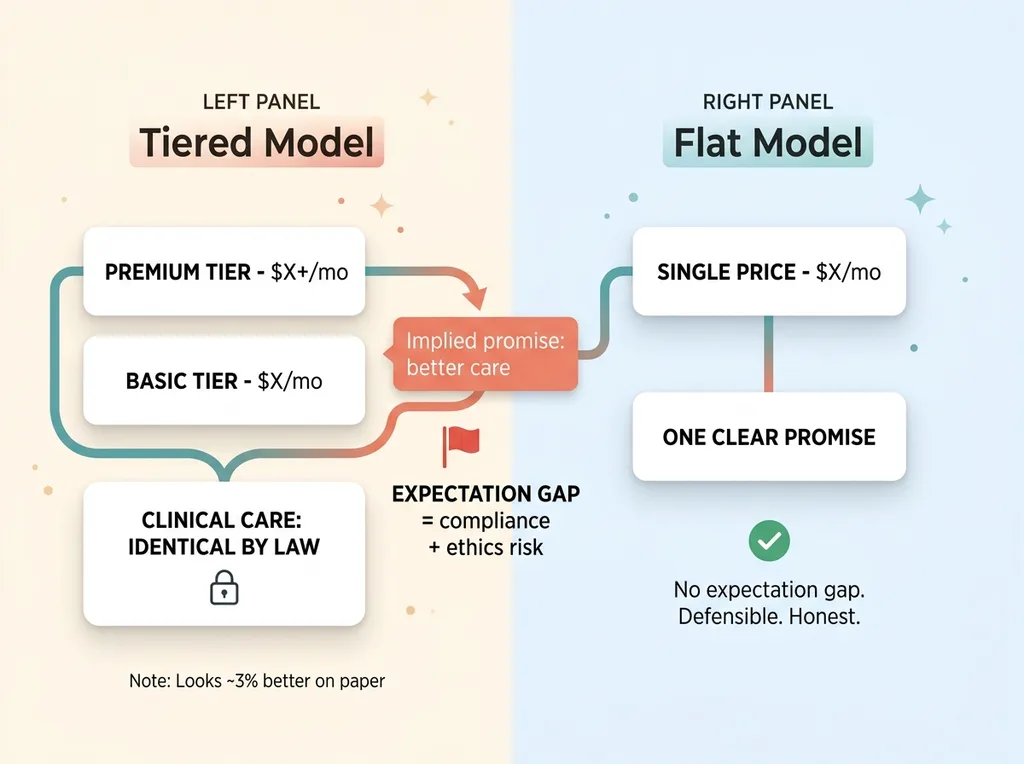 The tiered vs flat pricing trap in a regulated context
The membership had a regulated healthcare service on the backend. Clinical care, delivered under rules that don't bend for marketing convenience. And this is where the tiered pricing idea fell apart.
A higher pricing tier could raise the fee. Fine. But nothing about the actual care delivered could legally differ between tiers. The clinical service a "premium" member received had to be identical to what a "basic" member received. Same standard, same protocols, same care. That's not a preference. That's the law.
So a tiered price structure would imply something we could not deliver and legally must not deliver: a difference in care. Charging more for the same clinical service, dressed up as a "premium tier," creates an expectation gap. The premium member thinks they're buying better care. They're not. They can't be. That gap is a compliance problem and an ethics problem stacked on top of each other.
Now, here's the part that matters for anyone thinking about ai judgment limitations.
When I gave AI the regulatory context, it could state this constraint back to me. It understood it once I'd put it on the table. But it would have happily built the tiered model if I hadn't carried that context in. Nothing in the pricing math flagged it. Nothing in the revenue scenarios cared. The tiered version looked slightly better on paper, and AI optimized toward the better paper number, because that's what I'd pointed it at.
It had no way to weigh the reputational and legal downside against the revenue upside. It couldn't price the risk of an expectation gap, a regulator's attention, or a member who felt misled. Those aren't variables in a spreadsheet. They're judgments about consequence and context.
That weighing was the actual decision. The pricing model was just where the decision happened to surface. AI gave me two clean options and no way to know that one of them was a liability wearing a revenue model's clothing.
Why This Is the Pattern, Not the Exception
This wasn't a one-off. It's the shape of almost every AI project I run.
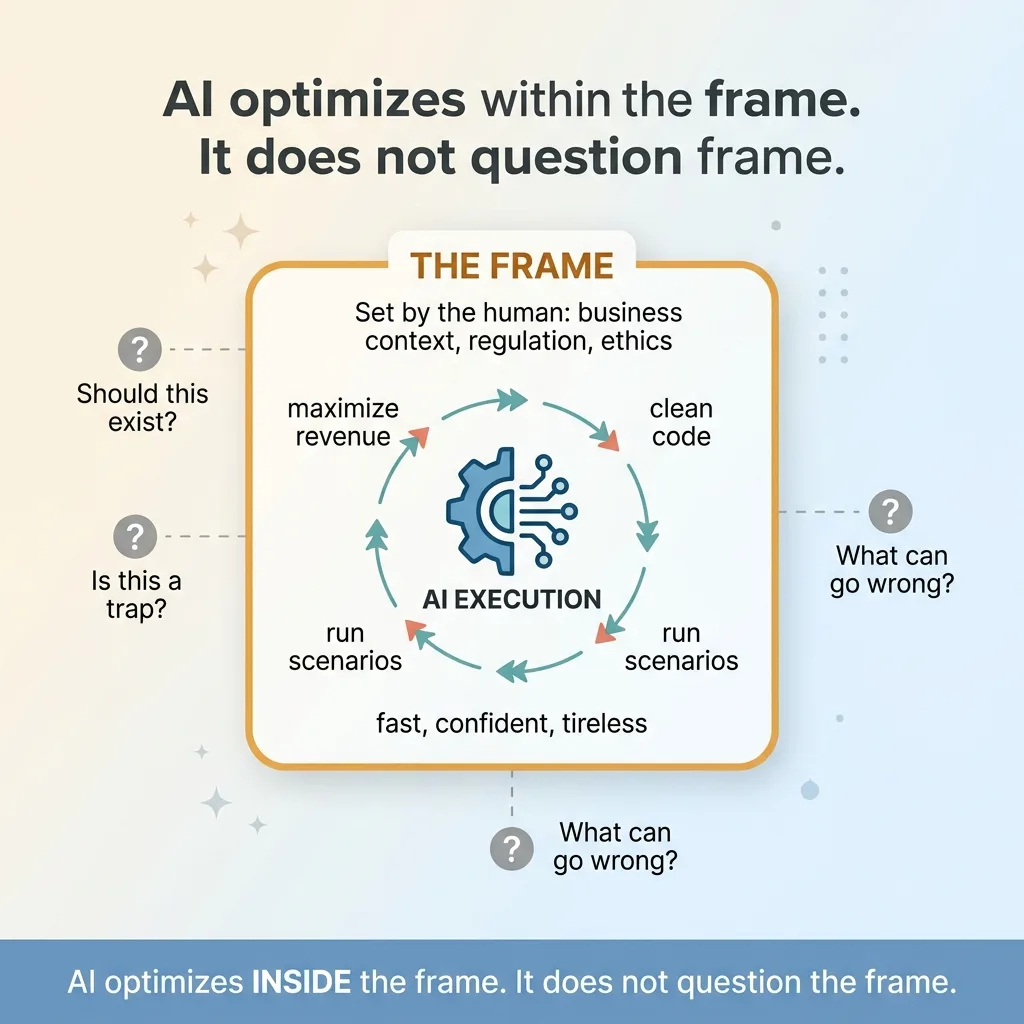 AI optimizes within the frame but cannot question the frame
The bottleneck is never engineering capacity. I can build fast. AI makes me build faster. The bottleneck is the judgment about what should be built and what should not. That's the through-line in why most AI projects fail, and it's the part that gets ignored because it's less fun than shipping.
Here's the mechanism. AI optimizes within the frame you give it. It does not question the frame. If you tell it to maximize revenue across two pricing models, it will do exactly that, brilliantly, and it will never stop to ask whether one of those models implies a promise you can't keep. The frame is your job. AI lives inside it.
And it will cheerfully execute a strategically wrong decision faster and cleaner than any human team could. That's the uncomfortable truth. A junior employee might hesitate. They might say "wait, doesn't this seem off?" AI doesn't hesitate. It builds. With confidence, with clean code, with good documentation, the wrong thing.
This is exactly why unsupervised AI on consequential decisions is dangerous. Not because AI is reckless, but because it's compliant. It does what you point it at, with full speed and zero friction. The friction, the pause, the "should we even do this," has to come from a human who understands the business context.
Velocity without judgment just means making mistakes faster. I've watched teams celebrate that they shipped an AI feature in two days, when the real question was whether that feature should exist at all. Shipping the wrong thing fast is not a win. It's a faster path to a problem.
The whole point of ai strategy vs execution is that we solved execution. Execution is cheap now. Strategy, the judgment about direction and constraint, is where the actual value moved. And most teams are still staffing it like it's the easy part.
The Decision I Made (And Why)
I scrapped both tiered models. I shipped a single flat price.
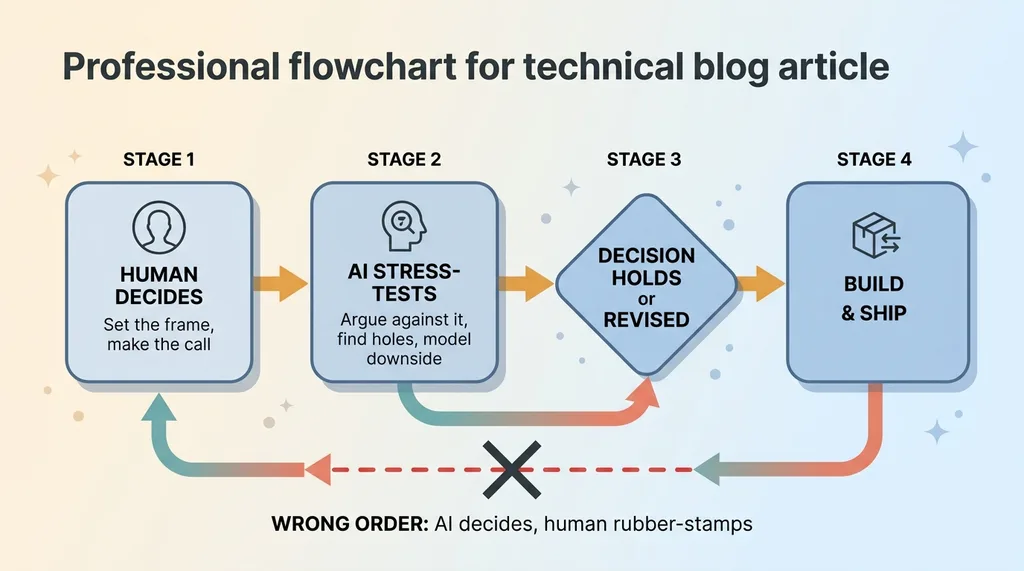 Human decides, AI stress-tests workflow
The reasoning was straightforward once I stepped out of the spreadsheet. One price meant one clear promise. No implied difference in care. No compliance gap to defend. No member ever wondering whether the people on the higher tier were getting something they weren't. The signup flow got simpler. The whole product got easier to explain, which in a regulated space is worth more than it sounds.
On paper, the tiered model looked slightly better. A few percentage points of projected revenue. AI had shown me that, accurately. But the tiered version carried risk that AI could not price into the equation, because that risk wasn't a number. It was a judgment about what could go wrong, how badly, and how hard it would be to recover from.
A flat price is honest. It's defensible. If a regulator or a customer ever asks "what does this fee buy," the answer is one sentence, and it's true. That clarity was worth more than the marginal revenue the tiered model promised.
Here's the part I want to underline, because it's the right order of operations. I made the decision first. Then I used AI to pressure-test it. I had AI argue against the flat price. Find the holes. Stress the assumptions. Model the downside. It did that well, and the decision held.
Human decides. AI stress-tests. Not the other way around. When you let AI make the call and then rubber-stamp it, you've handed the judgment to the thing that can't carry it. When you make the call and let AI attack it, you get a better decision and a faster validation. That's the workflow.
What This Means If You're Afraid AI Will Make Bad Calls
If you're a CEO worried that AI is going to start making consequential decisions and make them badly, I want to reframe the fear, because it's pointed in the wrong direction.
AI isn't a decision-maker. It's a force multiplier on judgment. The risk was never that AI is too smart and will outthink you. The risk is that it's confidently fast inside whatever boundaries it's given. It doesn't get tired, it doesn't second-guess, and it doesn't know what it doesn't know. Point it at the wrong target and it'll hit the bullseye every time.
So the safeguard isn't smarter AI. It's a human who knows where the boundaries are and builds the kill-switches before anything goes live. I'm specific about this in where I pull the plug on AI. There are places I let AI run fully autonomous, and places I will never let it make the final call. Knowing the difference is most of the job.
The real question for a CEO isn't "will AI make a bad call." It's "who is setting the constraints AI operates inside." That's the whole thing. The telehealth membership didn't need smarter AI. It needed someone who knew the regulatory frame and could see that one of the obvious options was a trap.
That's a role, not a tool. You don't buy your way out of this with a better model. You need a person who lives in both the business context and the build, who can see the trap before the code gets written. The tool is downstream of the judgment, always.
The Strategy Is Still the Job
AI collapsed the cost of building to near zero. That should make strategy more valuable, not less.
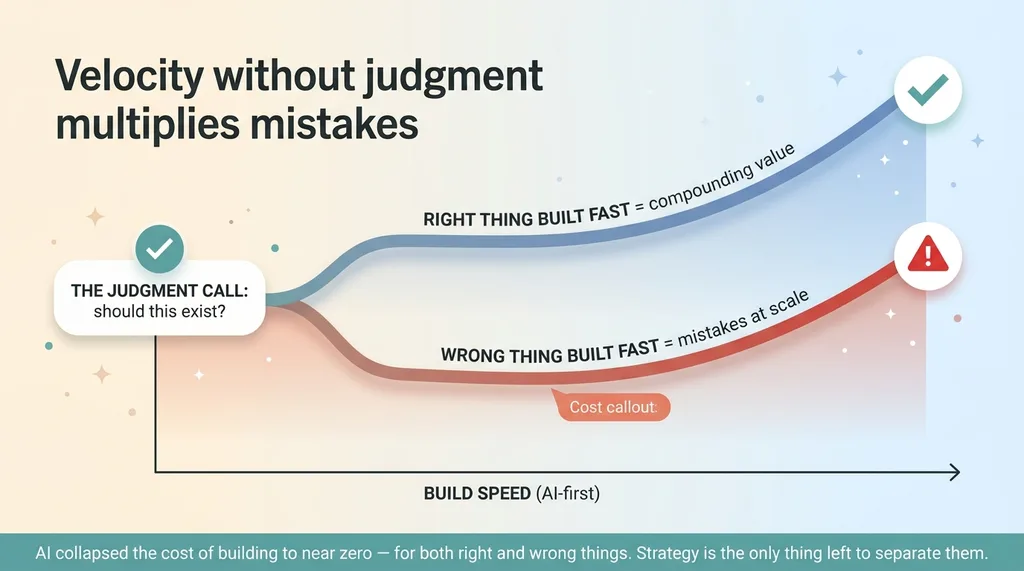 Velocity without judgment multiplies mistakes
Think about why. The cost of building the wrong thing is now also near zero, which means you can build wrong things fast, cleanly, and at scale. The constraint that used to slow down bad ideas, the sheer effort of building them, is gone. Nothing stands between a strategically wrong decision and a shipped product except the judgment to not build it.
That's the whole game now. The differentiator isn't who can build. Everyone can build. The differentiator is someone who can build the system and also make the call about whether it should exist in the first place.
That's what I do as a Chief AI Officer. I'm in the code and in the strategy. I'll ship the billing logic in an afternoon, and I'll also be the one who says "this tiered model is a compliance trap, we're going flat." Those two things in one person is the point. Separate them and you get fast execution of bad decisions, or good decisions that never ship.
If your team can build but keeps building the wrong things, or if you've got a decision stalled because nobody's sure what should exist, that's the gap I fill. If that sounds like your situation, you can work with me directly.
Want to explore what AI could do for your business?
Book a free 30-minute strategy call. No pitch deck, no sales team, just a real conversation about your operations and where AI actually fits.
Get AI insights for business leaders
Practical AI strategy from someone who built the systems — not just studied them. No spam, no fluff.
Hodgen.AI
Ready to automate your growth?
Book a free 30-minute strategy call with Hodgen.AI.
Book a Strategy Call