AI Content Planning From Your First-Party Data
How I built an AI content planner that turns search data, client emails, and past episodes into a weekly radio show rundown that never repeats itself.
By Mike Hodgen
Why Most AI Content Is Generic (And Why Yours Doesn't Have to Be)
A financial advisory firm I worked with hosts a weekly radio show. An hour, live, every week. The catch: the hosts are advisors, not producers. They know retirement planning cold. They do not know how to fill an hour of airtime that does not sound like the last forty episodes.
So every week, they stared at a blank page.
The blank-page problem
The instinct, when you are staring at nothing, is to open ChatGPT and type "radio show topics about retirement." You get a list. It looks fine. It is also the exact same list your three biggest competitors got when they typed the same thing.
This is the trap with AI content planning. The model gives you the average of everything it has ever read about your topic. Average is the enemy of relevant.
Generic in, generic out
Here is the part most people miss. The AI does not know anything about your audience. It does not know what your listeners type into Google to find you. It does not know what your clients are emailing you about this month. It has no idea what you already covered three weeks ago.
The fix is not a cleverer prompt. I want to be blunt about that, because the entire prompt-engineering industry is built on the opposite claim. You can polish a prompt for an hour and still get generic output, because the problem was never the prompt. It was the inputs.
AI content planning from first-party data is the difference between content that sounds like every other firm and content that sounds like you talking to your actual clients. The model becomes useful the moment you feed it signals only you have.
For this firm, I wired in four of them. Let me walk through each one.
The Four First-Party Signals That Make Content Relevant
These are not exotic. Every business reading this already owns all four. They just never connect them to their content.
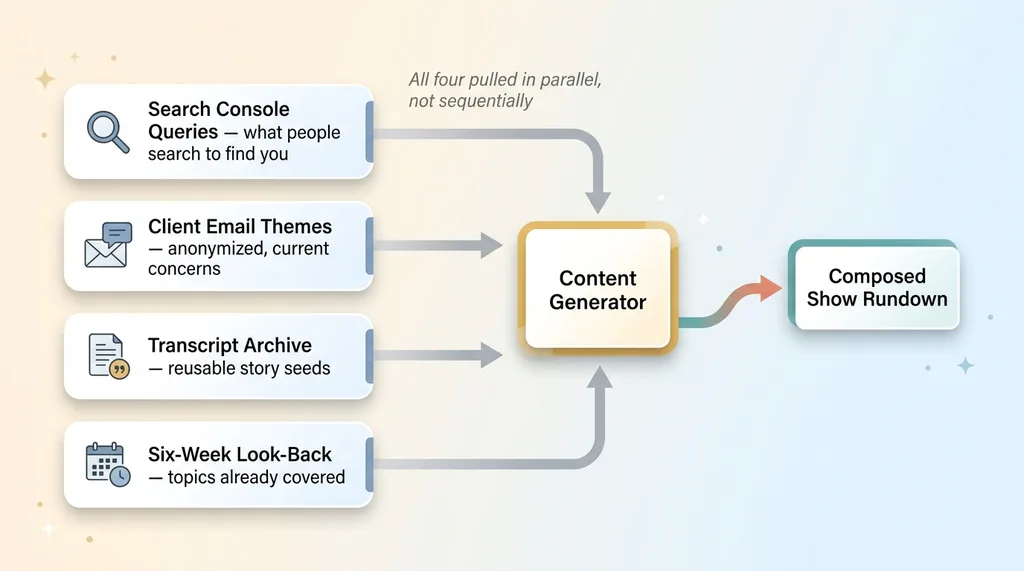 The Four First-Party Signals Feeding the Generator in Parallel
The important design detail: these run in parallel, not one after another. The generator pulls all four at once, then composes from the combined picture.
What people search to find you
The first signal is search query data, pulled from the firm's Search Console. These are the literal phrases real people typed before they landed on the firm's site.
This is gold. It is not a guess about audience intent. It is audience intent, in their own words. When you see the same retirement question phrased a dozen different ways, you stop guessing what your listeners care about. You already have the receipts. Search data content ideas beat brainstormed ones every time because nobody made them up.
What clients are actually emailing about
The second signal is theme extraction from client emails, fully anonymized. Not the contents of any one message. The patterns across all of them.
Client email content mining tells you what is keeping people up at night this month. Tax season looks different from a market correction, which looks different from a quiet summer. The inbox is a real-time read on client anxiety, and almost nobody mines it for content.
Case-study seeds from your own archive
The third signal comes from the transcript archive of past episodes. Years of shows, sitting in a folder, doing nothing.
I had the system mine those transcripts for reusable story hooks, anonymized into seeds the hosts could safely retell on air. Your best stories are usually ones you already told once and forgot.
A six-week look-back so you never repeat
The fourth signal is the simplest and the most appreciated. A rolling six-week look-back of every topic already covered.
This exists for one reason: so the generator never serves up something you discussed last episode. Repeating yourself on a weekly show is the fastest way to sound canned. The look-back makes that mistake structurally impossible.
How the Generator Composes a Full Show Rundown
Pulling four signals is half the job. The other half is turning them into something a host can actually walk into a studio with.
Mirroring the real four-segment format
The generator produces a four-segment rundown. Not an imagined structure I invented to look tidy. The actual format of the show, segment for segment.
This matters more than it sounds. AI loves to propose a clean five-point structure that has nothing to do with how your thing really runs. If the output does not map to reality, the hosts have to translate it on the fly, and translation under live-air pressure is exactly what you do not want. The rundown matches the show because I built it to match the show.
Braiding timeless principle with current news hook
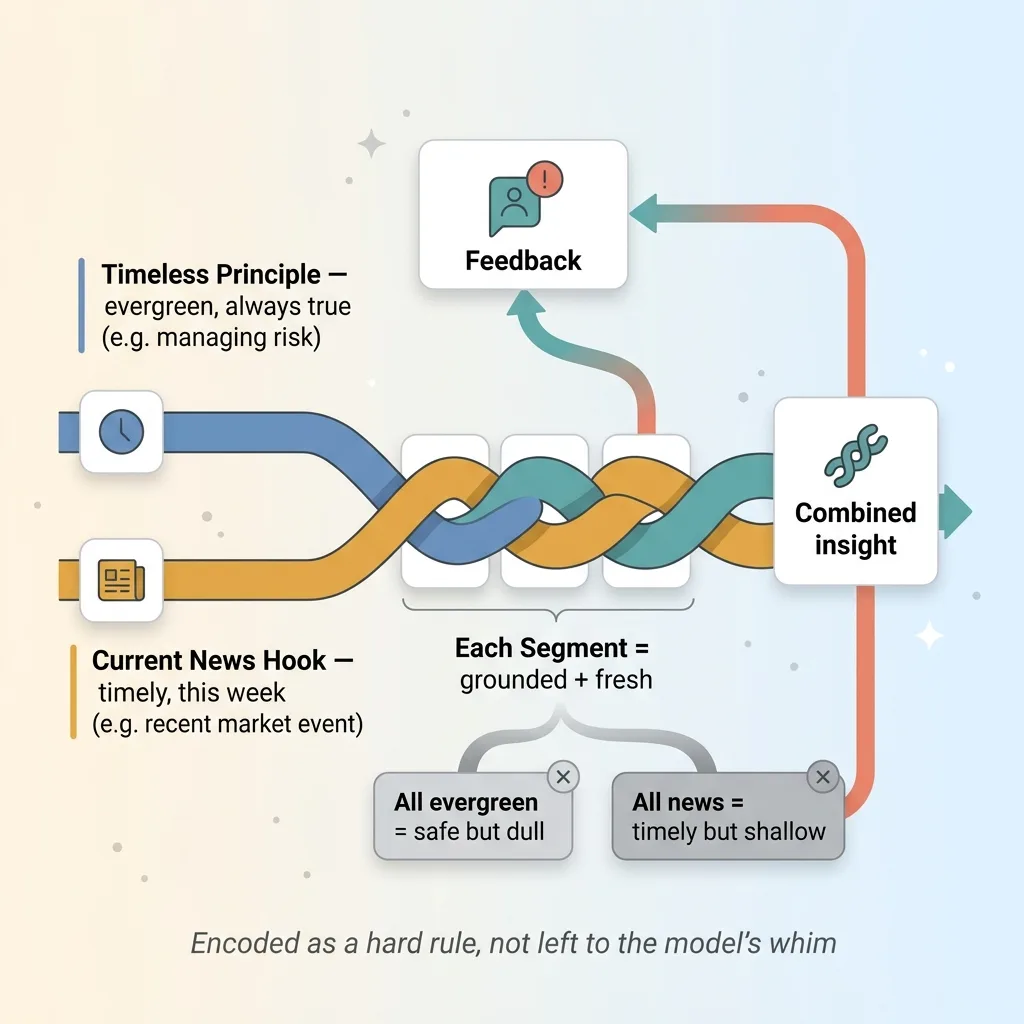
Here is the design decision I am proudest of. Each rundown deliberately braids one timeless principle with one current-week news hook.
 Braiding Timeless Principle with Current News Hook
The timeless principle is evergreen. It is always true and always worth saying. The news hook is timely. It makes the episode feel like it was made this week, because it was.
A concrete, anonymized example: segment one might pair a durable principle about managing risk with a specific market event from the past few days. The principle gives the segment weight. The news hook gives it freshness. Together they sound current and grounded at the same time.
That braiding is a rule I encoded, not a decision the AI makes on a whim. Left to its own devices, the model drifts toward all-evergreen (safe and dull) or all-news (timely and shallow). Encoding the braid as a hard requirement is what keeps every episode feeling both fresh and substantial. The producer's judgment became a rule, and the rule runs every week without anyone thinking about it.
The Memorizable Hook: Designing AI Output for How Humans Actually Use It
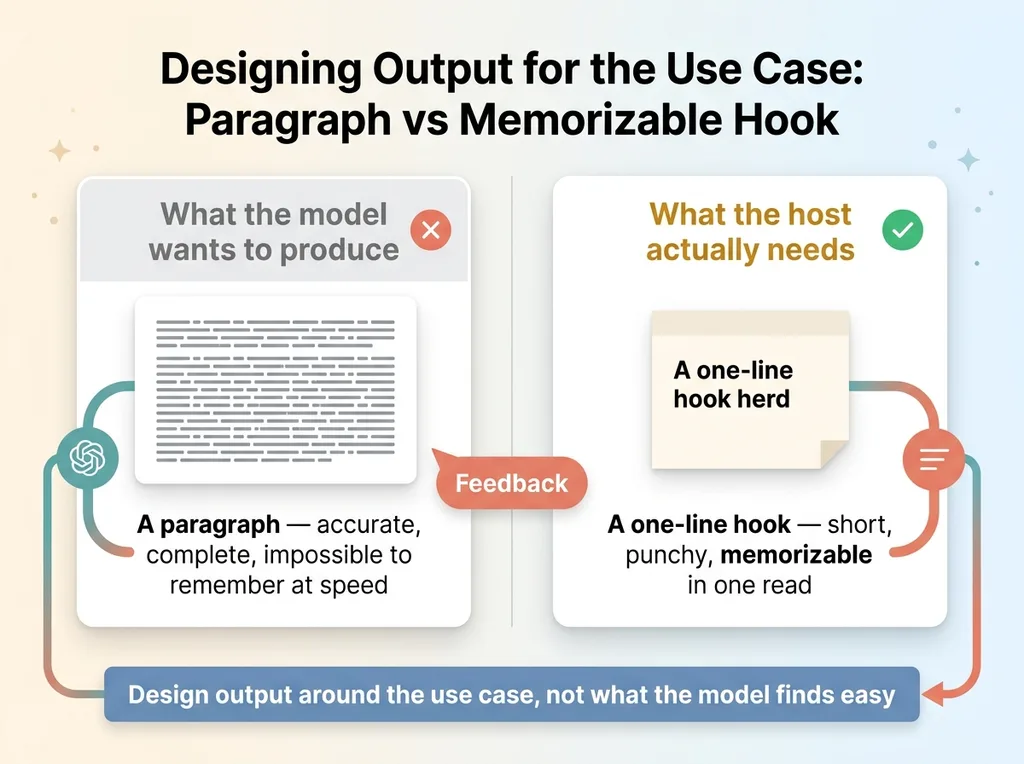
There was one more requirement that changed the whole design. Each segment gets a single one-line hook the host can commit to memory.
 Designing Output for the Use Case: Paragraph vs Memorizable Hook
Why? Because advisors are talking live on air. They are not reading a script off a teleprompter. A wall of perfectly correct text is worse than useless to someone mid-sentence in front of a microphone. The output had to be studio-printable and memorizable, or it would never get used.
This is a bigger lesson than radio prep, so I want to sit on it for a second.
Most AI output fails not because it is wrong. It fails because it is shaped for a screen instead of for the way the person actually works. The model produces a paragraph. The human needs a sticky note. Those are different products, and the gap between them is where most AI projects quietly die.
I design output around the use case, not around what the model finds easy to generate. For these hosts, the use case was a glance at a printed page, then an hour of confident talking. That meant short, punchy hooks, not summaries.
Honest limitation: getting the hooks short enough took real iteration. The early versions read like little paragraphs. Accurate, complete, and impossible to remember at speed. I had to keep tightening until a host could absorb a hook in one read and carry it through a segment. The first few rounds were too long. That is just how this work goes.
Why First-Party Data Beats Clever Prompting
Let me step back for the skeptic, because I would be skeptical too.
 Generic Prompting vs First-Party Data as a Moat
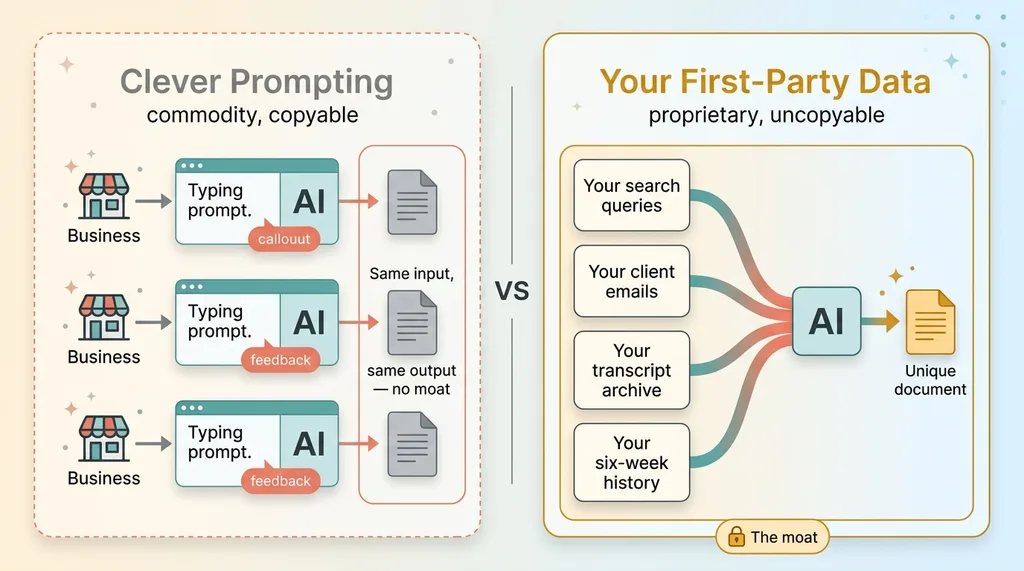
Anyone can prompt an AI. Prompting is a commodity skill now. Your competitor can type the same words you type and get the same output. There is no moat in the prompt.
The moat is the data you feed it.
Your search queries, your client emails, your transcript archive, your six-week history. No competitor has those. They are uncopyable by definition. This is the entire answer to the worry that AI content is generic. Generic content comes from generic inputs. Feed the model proprietary signals and the output stops being a commodity.
This radio prep tool is one piece of a larger system. It feeds into a content machine for a financial advisory firm that turns these same signals into multiple formats. The principle running through all of it is the same one I apply everywhere: lock the AI to real data instead of letting it invent. When the model is grounded in what is actually true about your business, it stops hallucinating and starts being useful.
Here is the blunt version. Generic AI content is worthless. It is the average of the internet, and the internet is already drowning in it. The only content worth shipping is content built on signals only you own.
And the real value was never the generator. It was the signals. The code that composes a rundown is the easy part. The hard, valuable part is figuring out what your audience actually cares about, which is why I always listen before you automate. The listening produced the inputs. The inputs produced the relevance. The generator just assembled it.
The Template You Can Steal for Your Own Business
This pattern is not about radio. It generalizes to almost any business that produces content.
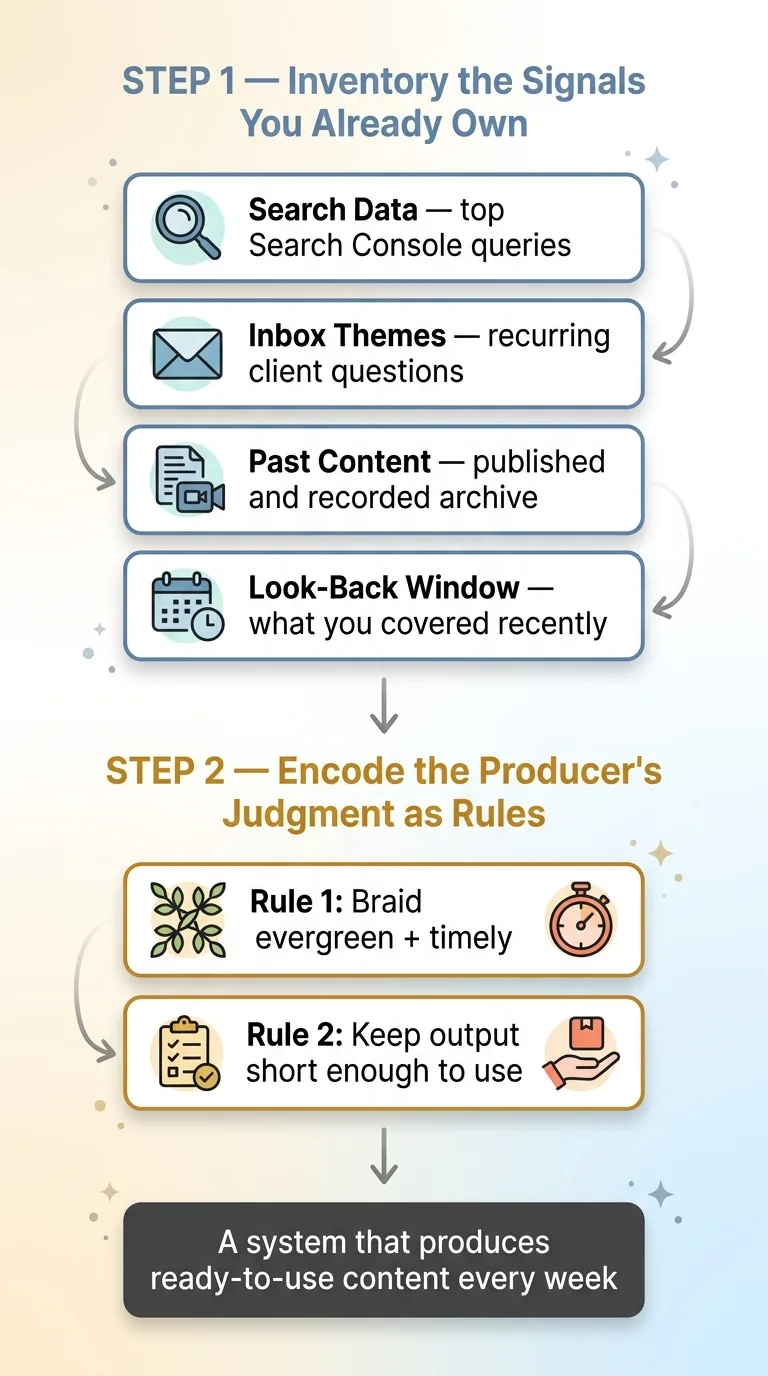 The Reusable Template: Inventory Signals, Encode Judgment
A law firm, a med spa, a B2B SaaS company. They all have the same four signal types sitting unused.
Inventory your own signals
Start by finding what you already own:
- Search data. Pull your top queries from Search Console. These are the exact phrases people use to find you. Stop guessing what they want.
- Inbox themes. Look at what clients and prospects email you about. The recurring questions are content topics in disguise.
- Your past content. Everything you have already published or recorded is an archive of story seeds. Mine it.
- A look-back window. Track what you have covered recently so you never accidentally repeat yourself.
Most businesses have all four and have never once thought of them as content fuel.
Encode the rules a producer would follow
The signals are the inputs. The judgment is what you encode on top.
For the radio show, that judgment was two rules: braid one evergreen idea with one timely hook, and keep every output short enough to remember. For your business the rules will differ, but the move is identical. You take the thing a good producer or editor does in their head and turn it into a rule the system applies every time.
That is the whole method. Inventory the signals you already have, then encode the judgment that turns raw signals into something usable. This is the teaser version. The real build is more involved, but the shape is exactly this.
Turning Your Own Data Into Content That Sounds Like You
The blank page is a solved problem. Not by asking AI to invent topics out of thin air, but by feeding it what you already know about your audience and letting it compose from there.
The hosts went from staring at nothing every week to walking into the studio with a printed rundown. Four segments, evergreen braided with timely, every hook short enough to remember. The same prep that used to eat their week now arrives ready.
Here is what I see over and over. Companies are sitting on the exact first-party data that would make their content relevant, and they have never connected it to a system that uses it. The search queries are there. The inbox is there. The archive is there. They just live in separate places, doing nothing.
That is the kind of thing I build as a Chief AI Officer. Finding the signals you already own and wiring them into something that produces real work every week, in a shape you can actually use.
If you run a business that publishes anything on a schedule, you almost certainly have these signals already. The question is whether anything is listening to them.
Thinking about AI for your business?
If this resonated, let's have a conversation. I do free 30-minute discovery calls where we look at your operations and find where AI could actually move the needle. No slides, no pitch, just a straight read on what is worth building.
Get AI insights for business leaders
Practical AI strategy from someone who built the systems — not just studied them. No spam, no fluff.
Hodgen.AI
Ready to automate your growth?
Book a free 30-minute strategy call with Hodgen.AI.
Book a Strategy Call