Building a Content Machine for a Financial Advisory Firm
How I built an AI content creation system for a financial services firm managing $500M+. Recording, voice cloning, compliance, and daily publishing.
By Mike Hodgen
A financial advisory firm I work with manages over $500M in assets under management. They have some of the sharpest market minds I've encountered — people who can explain the implications of a Fed rate decision to a retiree and a tech founder in the same afternoon, adjusting their language perfectly for each. And for 18 months, their website had three blog posts on it. Three. That's the core problem with AI content creation in financial services — it's not a knowledge problem, it's an extraction problem. The expertise exists. It's just locked inside people who bill $500 an hour and have seven client meetings today.
I see this pattern constantly. The firm's competitors — some objectively less talented — were publishing daily. Blog posts, LinkedIn articles, YouTube breakdowns, weekly email digests. They were capturing search traffic for terms like "Roth conversion strategies 2025" and "tax-loss harvesting after a correction." Not because they knew more, but because they had a content system and this firm didn't.
The options the firm had explored were all bad. Hire a marketing person for $60-80K who doesn't understand the difference between a 401(k) and a 403(b)? Outsource to a content agency that produces the same warmed-over "5 Tips for Retirement Planning" article every other firm publishes? Or keep doing nothing and watch the search traffic go somewhere else.
The real cost of doing nothing isn't the missing blog posts. It's the prospective clients who Google a question, find a competitor's article, and never learn your firm exists. Every day without content is a day you're invisible to the people actively searching for what you do.
The 10-Minute Recording That Powers a Week of Content
Why Recording Beats Writing for Advisors
The breakthrough was stupidly simple once we saw it: financial advisors don't need to write. They need to talk.
These people spend their entire day explaining complex financial concepts in plain language. They're naturally articulate because their job demands it. But ask them to sit down at a laptop and write 1,200 words? They'll stare at a blank screen for 20 minutes, write two paragraphs, get pulled into a client call, and never come back.
So we flipped the model. The advisor opens an app on their phone, hits record, and talks for 5-10 minutes about whatever's top of mind that morning. No script. No prep. No editing. Just the same thing they'd say to a client over coffee.
The recording gets transcribed using Whisper, then AI structures it into multiple content formats: a full blog article, a LinkedIn post, an email newsletter snippet, and social media clips. One 10-minute recording produces 4-5 distinct pieces of content.
The advisor's time investment: 10 minutes. The previous time to produce the same output manually: 6-8 hours. If it happened at all, which it usually didn't.
This parallels the AI blog automation pipeline I built for my own DTC fashion brand, where I've scaled to over 313 articles with AI-assisted SEO. The principle is identical — don't fight how people naturally work, build the system around them.
The 'Hot Take of the Day' Framework
We needed a framework that would actually get used. Something with zero friction. We landed on what I call the "Hot Take of the Day."
Every morning, the advisor records a quick take on whatever's live in their world. Monday it might be a reaction to weekend market moves. Tuesday could be a tax strategy they just used with a client. Wednesday might be a question they keep hearing from prospects. Thursday could be a reaction to an economic data release.
The framework works because it doesn't feel like "creating content." It feels like talking about your job for a few minutes. The advisor isn't writing — they're opining, explaining, reacting. That's what they do naturally, and that authenticity is exactly what makes the resulting content compelling.
The content that comes out of an unscripted 8-minute recording is consistently better than what the firm was previously agonizing over for hours. It's more specific, more opinionated, more useful. Because it captures real expertise in real time instead of corporate-approved pablum.
Voice Cloning and the Studio Generation Pipeline
Building the Advisor's Digital Voice
Generic AI content sounds like generic AI content. In financial services, that's a credibility killer. High-net-worth clients can smell inauthenticity from three paragraphs away. If your blog sounds like every other ChatGPT-generated financial article on the internet, you've actually damaged your brand more than if you'd published nothing.
The system uses voice cloning to capture each advisor's specific writing style, vocabulary, opinions, and cadence. We trained the content generation layer on 50+ hours of the advisor's existing communications — past client emails, webinar transcripts, meeting notes, even casual Slack messages to colleagues. All with permission, obviously.
The result: AI-generated content that sounds like this specific advisor. Their pet phrases show up. Their tendency to use baseball metaphors when explaining risk tolerance. Their habit of starting complex explanations with "Here's the thing..." It reads like them because the model learned from them.
From Transcript to Polished Content
The pipeline from raw recording to published content has multiple stages, and each uses a different model optimized for that specific task. This is the multi-model AI architecture approach I use across every system I build — the same philosophy behind the 29 automation modes running my own brand.
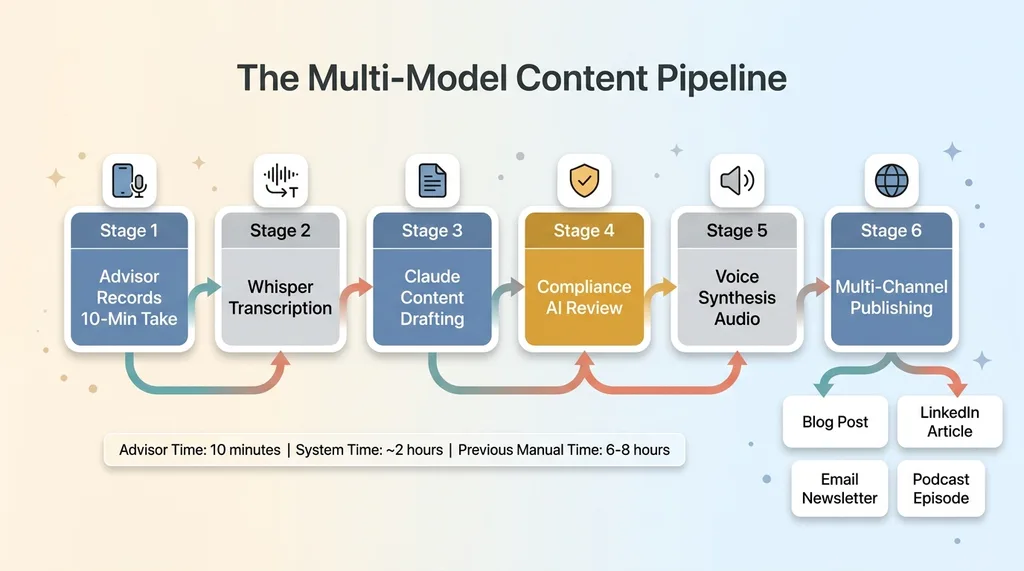 Recording-to-Publishing Content Pipeline
Whisper handles transcription. Claude handles content drafting because it's significantly better at nuance and tone matching than alternatives I've tested. A separate voice synthesis model produces polished audio versions of the written content — essentially creating podcast episodes from blog posts. The advisor records a rough, off-the-cuff take in their car. The system produces a polished article that sounds like them and a studio-quality audio version they can embed on their website or distribute as a podcast.
One input. Multiple outputs. Multiple models. Each doing what it's best at. The cost efficiency of this approach versus using a single premium model for everything is substantial — roughly 60% lower per piece of content without any quality loss.
The Compliance Problem Nobody Talks About
SEC, FINRA, and the AI Content Minefield
This is where most AI content projects in financial services fall apart, and it's the section I care about most because it separates real work from demo-ware.
Financial advisory content is regulated. FINRA and the SEC have specific, detailed rules about what you can and cannot say in marketing materials. You can't make performance promises. You can't use testimonials without specific disclosures. You can't provide what could be interpreted as personalized advice in public content. You can't cherry-pick performance periods. You can't use the word "guarantee" in most contexts.
Most AI content tools have zero awareness of these constraints. They will happily generate a blog post that says "Our strategies consistently outperform the market" — a sentence that could trigger a regulatory inquiry. They'll produce client testimonial content without required disclosures. They'll draft language that blurs the line between education and personalized advice.
This isn't a theoretical risk. FINRA fined firms over $89 million in 2023 alone. The compliance stakes are real — fines, license risks, and the kind of client trust erosion you never recover from.
Building a Compliance Review Layer
The compliance review layer is non-negotiable. Every single piece of generated content passes through a compliance-focused AI review that checks for specific regulatory red flags before any human sees it.
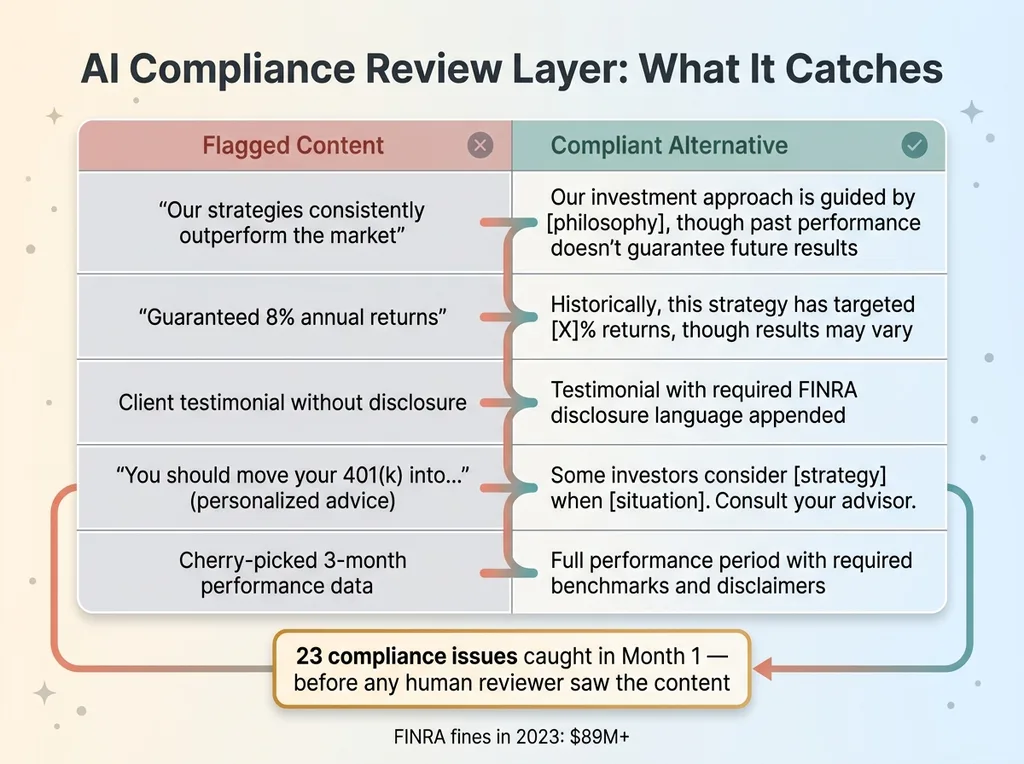 Compliance Review Layer Red Flag Detection
The system scans for performance guarantees, misleading claims, missing disclosures, forward-looking statements without proper caveats, anything that could be construed as personalized advice, and cherry-picked data presentations. When it finds an issue, it doesn't just flag it — it suggests a compliant alternative. "Our strategies consistently outperform" becomes "Our investment approach is guided by [specific philosophy], though past performance doesn't guarantee future results."
In the first month, the system caught 23 compliance issues across the content it generated. Twenty-three instances that would have required revision by the compliance officer anyway — or worse, would have been published and created risk. That's 23 potential problems eliminated before a human reviewer even opens the document.
This is the same philosophy I apply across all my systems — AI that rejects its own bad work. The content pipeline doesn't just generate output. It evaluates its own output against domain-specific criteria and fixes problems before they become someone else's problem. The compliance officer still reviews everything. But now they're reviewing clean drafts instead of spending hours redlining amateur mistakes.
What the Daily Publishing Cadence Actually Looks Like
Monday Through Friday: The Content Calendar
Here's a real week:
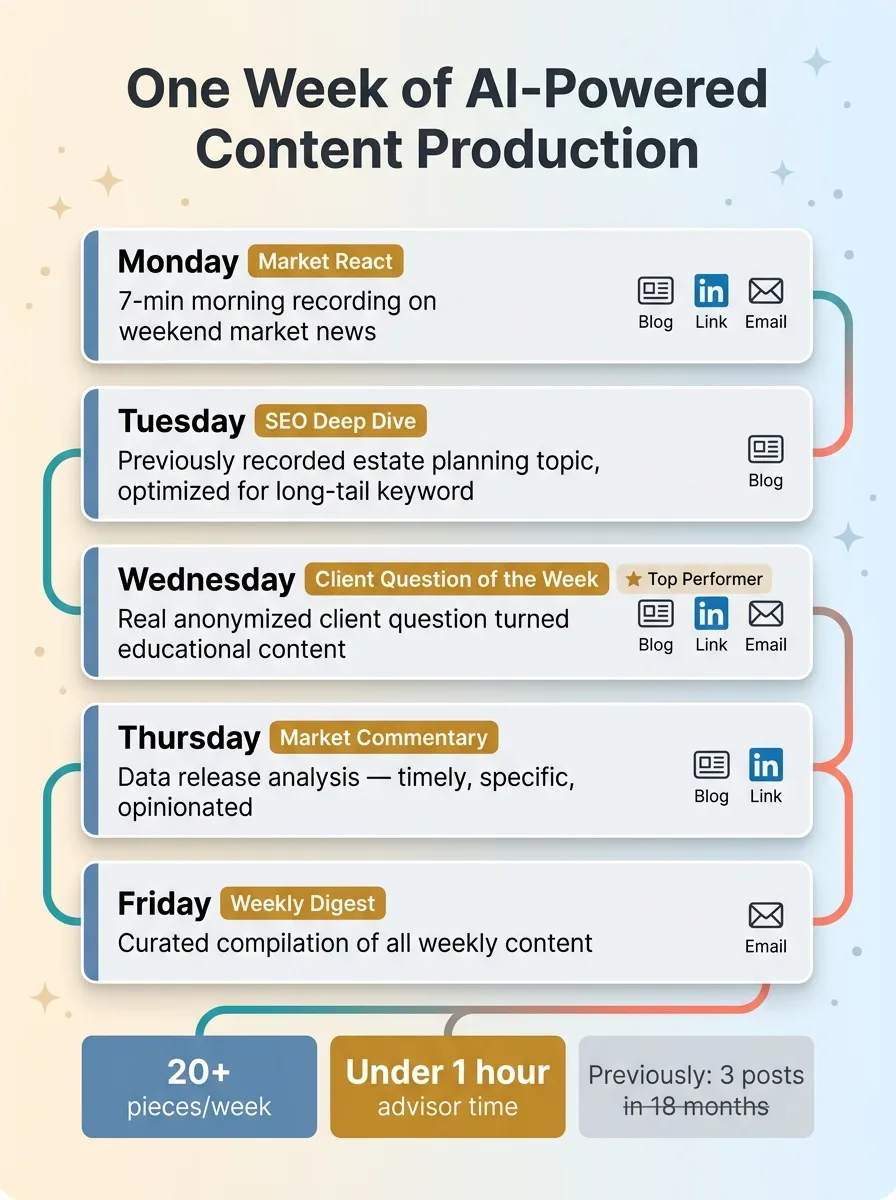 Weekly Content Calendar and Output Volume
Monday: The advisor records a 7-minute take on weekend market news while drinking coffee. By noon, the system has produced a blog post, a LinkedIn article, and an email snippet. All compliance-reviewed.
Tuesday: The system takes a previously recorded deep-dive on estate planning and produces an SEO-focused article targeting a specific long-tail keyword the firm wants to rank for.
Wednesday: "Client Question of the Week" — the advisor answers a real, anonymized client question. The system turns it into educational content. These consistently perform best because they address the exact questions prospects are Googling.
Thursday: Market commentary based on the week's data releases. Timely, specific, opinionated.
Friday: A curated weekly digest email compiled from all the week's content, sent to the firm's entire client and prospect list.
The firm went from 3 blog posts in 18 months to 20+ pieces of content per week. The advisor's total weekly time commitment: under 1 hour.
Measuring What Matters
After 90 days, organic search impressions increased roughly 8x. The firm started ranking on page one for 14 long-tail keywords they'd never appeared for. Email open rates held steady at 34% — notable because volume increased dramatically and open rates usually tank when you email more frequently. LinkedIn engagement tripled.
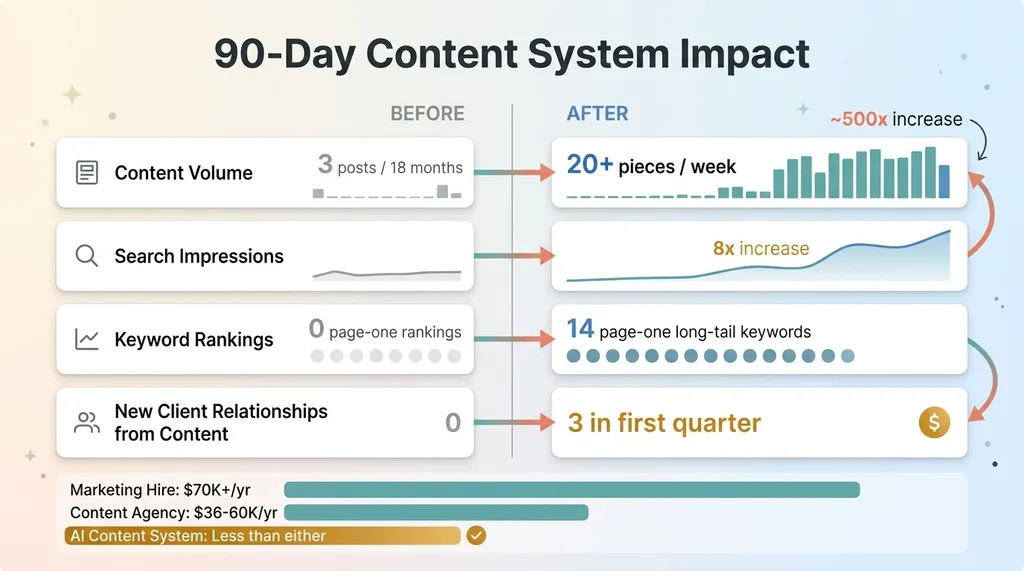 Before vs After: Content System Impact Metrics
But the metric that mattered most to the partners: three new client relationships in the first quarter that explicitly mentioned finding the firm through their content. At this firm's AUM levels, that's significant revenue from a system that costs less per month than a single client dinner.
That's the difference between a content strategy — a PowerPoint slide that says "we should blog more" — and a content system that actually runs.
Why This Doesn't Work With Off-the-Shelf Tools
The obvious question: why not just use Jasper, or ChatGPT, or any of the 500 AI writing tools on the market?
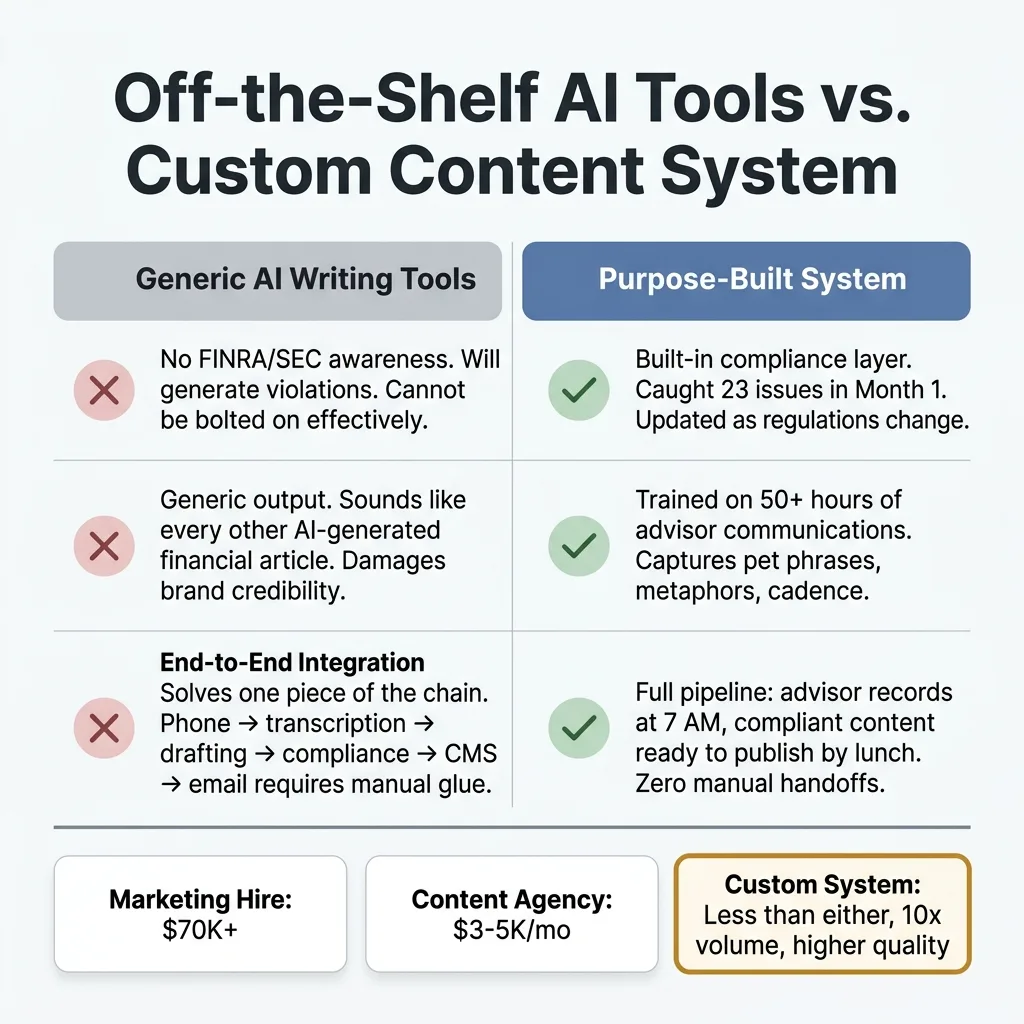 Off-the-Shelf Tools vs Custom Content System
Three reasons.
Compliance. None of them have a financial services compliance layer. And bolting one on after the fact is significantly harder than building the pipeline correctly from the start. Compliance can't be an afterthought when FINRA is the audience.
Voice fidelity. They produce generic content. The entire point of this system is to capture a specific advisor's perspective, vocabulary, and opinions. Generic financial content is worse than no content because it signals that your firm is generic.
Integration. The recording-to-publishing pipeline connects the advisor's phone to a transcription service to a content engine to a compliance check to a CMS to an email platform. Off-the-shelf tools solve one piece of that chain. The value is in the connected system — the fact that an advisor talks into their phone at 7 AM and compliant, on-brand content is ready to publish by lunch.
Cost comparison: a marketing hire runs $70K+ fully loaded. A content agency charges $3-5K per month for mediocre, non-compliant output. This system costs less than either and produces 10x the volume at meaningfully higher quality.
What It Takes to Build a Content System for a Regulated Firm
I'm going to be direct about what this requires, because I'd rather set honest expectations than oversell.
Building AI content production for financial services — or any regulated professional service — demands someone who understands both the AI tooling and the domain constraints. The compliance piece alone is not something you can hand to a general-purpose developer or a marketing agency that just discovered ChatGPT. The stakes are too high. Fines. License risks. Client trust that took decades to build and one bad blog post to crack.
The build for this firm took approximately 3 weeks from first conversation to daily publishing. The ongoing maintenance is minimal — the system runs, the advisor records, content publishes. The compliance layer gets updated when regulations change, which happens more often than most people realize.
What made this project work was three things. First, the firm's willingness to let their advisors' authentic voices lead instead of insisting on corporate-approved boilerplate that says nothing. Second, a recording-first workflow that respected how advisors actually work — on the move, between meetings, thinking out loud. Third, a compliance layer that earned the compliance officer's trust by catching real issues consistently.
For professional services firms — law, accounting, wealth management, consulting — the pattern is the same. Your experts have valuable knowledge trapped in their heads. Your competitors who've figured out how to extract, refine, and publish that knowledge at scale are eating your lunch on search, on social, on mindshare.
If you're running a firm where expertise is your product but content is an afterthought, I'd be interested to talk through how this would work for your specific firm.
Want to Explore What AI Could Do for Your Firm?
I do a free 30-minute strategy call. No pitch deck, no sales team, no pre-recorded demo. Just a real conversation about your operations, where the bottlenecks are, and whether AI makes sense for what you're trying to do.
Get AI insights for business leaders
Practical AI strategy from someone who built the systems — not just studied them. No spam, no fluff.
Ready to automate your growth?
Book a free 30-minute strategy call with Hodgen.AI.
Book a Strategy Call