The Mistake Almost Everyone Makes With AI
Every failed AI project I've watched started the same way: with a tool, and a frantic search for somewhere to bolt it on.
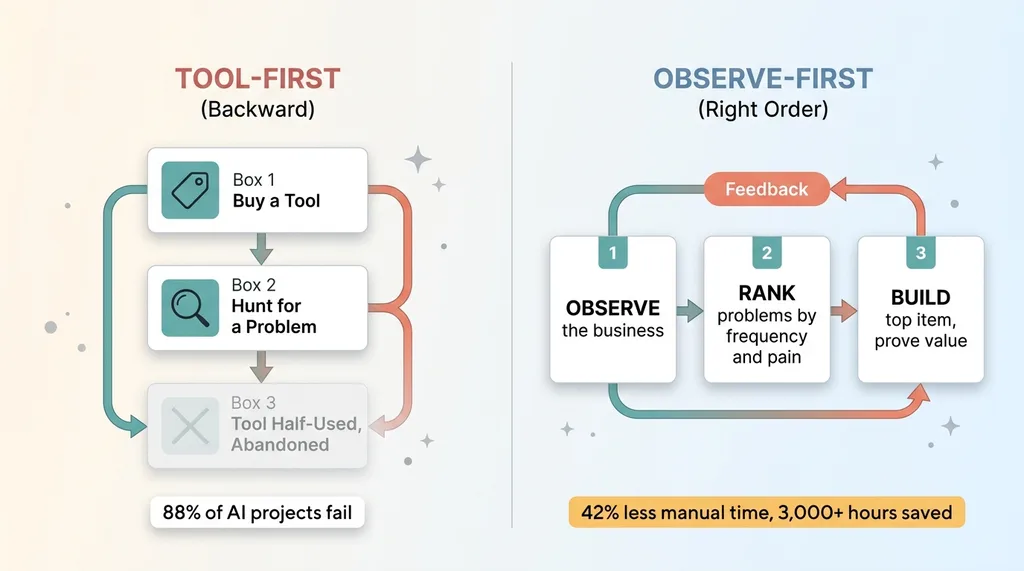 Tool-First vs Observe-First Sequence (Backward vs Right Order)
Someone reads a headline. The board asks what the company is doing about AI. A competitor announces something shiny. So leadership buys a chatbot, or a stack of copilot seats, or some platform with "intelligence" in the name. Then they go hunting for a problem the tool can solve.
That's backward. And it's the single biggest reason a working AI adoption strategy for business falls apart before it ever produces a dollar of value.
Here's the shape it usually takes. A company spends real money, sometimes six figures, on an AI tool. There's a kickoff, some training, a Slack channel. Three months later the tool is half-used. Two people log in occasionally. The rest of the team went back to doing things the way they always did.
And quietly, in a hallway conversation, somebody decides: "AI doesn't really work for us."
The tool wasn't the problem. The sequence was.
This is why 88% of AI projects fail to deliver, and it's almost never about the technology. The model was fine. The platform was fine. What was broken was the order of operations. They picked a solution before they understood the problem, and then acted surprised when the solution didn't fit.
I've built 15+ AI systems across my own DTC fashion brand and for clients. Not one of the ones that stuck started with a tool. They started with watching.
The right order is simple, and almost nobody follows it: observe, then rank, then build. Watch how the business actually runs. Rank the problems by how often they happen and how much they hurt. Build the top one, prove it works, then move on.
That's the whole method. The rest of this article is why it works and how to run it.
Why Tool-First AI Adoption Stalls
There are two reasons buying a tool first almost always stalls. Both are predictable once you've seen them a few times.
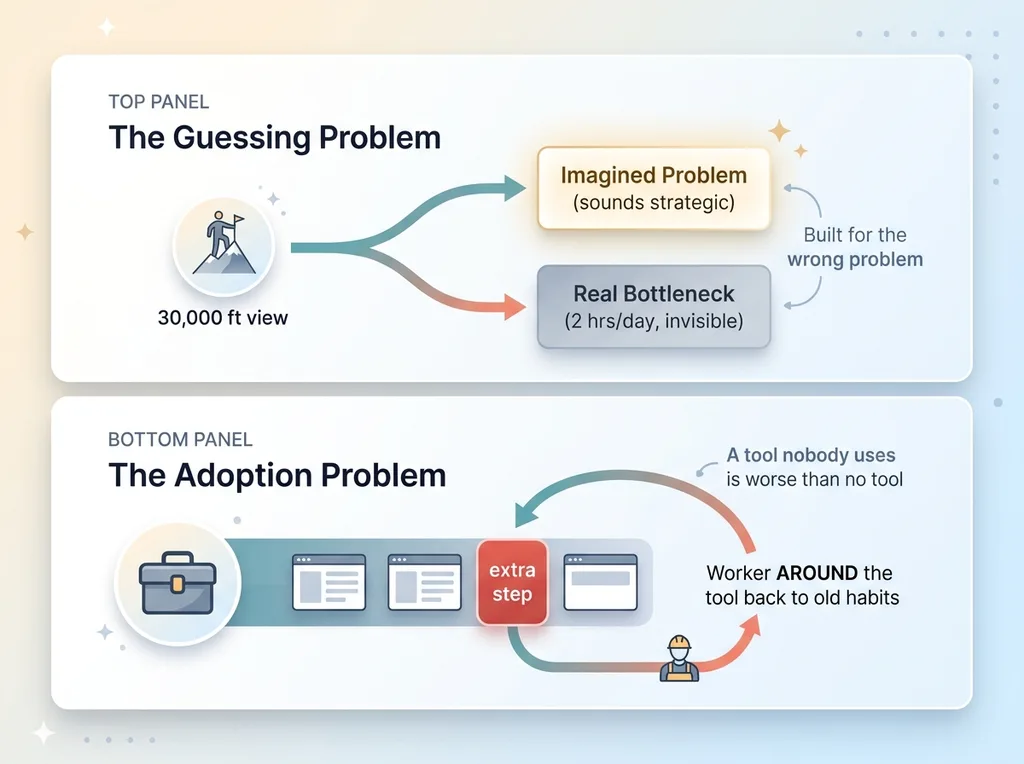 The Two Reasons Tool-First Stalls: Guessing Problem and Adoption Problem
The guessing problem
When leadership picks the problem to solve, they pick it from 30,000 feet. They choose the thing that sounds strategic in a meeting, or the thing a competitor is doing, or the process that's been annoying them personally.
But the real bottleneck is almost never the thing that gets discussed in strategy meetings. It's the boring task that quietly eats two hours of someone's day, every day, that nobody thinks to mention because it's just "how we do things."
So you build for the imagined problem and completely miss the real one. The tool works exactly as designed and changes nothing, because it was solving a problem that wasn't actually costing you much.
The adoption problem
Even when the tool is genuinely good, people don't use it. Not because they're resistant to change for its own sake, but because the tool wasn't built around how they actually work. It asks them to add a step, switch a window, learn a workflow that fights their muscle memory.
So they don't. And a tool nobody uses is worse than no tool, because you paid for it and now "we tried AI" is on the record as a failure.
My own numbers are the counterexample. After deploying AI across my brand, manual operations time dropped 42%. We save over 3,000 hours a year. There are 29 automation modes running in production right now.
None of that came from buying tools. It came from watching where the time was actually going, then building around it. The automations stuck because they removed work people already hated, in the exact spots where they were doing it.
Operations Audit Before AI: Observe the Real Business First
So how do you find the real problem instead of the imagined one? You watch.
I built a system that observes a business before it recommends automating anything. For a defined window, usually about a week, the AI quietly watches how the business actually communicates and operates. No automation yet. No recommendations yet. Just measurement.
It looks at the email threads. The questions that get asked over and over. The manual handoffs between people. The things someone copy-pastes from one tool into another, fifteen times a day, because no system connects them.
The point is to replace opinion with evidence.
By the end of that window, you don't have a theory about your biggest problem. You have a frequency count. You know that a specific question gets asked 40 times a week. You know that one report takes 90 minutes and gets built every Monday. You know exactly where the copy-paste happens and how often.
This is the operations audit before AI that nearly everyone skips. They skip it because it feels slow. There's no demo to show the board. Nothing gets "deployed" in week one. It feels like you're paying to have someone watch.
But it's the only step that makes everything after it work.
When I ran this on my own brand, I found things I'd have sworn weren't the problem. I assumed our bottleneck was somewhere upstream in product design. The data said otherwise. The real time sink was repeated customer questions and manual price updates, the boring stuff I'd stopped noticing because I did it on autopilot.
If I'd guessed, I'd have built the wrong thing first. The observation kept me honest. You can't argue with a frequency count, and that's exactly the point.
Rank by Frequency and Pain, Not by What's Trendy
Once you've watched, you have raw data. The next move is turning it into a ranked list.
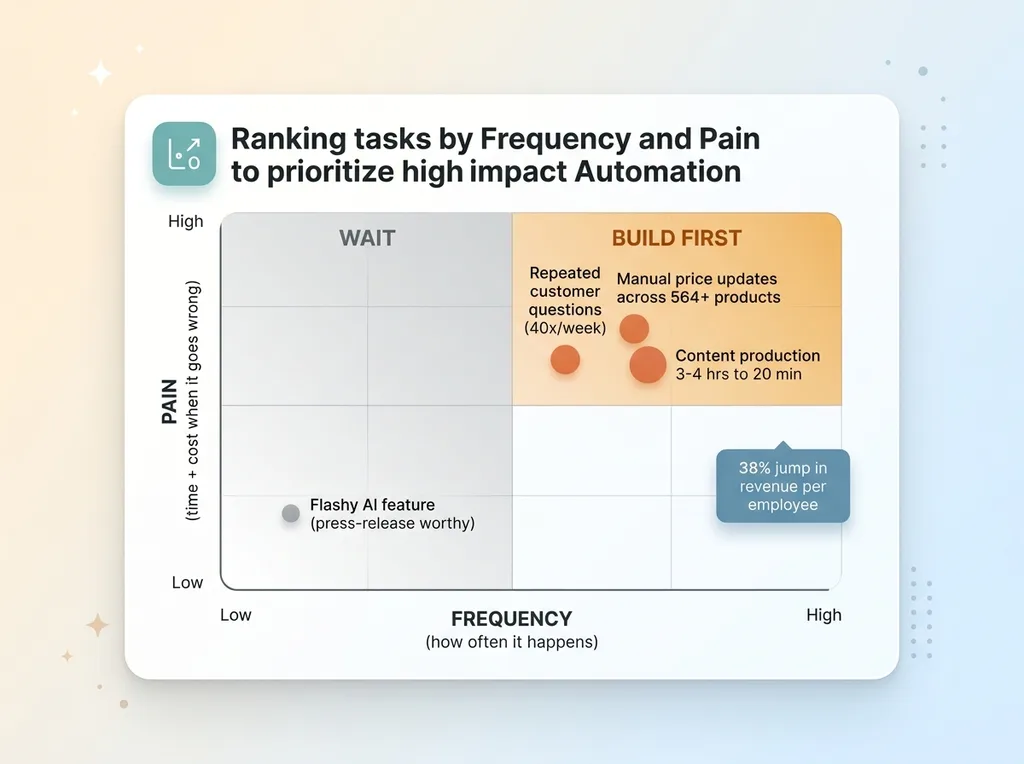 Ranking Tasks by Frequency and Pain (Why Boring Beats Trendy)
For each task, you ask three questions. How often does it happen? How much time does it take? How much does it hurt when it goes wrong?
Then you sort. And the sort almost always surprises people.
Something that happens 40 times a day beats something that happens twice a week, even when the twice-a-week thing sounds far more impressive in a meeting. Frequency compounds. A task that takes ten minutes but happens 40 times daily is eating you alive. A glamorous task that happens occasionally barely moves the needle, no matter how good the demo looks.
In my own brand, the highest-value automations were embarrassingly boring. Repeated customer questions. Manual price updates across 564+ products, which I now run through an AI pricing engine with four-tier ABC classification. Content production that used to take three to four hours per product and now takes 20 minutes, concept to live.
None of those were exciting. All of them happened constantly. That's exactly why they ranked at the top, and exactly why automating them produced a 38% jump in revenue per employee.
The trendy projects, the flashy AI feature you'd want to put in a press release, usually rank near the bottom. Not because they're worthless, but because they don't happen often enough to matter yet.
Ranking by frequency and pain strips out two things that wreck AI adoption: ego and hype. It doesn't care what sounds impressive. It only cares what's actually costing you.
The result is that the first thing you build is provably the thing that matters most. You're not betting on a hunch. You're acting on a count. And when you're spending real money and real team attention, "provably" is worth a great deal more than "probably."
Where to Start With AI: The Right Sequence
If you only take one thing from this, take the sequence. This is where to start with AI, in three steps.
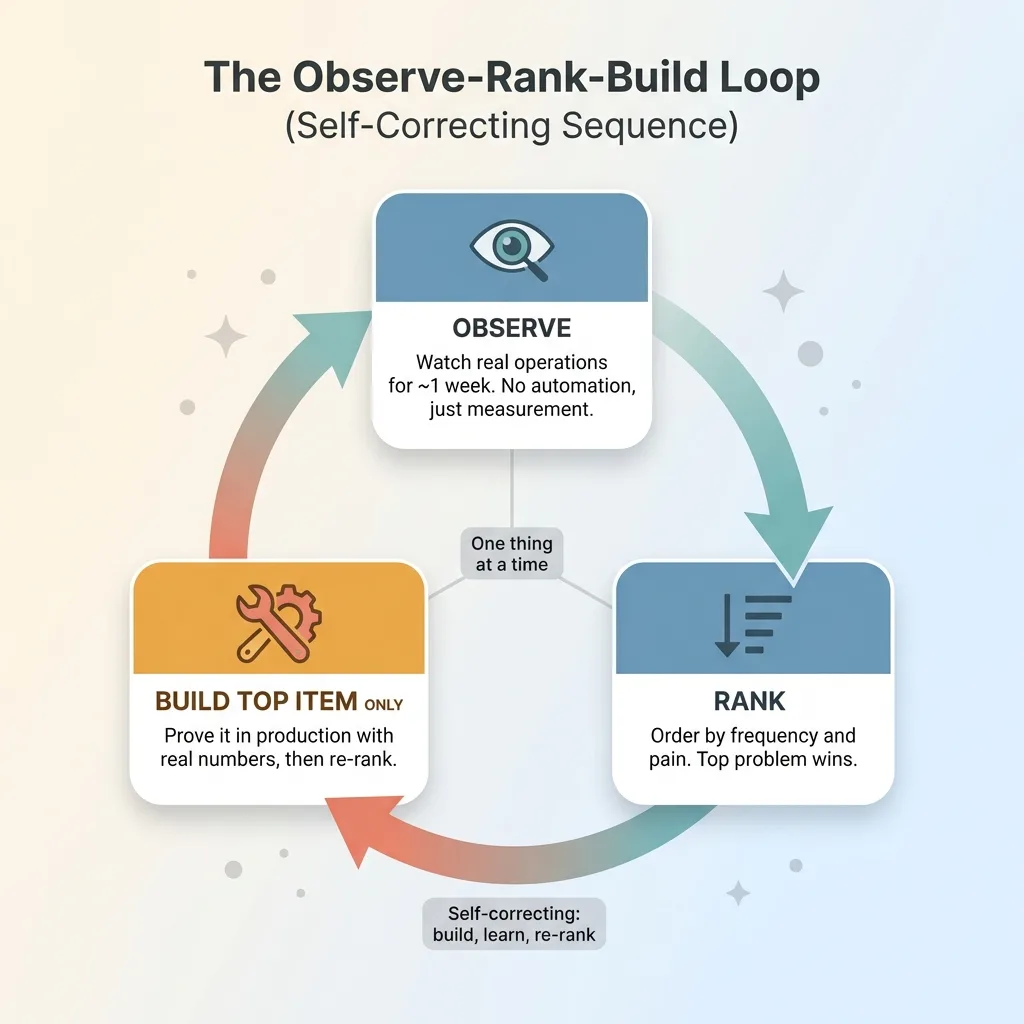 The Observe-Rank-Build Loop (Self-Correcting Sequence)
Observe
Watch the real communications and operations for a defined window. A week is usually enough. No automation, no recommendations, just measurement of how the business actually runs versus how you think it runs.
Rank
Turn the observation into a list ordered by frequency and pain. The thing that happens most and hurts most goes to the top. Everything else waits.
Build the top item only
Build the number-one item. Just that one. Prove it works, in production, with real numbers. Then move to the next item on the list.
That's it. That's the AI readiness assessment that actually matters, far more than any vendor checklist. A checklist tells you whether you have clean data and executive buy-in. Useful, but it doesn't tell you what to build. The observe-rank-build sequence does. If you want the broader version of this question, I wrote about whether your business is actually ready for AI and the systems most businesses should build first.
The discipline is doing one thing at a time and proving value before expanding. It sounds obvious. Almost nobody does it.
The common failure is the opposite: trying to "transform the whole business" with AI all at once. Five initiatives, ten stakeholders, a roadmap that spans a year. Nothing ships. Everyone's busy and nothing is finished, and a year later the only thing you have is a slide deck and a tired team.
Let me be honest about the limits. Observation doesn't catch everything. Some problems only surface once you start building, when you discover the real friction is one layer deeper than the data showed. That's fine. The ranking just resets with new data. It's a loop, not a one-time event. You build, you learn, you re-rank. The method is self-correcting, which is more than I can say for most strategies that live and die on a single guess.
What This Removes: Friction and Guesswork
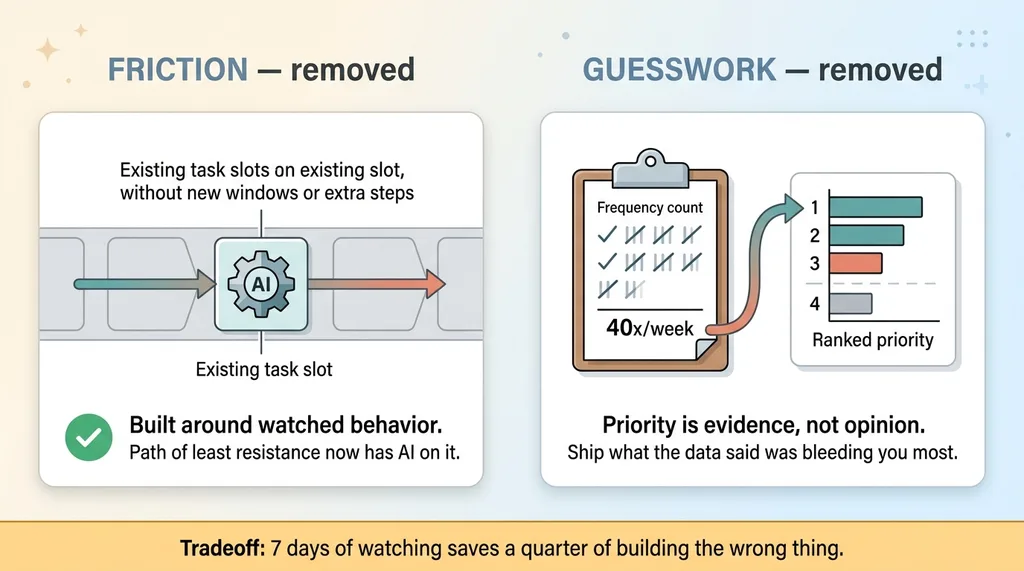
Two things kill AI projects: friction and guesswork. Observe-first removes both, and that's why adoption sticks.
 What Observe-First Removes: Friction and Guesswork
Friction goes away because the automation is built around behavior you actually watched, not behavior you wished for. People don't have to change how they work to use it. The AI shows up in the exact spot where the annoying task already lived, and it just handles it. There's no new window to learn, no workflow to fight. The path of least resistance becomes the path with AI on it.
Guesswork goes away because the priority list is evidence, not opinion. You're not betting the budget on a hunch about what matters. You ranked it. You counted it. The first thing you ship is the thing the data said was bleeding you the most.
And here's the part that makes adoption stick: the first thing your team sees AI do is the thing that was already annoying them most. Not some abstract "efficiency gain." The specific task they've grumbled about for months, gone. That's how you turn skeptics into people who ask what else AI can take off their plate.
Now the honest tradeoff. This is slower to start than just buying a tool. A week of watching before anything visible happens feels uncomfortable when you want momentum.
That's the point.
A week of watching saves you months of building the wrong thing. I'd rather lose seven days finding the real problem than lose a quarter solving a fake one. This is just an operations audit before technology, turned into a repeatable method instead of a one-off consulting exercise.
Start at the Right End
The whole thesis fits in one line: don't start with a tool, start by watching your own business.
The problem is that most companies can't do this objectively. You're too close to your own workflow. The tasks eating your time have become invisible to you precisely because you do them every day without thinking. You can't see the bottleneck because you are the bottleneck, and that's no insult, it's just how proximity works.
That's exactly the gap I fill.
When we start working together, I don't show up with a tool and a pitch. I observe how your business actually runs before I recommend automating anything. Then I bring you a ranked plan built on what I saw, not what I assumed. And only then do we build, top item first, proving value before we expand.
If you want to see the shape of it, I wrote about what the first weeks of working together actually look like. No mystery, no black box.
You don't have to guess which problem to solve first. You don't have to bet the budget on a hunch. You watch, you rank, you build. That's the relief most people don't realize they're missing until the guessing stops.
Get the next build note.
I write up each system I build, including what broke. Subscribe to my newsletter and I'll send you the next one.