The CEO's Guide to AI Strategy in 2026
Real CEO playbook for AI strategy in 2026. Cut through hype, find actual ROI, avoid costly mistakes. From someone running AI in production.
By Mike Hodgen
Where AI Actually Is in 2026 (Not the Hype Version)
I've deployed 15 AI systems at my DTC fashion brand over the past three years. I've watched the technology evolve from expensive experiment to production workhorse. And I've learned that most of what you read about AI strategy for business is either outdated, oversold, or both.
Here's what actually changed.
What Changed Since 2023
The economics flipped. In early 2023, running GPT-4 cost us about $60 per million tokens for input. Today, Claude 3.5 Sonnet — which is arguably better — costs $3 per million tokens. That's a 95% price drop in three years.
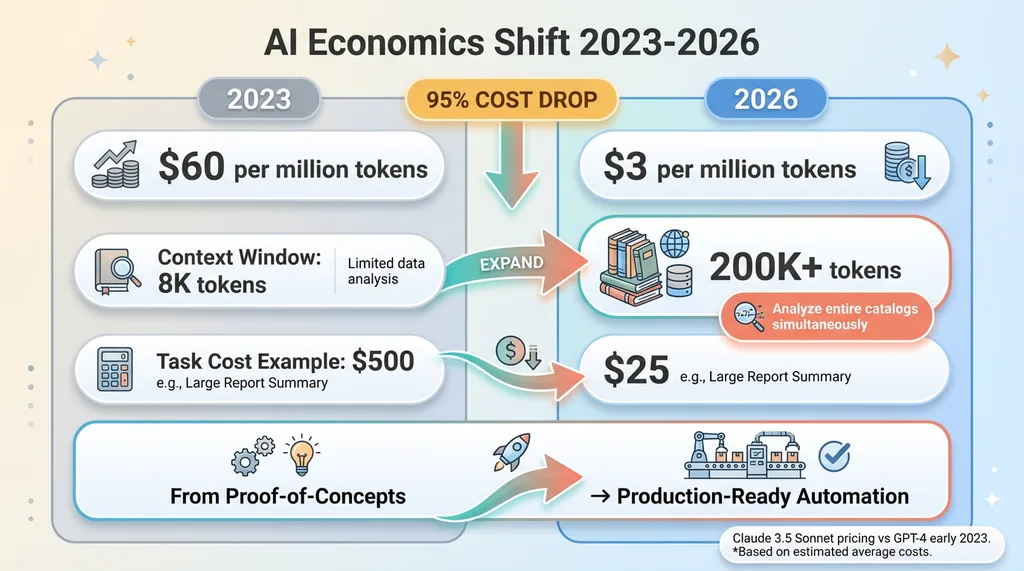 AI Economics Shift 2023-2026
That shift made automation viable for us. Tasks that cost $500 to run through AI in 2023 now cost $25. We went from testing proof-of-concepts carefully to running AI on everything repetitive.
Context windows expanded from 8K tokens to 200K+. That means AI can now read and analyze entire catalogs, customer histories, and documentation sets without choking. Our pricing engine analyzes all 564 products simultaneously, something that would have required breaking into batches and losing context in 2023.
Multimodal works now. We generate product photography with Gemini's image models. The results aren't perfect, but they're good enough for secondary images and cost $0.02 per image versus $50+ for a photographer. That economic difference unlocks use cases that never made sense before.
The models got smarter about following instructions. Early GPT-4 would drift off-task or ignore constraints. Current models stick to the script better, which matters when you're running thousands of automated operations per month.
What Still Doesn't Work
Autonomous agents fail at anything complex. I tried building a fully autonomous customer service system in 2024. It worked great for 70% of inquiries, then spectacularly failed on the other 30%. Customers got nonsensical responses, promises we couldn't keep, and policy violations.
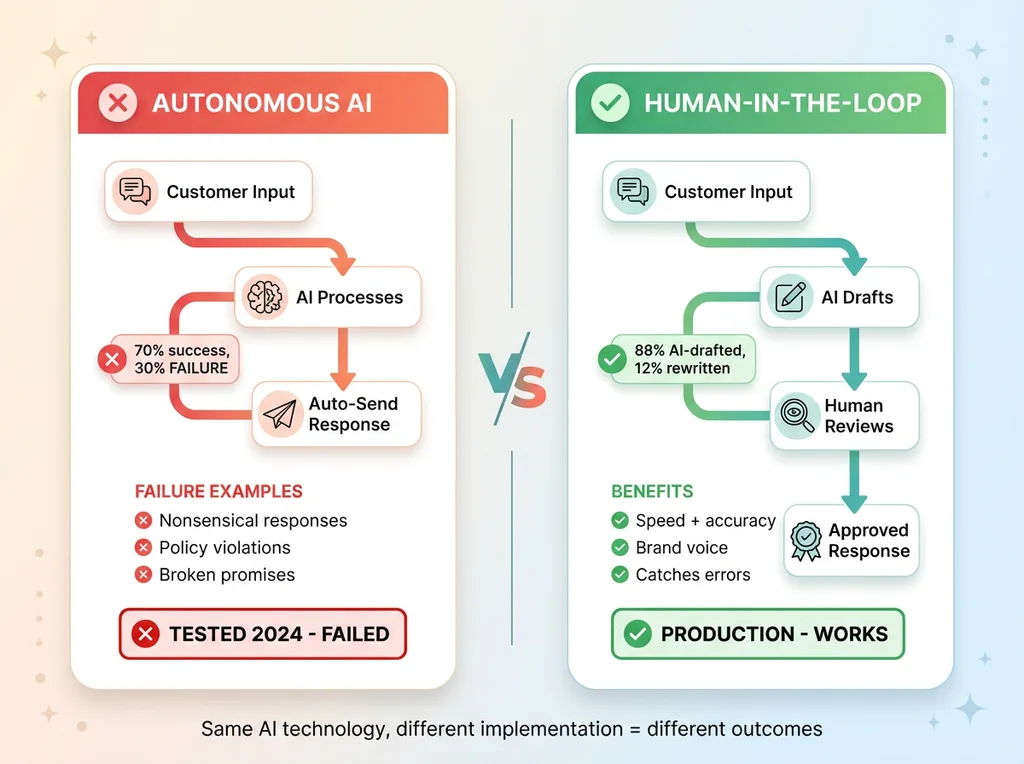 Human-in-Loop vs Autonomous AI
We pulled it back to human-in-the-loop. Now AI drafts responses, humans review and send. That works. Full autonomy doesn't.
Hallucinations still happen. Current models hallucinate about 3-8% of the time depending on the task and how you prompt them. We've built guardrails — fact-checking layers, confidence scoring, human review for anything customer-facing or financial. But you can't eliminate the risk entirely.
AI can't learn on its own. Every system we built required structured data, clear objectives, and ongoing monitoring. The fantasy of "just point AI at your business and let it figure things out" doesn't exist. You need to design the system, clean the data, and watch for drift.
Real-time reasoning is still expensive. The new o1 models that actually think through problems cost 5-10x more than standard models. They're worth it for complex decisions, but not for high-volume operations. We use them for strategic analysis, not routine automation.
The Four Areas Where AI Delivers Real ROI Right Now
After three years of building AI systems across every part of our business, I can tell you exactly where AI actually makes money. Not theory. Numbers.
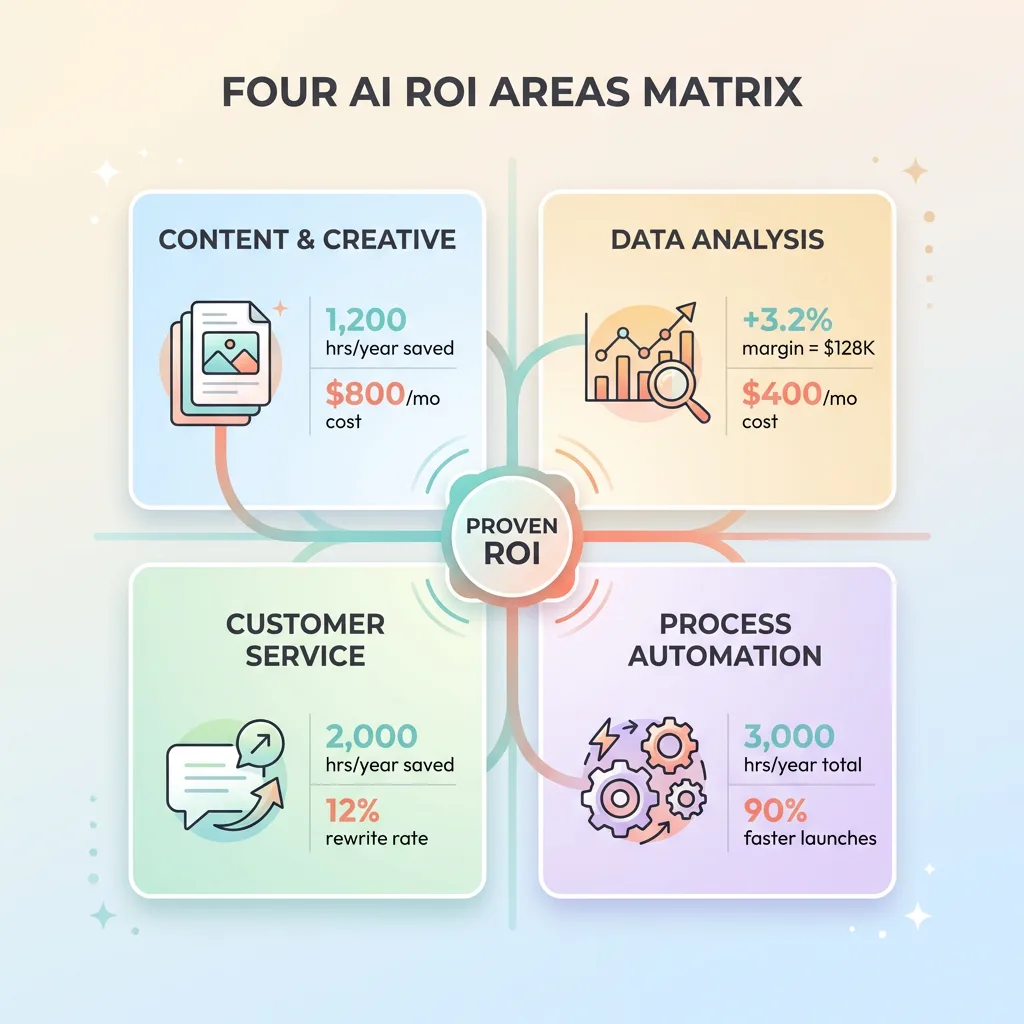 Four AI ROI Areas Matrix
Content and Creative Production
We publish 313 blog articles on the brand's site. AI writes first drafts, optimizes for SEO, generates meta descriptions, and suggests internal links. This system saves us about 1,200 hours per year.
Before AI: 3-4 hours per article from research to published. After AI: 45 minutes of human editing and fact-checking. The AI handles structure, keyword optimization, and semantic relevance. The human handles brand voice and accuracy.
Cost: about $800/month in API fees. ROI: we'd need to hire a full-time content person at $50K+ to produce the same volume. The system pays for itself in week one.
Our product creation pipeline went from 3-4 hours per design to 20 minutes. AI generates initial concepts, creates product descriptions, suggests pricing based on cost and market data, and produces secondary photography. A designer reviews, tweaks, approves.
We use Gemini for image generation at $0.02 per image. Professional product photography runs $50-150 per shot. For hero images, we still use photographers. For lifestyle shots and variations, AI is good enough and 1000x cheaper.
The content we produce isn't perfect. About 15% needs significant human rewriting. But 85% is publication-ready with minor edits, and that changes the economics completely.
Data Analysis and Decision Support
Our AI pricing engine manages 564 products across a 4-tier ABC classification system. It monitors competitor prices, tracks our costs, analyzes sales velocity, and recommends price adjustments twice per week.
The system increased our gross margin by 3.2% in the first six months. On $4M in annual revenue, that's $128K directly attributable to better pricing decisions.
Before AI: I reviewed pricing manually once per quarter, relied on gut feel, missed opportunities. After AI: dynamic repricing based on actual data, catching margin opportunities within days instead of months.
The system also flags anomalies. When material costs jumped 40% on a supplier, the AI caught it in the next pricing run and recommended adjustments before we sold products at a loss.
We use AI for sales forecasting, inventory analysis, and customer segmentation. It processes data we already had but never analyzed deeply because the manual effort wasn't worth it. Now the analysis runs automatically every week.
Cost for our full analytics stack: about $400/month in compute and API fees. Time saved: roughly 800 hours per year that I'm not manually analyzing spreadsheets.
Customer Service and Communications
We use AI to triage and draft responses for customer emails. It reads incoming messages, categorizes them (order issue, product question, return request, etc.), pulls relevant order data, and drafts a response.
A human reviews every response before it goes out. This is critical. The AI handles the repetitive research and writing, but humans make the final call.
This system handles about 200 emails per week. Before AI: 15-20 minutes per email including lookup time. After AI: 3-5 minutes to review and send. That's 2,000+ hours saved annually.
We also use AI for FAQ automation on the website, automated order confirmations with personalized recommendations, and review response generation. These run autonomously because they're lower stakes and templated.
The miss rate on email drafts is about 12%. That means 12% of the time, the human has to significantly rewrite or completely redo the response. We're okay with that. The other 88% still save massive time.
Process Automation
Our product pipeline is the showcase system. From concept to live on the website in 20 minutes, mostly automated.
The workflow: Designer provides core concept and reference images. AI generates product description optimized for SEO. AI creates secondary product images. AI suggests pricing based on cost data and market positioning. AI writes meta descriptions and assigns categories. Human reviews everything, approves, publishes.
This replaced a 3-4 hour process that involved multiple tools, manual data entry, and constant context switching. We now launch products 90% faster with fewer errors.
We've also automated: blog post scheduling and optimization, social media caption generation, inventory reports, competitor price monitoring, and customer data enrichment.
Each system is small. The blog scheduler saves 2 hours per week. Social captions save 3 hours per week. None are transformative alone. Together, they freed up 3,000+ hours annually.
That's why our revenue per employee increased 38% after AI deployment. Not because we got dramatically better at sales or marketing. Because we eliminated 3,000 hours of repetitive work and spent that time on high-value activities.
How to Build Your AI Roadmap (The Actual Steps)
Most companies fail at AI strategy for business because they skip straight to implementation. They see a demo, get excited, and start building without a plan. Then they waste six months and conclude AI doesn't work.
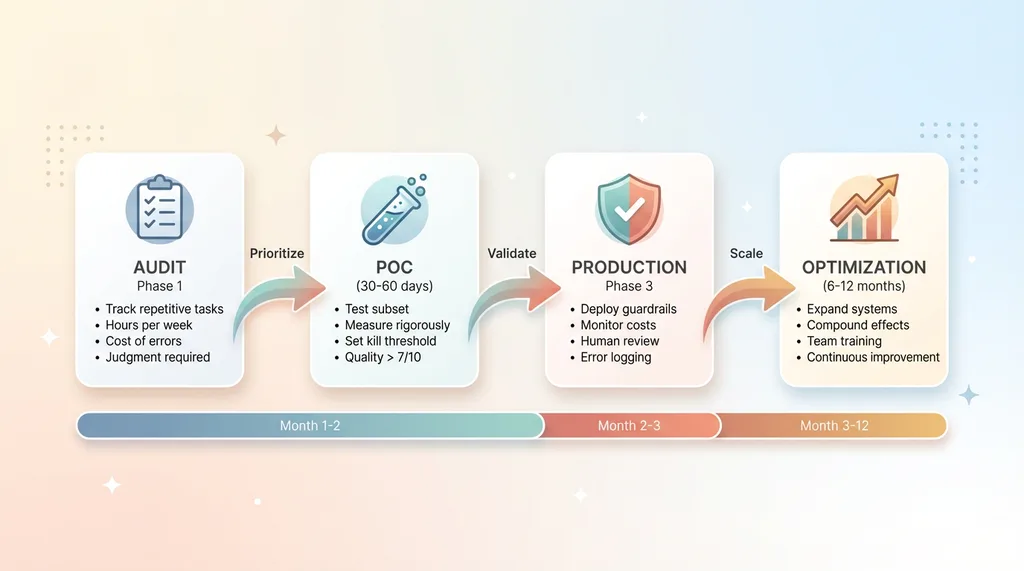 AI Roadmap 4-Phase Timeline
Here's the process that actually works.
Audit: Where You're Bleeding Time and Money
Start by identifying processes that are repetitive, data-based, and eating hours. Not everything. Just the obvious time sinks.
Walk through your operations for a week and track where humans are doing robot work. Data entry. Report generation. Email responses. Content creation. Price updates. Schedule coordination.
I track three things for each process: hours per week spent on it, cost of errors or delays, and how much judgment it requires. High hours, high cost, low judgment = great AI candidate.
At the brand, our audit revealed: 12 hours per week on product descriptions, 8 hours on pricing analysis, 15 hours on customer service lookup and response, 6 hours on blog SEO optimization, 5 hours on inventory reporting.
That's 46 hours per week of work that's repetitive and data-driven. At $50/hour fully loaded cost, that's $120K annually. That becomes your automation budget and your ROI target.
If you want a structured framework for this, I wrote about how to assess whether your business is ready for AI — it includes the specific questions to ask during your audit.
Prioritize: Start With High-Impact, Low-Complexity Wins
Plot everything on a simple 2x2 matrix: business impact vs technical complexity.
High impact, low complexity: these go first. Usually content generation, basic data analysis, and internal process automation. Low risk, high value, fast to build.
High impact, high complexity: these are your six-month projects. Customer-facing systems, predictive analytics, anything that needs complex integration.
Low impact, anything: skip these entirely. Doesn't matter if they're easy. If the impact is low, your time is better spent elsewhere.
We started with product description generation. High impact (12 hours per week saved), low complexity (text in, text out, no integration required). We had it running in production within three weeks.
We didn't start with customer service automation, even though it could save more hours. Customer-facing systems are high risk. Get it wrong and you damage trust. Build confidence with internal systems first.
Proof of Concept: Test Before You Scale
Run a 30-60 day proof of concept before committing to production. Pick a subset of the problem, build quickly, measure rigorously.
When we tested product description generation, we ran it on 50 products. We measured: time saved, quality ratings from our team, SEO performance, conversion rates. We set a threshold: if quality ratings dropped below 7/10, we'd kill it.
Results: 8.2/10 quality rating, 85% time savings, no drop in conversion rate. That was enough data to scale to our full catalog.
Define your success metrics upfront. Be specific. "AI helps with content" isn't measurable. "AI reduces time per article from 3 hours to under 1 hour while maintaining quality scores above 7/10" is measurable.
And be willing to kill it. We tried autonomous customer service in 2024. Failed our quality threshold in week two. We pivoted to human-in-the-loop instead. That willingness to change course saved us from deploying a broken system.
Production: Deploy With Guardrails
When you move to production, build in monitoring and controls. AI systems drift. Models change. Edge cases appear.
Every system we run has: cost monitoring (alerts if spend exceeds threshold), quality checks (random sampling and review), error logging (track failures and weird outputs), human review for high-stakes decisions.
Our pricing engine can suggest changes, but it can't execute them automatically. A human reviews the recommendations and approves. That saved us twice when the model suggested repricing based on bad competitor data.
Our content system has a profanity filter, brand voice checker, and fact validation layer. These aren't built into the base AI model. We added them because we learned what breaks.
Plan for 6-12 months to have a mature AI operation. First 3 months: deploy 1-2 systems, learn what works. Months 3-6: scale to 4-5 systems, develop your internal processes. Months 6-12: optimize, expand, start seeing compounding returns.
We're three years in and still learning. But the first production system went live in month two. You don't need to plan everything perfectly. You need to start, measure, adjust.
The Five Mistakes CEOs Make With AI Strategy
I've made four of these five mistakes personally. The fifth one I watched other companies make and learned from their pain.
Starting with customer-facing automation instead of internal tools. This is the most common failure pattern. CEO gets excited about AI chatbots, deploys customer service automation, it screws up 15% of interactions, customers get mad, company concludes AI doesn't work.
Start internal. Get your team comfortable with AI making mistakes where customers can't see them. Build confidence, develop processes, learn what breaks. Then move to customer-facing.
We spent 18 months on internal systems before we deployed anything customer-visible beyond basic templates. That patience paid off. When we finally launched AI-assisted customer service, we knew how to monitor it, where it would fail, and how to catch problems.
Treating AI as a technology project instead of an operations redesign. AI isn't software you install. It's a change to how your business operates.
When we built the pricing engine, 40% of the work was AI. 60% was restructuring how we tracked costs, standardized product data, and defined pricing rules. The AI was useless until we cleaned up our operations.
Most companies hand AI to IT and expect magic. IT builds something technically impressive that doesn't fit the actual workflow. It sits unused. This is a business transformation that uses AI, not a technology deployment.
Expecting autonomous systems instead of augmentation. The value is in human + AI, not AI alone.
We tried fully autonomous product description generation. Just let the AI write and publish. Results were mediocre. 60% were good, 40% were off-brand or awkward.
We shifted to AI drafts + human editing. Quality jumped to 85% good, 15% needing significant editing. The human adds judgment, brand voice, and catches weird errors. The AI adds speed and consistency. Together they're better than either alone.
Most AI value comes from augmentation. AI does the repetitive parts, human does the judgment calls. Companies that expect to remove humans entirely usually fail.
Underestimating the data cleanup required. Garbage in, garbage out. This isn't new with AI, but AI makes it more visible.
Our pricing engine didn't work for the first month. Not because the AI was bad. Because our product cost data was a mess. Some products had costs in one spreadsheet, others in another system, some were estimated, some were six months old.
We spent three weeks standardizing cost tracking before the AI could do anything useful. This isn't exciting work. But it's required.
If your data is scattered, inconsistent, or incomplete, AI will just process garbage faster. Do the data work first. Or accept that your first AI project is actually a data cleanup project that happens to use AI.
Hiring for AI expertise without domain expertise. I've seen companies hire data scientists who know PyTorch but don't understand their business. The models work technically but solve the wrong problems.
You need someone who understands your operations AND AI. The AI part is actually easier to learn. The business part takes years. I wrote about what a Chief AI Officer actually does — the key insight is that it's 60% business strategy, 40% technical execution.
At the brand, I built our AI systems because I know where the operational bottlenecks are. I know which 3% margin improvement matters and which doesn't. I know what our customers care about. The AI implementation follows from that understanding.
Hire someone who knows your industry first, AI second. Or bring in outside expertise that takes time to learn your business before building anything.
Building Your AI Team: Internal, Consultant, or CAIO
You have three options. Each makes sense in different situations.
Internal hire. Pros: dedicated resource, learns your business deeply, available for ongoing optimization. Cons: expensive ($150K-$300K+ for someone who knows both AI and business), hard to find qualified candidates, need enough AI work to justify full-time.
This makes sense if you're $50M+ revenue, have 10+ potential AI projects, and can afford to build a team. You're not hiring one person, you're building an internal capability.
For most mid-market companies, this is overkill. You don't have 40 hours per week of AI work yet. You're paying for capacity you won't use.
AI consultant. Pros: project-based cost, brings experience from other clients, defined scope. Cons: generic solutions that don't fit your business, no ongoing optimization after project ends, incentivized to sell more services rather than make you self-sufficient.
We used consultants for our initial AI exploration in 2022. They built a proof-of-concept chatbot that technically worked but didn't fit our workflow. It sat unused. We paid $35K for a demo project.
Consultants can be valuable for specific projects where you need expertise fast. But they're not building your AI strategy. They're executing defined projects.
Chief AI Officer. Pros: strategic + tactical execution, part-time cost structure, builds systems that run without constant oversight, knowledge transfer to your team. Cons: not dedicated full-time, working with multiple clients.
This is what we do at the brand and what I offer to other companies. I spend 20-30 hours per month on AI strategy and implementation. That's enough to build real systems but not so much that you're paying for unused capacity.
The model works because AI projects are bursty. Intense work for 2-3 weeks to build a system, then light maintenance for months. You don't need someone full-time. You need someone strategic part-time.
For companies doing $5M-$50M in revenue, this is usually the right fit. You get expertise without the full-time cost. You build systems that generate ROI, not proof-of-concepts that sit on a shelf.
Budget guidance: Internal hire runs $150K-$300K fully loaded. Consultant projects run $25K-$100K per project. CAIO runs $5K-$15K per month depending on scope and complexity. Do the math on how much AI work you actually need.
What Your First 90 Days Should Look Like
If you decide to move forward with AI strategy for business, here's the tactical roadmap.
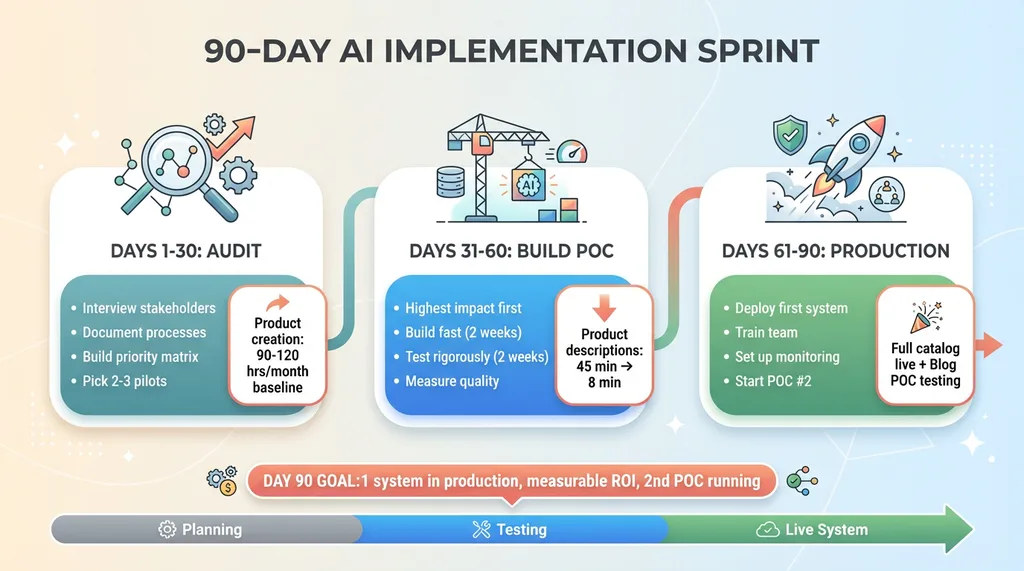 90-Day AI Implementation Sprint
Days 1-30: Audit and prioritization. Interview stakeholders across operations, customer service, marketing, sales. Ask: where are you doing repetitive work? Where are you making data-driven decisions manually? Where are delays costing you money?
Document everything. Build a prioritization matrix. Pick 2-3 pilot projects based on impact vs complexity. Get buy-in from the teams who'll use the systems.
At the brand, our first 30 days identified: product creation pipeline, blog content automation, and pricing analysis as our top three opportunities. We baselined current time and cost for each. Product creation: 3-4 hours per design, 30 designs per month, 90-120 hours monthly.
Days 31-60: Build first proof of concept. Pick the highest-impact, lowest-complexity project. Build fast, measure rigorously.
We built the product description generator first. Two weeks to build, two weeks to test on 50 products. We measured: time per product (dropped from 45 minutes to 8 minutes), quality ratings (8.2/10), error rate (2% needed complete rewrite).
Results were good enough to move forward. We established the workflow: AI generates draft, designer reviews and edits, publishes. We documented what works and what doesn't.
Simultaneously, start data prep for the next system. If you're building a pricing engine next, start standardizing your cost data now. Don't wait until the first POC is done.
Days 61-90: Deploy first production system, start second POC. Take your successful POC to full production. Train the team, establish monitoring, set up quality checks.
We deployed product descriptions to our full catalog in week 10. We set up: weekly quality audits (random sample of 20 products reviewed), cost monitoring (alert if monthly spend exceeds $500), error tracking (flag any products with incomplete data).
Start building the second POC. You're now running two parallel tracks: optimizing the first production system while building the next one.
By day 90, good looks like: one system in production generating measurable time or cost savings, clear data on ROI, second POC in testing, roadmap for the next 3-6 months, team trained and bought in.
Bad looks like: still in planning phase, no POC running, stack of vendor demos with no decisions, team skeptical because they haven't seen anything work yet.
At the brand, our first 90 days produced: product description system in production (saving 800 hours annually), blog automation POC running (preliminary results promising), pricing engine data cleanup in progress. Revenue impact in month three: minimal. But the foundation was built.
By month six, we had three systems in production and started seeing compound effects. Systems talked to each other. Data from one improved another. The blog automation fed product content. The pricing engine used sales data from both.
That's when AI strategy pays off. Not in the first system, but when multiple systems create a flywheel.
The timeline is aggressive but realistic. I've seen companies waste 12 months planning. I've also seen companies rush into production in 30 days and deploy broken systems. 90 days to first production system, 6 months to a real AI operation — that's the sweet spot.
Ready to Build Your AI Strategy?
I've spent three years building AI systems at my DTC fashion brand. I've deployed 15 systems in production, saved 3,000+ hours annually, increased revenue per employee by 38%, and learned what works and what breaks.
Most companies don't need more AI theory. They need someone who's actually done it, knows the pitfalls, and can build systems that generate ROI in months, not years.
If you're a CEO or business owner doing $5M-$50M in revenue, dealing with repetitive processes that eat hours, and ready to move past AI hype into actual implementation — let's talk.
I work with a small number of companies as their Chief AI Officer. Strategic + tactical. Building systems, not slide decks. Focused on ROI, not R&D.
The engagement starts with a free 30-minute strategy call. No pitch deck, no sales team. Just a real conversation about your operations, where AI fits, and whether it makes sense to work together.
We'll look at your biggest operational bottlenecks, identify 2-3 high-impact opportunities, and map out what the first 90 days could look like. If there's a fit, great. If not, you'll walk away with a clearer picture of where AI could help.
I only take on clients where I'm confident I can deliver measurable value. If I don't think AI is the right move for you right now, I'll tell you.
Want to explore what AI could do for your business? Book a discovery call and let's figure it out.
Or if you want to think through your specific situation first, talk through your AI readiness and we'll go from there.
Get AI insights for business leaders
Practical AI strategy from someone who built the systems — not just studied them. No spam, no fluff.
Hodgen.AI
Ready to automate your growth?
Book a free 30-minute strategy call with Hodgen.AI.
Book a Strategy Call