Google Core Update Ranking Drop: How I Found the Cause
A head keyword dropped from #3 to #11. Here's how I diagnosed a Google core update ranking drop with live SERP data instead of guessing.
By Mike Hodgen
The Morning a 47K-Volume Term Slid From #3 to #11
I run a DTC fashion brand out of San Diego. Our homepage ranked around #3 for its head term, a phrase pulling roughly 47,000 monthly searches. That one keyword drives a meaningful slice of our organic revenue, the kind of number where a position change shows up in the bank account, not just a dashboard.
During the May 2026 Google core update, it slid. Not a wobble. From about #3 to roughly #11. Off the first page, basically invisible.
I have seen this movie before, and I know the reflex. Every agency on the planet has the same two answers when they see a google core update ranking drop: build more backlinks, or publish more content. Both cost money. Both take months. Both assume you already know what broke.
I didn't. And that bothered me more than the ranking did.
Here's the thing nobody wants to admit. Most ranking-drop responses are expensive guesses dressed up as strategy. Someone sees the number go down, panics, and starts spending before they've proven a single thing about the cause. They treat the symptom because the symptom is the only thing they can see.
I refused to spend a dollar until I could prove what actually happened. Not a theory. Not a hunch. Evidence.
What follows is the exact diagnostic process I ran on my own brand. It took an afternoon. It saved me months of misdirected work and a five-figure budget aimed at the wrong target. And it ended with a strategic decision I never would have reached if I'd done what the agencies wanted.
The Four Things That Can Tank a Ranking (And Why They Look Identical)
Here's the trap. Four completely different problems all produce the exact same symptom: rankings go down. Your dashboard doesn't tell you which one you're facing. It just shows red.
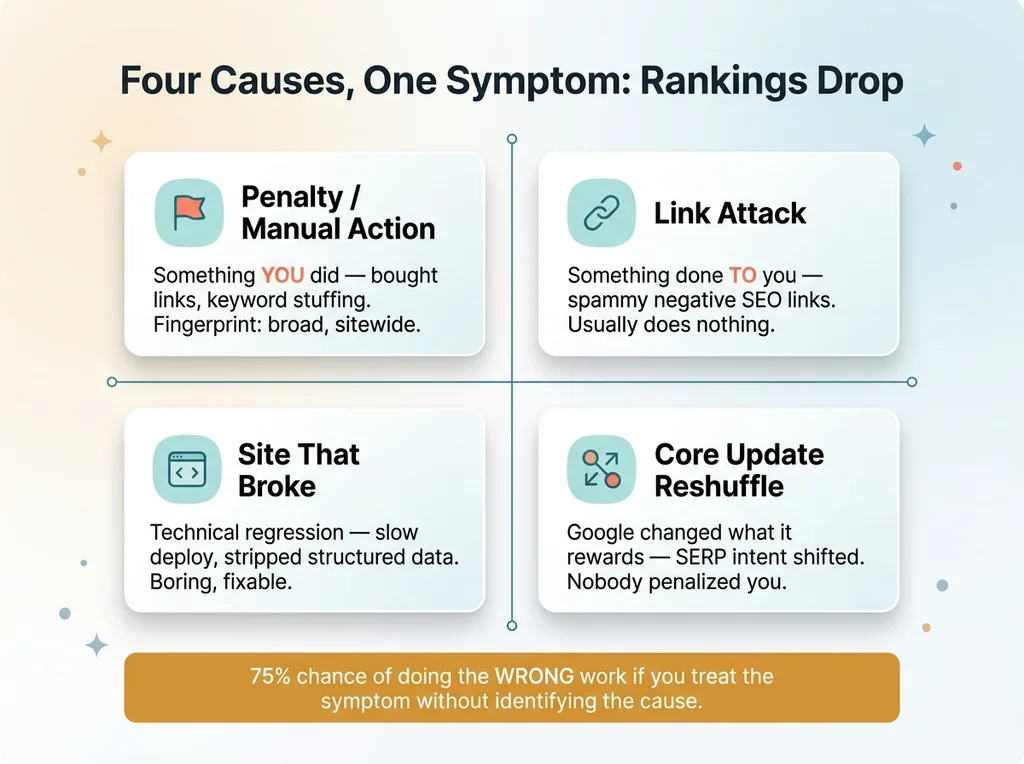 Four causes of a ranking drop that look identical
If you treat the symptom without identifying the cause, you have a 75% chance of doing the wrong work. Three of these four lead you to waste months fixing something that was never broken.
Penalty or manual action
This is something you did. You bought links, stuffed keywords, ran thin doorway pages, and Google noticed. A manual action shows up in Search Console. An algorithmic penalty doesn't announce itself, but it has a fingerprint: broad, sitewide, and it correlates with your own behavior.
A link attack
This is something someone did to you. Negative SEO, where a competitor (or a bored troll) points a pile of spammy links at your domain hoping Google blames you. It feels personal and it triggers real panic. Most of the time it does nothing, but you can't assume that.
A site that broke
This is a technical regression. A deploy slowed your page down. A template change stripped your structured data. Something in the stack broke and Google quietly stopped trusting the page. Boring, common, fixable.
A Google core update reshuffling intent
This is Google changing what it rewards. Nobody penalized you. Nothing broke. Google simply decided the query means something different than it did last week, and it reordered the SERP to match. This is a serp intent reshuffle, and it's the one everyone misreads as a problem they caused.
The whole game is figuring out which of these four you're actually looking at. You cannot fix it until you know. And the symptom alone will never tell you, because the symptom is identical across all four.
The Decisive Test: Did the Whole Site Move, or Just One Term?
This is the single most important diagnostic I ran, and if you only remember one thing from this article, make it this one.
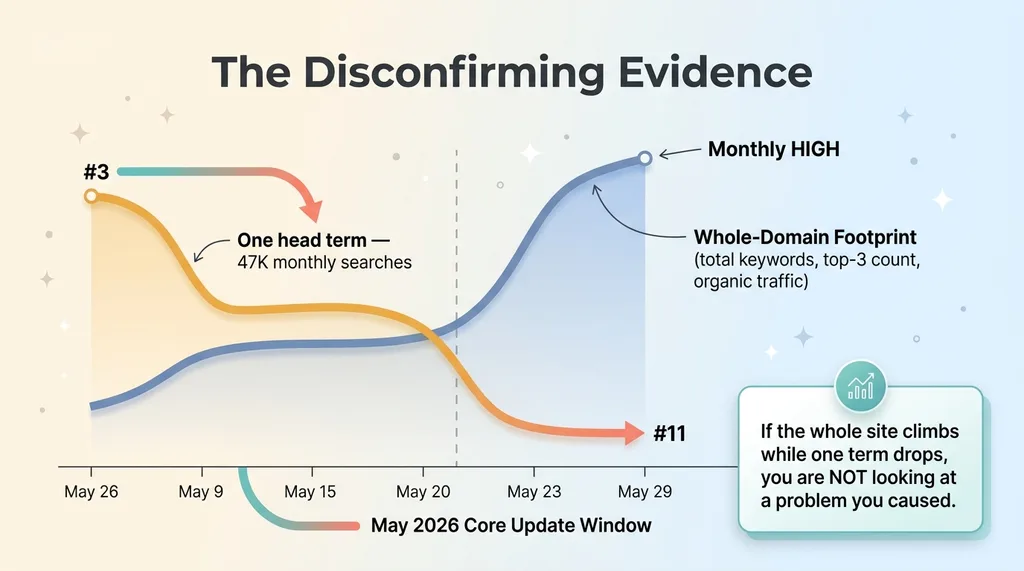 The decisive test: whole-site vs single-term movement
Ask whether your entire domain moved, or whether only the one term moved. That single question eliminates most of the candidate causes in about ten minutes.
So I checked the whole-domain footprint. Not the head term. Everything. Total keyword count, top-3 count, estimated organic traffic across the entire site during the exact window the head term dropped.
The entire site hit a monthly high during that same window. My top-3 keyword count actually rose. Organic traffic across the domain climbed while my one big term fell off a cliff.
Sit with that for a second, because it's the key. A penalty drags everything down. A link attack, if it works, suppresses the whole domain. A site that broke takes a chunk of pages with it. All three of those problems are sitewide by nature.
My site was going up.
That is disconfirming evidence, and disconfirming evidence is worth ten times more than confirming evidence. When you're scared, your brain hunts for proof that your fear is real. The discipline is to do the opposite: actively look for the data that would prove your fear is wrong.
If the whole domain is climbing while one term drops, you are almost never looking at a problem you caused. You're looking at a SERP-specific reshuffle on that one query. Something changed about that specific search, not about your site.
That one check reframed the entire investigation. I stopped asking "what did I break?" and started asking "what changed about this query?" Completely different question. Completely different fix.
What Live SERP Data Showed That Ahrefs Couldn't
Now I needed to see the actual SERP. And this is where most people get lied to by their own tools.
Why your rank tracker lies to you for days
Ahrefs still showed my term sitting at #2. Reassuring, except it was wrong. Third-party rank trackers don't query Google in real time. They sample on a schedule and they lag the live SERP by days, sometimes a week during volatile periods like a core update rollout.
So during the exact window when I needed accurate data most, my paid rank tracker was showing me a snapshot from before the drop even happened. If I'd trusted it, I'd have concluded nothing was wrong at all.
What actually appeared in the top 10
I pulled the live results myself using Serper and Firecrawl, the same live SERP monitoring approach I use to track competitors in real time. Not a cached estimate. The actual page Google was serving that afternoon.
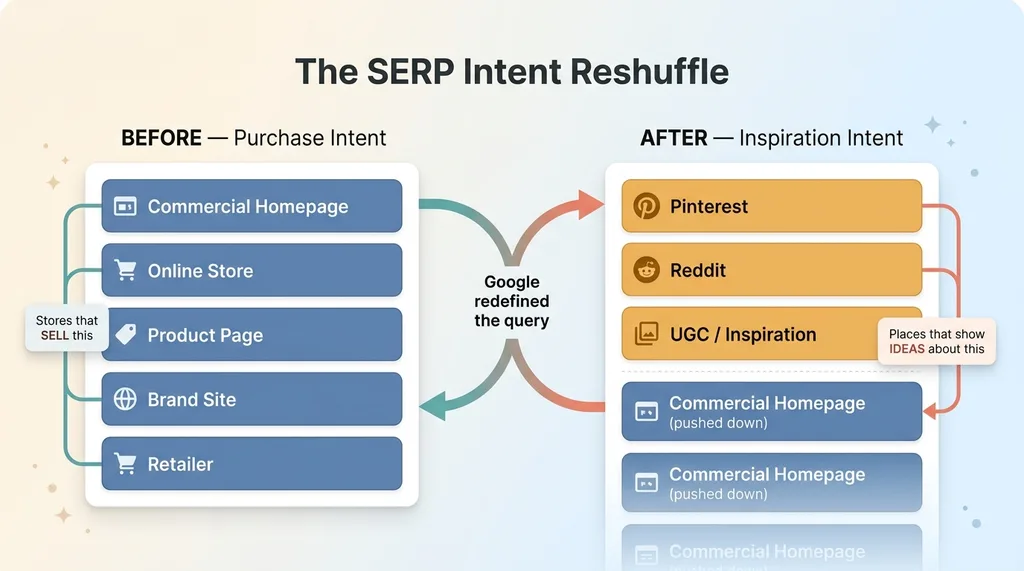 SERP intent reshuffle, before and after composition
The story was right there. Google had injected Pinterest, Reddit, and a couple of other UGC and inspiration sources above the commercial homepages that used to own the top of that SERP. The whole top 10 had tilted away from "stores that sell this" and toward "places that show you ideas about this."
My homepage didn't get worse. The query's meaning, in Google's eyes, changed. Google decided this search carried more inspiration intent than purchase intent, and it rebuilt the results page around that decision.
That's a serp intent reshuffle, and you cannot diagnose it from a rank-tracking number. You have to look at what's actually winning. The composition of the SERP told me everything the position number hid.
Ruling Out the Two Red Herrings
Two scary things were happening at the same time as the drop. Both looked like obvious culprits. Neither was. This is the part of diagnosis nobody has the patience for, and it's exactly where the money gets wasted.
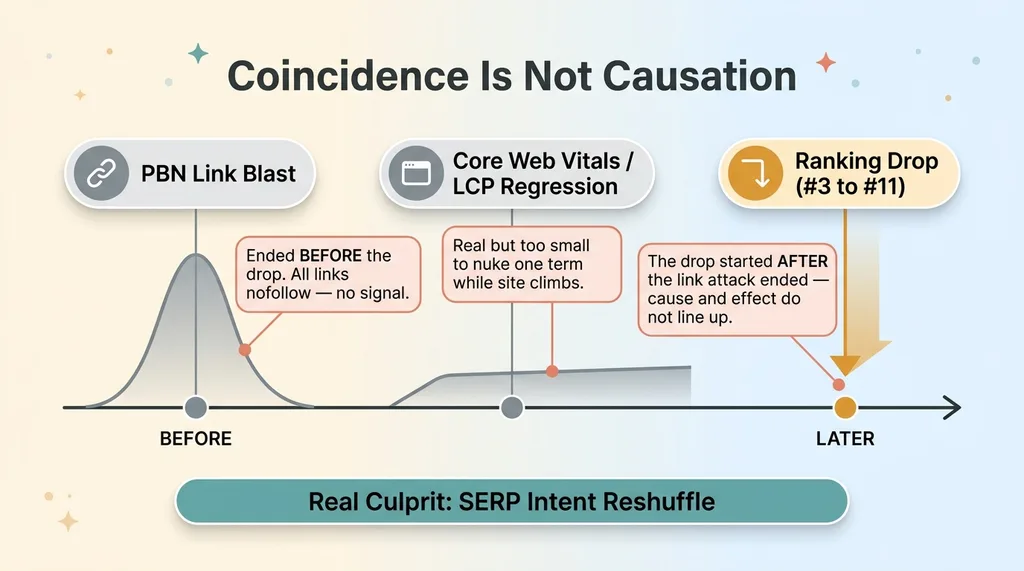 Ruling out red herrings with timeline correlation
The PBN blast that peaked and died before the slide
There was a real private blog network blast pointed at my domain during this period. A wave of spammy links, the exact thing that makes an owner scream "negative SEO" and reach for a disavow file.
But I checked the timeline before I panicked. The blast peaked and died before the ranking slide even started. The cause-and-effect didn't line up. And every link in it was nofollow, which means it passed no signal Google would act on anyway.
I walked through the full reasoning in a separate piece on how I ruled out a PBN link attack with a rank-vs-traffic heuristic. Short version: a link attack that ends before the drop begins is not the cause of the drop. Timeline correlation matters more than the scary-looking volume.
The Core Web Vitals regression that was real but secondary
There was also a genuine LCP regression on the homepage. A real Core Web Vitals problem, not imagined. The page had gotten slower.
But the math didn't support it as the cause. A small speed regression does not drop a #3 ranking ten positions while the rest of the site climbs to a monthly high. The scale was wrong and the selectivity was wrong. CWV degradation would nudge, not nuke one specific term while lifting everything else.
I dug into the lab-versus-field gap on that one too, because Core Web Vitals were a real but secondary problem worth fixing on its own merits, just not the reason for the drop.
The lesson holds in both cases. Two alarming things were happening at once and neither was the culprit. Coincidence is not causation, and a core update is exactly the kind of chaotic window where unrelated problems stack up and beg to be blamed.
The Strategic Call: Stop Trying to Win Back #3
Once the diagnosis held, the strategy flipped completely.
If Google reshuffled this term toward inspiration intent, then fighting to reclaim #3 with the same commercial homepage is fighting the algorithm's new definition of the query. I'd be pouring budget into ranking a "buy now" page for a search Google has decided is about browsing ideas. That's not an SEO problem you can out-optimize. That's a mismatch between my asset and the intent.
More backlinks won't fix it. More commercial content won't fix it. Those moves assume the old SERP is coming back. It isn't.
The smarter play is to capture the intent Google is now rewarding. The formats Pinterest and Reddit are filling: visual inspiration, user-generated content, the browsing-stage material that sits upstream of purchase. If Google wants inspiration in those slots, I build inspiration content that can earn those slots, instead of demanding my product page get its old position back.
I'll be honest about core update recovery, because this is where most advice lies to you. Recovery does not always mean restoring the old position. Sometimes recovery means adapting to the new SERP. The query moved, and the winning move is to move with it, not to spend twelve months trying to drag it back to where it used to be.
This is the entire distinction that matters: a fixable problem versus Google moving the goalposts. If you broke something, fix it and rankings return. If Google redefined the query, restoration is the wrong goal and adaptation is the right one. Knowing which situation you're in is worth more than any tactic, because it determines whether your effort compounds or evaporates.
When Your Traffic Tanks, Diagnose Before You Spend
Here's the question every owner asks when traffic drops: is this something I can fix, or is Google just moving the goalposts?
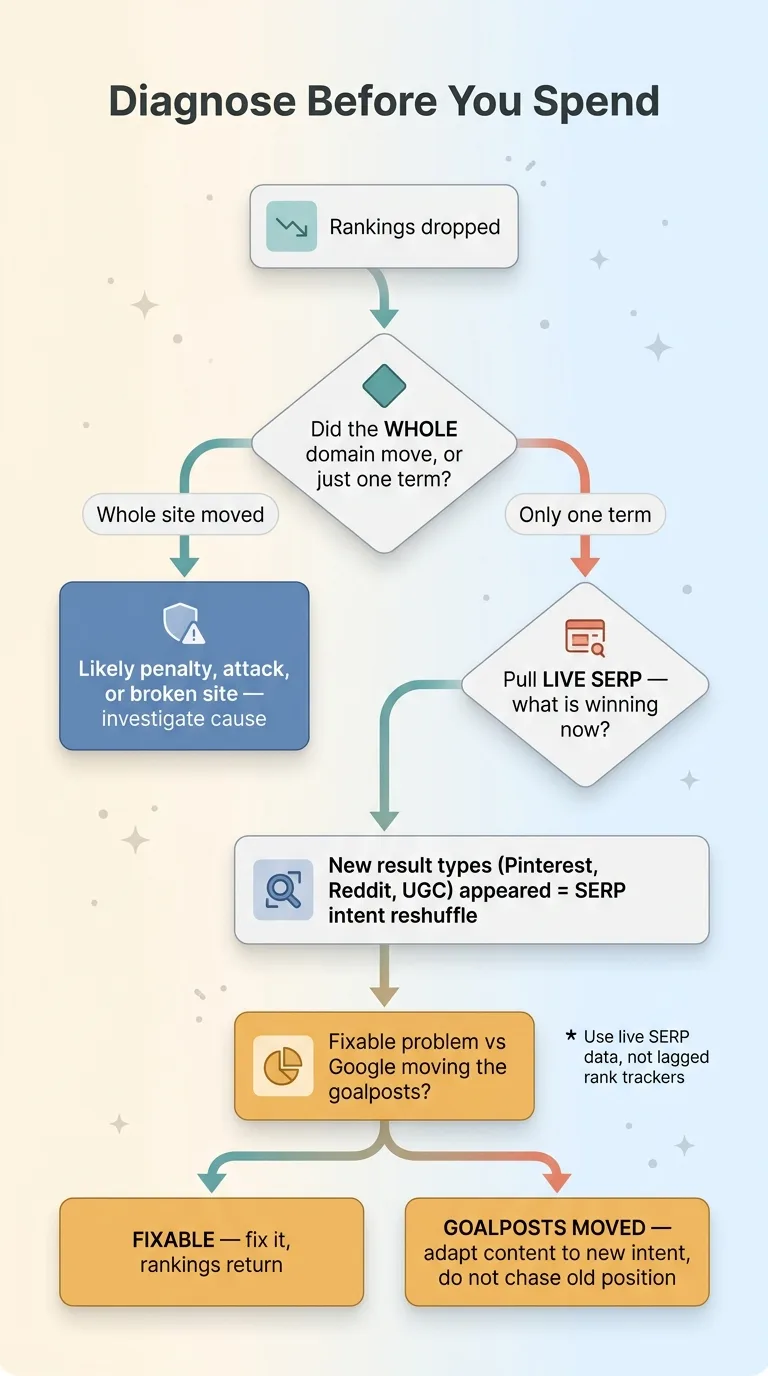 Diagnose-before-you-spend decision flow
You answer it by building the instrumentation to tell the difference. Live SERP data instead of lagged rank trackers. Whole-domain footprint monitoring so you can see whether one term moved or the entire site moved. Timeline correlation that lines up the drop against your link events, your deploys, and the core update rollout dates.
With those three things, the diagnosis takes an afternoon. Without them, you're blind, and blind owners pay agencies to guess. The guess is almost always the same: more content, more links. It sounds like progress and it bills like progress, but if the real cause was a serp intent reshuffle, you just spent a quarter solving a problem you never had.
That diagnosis saved my brand months of misdirected work and a budget aimed at the wrong target. Not because I'm smarter than the agencies, but because I built the systems to look before I spent.
This is exactly the kind of systems thinking I bring as a Chief AI Officer. Not "let's publish more." Instrumentation that tells you what's actually true, so every dollar you spend is aimed at a problem you've proven exists.
If your rankings cratered and you don't know why, bring me in to diagnose it before you spend on the wrong fix. The diagnosis is cheap. The wrong fix is what's expensive.
Want to explore what AI could do for your business?
Book a free 30-minute strategy call. No pitch deck, no sales team, just a real conversation about your operations and where AI actually fits.
Get AI insights for business leaders
Practical AI strategy from someone who built the systems — not just studied them. No spam, no fluff.
Hodgen.AI
Ready to automate your growth?
Book a free 30-minute strategy call with Hodgen.AI.
Book a Strategy Call