AI Child Development Tracking: What Actually Changed
AI child development tracking replaces paper checklists with daily personalized plans, milestone predictions, and video analysis. Here's what really changed.
By Mike Hodgen
How We Tracked Child Development for the Last 50 Years
Here is how ai child development tracking used to work, which is to say, here is how it worked for decades without any AI at all.
Your kid hits nine months. You go to the pediatrician for a well-child visit. A nurse hands you a paper checklist. Does your baby sit without support? Does she babble? Does he point at things he wants? You check some boxes, the doctor glances at the sheet, and you go home.
That is the system. Periodic visits, a paper checklist, and a parent trying to remember what their child did three months ago.
The paper checklist at the 9-month visit
These visits happen maybe six times before a child turns two. After that, they thin out fast. Each visit captures a few checkmarks against a list that is identical for every child in the waiting room.
So the data is sparse. A handful of data points across two years of explosive brain development. And it is generic. The same questions for a kid who is sprinting ahead on language and a kid who is taking their time.
Why parent memory is the weakest link
Then there is the recall problem. The nurse asks if your child pointed at objects to show you something. You think. Was that last month? Or am I thinking of when she reached for the dog? You check the box anyway.
Recall bias is real, and it is the weakest link in the whole chain. We are asking exhausted parents to be accurate historians of behavior they witnessed once, weeks ago, in the middle of a sleep-deprived blur.
None of this is a knock on pediatricians. They are working with the tools they were given. The model is just sparse, generic, and forgetful by design. That is the problem worth solving.
What AI Actually Changes (And What It Doesn't)
Let me kill the obvious fear first, because it is the same fear every buyer in a regulated field has.
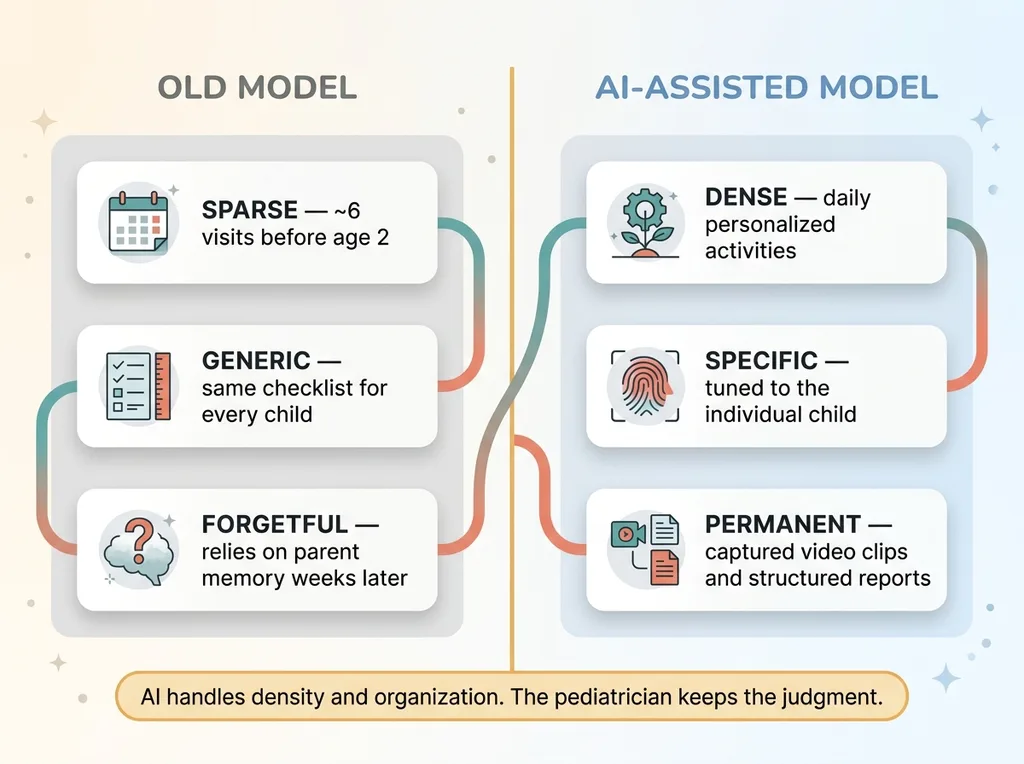 Old vs New child development tracking model
AI does not replace the pediatrician. It does not make the diagnosis. It does not decide whether your child needs an intervention. I built a consumer app for tracking early childhood development, and at no point does the AI play doctor.
What it changes is narrower and more useful: the density and personalization of the data between visits, and how that data gets organized for the clinician.
Here are the four concrete shifts I built in.
One: daily personalized activities instead of a one-time generic list. The app suggests age-appropriate play tuned to the specific child, not a sheet handed to everyone.
Two: milestone predictions with confidence ranges, grounded in the CDC's 2022 milestone framework. Not vibes. Not false certainty. Honest ranges.
Three: structured pre-visit reports instead of foggy parent recall. The parent walks into the appointment with organized observations, not a shrug.
Four: vision-based assessment of short clips. A parent records 20 seconds, and a vision model reads it for developmental markers.
What stays the same is everything that matters clinically. The judgment. The diagnosis. The human in the loop.
This split is not specific to pediatrics. It is the exact pattern I see in every field I touch. AI handles the density, the organization, and the surfacing. The expert keeps the conclusion. The same pattern shows up in every regulated industry I touch, from financial advisory to labor compliance. The names change. The structure does not.
From a Generic List to a Daily Plan That Adapts
The first shift sounds small and is not. Replacing one static checklist with a daily plan that actually adapts changes parent behavior.
Personalized to the individual child
The old model gives every child the same list for months. The new model gives a parent two or three suggested activities a day, tuned to that child's current stage and recent progress.
Not medical advice. Age-appropriate play and engagement, organized so a busy parent actually does it. The difference between a sheet that lives crumpled in the bottom of a diaper bag and a short, doable prompt that shows up today.
That distinction matters more than the technology. The best milestone tracking AI in the world is useless if the parent never engages with it. So the design constraint was never "be smart." It was "be done." Two or three things, today, that fit into a real day with a real kid.
Feedback that reshapes tomorrow's plan
Then the parent reports back. Tried this, she loved it. Tried that, he was not ready. The plan adjusts.
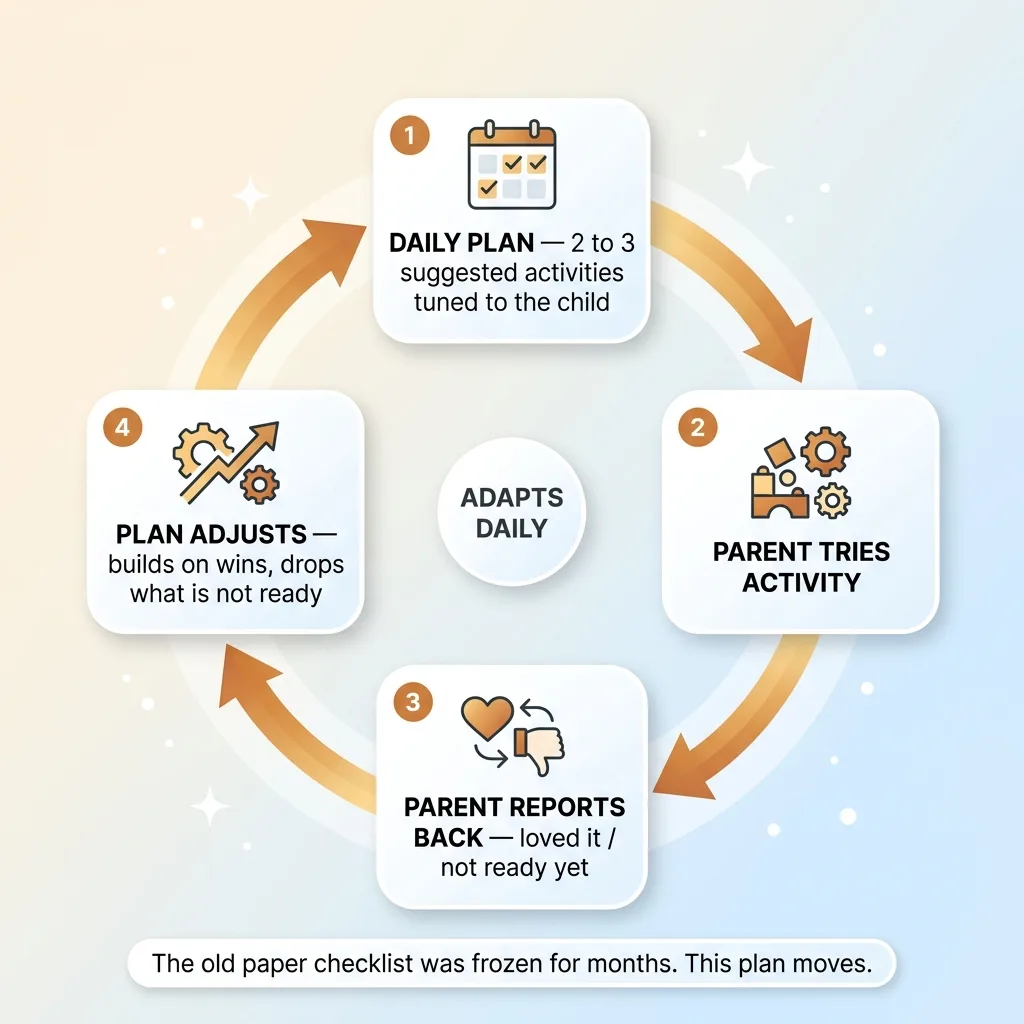 Adaptive daily plan feedback loop
This is the part the paper checklist could never do. The old list was frozen for months at a time. This one moves. If a child clearly is not ready for an activity, the plan does not keep pushing it. If a child takes to something, the plan builds on it.
It is a feedback loop, the same kind I build into every system. The product priced 564 items in my DTC brand by watching what actually sold, not by guessing once and freezing the number. Same logic here. The plan that adapts to yesterday beats the plan that was perfect on paper six weeks ago.
Milestone Predictions Grounded in CDC Data (With Confidence Bars)
The second shift is where consumer health AI usually goes wrong, so I want to be careful about how I describe it.
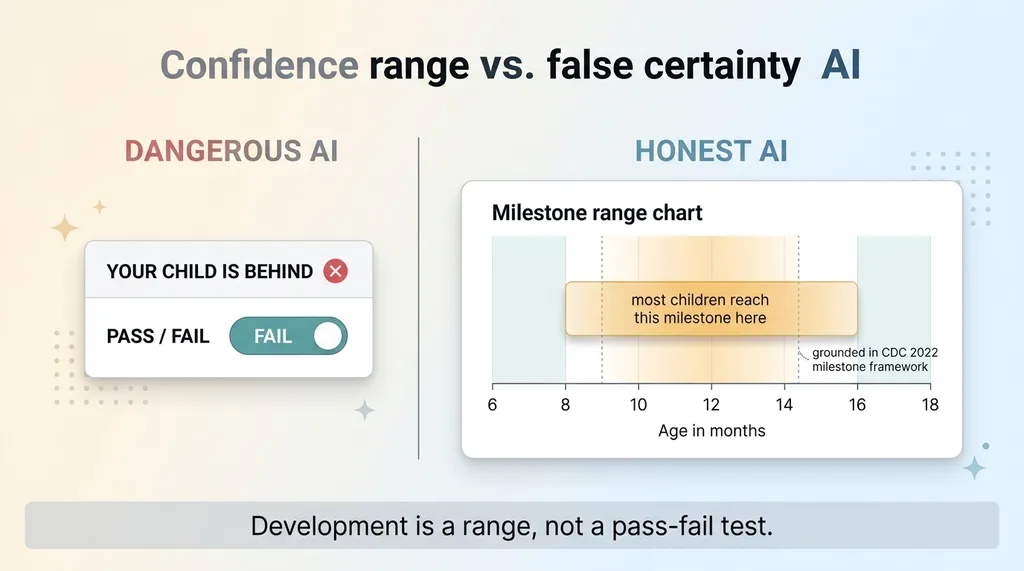 Confidence range vs false certainty in predictions
The predictions are not guesses. They are grounded in the CDC's 2022 milestone framework, which is the same evidence base pediatricians reference. The AI is not inventing developmental timelines out of training data. It is organizing observations against an established clinical standard.
But here is the part that mattered most to me. The predictions come with confidence ranges, not false certainty.
A confidence bar tells a parent "most children reach this between X and Y months." It does not say "your child is behind" or "your child is fine." It communicates a range, because development is a range, not a pass-fail test.
This is the difference between honest AI and dangerous AI. Think about the stakes. This is a parent and their child. An overconfident prediction here is not a bad product recommendation. It is a parent lying awake at 2am because a black box told them something certain about a thing that is inherently uncertain.
So the design choice was grounding plus humility. Grounded in CDC data, honest about what it does not know. The confidence bar is not a UI decoration. It is the whole ethical position of the feature.
I hold the same standard in every system I ship. My pricing engine gives ranges and reasons, not commandments. The AI that admits "I am not sure" is more trustworthy than the one that sounds confident and is wrong. In a field about someone's child, that is not a nice-to-have. It is the line between a responsible tool and a reckless one.
A Vision Model That Watches a 20-Second Clip
This is the shift that makes people lean in, and it is the clearest answer to "what does AI actually change in a field that worked the same way for decades."
A parent records a short clip, 20 seconds of their child playing or moving. A vision model reads it for developmental markers. Movement patterns, engagement cues, fine and gross motor signals. The kind of thing that flickers past in real time and is gone before a tired parent can register it.
If you want the technical breakdown, I wrote up a vision model that reads a short clip separately. The short version is that modern vision models can read a video the way they read text, frame by frame, and surface structured observations from it.
What it reads, and what it refuses to say
Here is the honest part. It surfaces observations a parent might miss. It does not diagnose anything.
The model is not saying "your child has a delay." It is saying "here is what was observable in this clip." It turns a fleeting moment into a structured note. The parent goes from "I think she did the thing once, maybe?" to a clip plus a clear set of observations a pediatrician can actually review.
That is the real value. Not replacing the doctor's eye, but giving the doctor something concrete to look at. A pediatrician gets maybe 15 minutes per visit. Walking in with structured observations from real moments, instead of secondhand recall, makes that limited time dramatically more useful.
This is the answer to the decades-old problem I opened with. The old model was sparse, generic, and forgetful. A 20-second clip read by a vision model is dense, specific, and permanent. The moment does not depend on whether a parent remembered it correctly three weeks later. It is captured, and it is structured.
The Guardrail Layer: Why the Pediatrician Still Decides
Everything I have described would be reckless without one more layer. So this is the part I care about most.
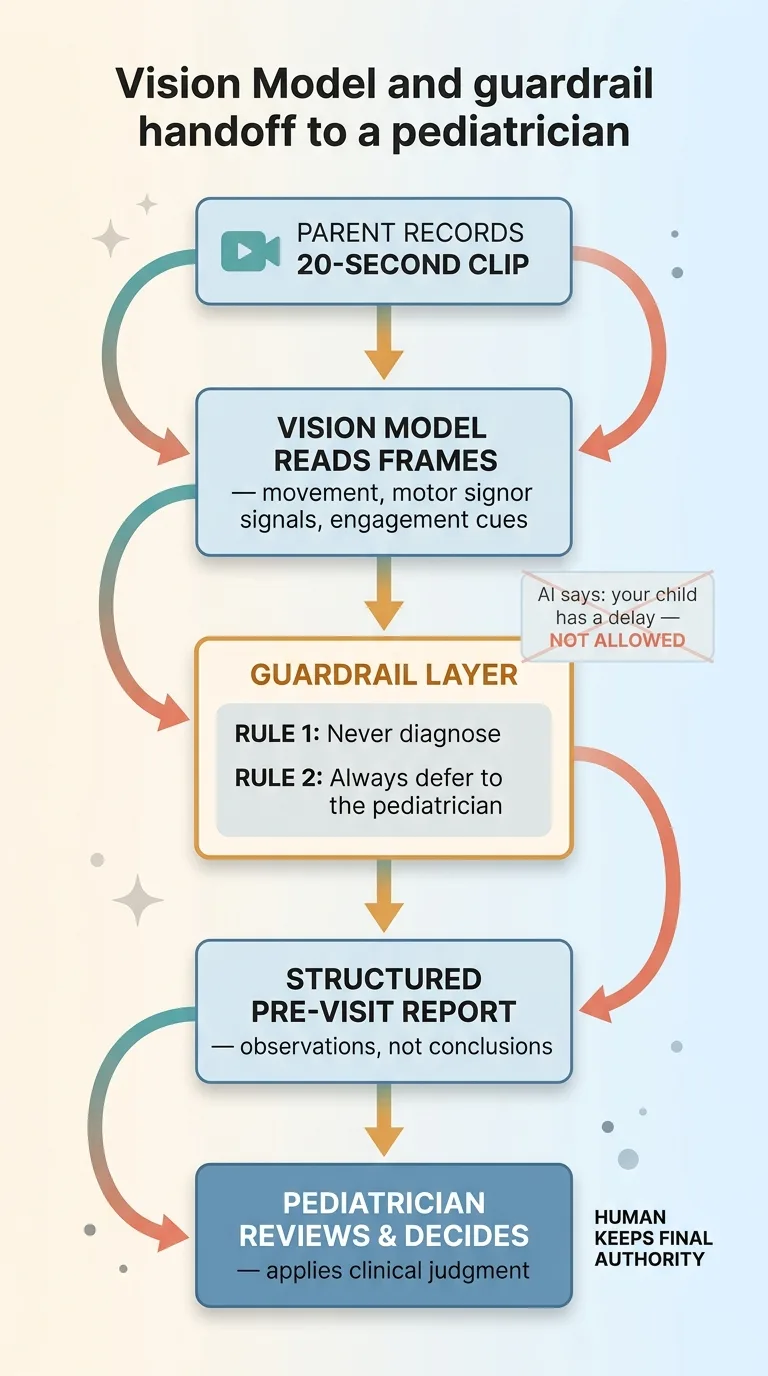 Vision model and guardrail handoff to pediatrician
There is a hard guardrail layer that enforces two rules. Never diagnose. Always defer to the pediatrician.
The AI organizes, tracks, and surfaces. It does not conclude. No matter how clear an observation looks, the system does not tell a parent what it means clinically. That is not the AI's job, and the guardrail makes sure it never drifts into pretending otherwise.
The output is a structured pre-visit report. The parent brings it to the appointment. The pediatrician reads it, applies clinical judgment, and decides. The AI made the 15 minutes in the exam room more useful. It did not try to replace them.
I want to be plain about something. This is the design, not a limitation. People sometimes hear "the AI won't conclude" as a weakness, like the technology is not quite good enough yet. Wrong. The refusal to conclude is the feature. Every AI system I ship stops for a human, and in health it stops harder than anywhere else.
Without the guardrail, this app would be a liability machine, handing out implied diagnoses to scared parents. With the guardrail, it is an organizing tool that makes both the parent and the doctor better equipped, while the clinician keeps final authority.
That is the entire difference between a responsible consumer health product and hype. Anyone can build a model that spits out a confident answer. The hard part, and the part that earns trust, is building the system that knows what it is not allowed to say.
The Same Question, For Your Business
Step back from pediatrics for a second, because the buyer who reads this is rarely asking about child development.
The real question is "what does AI actually change in my field?" And the answer that worked here is the answer that works almost everywhere.
It does not change the expert's judgment. It changes everything around it.
Denser data between the formal touchpoints, so you are not flying blind between the moments that matter. Predictions with honest confidence ranges instead of black-box certainty. Structured handoffs to the human expert, so their limited time gets spent on judgment instead of reconstruction. And hard guardrails on what the AI is allowed to conclude.
That pattern is field-agnostic. I have applied the same structure to a financial advisory firm, to a labor compliance SaaS, to my own DTC brand where it cut manual operations time by 42 percent. The subject matter changes. The shape of the solution does not.
So if your business has run the same way for decades, the question is not whether AI replaces the people who run it. It is which of the sparse, generic, forgetful parts can become dense, specific, and organized, while your experts keep doing the part only they can do.
That is the conversation worth having. Not "AI will transform everything," but "here is the one workflow where it actually fits." Let's talk about where AI actually fits in what you already do well.
Thinking about AI for your business?
If this resonated, let's have a conversation. I do free 30-minute discovery calls where we look at your operations and find the places where AI could actually move the needle, not the places where it just makes a good demo.
Get AI insights for business leaders
Practical AI strategy from someone who built the systems — not just studied them. No spam, no fluff.
Hodgen.AI
Ready to automate your growth?
Book a free 30-minute strategy call with Hodgen.AI.
Book a Strategy Call