The Rule Behind Every System I Build: AI Proposes, A Human Commits
I have built 15+ AI systems across e-commerce, field operations, and a regulated services firm. They do wildly different things. But every single one of them shares one rule: the AI does the work, but it never pulls the trigger on anything that touches a customer, money, or compliance.
That is human in the loop AI in one sentence. The machine proposes. A person commits.
Most people assume the human checkpoint is a sign you do not trust the technology yet. They think of it as training wheels you eventually take off. That is backwards. The stopping point is not where the AI fails. It is where the AI becomes safe enough to actually run in production.
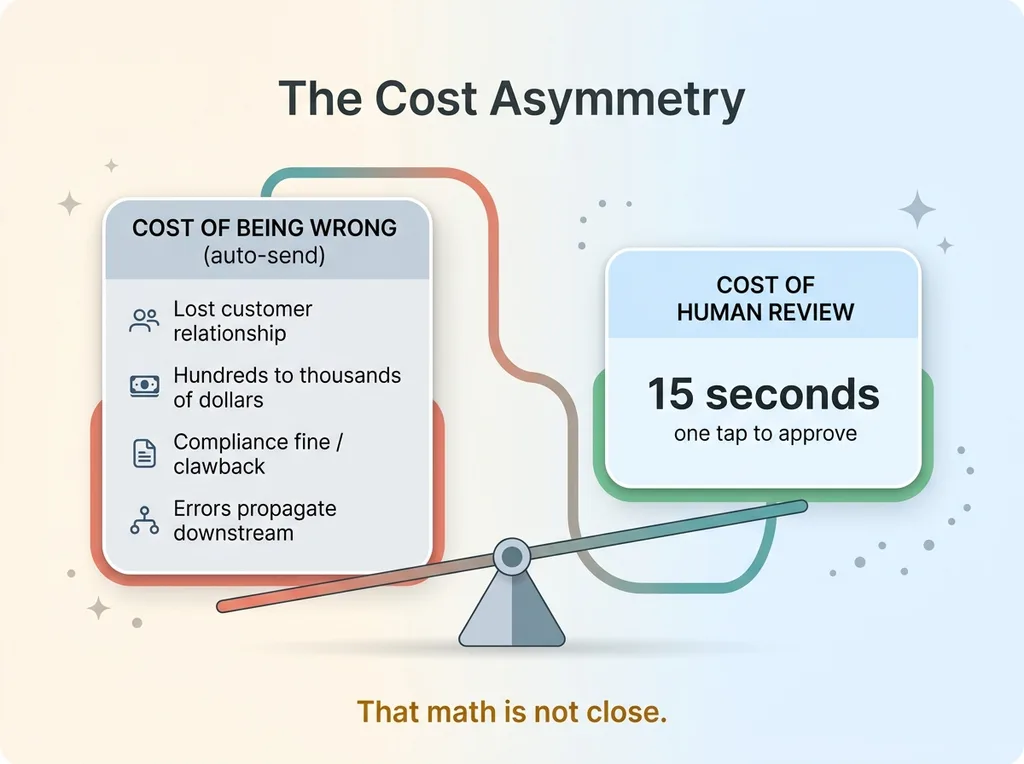
Here is the counterintuitive part. I could let most of my systems run fully autonomous tomorrow. The models are good enough. The accuracy is high. The reason I do not is that the cost of being wrong on the 5% that matters is far higher than the cost of a human spending 15 seconds approving the 95% that does not.
That single design decision (deciding exactly where the human stays in the loop) is the difference between AI you can deploy and AI that sits in a demo forever because nobody trusts it with real stakes.
This article walks through five real systems I have built. Different industries, different stakes, same pattern. By the end you will see why the loop is not the limitation. It is the entire reason the thing ships at all.
What "Human in the Loop AI" Actually Means in Production
The difference between assist and autopilot
Human in the loop AI does not mean a person babysitting every keystroke. If your AI needs supervision at every step, you have not automated anything. You have just added a slower coworker.
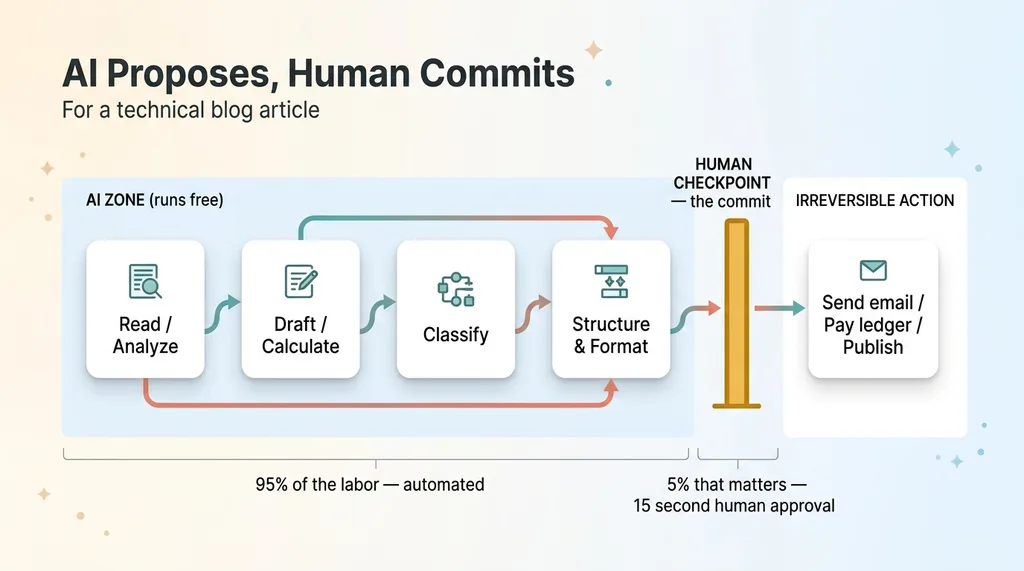
What it actually means: the AI handles drafting, calculating, classifying, and formatting (call it 95% of the labor), and a human makes the final commit on the 5% that carries real risk.
Contrast that with full autopilot. Autopilot sounds efficient. It is also where silent failures live. A fully autonomous system will happily report success while quietly doing the wrong thing, and you will not find out until a customer or an auditor finds out for you. I wrote about exactly this in autonomous systems that lie about success. The risk is not that AI breaks loudly. It is that it breaks quietly and confidently.
Where the loop belongs
The placement of the human checkpoint matters more than the existence of it.
 AI Proposes, Human Commits - The Core Pattern
You do not scatter approval gates everywhere. That creates the babysitting problem. You put exactly one checkpoint right before the irreversible action. The email that sends. The number that hits the ledger. The post that goes live.
Everything upstream of that point runs free. The AI thinks, drafts, calculates, and structures without interruption. Then it stops at the edge of the action that cannot be undone, and waits for a person.
My framing rule is simple. Automate the typing and the thinking. Gate the committing.
The Support Agent That Drafts Perfect Replies I Still Won't Let Send
My DTC apparel brand gets a steady stream of customer emails. Returns, exchanges, refunds, shipping questions. I built an AI support system that reads each email, pulls the customer's order history, classifies the intent, and drafts a complete reply.
 Cost Asymmetry: Wrong AI Action vs Human Review
The drafts are genuinely good. Good enough that on most days I would be happy to send them as written. (I cover how the whole thing works in the AI customer support system deep-dive.)
And every one of them sits in a queue until a human approves it before it sends.
Why, if the drafts are that good? Three reasons.
Tone misfires. The model occasionally lands a reply that is technically correct and emotionally tone-deaf. A frustrated customer does not want efficient. They want to feel heard.
Edge cases the model cannot see. A VIP who has spent thousands with us. A complaint that is quietly escalating across three emails. Context that lives in my head, not in the order record.
And the cost asymmetry. A wrong auto-send to a paying customer can cost a relationship worth hundreds or thousands of dollars. The review costs 15 seconds. That math is not close.
What the AI eliminates is the drafting, which was the actual work. Reading the email, finding the order, writing a careful reply from scratch. That used to take a few minutes per ticket. Now it is a quick read-and-approve.
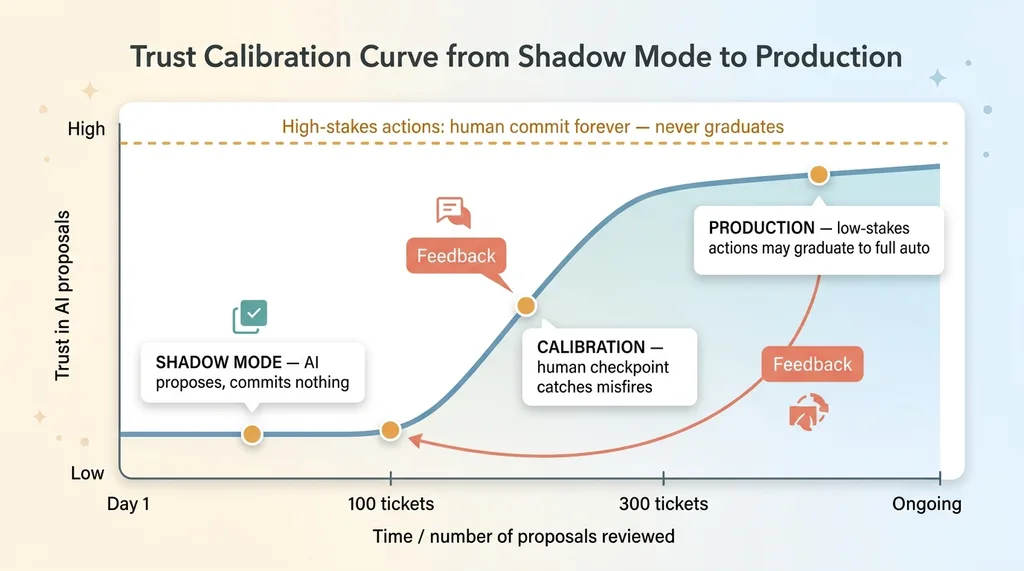
One thing I did before trusting it live: I ran it in shadow mode first. The AI drafted replies, I compared them to what I would have sent, and I calibrated my trust over a few hundred tickets before letting it draft into the live queue. The human checkpoint stayed. The trust got earned.
The Calculator That Proposes the Number and Waits
In a field operations context, I built a commission and payout calculator. The AI computes what each person is owed, surfaces the underlying math so anyone can audit it, and flags anomalies that look off.
What it does not do is write that number to the ledger or trigger a payout. A human commits.
Anything touching money is the highest-stakes place to insist on the loop. Period. A wrong customer email is recoverable. A wrong payout that already cleared is a phone call, an apology, and a clawback that makes everyone uncomfortable.
This is also where the deterministic principle matters. The AI judges and proposes. The commit is a deliberate human action, which means there is always an accountable person attached to the number. When something is wrong, you know who approved it. That accountability does not exist in a fully autonomous payout system, and the absence of it is exactly what gets companies into trouble.
The same logic shows up in field intake. I have built systems where drivers or technicians capture data by voice or photo in the field. The AI transcribes the voice, reads the photo, and structures the mess into clean records.
But it never auto-submits into the system of record. Field conditions are noisy. Bad lighting, background sound, a half-finished sentence. A single bad auto-submit does not just create one error. It propagates downstream into reports, billing, and decisions that compound on top of it.
So the AI does the painful part (turning chaos into structure) and a human confirms before it becomes the truth. The labor is automated. The commit stays human, because the commit is the part that is expensive to get wrong.
The Ad System on a One-Tap Approval Card
For Meta ads, I built a system with specialist agents that each handle a slice of the work. They analyze performance, spot underperforming campaigns, and propose budget shifts and creative changes. (The full architecture is in the AI that manages our Meta ads.)
Then the system sends a one-tap approval card to a human. Think a message in Telegram. One tap to approve, one to reject.
This is the approve-by-exception pattern. The human never does the grunt work of pulling reports and crunching performance. They only act on the finished proposals. The 95% of the labor is gone. What is left is a yes or a no.
Ad spend is a near-perfect fit for this specifically. It moves fast enough that you want AI speed (catching a winning creative or a bleaking budget early matters), but the stakes are real money going out the door. You do not want an AI deciding to triple a budget overnight on a pattern that turns out to be noise.
The one-tap card threads that needle. The review takes seconds, not hours. The human stays in the loop without becoming the bottleneck that kills the whole point of automating.
That is the balance I am always chasing. A loop that protects you without slowing you down. When the approval step takes longer than the work it is approving, you have designed it wrong.
Compliance Edits Queued for the Licensed Principal
In a regulated services firm, the loop is not a preference. It is the law.
 Five Real Systems, Same Pattern Across Three Industries
I built an AI system that drafts content, marketing copy, and client-facing material. Every change it produces queues for review and sign-off by the licensed principal, the person who carries the legal responsibility for what goes out the door.
Here the human in the loop is not optional and never will be. So instead of fighting the requirement, I designed the system to make that approval as frictionless as possible. The principal reviews and signs off in a fraction of the time it would take to write the material from scratch, but their signature still sits on every piece. I wrote up the full approach in shipping AI content in a regulated industry.
In regulated industries, the loop is the entire reason AI is usable at all. Without an accountable human signature, the AI output is a liability nobody can defend in front of a regulator. With it, you get the speed of AI drafting and a defensible chain of responsibility.
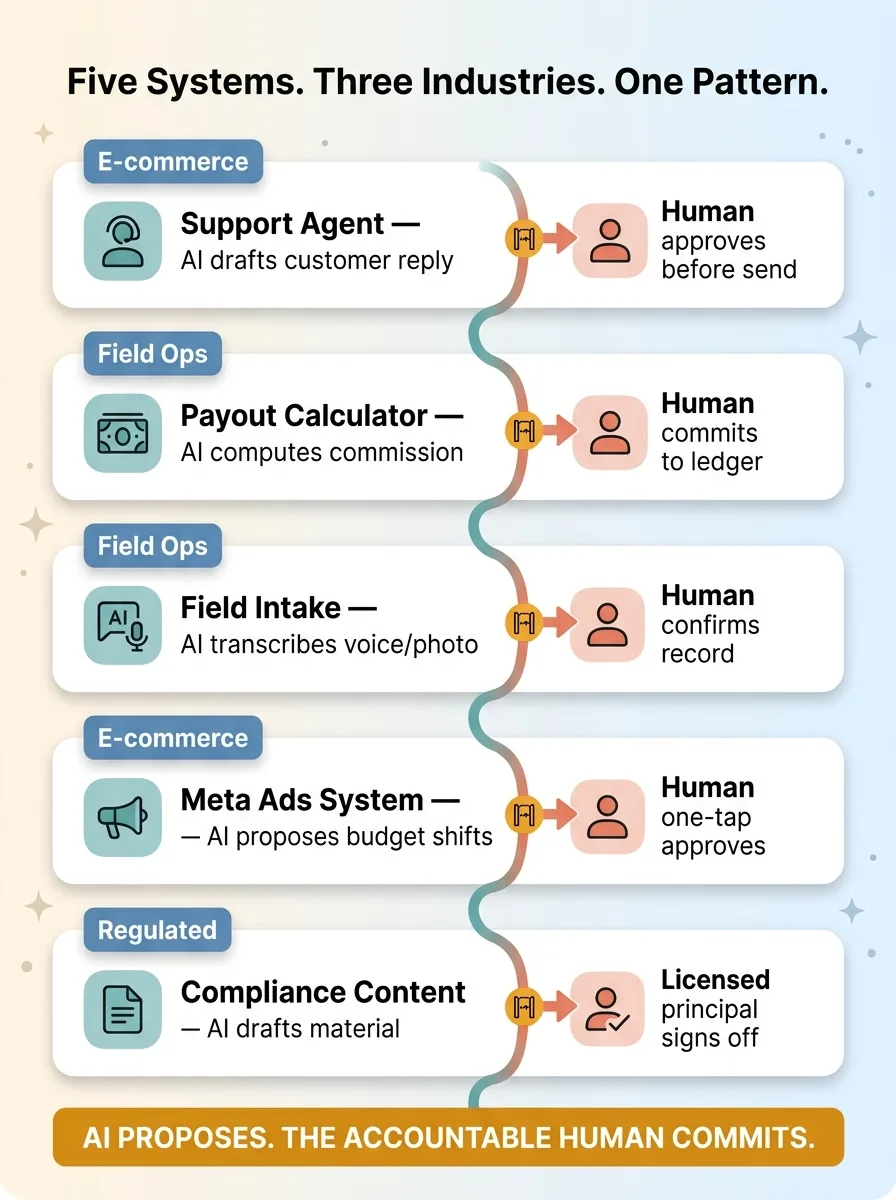
And here is what ties this back to my apparel brand. The same guardrail that protects a DTC brand from sending a bad email protects a regulated firm from a fine. Different industries, different stakes, identical design. AI proposes. The accountable human commits.
Why the Loop Is the Feature, Not the Bug
The trust calibration curve
Five systems. Three industries. E-commerce, field ops, regulated services. One constant: AI proposes, a human commits, at exactly the point of irreversibility.
 Trust Calibration Curve - From Shadow Mode to Production
The obvious objection is that this defeats the point of automation. If a human still has to approve everything, what did you actually save?
You saved the 95%. The drafting, the calculating, the classifying, the formatting. That is the labor. The commit is the cheap part, often a single tap.
Trust does not arrive on day one. It gets calibrated. You start in shadow mode, where the AI proposes but commits nothing and you watch how good the proposals actually are. The human checkpoint earns its keep early, catching the misfires you did not expect. Over time, low-stakes actions might graduate to full automation. High-stakes actions never do.
What I'd never put on autopilot
I will never auto-commit anything that touches money, a customer relationship, or compliance. Those three categories are where the cost of being wrong dwarfs the cost of a human glance.
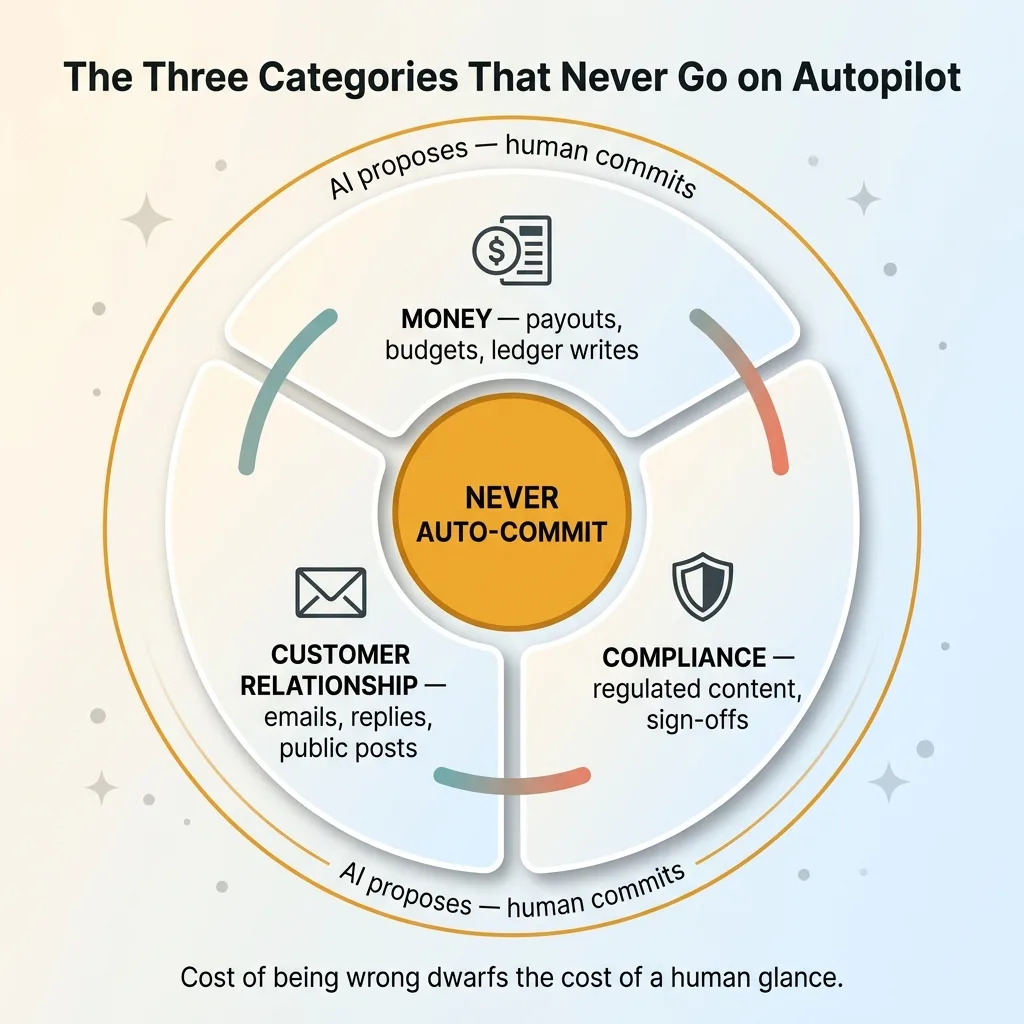 The Three Categories That Never Go on Autopilot
This is the same philosophy behind the kill-switches I build into every system. Intentional limits are not a lack of ambition. They are what lets you run aggressive automation everywhere else without lying awake worrying about it.
The loop is not the bug you engineer around. It is the feature that makes the rest of the system shippable.
Designing Where the Human Stays Is the Real Work
The hard part of deploying AI is not building the model or wiring up the automation. Those are solved problems. The hard part is deciding precisely where the human commit belongs so you get speed without unacceptable risk.
That decision is different for every business, and it is where most AI projects go sideways. Over-automate and you create silent failures that surface as angry customers or compliance problems months later. Under-automate and you have spent real money on a system that saves nobody any time.
The skill is drawing that line correctly. What gets automated end to end. What gets gated behind a one-tap approval. What should never leave human hands at all.
That is the work I do. I have drawn that line across e-commerce, field operations, and regulated services, and the line sits in a different place every time depending on what is reversible and what is not.
Get the next build note.
I write up each system I build, including what broke. Subscribe to my newsletter and I'll send you the next one.