SaaS Pricing Tiers vs Flat: Why I Killed Three Tiers
I ran the real economics on SaaS pricing tiers vs flat for a telehealth membership. One flat price netted more per member and broke even sooner. Here's the math.
By Mike Hodgen
The Instinct Everyone Has: Build a Good/Better/Best Ladder
Every founder reaches for the same lever. More tiers equals more revenue. Give budget buyers an entry point, capture the price-insensitive crowd at the top, and let a premium tier anchor the whole page so the middle option looks reasonable. It is the standard SaaS playbook, and most people run it on autopilot.
I almost ran it too. When I was pricing a membership for a longevity and telehealth platform, my first draft was a clean Good/Better/Best ladder. Three tiers, nice psychology, a premium option to make the middle feel like a deal.
Then I ran the actual numbers. And the whole saas pricing tiers vs flat debate collapsed for this particular business.
Three tiers were strictly worse on every axis that mattered. A single flat price netted more per member. It broke even sooner. And it sidestepped a compliance landmine I did not see until I started mapping what each tier was actually allowed to promise.
This is not a theory post. I am going to walk you through the real math, the real trap, and the decision framework I used. The figures are anonymized and illustrative, but the logic is exactly what I applied.
Here is the thesis up front. Tiers are not a default. They are a tool that earns its place only when something material can differ between the steps. When nothing real can differ, tiers stop being a pricing strategy and become a guess that some people will overpay. For this membership, that guess would have cost revenue and created legal exposure at the same time.
If you have a board asking about pricing tiers, or you are staring at a Good/Better/Best draft right now, this is the math nobody runs before they publish the page.
Why Tiers Only Work When Something Real Can Differ
The test: what changes between tiers?
Run this test on any tiered model. Point at the line between tier one and tier two and name the thing that changes. More seats. More usage. A faster SLA. A feature the lower tier does not get.
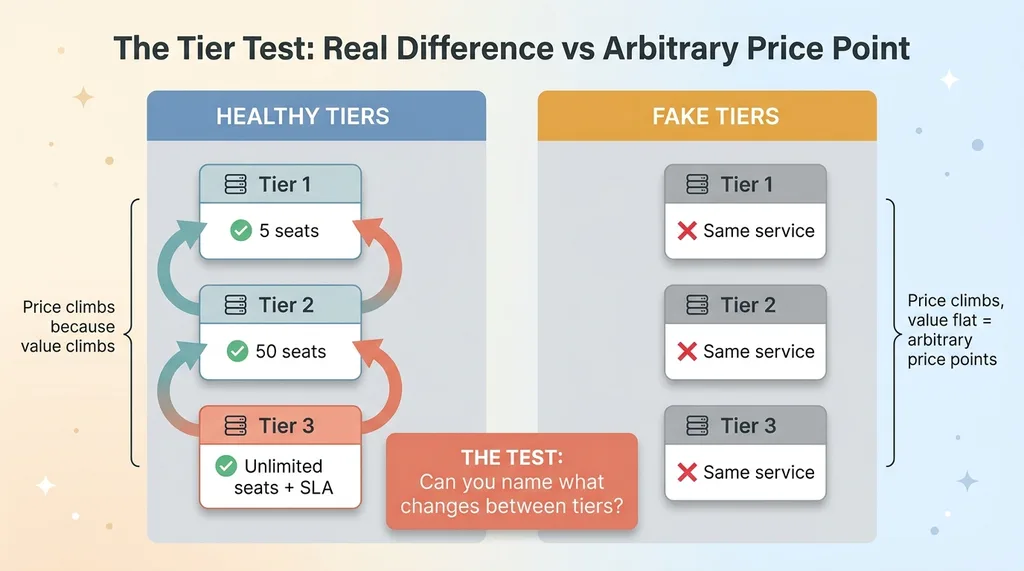 The Tier Test: Real Difference vs Arbitrary Price Point
If you can name it, you have tiers. If you cannot, you have arbitrary price points wearing a tier costume.
That is the whole test. Healthy tiers map to a real difference in what the customer receives. Each step up delivers something the customer can feel and value. The price climbs because the value climbs.
When tiers become a fee increase in disguise
I ran that test against the telehealth membership and it failed immediately.
On this clinical platform, the things a member actually cares about were flat for everyone by contract:
- Provider access was identical for every member
- Visit modality (how you see a provider) did not change
- Clinical review speed was fixed
- Prescribing eligibility followed the same rules for all
- Medication price was a pass-through, the same for everyone
Every lever that would normally justify a higher tier was locked. I could not legally or operationally make a premium member's care better, faster, or more attentive. The clinical experience was uniform by design.
So what could a higher tier actually do? One thing only. Charge more money for the same thing.
A tier that costs more but delivers nothing extra is not a tier. It is a bet that a slice of your customers will not notice they are overpaying. That is a fragile foundation for a recurring revenue business, and it is the kind of thing that erodes trust the moment a member compares notes with another member.
Here is the generalizable rule for your business. If you cannot name the concrete thing that changes between each tier, you do not have a membership pricing strategy. You have price points you are hoping nobody scrutinizes.
The Compliance Trap Hiding in the Premium Tier
This is the part that turned a pricing question into a legal one.
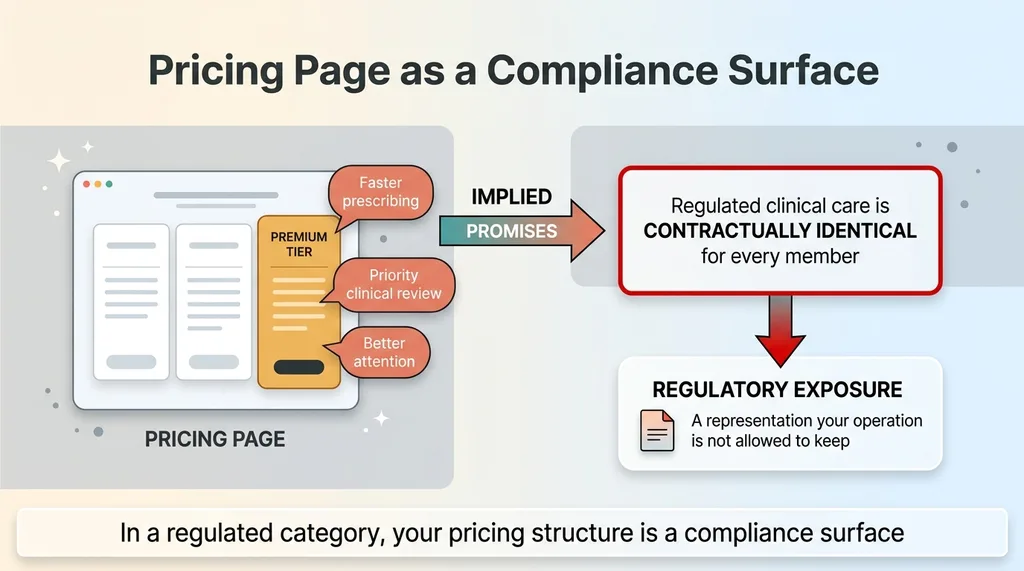 Pricing Page as a Compliance Surface
Because the clinical care was contractually identical for every member, a "premium" tier does not just fail economically. It implies a difference in care that we legally could not deliver or promise.
Think about what a premium clinical tier signals on a pricing page. It tells the customer: pay more and get better attention, faster review, priority prescribing. In a regulated health category, every one of those implied promises is a liability you manufacture with a dropdown menu.
You cannot promise a higher-paying member faster prescribing in a controlled category. You cannot imply priority clinical review when review timing is governed by contract and regulation, not by what someone paid. The moment your pricing page suggests money buys better care, you have created a representation your operation is not allowed to keep.
That is the trap. The Good/Better/Best ladder was not merely suboptimal. It was regulatory exposure baked into the marketing.
This is the thing most founders miss. In a regulated industry, your pricing structure is a compliance surface, not just a marketing decision. The pricing page is a place where you can accidentally make promises your legal terms forbid.
I had already structured the underlying model so the revenue could not vary with prescriptions, which kept the financial incentives clean. Layering tiers on top of that would have reintroduced the exact problem the flat architecture was designed to remove. The tiers would have implied differentiated care that the contract explicitly prohibited.
Reader takeaway: tiers can manufacture promises your operation cannot keep. In a regulated category, that is not a marketing misstep. It is the kind of thing a regulator reads back to you in a letter.
The Math: What One Flat Price Actually Netted
The single-price structure
Here is how the flat model was built. Anonymized, but the shape is real.
One membership at a locked founding rate. A fixed per-order facilitation fee. And the medication and consult costs ran through as zero-markup pass-through, so the business made no margin on the regulated good itself.
That last piece matters twice. It keeps the unit economics clean, and it keeps the compliance story clean, because the business is not profiting on the prescription. You are paid for the membership and the facilitation, not for the drug.
Net per member and break-even
Now the numbers. These are illustrative figures for one specific model, not a universal law, so do not copy them into your own spreadsheet.
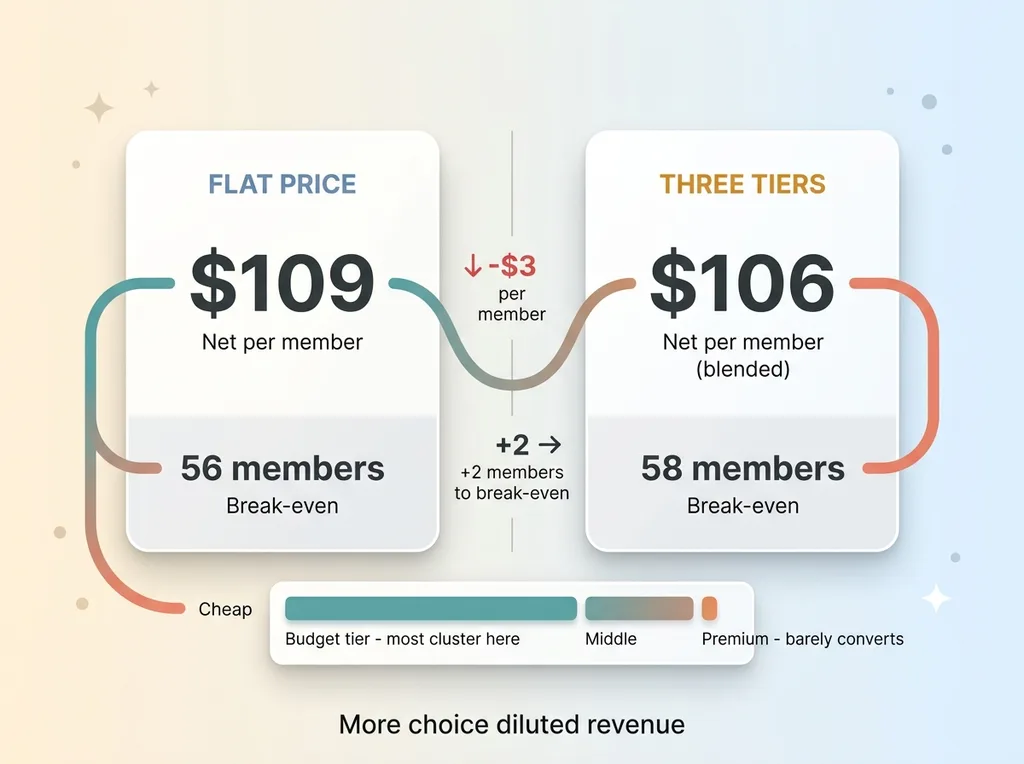 Flat Price vs Three Tiers: Net per Member and Break-even
The single flat price netted roughly $109 per member, with break-even at about 56 members.
The three-tier ladder, once I blended across realistic tier adoption, netted roughly $106 per member, with break-even pushed out to about 58 members.
More choice did not add revenue. It diluted it.
Here is why the blended net drops, and this is the part founders skip. You cannot price three tiers and assume everyone buys the middle one. You have to weight by how members actually distribute.
In practice, members cluster in the cheaper tiers. The premium tier barely converts, because most people will not pay a higher fee for something they correctly perceive as the same service. And the discounted entry tier, which you added to capture budget buyers, drags your average down by pulling in people who would have paid the flat rate anyway.
So your blended net per member is dominated by the cheap end and barely lifted by the premium end. The math on this exact decision is why one flat membership beat three tiers for this business.
Three dollars per member sounds small. Across a membership base it is real money, and it comes with a longer break-even, more build cost, and the compliance exposure from the last section. You are paying more, in every sense, to net less.
Why More Choice Cost More Than It Earned
Decision friction at checkout
There is a tax on tiers that never shows up in the blended-net calculation.
Three options at signup is three chances to stall. The customer compares, second-guesses, wonders if they are picking wrong, and a meaningful slice of them abandon instead of choosing. Choice feels generous to the founder and feels like work to the buyer.
A single clear price removes the comparison entirely. There is one decision: yes or no. That converts cleaner, especially for a recurring membership where the buyer is already weighing a long-term commitment.
Build and support cost of every extra tier
Then there is everything you have to build and maintain.
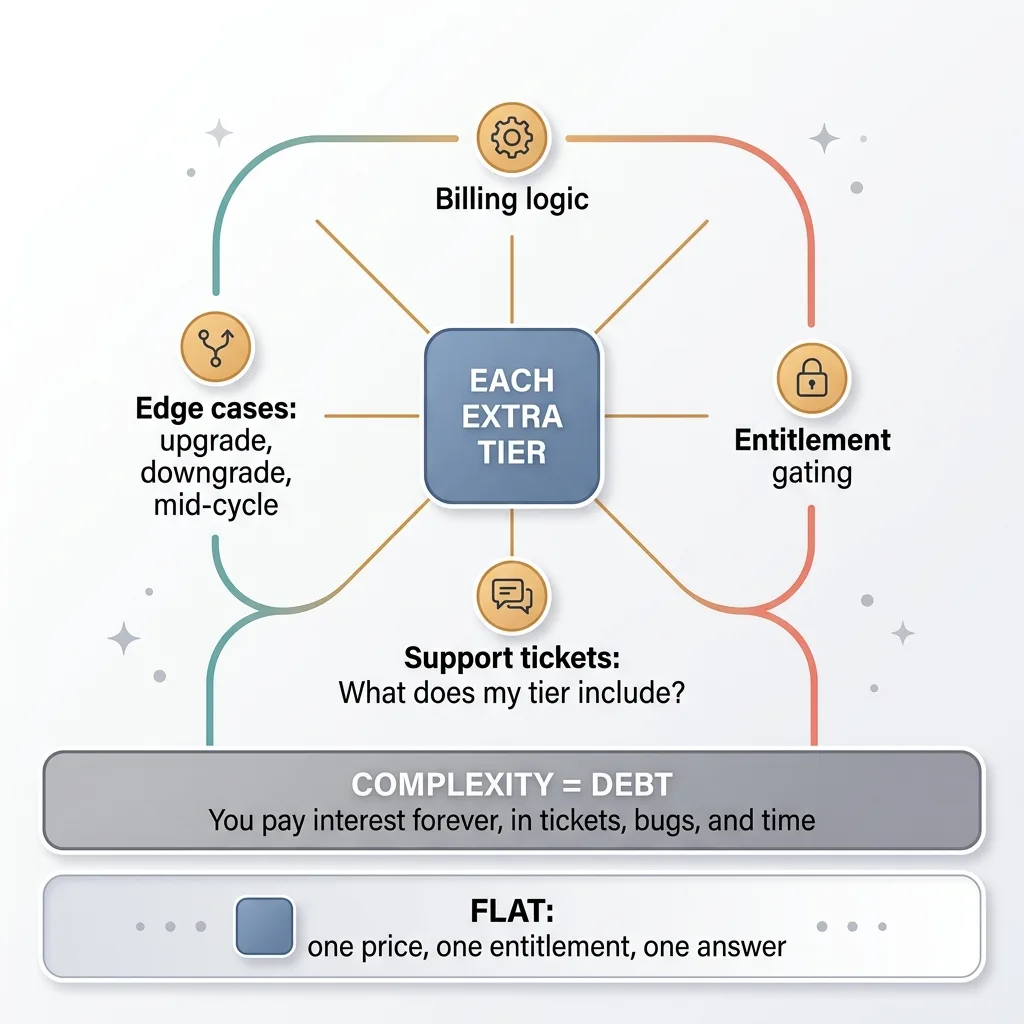 The Hidden Cost of Every Extra Tier
Every tier is more billing logic. More entitlement gating to enforce who gets what. More edge cases in the codebase when someone upgrades mid-cycle, downgrades, or sits between states. And more support tickets, because the single most common question in a tiered product is "what does my tier include?"
For a small operation, that build-and-maintain tax is real money and real hours. I have built 15-plus AI systems across my own businesses and clients, and the pattern is consistent: complexity you do not need is debt. You pay interest on it forever, in tickets, in bugs, in the time it takes to explain your own pricing.
The flat membership was less to build, less to explain, and less to break. One price, one entitlement, one answer to the "what do I get" question. That simplicity is not a consolation prize. It is part of why the flat model won.
What the Category Leaders Already Figured Out
I did not arrive at flat pricing in a vacuum. I looked at what the established players in this category actually do.
Every comparable category leader runs the same structure: one flat membership, plus separate pass-through medication. Not one of them runs a Good/Better/Best clinical ladder.
These are not naive companies leaving money on the table by skipping tiers. They have pricing teams and lawyers. They converged on flat because it converts and because it stays compliant in a regulated category. When the experienced operators in a space all land on the same structure, that is data.
Here is the generalizable rule. In categories where the core service is regulated or contractually uniform, flat pricing is not a compromise. It is the correct structure. The thing tiers are supposed to differentiate cannot legally differ, so the whole apparatus collapses to a single price.
Now, the honest caveat. This is the opposite of pure software SaaS. In real software, usage and seats genuinely scale with what the customer gets. A 5-seat plan and a 50-seat plan deliver materially different value, and the marginal cost differs too. There, tiers map to something real, and the saas pricing tiers vs flat answer often lands on tiers.
So the lesson is not "flat always wins." The lesson is to price to your actual cost and value structure, not to a generic playbook you copied from a SaaS pricing blog. The telehealth membership and a seat-based SaaS tool have opposite correct answers, and both answers come from the same question: does anything real differ between the tiers?
How to Decide for Your Own Business
The three questions to run before you draw a pricing page
Before you publish a single tier, run these three.
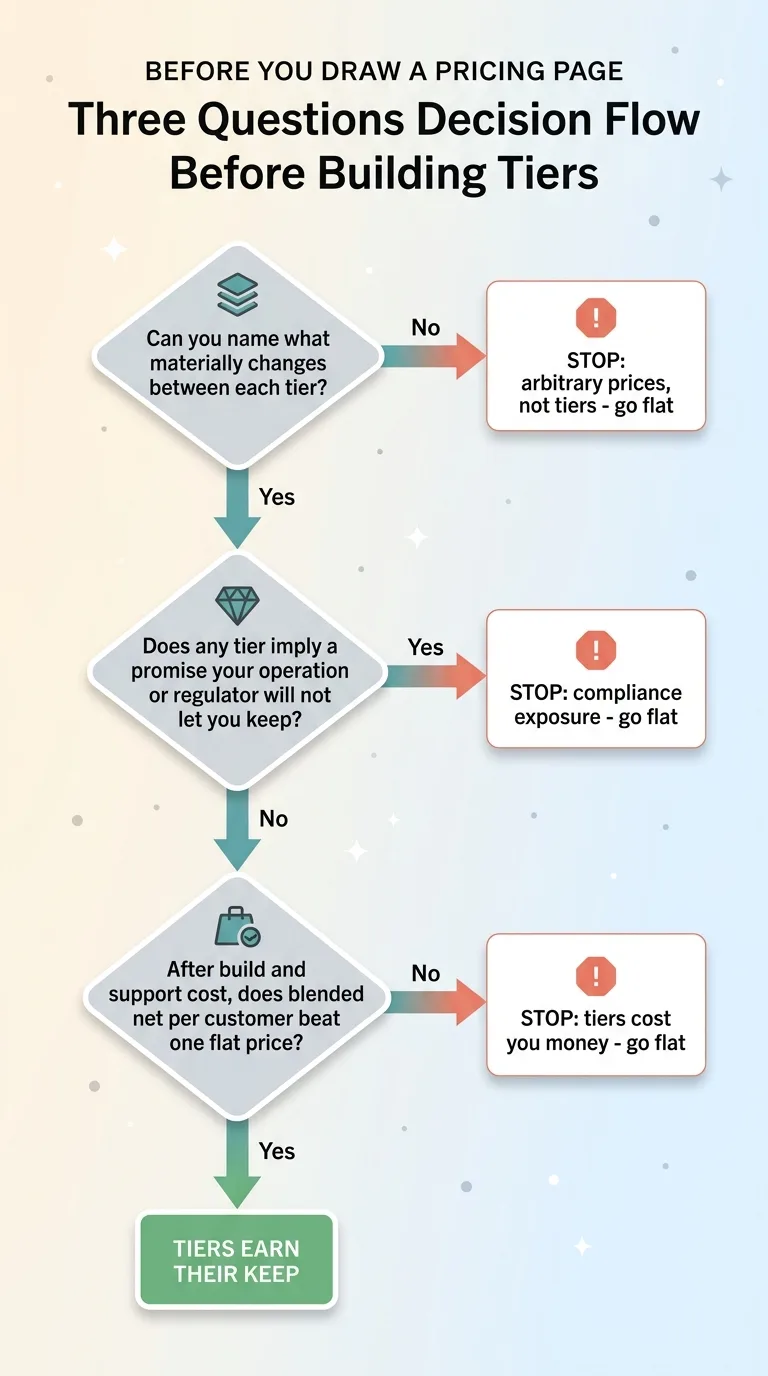 Three Questions Decision Flow Before Building Tiers
One. Can you name what materially changes between each tier? Point at the line and say the difference out loud. More seats, more usage, faster SLA, a real feature. If you cannot name it, you have arbitrary prices, not tiers.
Two. Does any tier imply a promise your operation or your regulator will not let you keep? This is the one most founders never ask. In any regulated or contractually uniform category, a premium tier can imply differentiated service you are not permitted to deliver. Your pricing page is a compliance surface.
Three. When you blend realistic adoption across tiers, does your net per customer actually beat a single clear price? And do it after the build and support cost of maintaining the tiers. Weight by where customers actually cluster, not where you hope they land.
When you're staring at numbers you can't read
I want to be straight about something. This was a judgment call, not an output a model spit out.
I used AI to run the scenarios fast, but the decision to kill three tiers came from reading what the numbers meant against the compliance terms and the operational cost. That is the part the tooling does not do for you. AI replaced the typing, not the thinking.
If you are staring at a pricing model you cannot quite read, that is the work. The break-even analysis, the blended-net math, the compliance read, the build-cost honesty. I will run the same analysis on your model that I ran on this one. Work through your own pricing math with me and we will find out whether tiers earn their keep for your structure or quietly cost you money.
And if you run true usage-based SaaS, tiers may well be right. The answer is always the same: do the math for your structure, not the playbook's.
Ready to bring AI leadership into your company?
I work with a small number of companies at a time. If you're serious about AI, apply to work together and I'll review your application personally.
Get AI insights for business leaders
Practical AI strategy from someone who built the systems — not just studied them. No spam, no fluff.
Hodgen.AI
Ready to automate your growth?
Book a free 30-minute strategy call with Hodgen.AI.
Book a Strategy Call