How to Launch a Telehealth Brand With AI (The New Way)
I helped launch a compliant DTC health brand with AI as one operator. Here's how to launch a telehealth brand with AI without a year-long agency build.
By Mike Hodgen
The Old Way: A Year, a Team, and a Lawyer on Retainer
If you wanted to launch a telehealth brand with AI even three years ago, the answer would have been simple: you don't. You launch it the old way, which means a year of your life, a team of specialists, and a lawyer billing you by the hour to read every word on your website.
I know this because I'm the technical cofounder of a longevity and telehealth startup, and I watched the conventional path play out for plenty of companies in this space before we started.
What a traditional regulated launch actually costs
Here's how the old playbook runs. You start with vendor evaluation for the clinical stack: telehealth platform, e-prescribing, the payment rails that have to be HIPAA-compliant. That's months of demos.
Then contract negotiation. Every Business Associate Agreement, every terms-of-service document, every data-handling clause goes to counsel. Lawyers reading documents at $400 to $600 an hour.
Then a custom clinical build, because nobody trusts the off-the-shelf version yet. Then an agency to build the marketing site and write the health content. Then that same lawyer reviews every single page for medical claims before it can go live.
Add it up and you're looking at tens of thousands in agency fees, a comparable bill from legal, and roughly a year before the brand is actually live.
Where the time really went
Here's the part nobody tells you. The bottleneck was never any single piece of work.
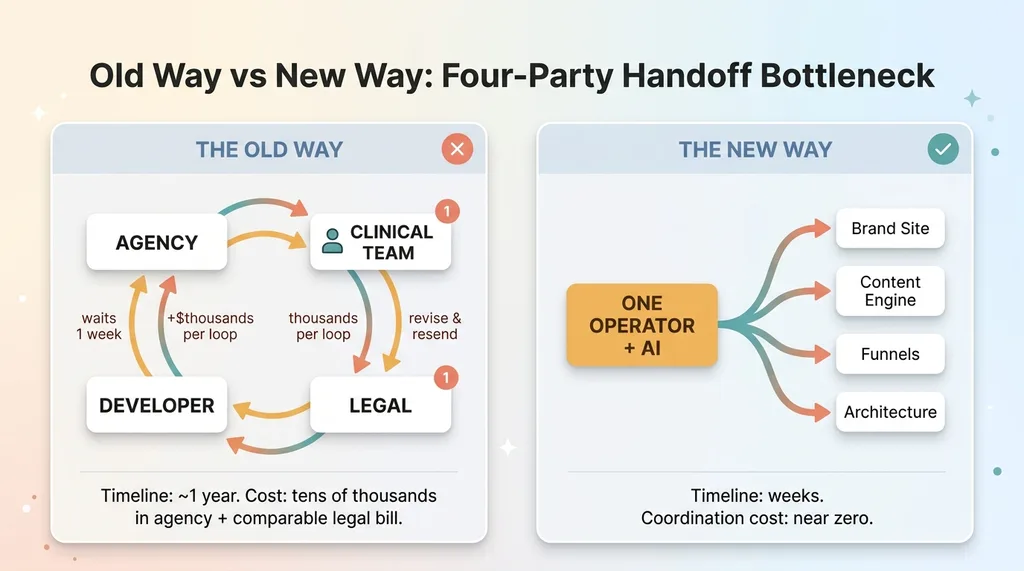 Old Way vs New Way: Four-Party Handoff Bottleneck
The bottleneck was the handoffs. The agency waits on the clinical team. The clinical team waits on legal. Legal sends edits back to the agency. The agency revises and sends it back to legal. Every loop costs a week and a few thousand dollars.
Speed was never the hard part. Getting compliance right at every single layer, that was the hard part. And the traditional structure made compliance slow by spreading it across four parties who couldn't move without each other.
What I Actually Stood Up as One Operator
I want to be precise about scope here, because "one person built a telehealth brand with AI" sounds like a toy project. It wasn't. This is a real regulated business with actual clinical and legal stakes.
The full surface area
Working as a single technical operator with AI, here's what I stood up:
- The public-facing brand and marketing site
- A compliance-gated content engine that cites its sources
- An intake quiz that routes prospects by rules
- Lead funnels with conversion copy
- A pricing model structured for regulatory cleanliness
- A HIPAA-aware architecture from the first commit
That's the work that used to get split across an agency, a clinical team, a copywriter, and a developer.
Why one person could cover it
The honest version: AI didn't let me skip the work. It collapsed the handoffs.
The whole drag in the old model came from four parties coordinating. When one operator who actually understands the rules can direct AI to produce each piece, the coordination cost goes to near zero. There's no agency waiting on legal, because the person writing the content already knows what legal will flag.
That's the real shift. It's not that AI writes faster than a human (though it does). It's that one operator who holds the full picture, compliance included, can move through the whole stack without the week-long handoff between every step.
This is the model behind a compliant DTC health brand built by a solo founder with an AI stack. Not magic. Just removing the seams between specialists by putting the whole job in one head, with AI doing the production.
AI-Assisted Vendor and Contract Analysis
The first genuinely hard part of any regulated startup AI stack is choosing your clinical vendors and getting through their contracts.
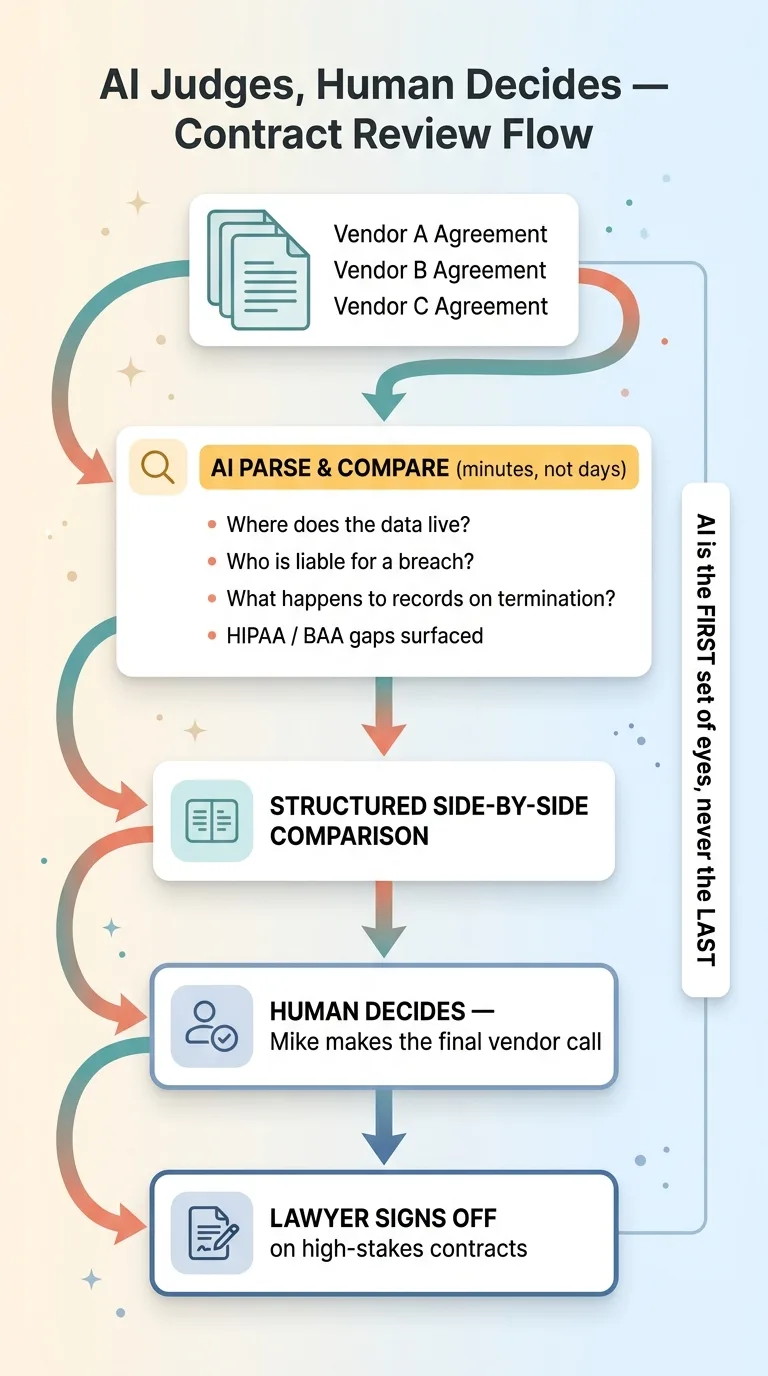 AI Judges, Human Decides, Contract Review Flow
The old way was months of vendor demos followed by lawyers reading every BAA and terms document line by line. Slow and expensive, and most of that time was just reading and comparing.
The new way: I used AI to parse the vendor agreements, surface the HIPAA and BAA gaps, and compare pricing and data-handling terms across the options side by side. When you feed three vendors' agreements into a properly prompted model, it pulls the clauses that actually matter, where the data lives, who's liable for a breach, what happens to records on termination, in minutes instead of days.
That turned a multi-week reading project into an afternoon of structured comparison.
But here's where I drew a hard line, and you should too.
AI accelerated the reading and the comparison. It did not make the decision. A human, me, made the final call on which vendor to use. And a real lawyer still signed off on the high-stakes contracts before anything got executed.
The principle: AI judges and summarizes. A human decides. On contracts that carry breach liability and regulatory exposure, you do not let a model be the last set of eyes. You let it be the first, so the human can spend their expensive time on the three clauses that matter instead of all sixty pages.
A Thin Rent-Now, Own-Later Architecture
The biggest architectural decision was refusing to build everything on day one.
Why thin beats custom at launch
The old instinct in a regulated space is to build custom, because you want control. But a full custom clinical build on day one means you own every regulated piece, and every regulated piece is a liability you have to maintain and defend.
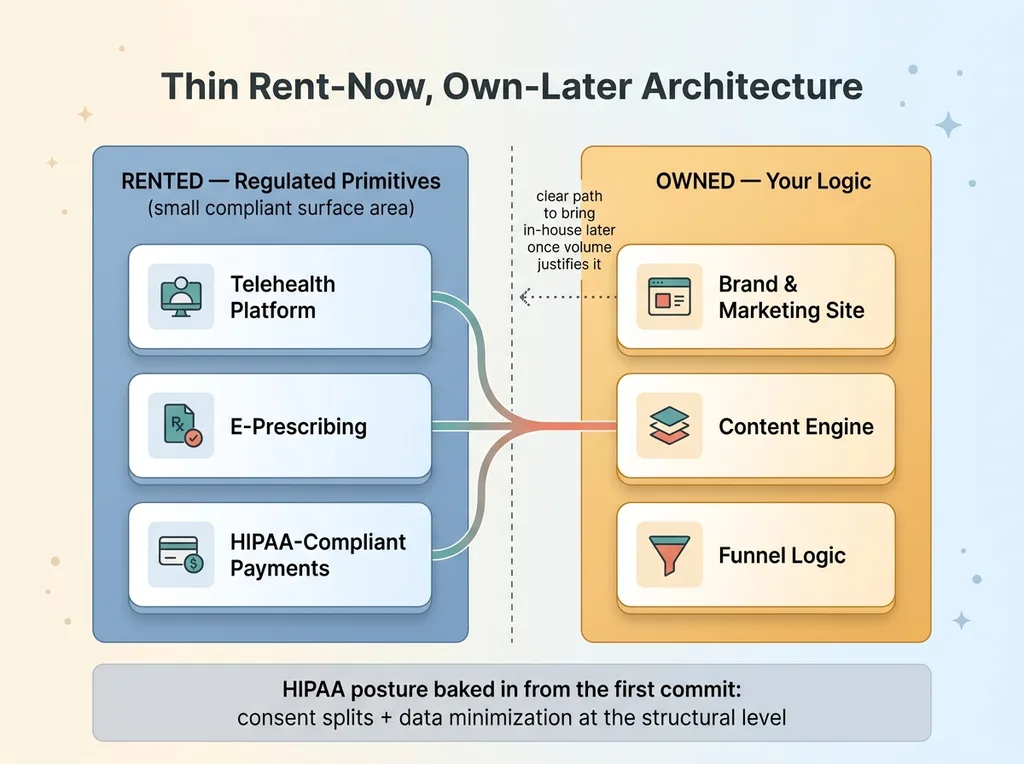 Thin Rent-Now, Own-Later Architecture
So I went thin. The architecture rents the regulated primitives, the telehealth platform, the e-prescribing, the compliant payment processing, and owns only the brand, the content, and the funnel logic.
This keeps the compliant surface area small. The brand can launch without me having to build and certify every regulated component up front, and there's a clear path to bring pieces in-house later once volume justifies it.
That's the same logic I write about in AI was the last thing I built, not the first. You pay for the boring regulated primitives. You build the logic that's actually yours. The plumbing comes before anything clever.
Designing for HIPAA from the first commit
The part you cannot retrofit is the HIPAA posture.
Consent splits and data minimization were baked into the architecture from the start, not bolted on after launch. That means the system was designed to collect only what it needs, separate identifiable health information from marketing data at the structural level, and capture consent at the right boundaries.
If you try to add this later, you're re-architecting under regulatory pressure, which is the worst time to do it. Designing for it on the first commit cost me nothing extra. Bolting it on after a launch would have cost a rebuild.
A Compliance-Gated Content Engine That Cites Its Sources
This is the part I'm proudest of, and it's the part that most directly replaces an entire agency plus a chunk of the legal bill.
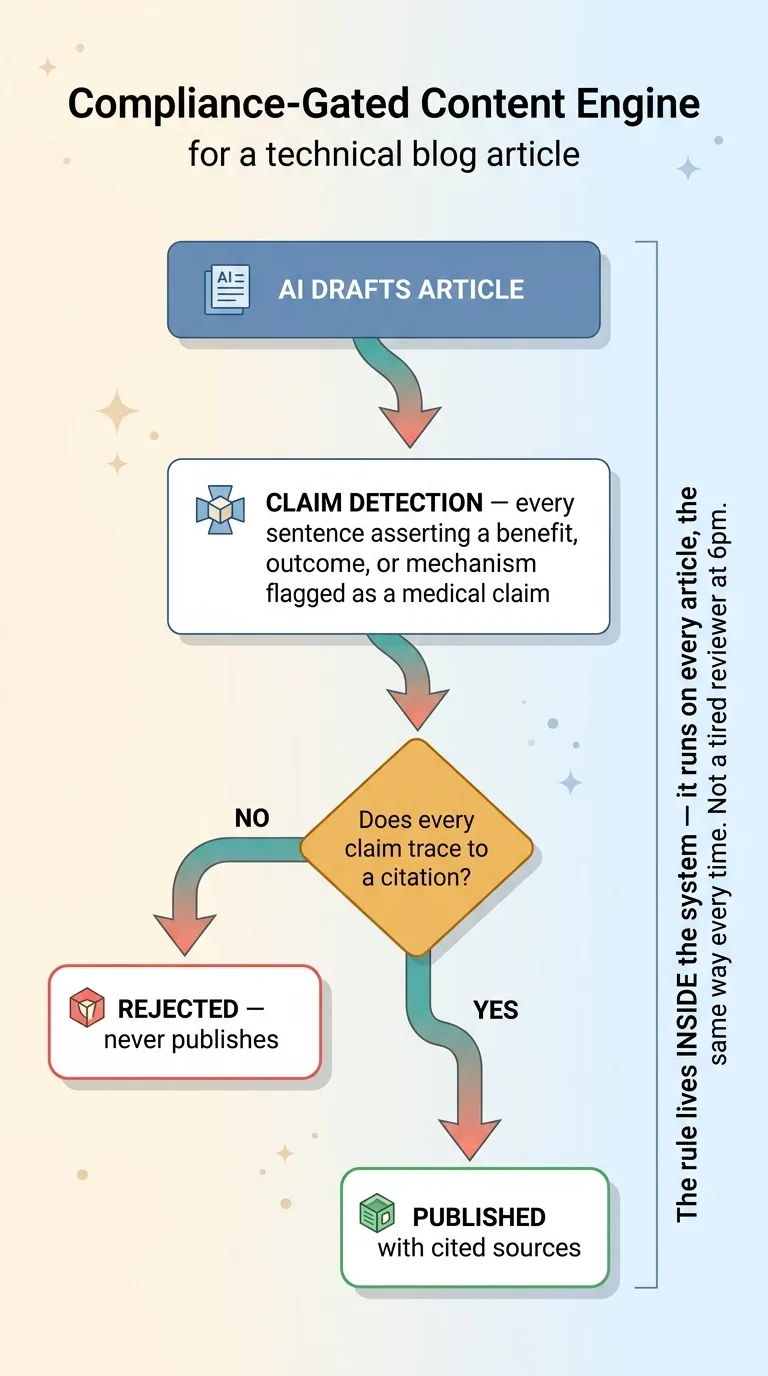 Compliance-Gated Content Engine
The old way: an agency writes health content, and a lawyer reviews every page for medical claims before it publishes. Every article is a manual review loop. Expensive, slow, and entirely dependent on a human catching every unsubstantiated claim.
The new way: an autonomous content engine that produces cited articles, with compliance gates that block anything making an unsubstantiated medical claim before it ever reaches publication.
Here's how the gating works conceptually. Every health claim in a draft has to trace back to a citation. If a sentence asserts a benefit, an outcome, a mechanism, anything that reads as a medical claim, it has to be backed by a source. Content that can't clear that gate gets rejected automatically. It doesn't get published and flagged later. It doesn't publish at all.
I've built AI content systems at scale before. On my own DTC brand, I manage 313 blog articles with AI-assisted SEO. So I know how to run a content engine that produces volume. The difference in a regulated health context is that volume without gating is a liability machine. One unsubstantiated cancer claim and you have a regulator's attention.
The key insight is that the compliance rule lives inside the system. It's not a checklist a tired reviewer works through at 6pm. It's a gate every single article passes through automatically, the same way every time.
This is exactly the pattern I keep finding, the same pattern shows up in every regulated industry I've worked in. The compliance work doesn't disappear. It moves from a human bottleneck into the system itself, where it runs on every item instead of depending on someone remembering to check.
That's the whole game. You don't remove the rule. You encode it so it can't be skipped.
A Deterministic Quiz, Funnels, and Clean Pricing
The conversion layer is where most people would be tempted to let AI run wild. I deliberately didn't.
Why the quiz logic is deterministic, not generative
The intake quiz and the lead funnels route people based on explicit rules, not AI improvisation.
In a regulated health context, you cannot have a model freelancing medical recommendations. If a prospect answers a set of questions, the path they get routed to has to be determined by auditable logic, not by whatever a language model decides to generate that time.
So AI helped me build the funnel and write the copy. But the routing itself is deterministic. Given the same answers, you get the same path, every time, and I can show exactly why. That's not a limitation. In this context it's a requirement. An auditable path is the difference between a defensible system and a regulatory problem.
Pricing designed for regulatory cleanliness
The pricing model was built for the same reason: regulatory cleanliness.
It cleanly separates what's clinical from what isn't. The structure is designed so the compliance story is obvious from the start rather than something I'd have to untangle under scrutiny later.
For context, I run AI-driven pricing on my own brand across 564 products with a four-tier classification system. So I'm comfortable letting AI handle pricing decisions when the stakes are commercial. But here the structure is fixed by hand, because the line between a clinical charge and a non-clinical one carries legal weight.
That's the rule underneath all of it. I keep AI out of every decision that carries legal weight. It builds, it drafts, it compares. It doesn't decide where the regulatory lines fall.
What One Operator Plus AI Actually Replaces
Let me tally this honestly, because the honest version is more useful than the hype version.
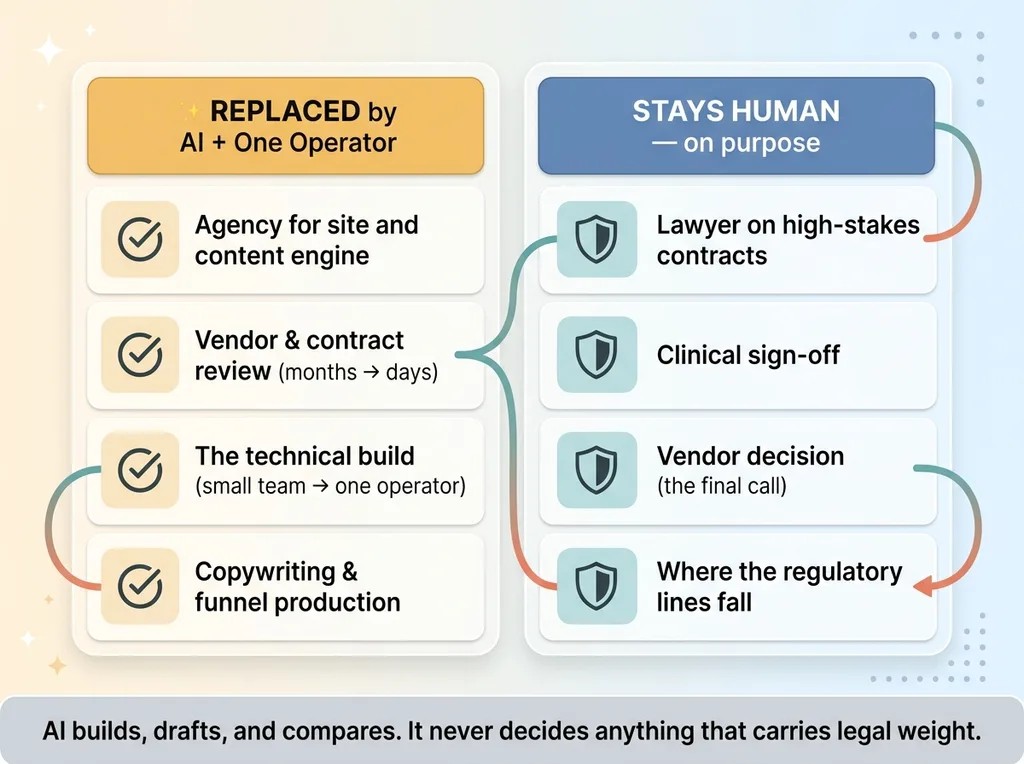 What AI Plus One Operator Replaces (and What Stays Human)
AI plus one operator replaced the agency for the site and the content engine. It compressed the vendor and contract review from months into days. It handled the technical build that used to need a small team.
What it did not replace: the lawyer on the high-stakes contracts, and the clinical sign-off. Those stayed human, on purpose. Anyone telling you AI removes the lawyer from a regulated launch is selling you a future lawsuit.
So the lesson for a skeptical CEO is the one I keep coming back to. AI doesn't let you skip compliance. It lets one person do a team's work, with the rules baked into the system so they run automatically instead of depending on someone catching them.
Reframe the whole thing. The constraint was never speed. I could have built a fast, sloppy site in a weekend. The constraint was getting compliance right at every layer, the contracts, the architecture, the content, the funnel, the pricing.
That is exactly what an AI-native operator is built to do, collapse the handoffs while keeping the rules intact. It's the same shift I describe in the new timeline for custom software: the year-long path becomes a weeks-long path, without cutting the corners that actually matter.
If you're standing up something serious in a regulated space, this is the kind of work I do. You can bring me in to do the same.
Thinking about AI for your business?
If this resonated, let's have a conversation. I do free 30-minute discovery calls where we look at your operations and identify where AI could actually move the needle.
Get AI insights for business leaders
Practical AI strategy from someone who built the systems — not just studied them. No spam, no fluff.
Hodgen.AI
Ready to automate your growth?
Book a free 30-minute strategy call with Hodgen.AI.
Book a Strategy Call