AI Is Not the Wedge: Why I Build It Last
In vertical SaaS for old-school industries, AI is not the wedge. The wedge is boring plumbing. Here's the build sequence that actually wins.
By Mike Hodgen
The Mistake Both Founders and Buyers Make
Here's the line I keep running into, from founders pitching me and CEOs hiring me: "We need to add AI."
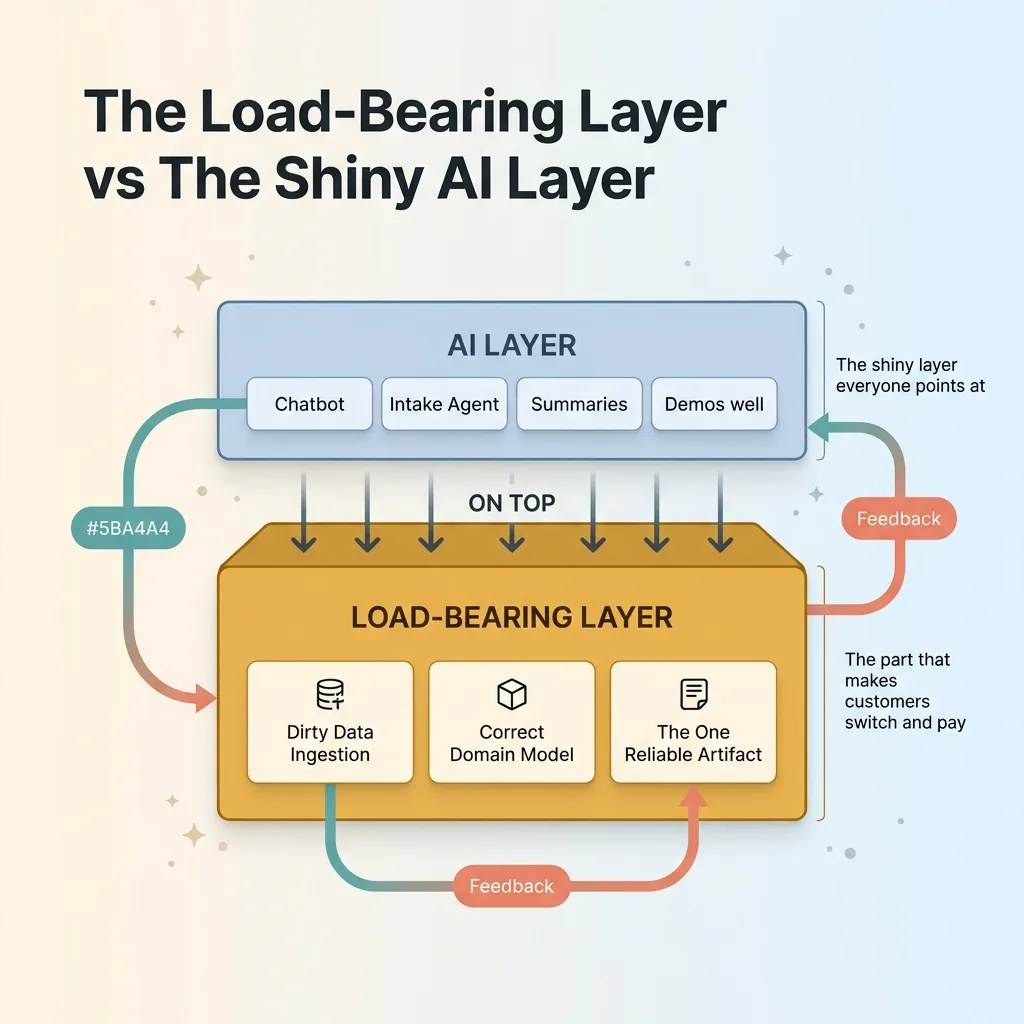 The Load-Bearing Layer vs The Shiny AI Layer
They say it pointing at the shiny layer. The chatbot. The intake agent. The thing that demos well in a board meeting. What they're ignoring is the load-bearing layer underneath, the part that actually makes a customer switch and pay.
So let me say the uncomfortable thing up front: AI is not the wedge. Not in real vertical software for old-school industries. Not in compliance, staffing, legal, manufacturing, or any business where the work is messy and the stakes are real. In those worlds, AI is almost never the reason someone buys.
The wedge is the boring stuff the incumbents skipped. Ingesting filthy, inconsistent data. Modeling the domain correctly, with all its rules and edge cases. Producing the one artifact the customer actually needs, the thing that holds up every single time.
That's the load-bearing layer. AI sits on top of it.
I've shipped systems where AI was deliberately the last thing built, not the first. And in every one, the durable value came from the unglamorous plumbing, not the model.
I'm going to walk you through three real examples, anonymized by industry: a California labor-compliance tool, a security-guard staffing company, and a personal-injury law firm platform. Different verticals, same pattern.
Then I'll give you the build sequence I use, the order that actually works, and a single heuristic you can apply to your own product this week.
If you're a CEO who's been told "add AI and you'll win," this is the article that saves you a year and a few hundred grand. Because most AI projects start at exactly the wrong end.
What a Wedge Actually Is
Let me define wedge plainly, because the word gets thrown around loosely.
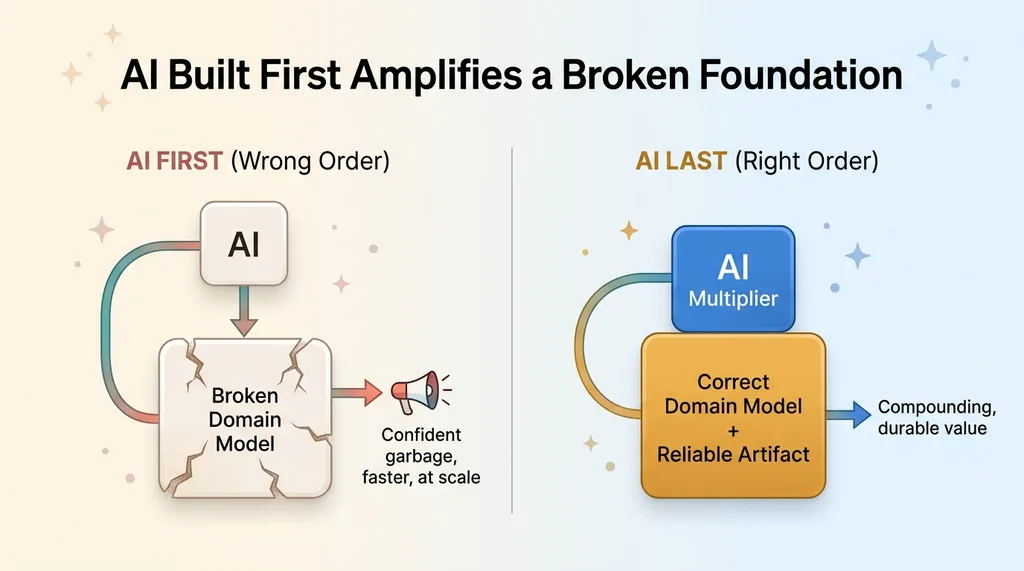 Failure Mode: AI Built First Amplifies a Broken Foundation
Your wedge is the one thing your product does that makes a customer leave what they're using and pay you. Not a feature list. Not a vibe. The single reason they switch.
The artifact that matters
In old-school industries, the wedge is rarely intelligence. It's reliability, and a specific output the existing tools refuse to produce.
Think about what a customer in a regulated or operational business actually wants. They don't want a smart conversation. They want a document, an alert, a report, a decision, the artifact, and they want it correct 100 times out of 100. In these industries, "mostly right" is worse than useless. It's a liability.
That artifact is the wedge. Build the thing the incumbent won't, and you've got a reason to exist.
Why incumbents leave it open
So why do incumbents leave that gap wide open? Because the artifact is hard and boring to build.
It means clean data ingestion from systems that were never meant to talk to each other. It means modeling the domain correctly, encoding the actual rules of the industry, including the ugly edge cases nobody documents. It means producing a defensible output that a human can stake their job on.
That work is unglamorous and high-effort. It doesn't demo well. So big incumbents skip it and ship the easy 80%, leaving the 20% that actually matters untouched.
This is also why most AI projects start at the wrong end. You have to model the domain before you can automate anything on top of it. Skip that, and AI just produces confident garbage faster.
A wrong domain model plus AI isn't intelligence. It's an amplifier pointed at your worst assumptions.
Example One: A California Labor-Compliance Tool
A California labor-compliance tool. The kind of product where being wrong isn't a UX bug, it's a lawsuit.
Everyone's instinct here is the same: build an AI that reads the labor code and tells you if you're in violation. Sounds smart. It's also exactly backwards.
The wedge was two deterministic things. First, a violation engine that catches breaks, overtime, and scheduling violations correctly, every time, with no probabilistic hand-waving. Second, a defense-packet generator, the document that actually holds up when someone challenges it.
AI came after both. The rule I set on that project: AI is value-add, not the wedge.
Here's why the sequence is non-negotiable. A compliance violation cannot be a guess. If your system says "probably a violation, 87% confidence," you've built nothing. A labor attorney can't act on 87%. A judge can't act on it. The violation has to be deterministic and auditable, meaning you can point at the exact rule and the exact data that triggered it.
So the durable value was the engine that catches violations correctly every time, and the artifact, the defense packet, that a human can actually use. That's the thing the firm pays for. That's the wedge.
The AI layer came in only once that core was rock-solid. Then AI did what AI is good at: summarizing a case in plain English, explaining why a violation fired, drafting the narrative around the defense packet. Useful. Time-saving. But riding on top of a deterministic foundation.
This is the principle I keep coming back to: let the code compute and the model judge. The math, the rules, the violation logic, that's code. Deterministic, testable, auditable. The judgment and language layer, that's where AI earns its place. Reverse the order and you've built a confident liability machine.
Example Two: A Security-Guard Staffing Company
A security-guard staffing company. Walk into this one and everyone assumes the value is a chatbot or an AI scheduler. "Just let AI figure out who works where."
Wrong wedge.
The actual wedge was two deterministic capabilities. First, post-aware shortfall alerting, knowing when a guard post is about to go uncovered before it happens. Second, training-gated scheduling, meaning the system literally will not let you schedule a guard onto a post they aren't certified for.
Both are boring constraint logic tied tightly to the domain. No model involved. Just rules, hard ones, enforced without exception.
Here's why that's the wedge and not the AI. In this industry, an uncovered post isn't a scheduling inconvenience. It's a liability event. A client site sitting unguarded is a breach of contract, possibly a safety incident, possibly a lawsuit. An uncertified guard on a post that requires specific training is the same kind of exposure.
So the value isn't convenience. It's the system refusing to let you screw up.
That's a completely different product than a friendly scheduling assistant. The constraint logic is the moat, because it's tied to real-world consequences the operator loses sleep over. When the system catches a shortfall eight hours before a shift goes uncovered, that operator becomes a customer for life.
The AI on top was a thin convenience layer. Natural-language queries, quick summaries of coverage gaps, drafting messages to guards. Nice to have. Not the reason anyone switched.
Buyers in this world don't switch for a chatbot. They switch because the system won't let them make the one mistake that ends contracts. That's where AI actually helps in vertical SaaS, and where it doesn't: it polishes the experience, but the deterministic constraint engine is what earns the trust.
Get that backwards and you've shipped a charming assistant that still lets a post go dark.
Example Three: A Personal-Injury Law Firm Platform
A personal-injury law firm platform. This is the one people most expect to be "AI-first," because everyone wants an AI intake agent answering leads at 2 a.m.
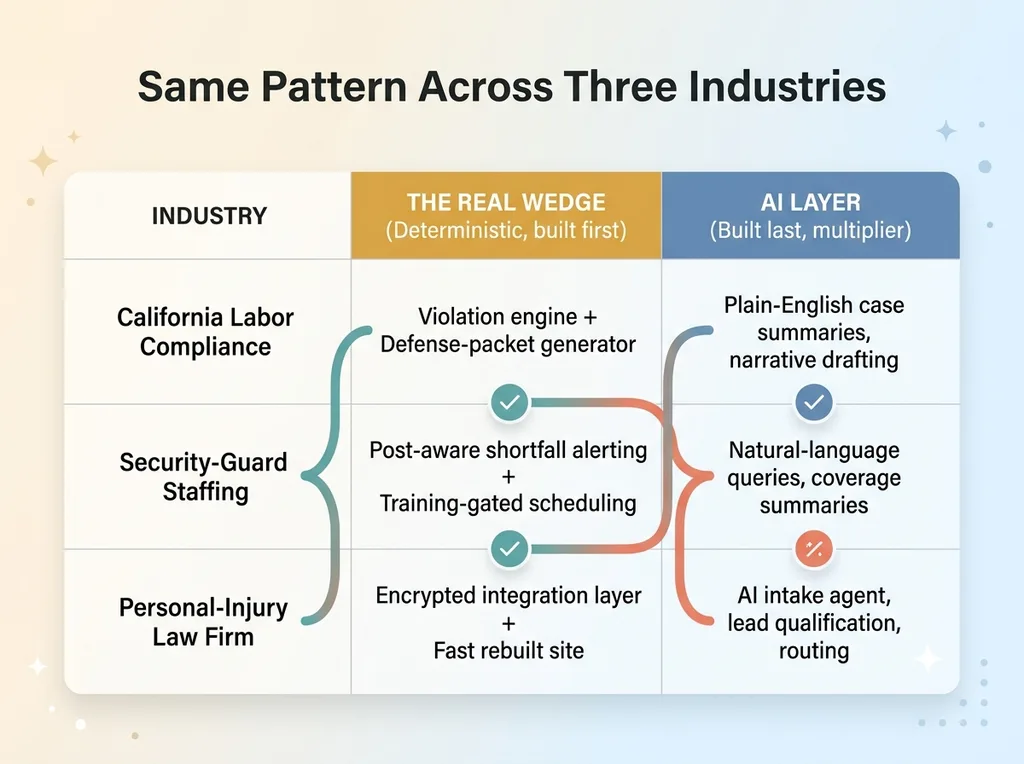 Three Verticals, Same Pattern (Wedge vs AI)
The durable value wasn't the intake agent. It was two unglamorous things.
First, an encrypted integration layer, connecting the firm's messy, disconnected systems securely so data actually flowed where it needed to. Case management, intake, documents, communications, all of it had been living in silos held together with manual copy-paste and prayer.
Second, a fast, rebuilt site that actually performed. The old one was slow and leaking leads. Performance wasn't cosmetic; for a PI firm, a slow site is lost cases.
Those two things changed the firm's operations. Real, measurable change in how they ran day to day. That was the wedge.
The AI intake agent rode on top of all that, built last. And once it sat on a clean, integrated data layer, it was genuinely valuable, qualifying leads, capturing details, routing cases. But it was the compounding bonus, not the foundation.
This is the pattern that holds in every one of these. The unglamorous layer is the moat. The AI is the multiplier.
And the failure mode is brutal if you reverse it. An AI intake agent sitting on top of a broken data layer doesn't help. It captures leads and dumps them into the same broken silos, faster. You've automated the chaos. Now you're losing cases at scale, with a confident AI assuring everyone it's working.
The integration plumbing and the site performance were what made the AI safe to add. Without them, the AI would have been a liability wearing a friendly face.
The Right Build Sequence
Three examples, three industries, one sequence. Here's the order I use, every time.
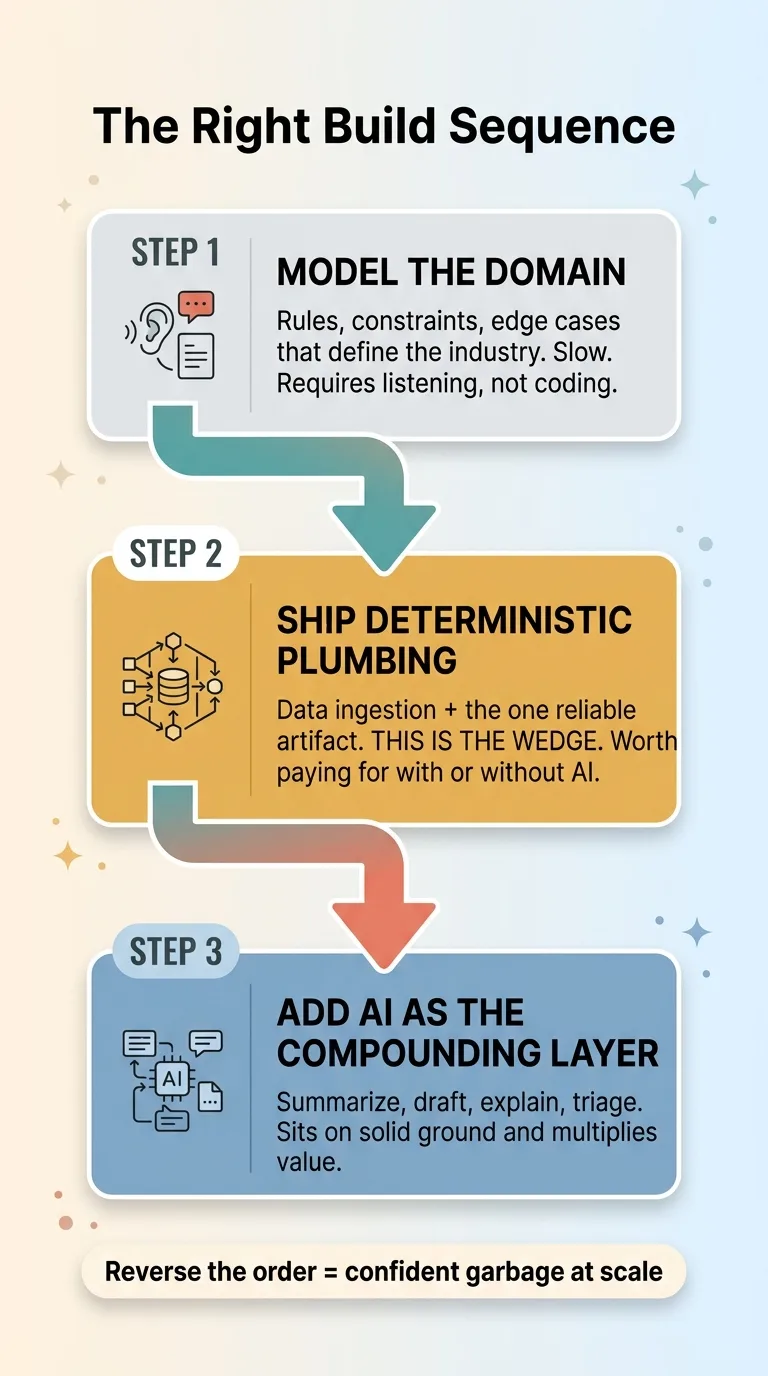 The Right Build Sequence (3-step order)
Model the domain
First, model the domain correctly. The rules, the constraints, the edge cases that actually define the industry.
In labor compliance, that's the exact legal triggers. In guard staffing, it's certification requirements and coverage rules. In a law firm, it's how cases and data actually move through the business.
This is the step everyone skips because it's slow and requires listening, not coding. It's also the step that determines whether everything you build on top is solid or rotten.
Ship the deterministic plumbing
Second, ship the deterministic plumbing. Data ingestion, and the one artifact that matters, the thing that's reliable every single time.
The violation engine and defense packet. The shortfall alert and the training gate. The encrypted integration layer and the fast site. This is the wedge. This is what makes the customer switch and pay, with or without any AI in the product.
Add AI as the compounding layer
Only then do you add AI, where it compounds value. Summarizing, drafting, explaining, triaging, the language and judgment work AI is genuinely good at.
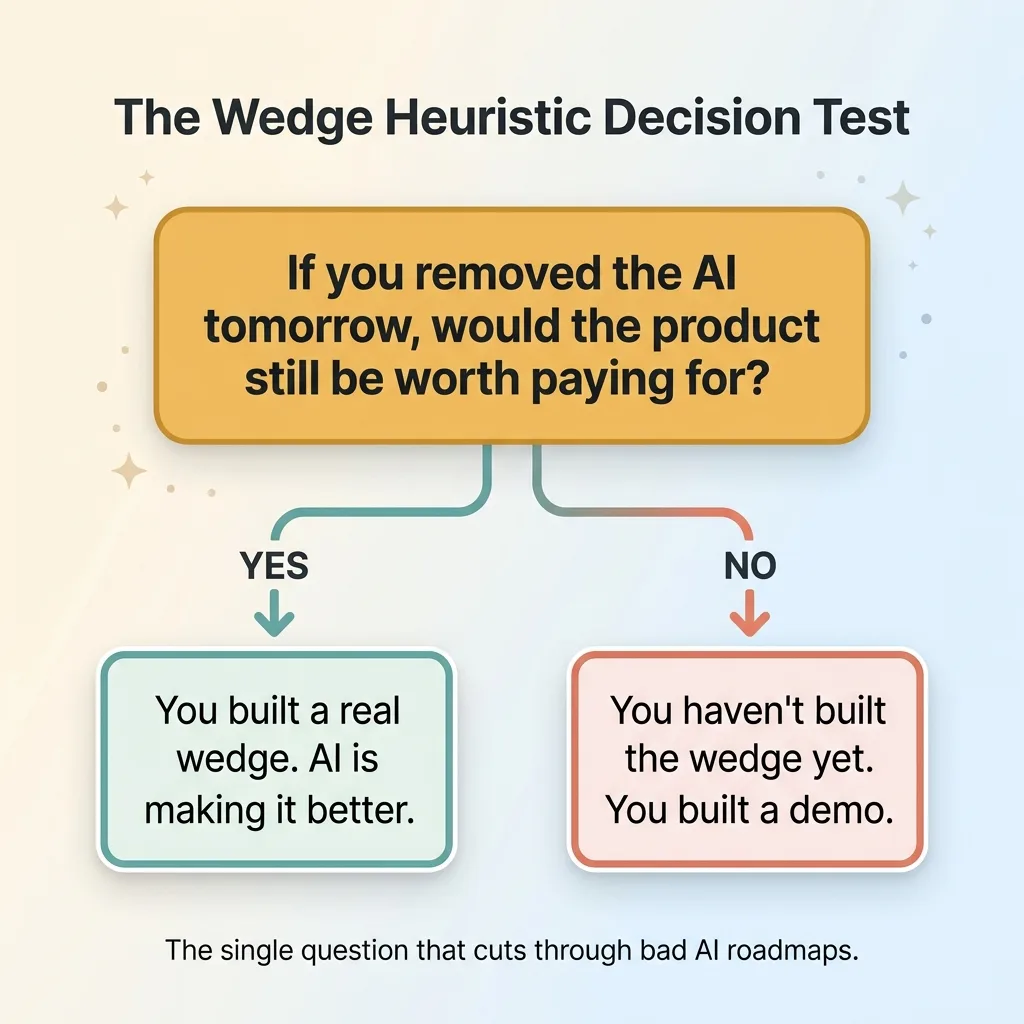 The Wedge Heuristic Decision Test
Why does the order matter so much? Because AI added first inherits every flaw in your domain model and amplifies it. Garbage foundation, confident garbage output, at scale. That's the exact mechanism behind why most AI projects fail. "Add AI" as a strategy isn't a strategy. It's how the project dies.
AI added last sits on solid ground and compounds the value that's already there.
Here's the heuristic I give every CEO: if you removed the AI tomorrow, would the product still be worth paying for?
If yes, you've built a real wedge and AI is making it better. If no, you haven't built the wedge yet. You've built a demo.
That single question cuts through more bad AI roadmaps than any framework I know.
How to Find Your Real Wedge
So if you're a CEO sitting on the instinct to "add AI," let me reframe the question for you.
The question isn't "how do we add AI." It's two different questions. What's the one boring, reliable thing the incumbents in our industry refuse to build? And what's the artifact our customer actually needs, the output they'd switch and pay for?
Answer those, and your AI roadmap falls into place naturally, because now you know what the AI is compounding instead of what it's pretending to be.
I build these systems. I don't just hand you a slide deck and walk away. I build these systems, not just advise on them, which means I find the wedge by getting into the actual data and operations, not by theorizing about them.
I've done this across multiple regulated and old-school industries, compliance, staffing, legal, and a fashion brand I run myself in San Diego. The pattern holds every time. The wedge is the boring, defensible plumbing. The AI is the multiplier on top.
If you want to figure out what your real wedge is before anyone writes a single line of AI code, that's exactly the conversation I want to have. Start at figure out what your real wedge is and let's find the load-bearing layer in your business.
Thinking about AI for your business?
If this resonated, let's talk. I run free 30-minute discovery calls where we look at your actual operations and find where AI would genuinely move the needle, and just as importantly, where it wouldn't.
No slides. No hype. Just a straight conversation about what's worth building.
Get AI insights for business leaders
Practical AI strategy from someone who built the systems — not just studied them. No spam, no fluff.
Hodgen.AI
Ready to automate your growth?
Book a free 30-minute strategy call with Hodgen.AI.
Book a Strategy Call