The Split Is Already Here
Something happened in the last eighteen months that most people haven't fully processed yet.
 The Collapse of Idea-to-Product Timeline
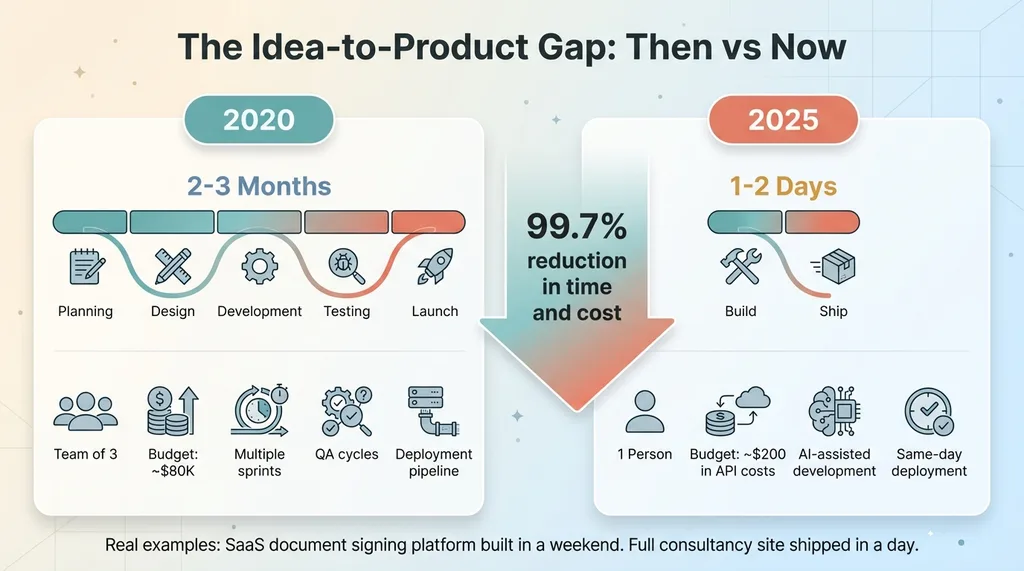
The gap between having an idea and shipping a product collapsed. Not narrowed. Collapsed. I built a SaaS document signing platform in a weekend. I built this entire consultancy site in a day. Not prototypes. Production software that handles real users, real money, real transactions.
Five years ago, those projects would have taken a team of three and two months of work. Maybe $80K all-in. Today it takes one person with the right tools and the willingness to sit down and do the work.
That shift didn't just change what's possible. It changed who wins.
The Old Guard Is Losing
There's a specific type of person who is deeply uncomfortable right now. You know them. They're brilliant. Well-read. Articulate. They can explain the nuances of transformer architectures, debate the philosophical implications of artificial general intelligence, and quote Kahneman from memory.
They haven't built anything.
They write thoughtful blog posts about why the current crop of AI tools are "just autocomplete." They tweet about hallucination rates. They hold court at dinner parties about how AI can't really think. They're technically correct about a lot of things.
And they're losing.
Not because they're wrong about the limitations. They're losing because the limitations don't matter as much as they think. While they're debating whether large language models truly "understand" language, someone with half their IQ and twice their urgency just shipped a product that serves ten thousand customers.
The market doesn't care about your critique. It cares about your output.
Intelligence Got Commoditized. Most People Haven't Noticed.
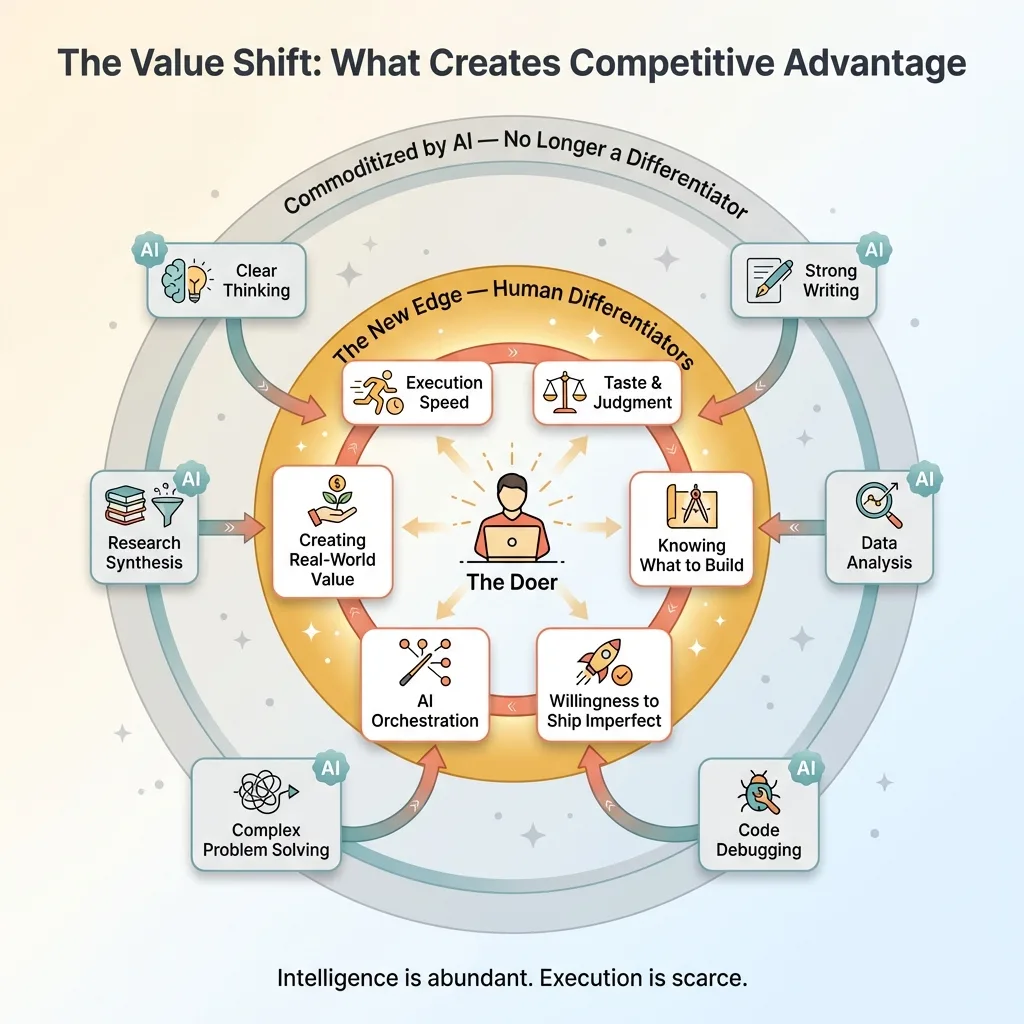
Here's the thing nobody wants to say out loud: intelligence used to be scarce. If you could think clearly, write well, and analyze complex problems, you had a genuine competitive advantage. Companies paid a premium for smart people because smart people were rare and hard to replicate.
 Intelligence Commoditization and the New Edge
That's over.
Not because people got dumber. Because the tools got smarter. Claude can write better prose than 95% of professional writers. It can analyze a dataset faster than any analyst. It can debug code, draft legal documents, design systems architectures, and explain quantum mechanics to a five-year-old — all in the same conversation.
When intelligence is abundant, it stops being a differentiator. What differentiates you now is what you do with it.
This is the part that makes smart people uncomfortable. Their entire identity was built on being the smartest person in the room. Now the room has an AI that's smarter than everyone in it. The smart person's edge didn't get smaller. It disappeared.
The new edge is execution. Speed. Taste. Judgment about what to build. Willingness to ship something imperfect and iterate. The ability to orchestrate AI tools toward a specific outcome that creates value for real people.
These are doer skills, not thinker skills.
The Wealth Transfer Is Happening Right Now
I see it every week in my consulting work. The companies that are pulling ahead aren't the ones with the best AI researchers or the most sophisticated technical teams. They're the ones where someone — usually a founder or an operator — sat down with AI tools and started building.
 The Wealth Transfer from Knowers to Doers
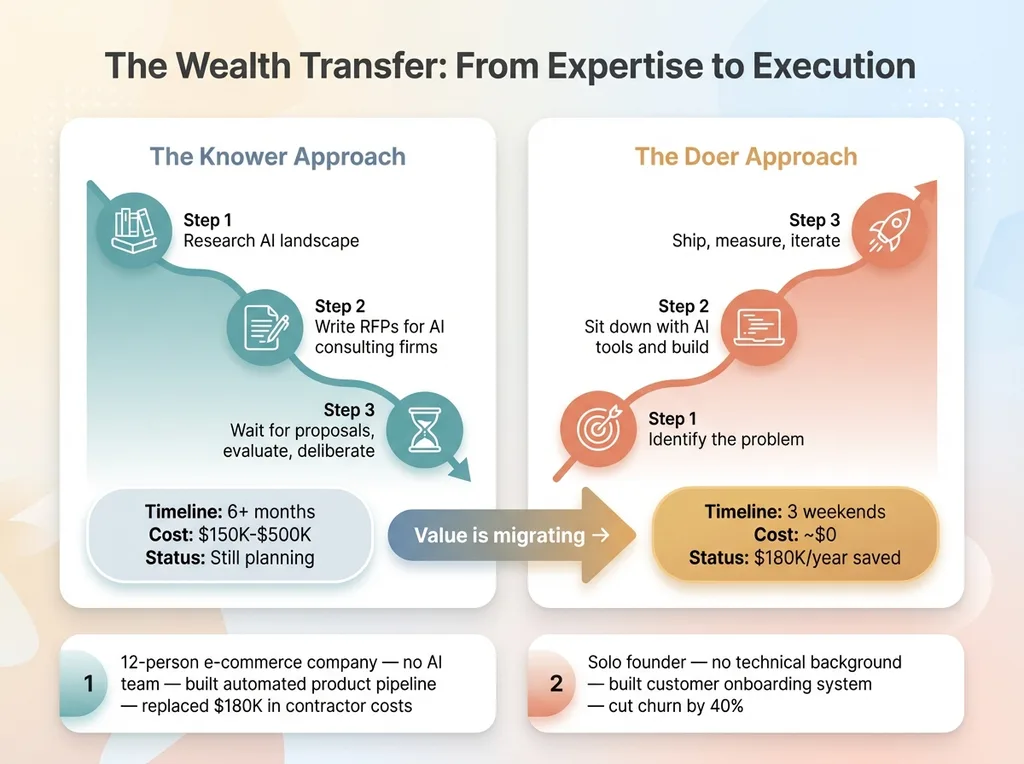
A client of mine runs a 12-person e-commerce company. No AI team. No data scientists. No machine learning engineers. He spent three weekends learning Claude Code and built an automated product pipeline that replaced $180K worth of annual contractor work. His competitors are still writing RFPs for AI consulting firms.
Another client — solo founder, no technical background — used AI to build a customer onboarding system that cut their churn rate by 40%. She didn't understand the code. She understood the problem. AI handled the implementation.
This pattern repeats everywhere I look. The people capturing value from AI aren't the ones who understand it best. They're the ones who use it most.
That's the wealth transfer. It's moving from people who know things to people who do things. From expertise to execution. From credentials to output.
And it's accelerating.
The Romanticism Trap
The most dangerous position right now is nostalgia for the way things used to work.
I talk to executives who genuinely believe that "real" work requires deep expertise built over decades. That shortcuts are cheating. That if you didn't suffer through years of learning, your output can't be legitimate.
They're romanticizing struggle. Confusing the difficulty of the process with the value of the outcome. Nobody cares how long it took you to learn to code. They care whether the software works.
This romanticism shows up everywhere:
"AI-generated content is lower quality." Sometimes. But I've seen AI-assisted content outperform hand-crafted content in engagement, SEO ranking, and conversion — because the human focused on strategy and taste while AI handled the production. Quality comes from judgment, not from typing speed.
"You need to understand the fundamentals first." For what? If I need to understand database design to build a product, I'll learn it when the product requires it. Learning fundamentals for their own sake is a luxury that doers can't afford and don't need. Context-driven learning beats curriculum-driven learning every time.
"This is just a bubble." People said that about the internet in 1999. They were right about the timing and wrong about the trajectory. AI tools are getting better every month. The gap between early adopters and holdouts is widening, not closing.
The romantic view of intelligence — that it's something you cultivate slowly, display modestly, and deploy carefully — is a beautiful idea. It's also a losing strategy.
The Cyborg Convergence
Here's where this gets interesting.
 The Cyborg Convergence Adoption Curve
Right now, there's a clear spectrum. On one end, people who refuse to use AI tools. On the other end, people who use AI for everything. Most people are somewhere in the middle, experimenting, dipping their toes in.
That middle is going to collapse.
Not because of ideology. Because of economics. When someone using AI tools can produce 10x the output at one-tenth the cost, the market adjusts. Salaries adjust. Expectations adjust. The baseline for what one person can accomplish shifts upward, permanently.
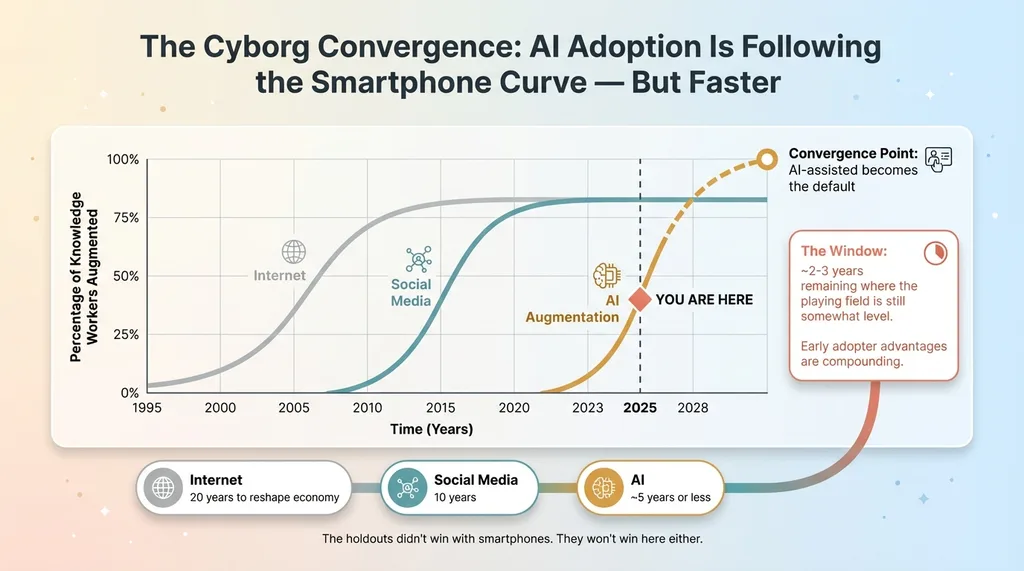
We're heading toward a convergence point where the distinction between "human work" and "AI-assisted work" stops being meaningful. Every knowledge worker will be augmented. The question isn't whether you'll work with AI. It's whether you'll be good at it.
Think about what happened with smartphones. In 2007, plenty of people said they didn't need one. By 2015, not having a smartphone meant you couldn't participate in modern life — banking, communication, navigation, employment. The holdouts didn't win. They just delayed their own adaptation.
AI augmentation is following the same curve, but faster. Much faster.
The people who are building their AI-augmented workflows now — learning how to prompt effectively, how to orchestrate multiple models, how to validate AI output, how to maintain quality at scale — are developing skills that will compound over years. They're becoming cyborgs in the most practical sense: humans whose capabilities are permanently extended by AI tools.
The people who are waiting are falling behind at an accelerating rate.
The Attention Shift
There's a subtler dynamic at play that most people are missing.
Intelligence used to command attention. When a brilliant person spoke, people listened, because access to that level of thinking was rare. Thought leaders built audiences by being smarter than their readers. Consultants charged premium rates because their analysis was hard to replicate.
AI is pulling that attention away.
Why read a 4,000-word analysis from an industry expert when you can ask Claude to analyze the same topic and get a response in thirty seconds? Why pay a consultant $500/hour for their expertise when you can access comparable analysis for pennies?
The experts who survive this shift are the ones who offer something AI can't: lived experience, real results, skin in the game. "I built this" beats "I think this" every time. The audience for pure intellect is shrinking. The audience for demonstrated execution is growing.
This is why I write about what I actually build, not about what I think about AI in the abstract. Theory without practice is content. Practice with results is proof.
The tipping point comes when the majority of knowledge workers realize that their audience — their customers, their employers, their market — values output over insight. When that happens, the remaining holdouts don't gradually come around. They get left behind suddenly, the way Blackberry didn't slowly lose to iPhone. One day you're the standard. The next day you're a case study in denial.
What Doers Actually Do Differently
This isn't about being reckless or moving fast and breaking things. The best doers I work with share a few traits:
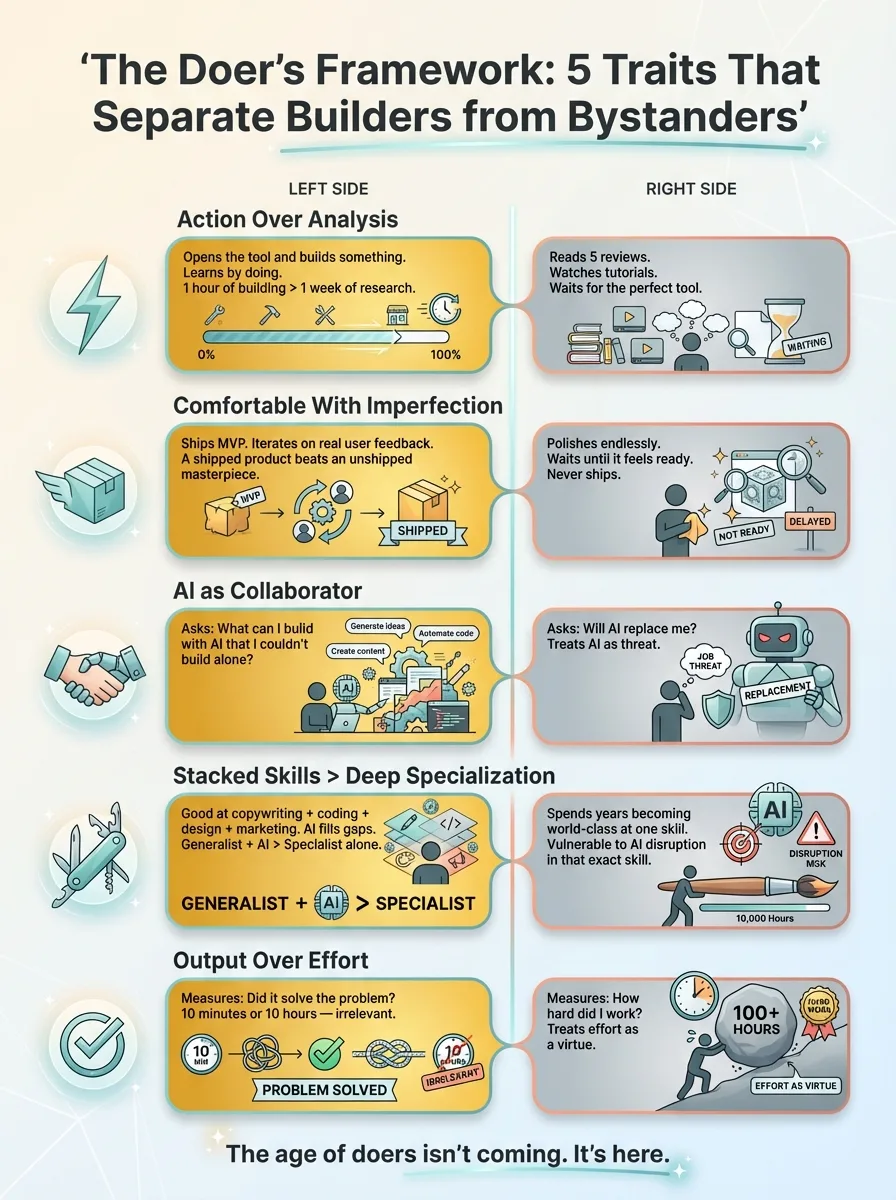 What Doers Do Differently — The Doer Framework
They bias toward action over analysis. When they encounter a new AI tool, they don't read five reviews. They open it and build something. The feedback from building teaches them more in an hour than research teaches in a week.
They're comfortable with imperfection. They ship before they're ready. They iterate based on real user feedback, not hypothetical objections. They know that a shipped MVP beats an unshipped masterpiece.
They treat AI as a collaborator, not a threat. They don't ask "will AI replace me?" They ask "what can I build with AI that I couldn't build alone?" That reframe changes everything.
They stack skills, not deepen them. Instead of becoming the world's best copywriter, they become a good copywriter who can also code, design, and market. AI fills the gaps. The generalist with AI tools outperforms the specialist without them.
They measure in output, not effort. They don't care if a project took ten hours or ten minutes. They care if it solved the problem. Effort is a cost, not a virtue.
The Choice
We're in a window right now — maybe two to three years — where the playing field is still somewhat level. AI tools are accessible. The learning curve is manageable. The early adopter advantage hasn't calcified into an insurmountable lead.
That window is closing.
Every month, the people who are building with AI get better at it. Their workflows compound. Their output scales. Their competitive advantage widens. Meanwhile, the people on the sidelines are doing the intellectual equivalent of watching Netflix while their neighbors build equity.
This isn't a technology story. It's a human behavior story. The same pattern plays out in every major technological shift. A small group adopts early, captures disproportionate value, and creates a new baseline that everyone else eventually has to meet.
The difference this time is speed. The internet took twenty years to reshape the economy. Social media took ten. AI is going to do it in five. Maybe less.
You can be romantic about the way things were. You can argue that real intelligence can't be automated. You can wait for the technology to mature, the hype to settle, the best practices to emerge.
Or you can build something today.
The age of doers isn't coming. It's here. The only question is whether you're doing, or watching.