The Delete Button That Quietly Voids Your Legal Protection
Here's a scenario that should make anyone in a compliance-sensitive field nervous. You send a contract for signature. One party opens it. Then someone hits delete, and the document is gone. No record it ever existed. No record of who saw it, when, from what IP address, or what they agreed to. The whole thing vanishes like it never happened.
That's the failure I designed around when I built the e-signature system I built without DocuSign. Most people think the signature itself is the legally meaningful part. It isn't. The thing that makes an esignature audit trail void document workflow actually hold up in front of a regulator is the trail, not the squiggle. The signature image proves nothing on its own. The immutable record of events around it proves everything.
So if your tool lets a signed document get deleted, you don't have a weaker version of legal protection. You have something worse than nothing. A deletable signed document gives you false confidence. You think you have a record. You don't. And in legal, finance, healthcare, or contracting, that gap shows up at the exact moment you can least afford it: an audit, an arbitration, a regulatory request.
A signature toy lets you delete. A defensible system does not.
The fix I built is simple to state and important to get right: you don't delete a document that has been sent or signed. You void it. Void cancels the document while preserving the entire history of what happened. The record survives. The protection survives.
That single design decision, void instead of delete, is the difference between a tool you can rely on and a liability you don't know you're carrying.
Why a Signature Pad Isn't the Hard Part
When people imagine building e-signature, they picture the signature pad. The smooth canvas where you draw your name, the rendered cursive, the little checkmark when it's done. That's the easy 5%. I could build a decent signature capture component in an afternoon.
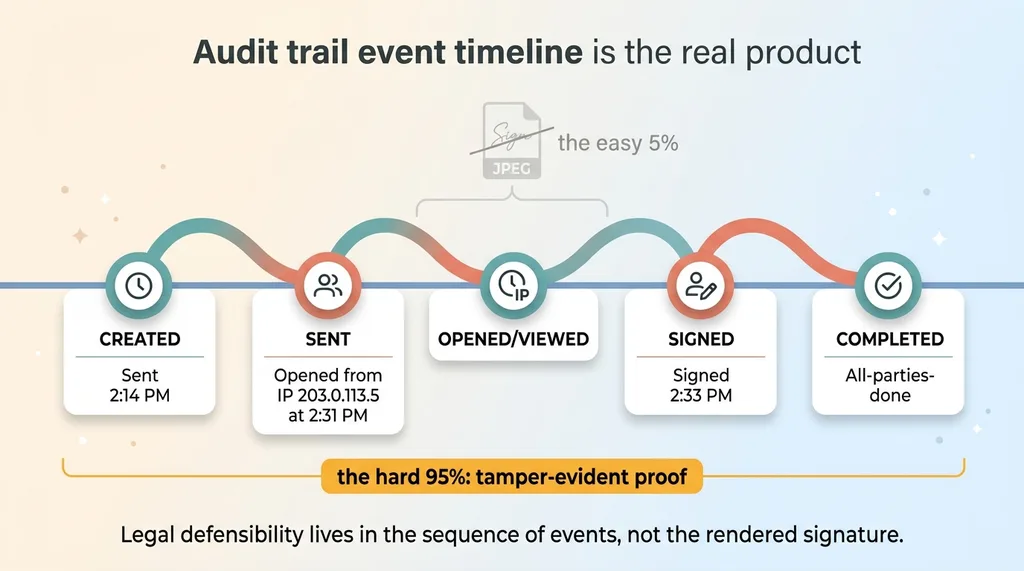 The audit trail event timeline as the real product
The hard 95% is integrity. Proving who signed. Proving when. Proving from where. Proving the document hasn't changed since they signed it. And proving the record can't be quietly tampered with after the fact. None of that lives in the pretty pad. All of it lives in the audit trail.
Here are the events that actually matter, the ones I log immutably for every document:
- Created, the document exists, with a timestamp
- Sent, dispatched to specific signers, recorded per recipient
- Opened/viewed, with timestamp and IP address, per signer
- Signed, who signed, when, in what order
- Completed, fully executed, all parties done
That timeline is the product. Legal defensibility lives entirely in that sequence of events, not in the rendered signature graphic. If opposing counsel challenges a signature, you don't wave a JPEG at them. You produce a tamper-evident timeline showing the document was sent at 2:14 PM, opened from a specific IP at 2:31 PM, and signed at 2:33 PM, with no modification to the underlying content in between.
This reframes what you should evaluate when you pick or build an e-signature tool. Stop asking how nice the signing experience looks. Start asking what gets recorded, whether that record can be altered, and what happens to it when someone tries to make a document go away.
The signature is the easy part. The proof is the whole job.
Void vs Delete: Two Words That Decide If Your Document Holds Up
This is the core of the whole design, and it comes down to two words that most people use interchangeably. They are not interchangeable.
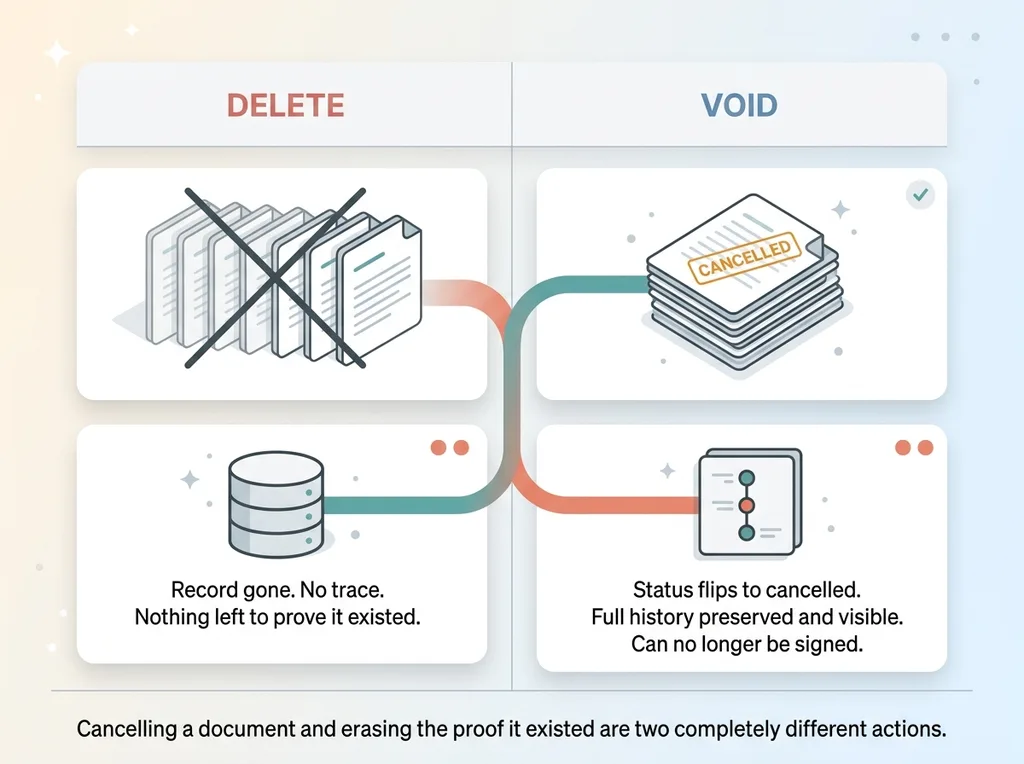 Void vs Delete side-by-side comparison
Delete means the record is gone. No trace. The row leaves the database, the history disappears, and there is nothing left to prove the document ever existed.
Void means the document is cancelled but the full history is preserved and visible. The status flips to cancelled. The audit record stays. You can still see it was created, sent, and opened. You just can't sign it anymore.
What Void actually does
When you void a document in my system, three things happen atomically. The status moves to cancelled. The complete audit trail is preserved, untouched. And the live signing links are killed, which I'll get into in the next section.
The point of void is that cancelling a document and erasing the proof it existed are two completely different actions. You almost always want the first. You should almost never be allowed the second.
Why hard delete only exists for drafts
Here's the rule I enforced and would enforce in any system that has to hold up under scrutiny: hard delete is restricted to documents in draft and cancelled states only. Anything that has been sent, viewed, or signed cannot be deleted. The only way to stop it is to void it.
A draft has no legal weight. Nobody has seen it, nobody has acted on it. Deleting a draft is like throwing away a sticky note. Fine. But the moment a document gets sent, it has touched the outside world, and now the fact that it was sent is itself a piece of evidence.
Concrete scenario. You send a contract to two signers. One of them opens it. Then you realize the terms are wrong, the price is off, a clause is missing. Your instinct is to delete it and start over.
Don't. You void it. Now there's a permanent record that this version was sent and that one party opened it. If that signer later claims they agreed to terms they actually didn't, you have the proof of exactly what was on the table and what happened to it.
This is the same append-only thinking I used when I built my accounting ledger. You don't edit history to fix a mistake. You write a new entry that corrects it. Deletion is the wrong primitive for any data that has to survive scrutiny. Compliance records are append-only by nature, and your software should enforce that, not leave it to whoever's holding the delete button.
The Security Hole Nobody Talks About: Stale Signing Links
Here's the failure mode that even careful builders miss. You cancel a document. You mark it void. The status is correct, the audit trail is preserved, everything looks clean. But you left the email signing links live.
Those links still work. Anyone who received the original email can click through and open, or even sign, a document that is supposed to be dead. You voided it in your database, but out in the world, the kill switch never fired. That's a real security and liability hole, and it's exactly the kind of gap that doesn't show up until someone exploits it.
Rotating each signer's token on void
My fix: on void, I rotate each signer's access token. That single action invalidates every email link that was already sent to that signer. The recipient who clicks the old link now hits a dead, expired page instead of a signable document.
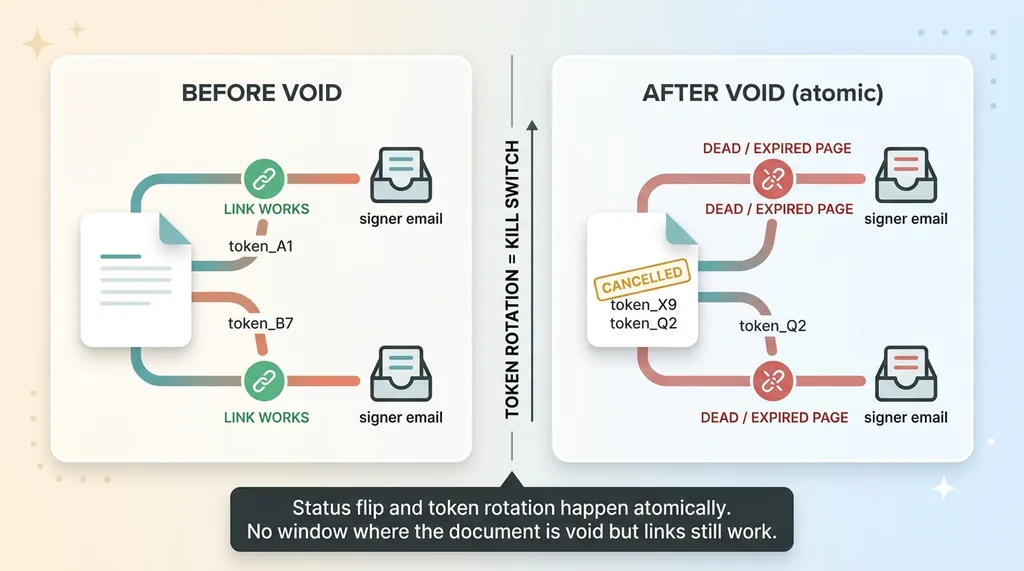 Stale signing link kill switch via token rotation
A few mechanics that make this work:
-
Per-signer tokens, not one shared link. Each signer gets their own access token embedded in their own link. This matters for audit accuracy (you know exactly who opened what) and it means you can invalidate one signer without disturbing another if you ever need to.
-
Token rotation as the kill switch. Rotating the token is the act of killing access. You don't have to track down sent emails, recall messages, or hope nobody clicks. The link is rendered useless because the token it carries no longer matches anything valid.
-
No email chasing required. Once the document carries a fresh token, every old link is automatically dead. The recall happens server-side. You change one thing and every stale link in every inbox goes inert.
The critical detail is that token rotation and the lifecycle change happen atomically. The status flip to cancelled and the token rotation are one operation, not two. There is no window where the document is marked void but the links still work, and there is no window where the links are dead but the status still says active. Either both happen or neither does.
A cancelled document with live links isn't cancelled. It's a loaded gun you forgot about.
Document Lifecycle States That Can't Be Cheated
The whole thing is a state machine, and the integrity comes from the fact that the states can't be cheated. Here's the lifecycle:
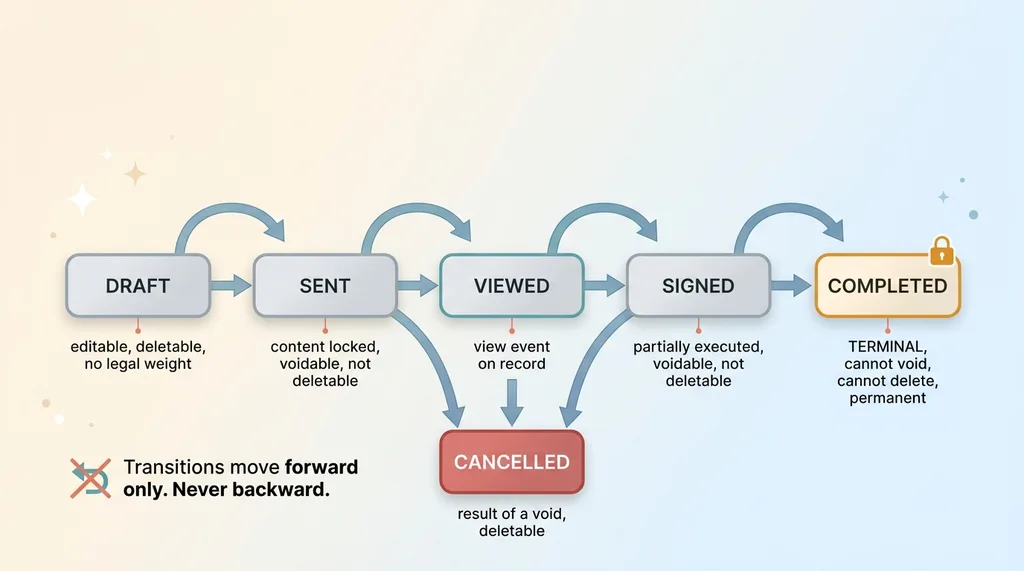 Document lifecycle state machine
draft → sent → viewed → signed → completed, with cancelled as the off-ramp from any active state.
Here's what each state allows:
- Draft, editable, deletable. No legal weight yet.
- Sent, locked content, can be voided, cannot be deleted.
- Viewed, same, plus the view event is now on record.
- Signed, partially executed, can still be voided, cannot be deleted.
- Completed, terminal. Cannot be voided. Cannot be deleted.
- Cancelled, the result of a void. Deletable (the history is what matters, not the live document).
The terminal state: completed
Completed is the end of the line. A fully executed agreement, signed by everyone, is a permanent record. You can't void it. You can't delete it. It exists forever.
This trips people up, and it's supposed to. Once everyone has signed, the deal is done and the record of that deal is no longer yours to make disappear. That's not a limitation. That's the entire point of having a defensible system.
Why state transitions must be one-directional
Transitions only move forward. Never backward. You cannot walk a signed document back to draft so you can quietly edit it and re-send it as if nothing happened.
This is what makes the state machine trustworthy. If states could move backward, the whole audit trail becomes meaningless, because anyone could rewind a document, change the terms, and erase the evidence of what was originally agreed. One-directional transitions mean the timeline only ever grows. History accumulates. It never gets rewritten.
A document you can secretly rewind isn't a record. It's a draft pretending to be one.
What This Looks Like When a Buyer Actually Needs It
If your signed documents might ever end up in front of a regulator, an auditor, an arbitrator, or opposing counsel, this is the difference between a tool you can stand behind and one that quietly fails you under pressure.
I'm talking about financial advisory firms, healthcare providers, anyone in contracting, anyone in a regulated industry where "show me the record" is a question that gets asked in earnest. For those buyers, the integrity model is the product. The signing experience is table stakes. The proof is what you're actually paying for.
Now let me be honest about the tradeoff, because it's real. This design makes some things deliberately harder. You can't clean up a mistake by deleting it. If you void a document, that void record lives forever. You don't get to pretend the awkward draft never went out. The friction is the point.
And completed-is-terminal genuinely frustrates people. They want an undo button. They want to fix the executed agreement, walk it back, re-sign it. The system says no, and the system is right. A fully executed agreement that can be undone isn't an agreement. It's a suggestion.
I'd rather tell a buyer up front that this design will occasionally annoy them than build something that feels frictionless right up until the moment it costs them a case. The annoyance is a feature working correctly.
Integrity Is a Design Decision, Not a Feature You Bolt On
You cannot patch integrity in after a compliance scare. Audit trails, kill switches, one-directional state machines, these have to be designed in from the first table you create, not retrofitted once a regulator comes knocking. By then the deletable records are already gone, and you can't audit what doesn't exist.
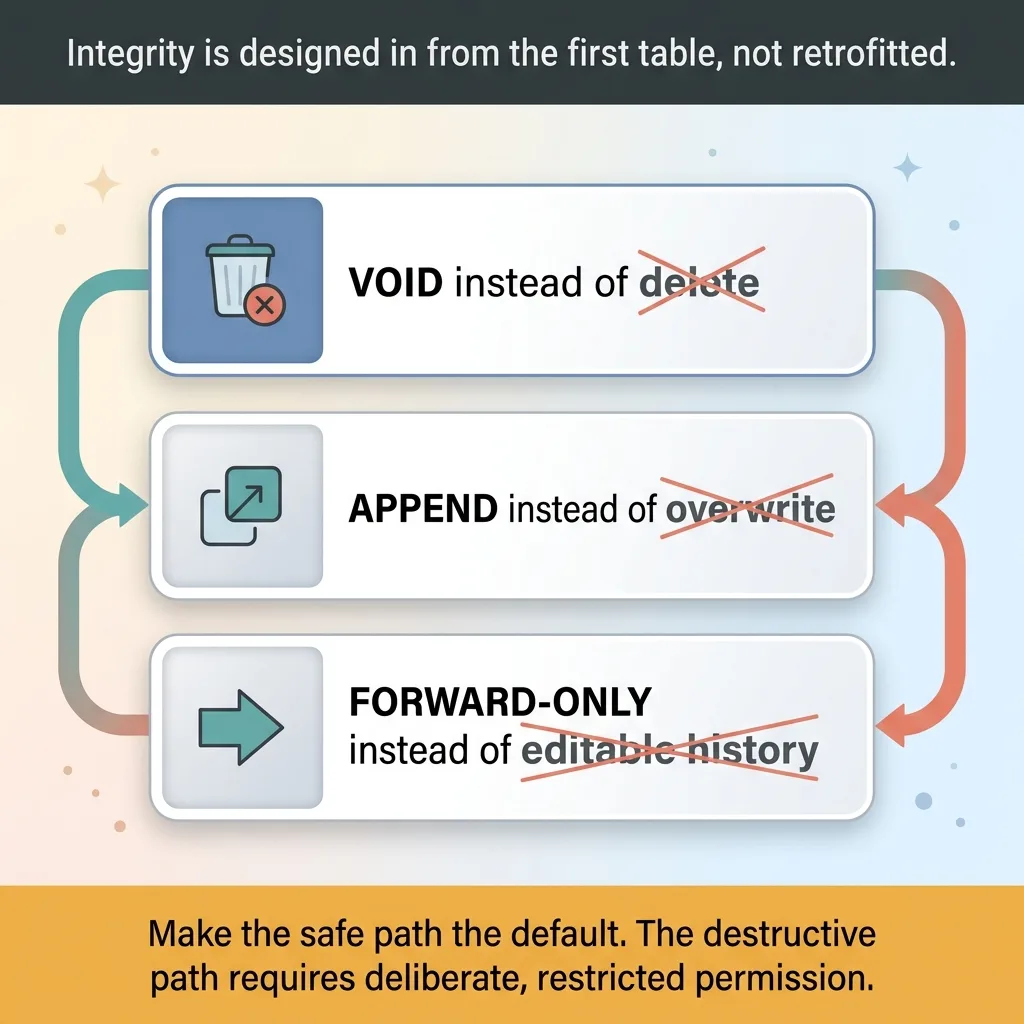 Integrity-by-design principles
This is how I build everything. Preserve the record. Restrict the destructive actions. Make the safe path the default so that doing the right thing requires no discipline and doing the dangerous thing requires deliberate, restricted permission. Void instead of delete. Append instead of overwrite. Forward-only instead of editable history.
It's the same philosophy behind why every system I ship stops for a human before it does anything irreversible. The destructive actions get the guardrails. The default is always the safe one. Integrity isn't a checkbox you add at the end. It's a set of decisions baked into the structure from day one.
If you're in a field where a document, a transaction, or a record has to hold up under scrutiny, I build the integrity model in from the start, not after the audit. That's not an upsell. It's the only way it actually works.
Get the next build note.
I write up each system I build, including what broke. Subscribe to my newsletter and I'll send you the next one.