Human in the Loop AI Design: Why Nothing Auto-Submits
How I use human in the loop AI design to make AI safe for real money and orders. AI proposes, a human approves, the server recomputes. Here's the rule.
By Mike Hodgen
The Fastest Way to Lose Trust in AI Is to Let It Commit Something Wrong
Picture the moment an AI tool overpays a commission. Not by a rounding error. By $4,000, to the wrong rep, posted silently to the ledger while everyone was busy.
You don't get a second chance after that. The tool gets unplugged that afternoon, and every future AI conversation in that company starts with "remember when it paid the wrong person." One expensive mistake erases a year of good ones.
This is the real question every CEO asks me before they say yes to anything: how do I trust AI with money and customer orders? Not "is it smart enough." They assume it's smart. They're scared it's confidently wrong in the one place that costs them.
Here's the answer I've built into every system that touches anything consequential. Take a window-treatment company I worked with, with operations tools spanning intake, commissions, scheduling, and pricing. Every single AI feature that touches money, customers, or orders stops for a human before it commits. No exceptions.
The backbone rule is three words long: AI proposes, a human approves, then the server recomputes from scratch.
That's it. The AI never has the last word, and neither does the person clicking approve. The machine does the final math from trusted inputs after a human has signed off on the intent.
This is a design choice, not a shortcoming. I get pushback that it makes the AI "less autonomous." Correct. That's the point. This is the same stance behind every AI system I ship stops for a human, and it's why those systems are still running long after the flashy autonomous demos got switched off.
Human in the loop AI design isn't a safety blanket you add at the end. It's the thing that lets the AI exist in production at all.
What Human in the Loop AI Design Actually Means
Most people hear "human in the loop" and picture someone glancing at a finished action before it goes out. That's not what I mean, and the difference is everything.
AI proposes, a human approves, the server recomputes
There are three distinct stages, and each one is a real gate:
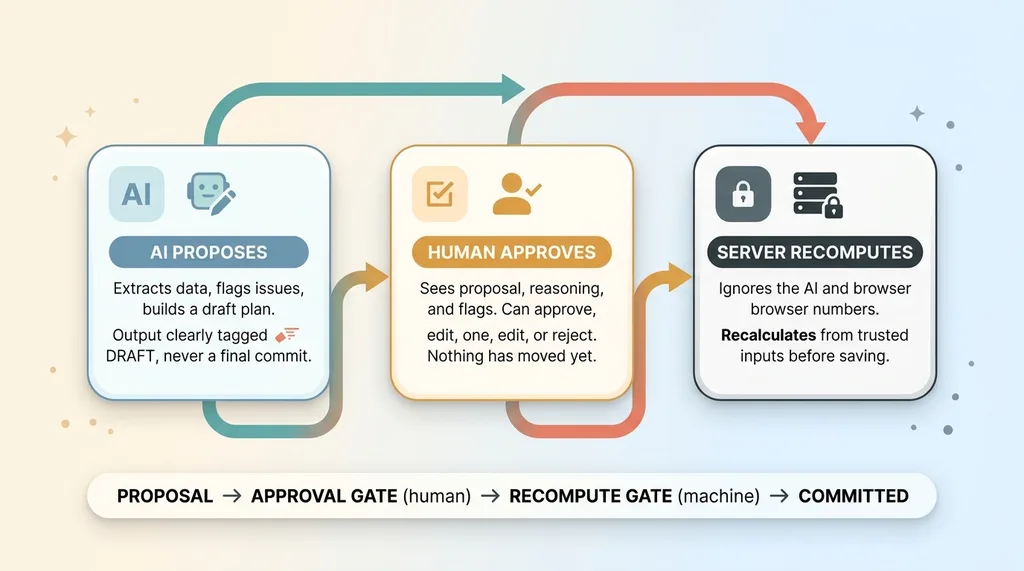 The core three-stage gate: AI proposes, human approves, server recomputes
-
The AI proposes a draft. It extracts data, flags an issue, or builds a plan. It never produces a final commit. What it makes is a proposal, clearly labeled as one.
-
A human approves with full context. The person sees the proposal, the reasoning behind it, and any flags worth checking. They approve, edit, or reject. Nothing has moved yet.
-
The server recomputes from scratch. On approval, the server ignores whatever number the AI or the browser sent and recalculates the real value from trusted inputs before anything is saved.
Why all three steps matter
The trap is collapsing this into "human reviews a finished action." If the action is already finished, the human is rubber-stamping a thing that's effectively done. The psychology is wrong. People approve fast and stop reading.
When the human approves before any action, they're the gate, not a witness. Nothing reaches the database, the calendar, or the ledger on the AI's say-so alone.
And the third step matters because humans approve intent, not arithmetic. A dispatcher can approve "schedule these jobs together" without personally verifying every price and part. The server handles the math so the human can focus on judgment.
This is a company-wide stance, not a feature toggle. It shapes every tool I build, which is also why I'm deliberate about the kill-switches I build into every system. Stopping for a human is the design, not the fallback.
Voice and Photo Intake: Drafts in a Review Grid, Never a Write
A field worker is standing in a customer's living room. They speak the measurements out loud, or snap a photo of a handwritten measure sheet. AI extracts the order lines: window dimensions, product type, mount style, fabric.
Here's what does not happen. Those lines do not flow straight into an order. They land in a review grid where a human looks at them first.
Per-field confidence so the human knows what to check
The grid shows a confidence score per field, not one blanket "looks good." A width the AI heard clearly reads high. A smudged number on a photo, or a spoken value that could be "thirty-two" or "thirty-two and a half," gets flagged low.
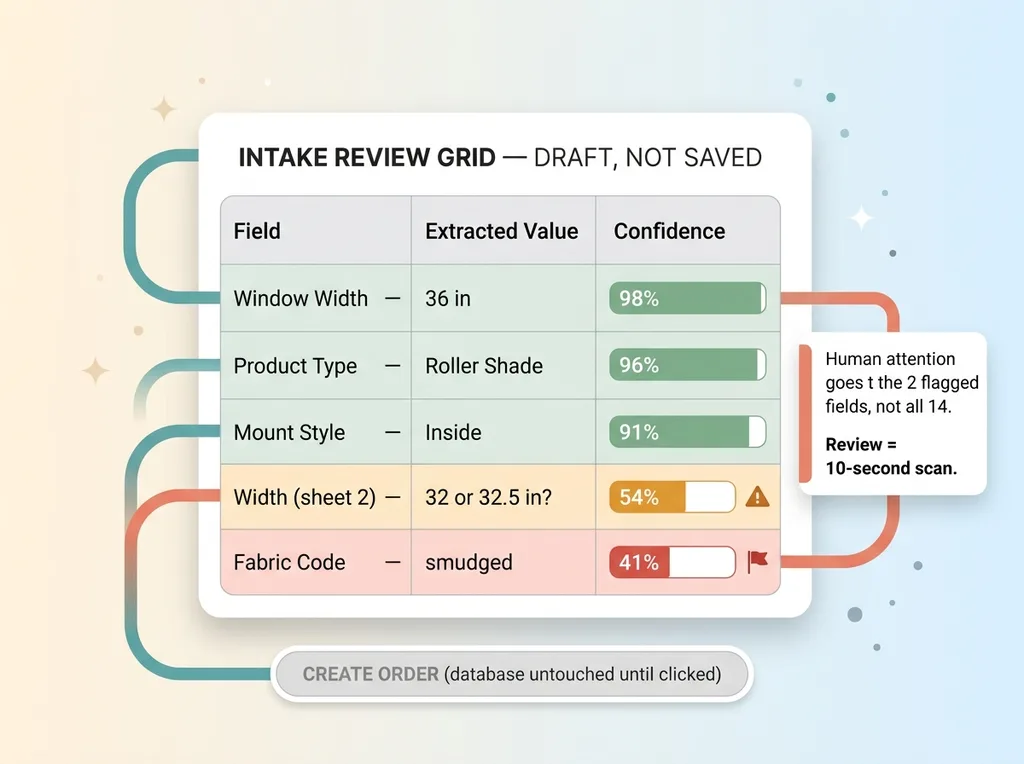 Voice/photo intake review grid with per-field confidence scores
This is the part that makes review actually work. Without it, the human either trusts everything (rubber stamp) or rechecks everything (slow, so they stop using the tool). The confidence display points their attention straight at the three fields most likely to be wrong and lets them blow past the twelve that are obviously right.
Review becomes a ten-second scan instead of a two-minute audit.
The database stays untouched until a human clicks create
Nothing is written until a person clicks create. The draft can sit there, get edited, get corrected against the photo, and only then become a real order.
Why this is non-negotiable: extraction errors are inevitable. Spoken numbers are ambiguous, handwriting is messy, photos are taken at bad angles in bad light. I will never get extraction to 100 percent, and I don't try to.
But the cost of a wrong order line isn't a typo. It's a wrong product manufactured, cut to the wrong size, and shipped to a customer who's now angry and owed a remake. The intake AI saves real time on data entry. The review grid makes sure that speed doesn't turn into a warehouse full of mistakes.
The Commission Engine: AI Adds Judgment, a Person Approves the Run
Now the money example, where the stakes get personal fast.
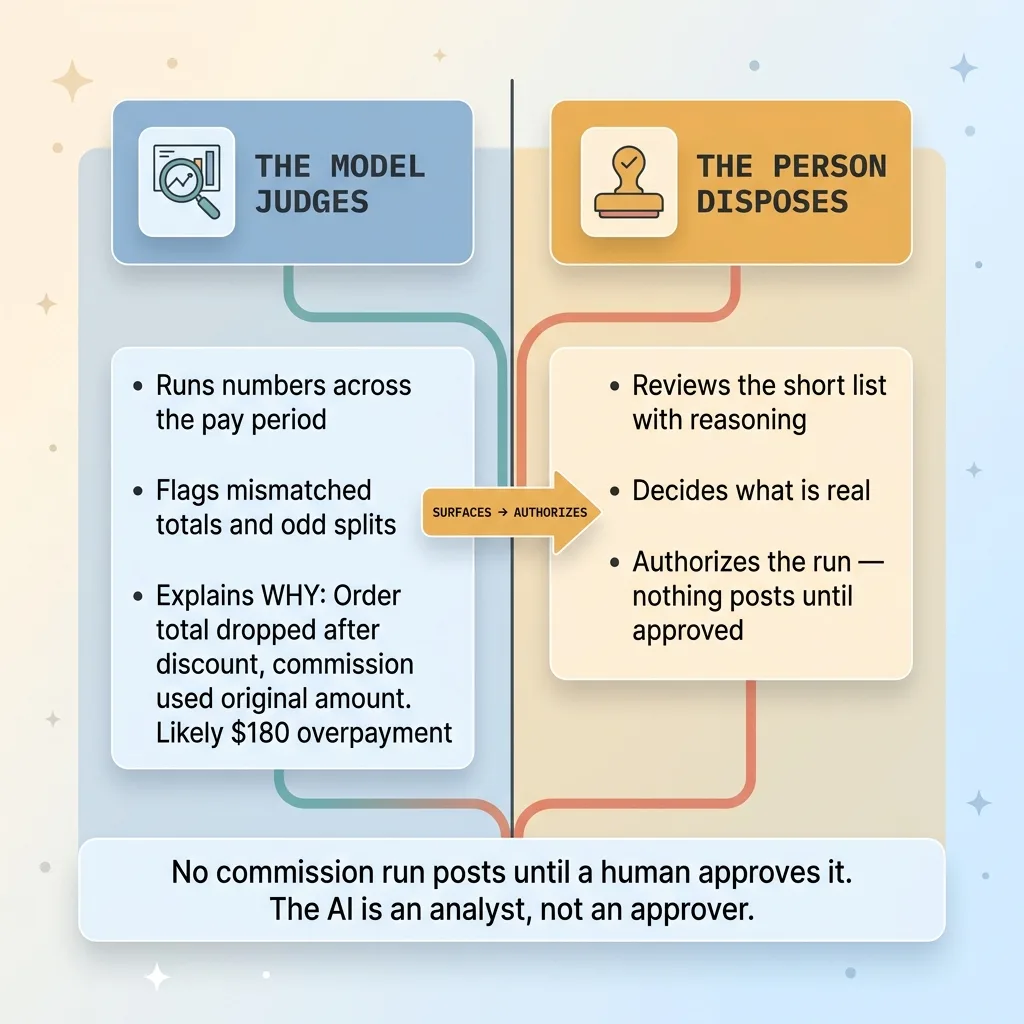 Division of labor: model judges, human disposes (commission engine)
The commission engine runs the numbers across a pay period and flags discrepancies: mismatched totals, unusual split percentages, an order that landed in two reps' buckets, an edge case the rules didn't cleanly cover.
On top of the raw flags, an AI reviewer layers judgment. Instead of just "totals don't match," it explains: "This order's total dropped after a post-sale discount, but the commission was calculated on the original amount. Likely overpayment of $180." It tells the human why the flag matters and what it suspects happened.
That's genuinely useful. It turns a wall of numbers into a short list of "look at these, here's why."
But no commission run posts until a human approves it. The AI is an analyst, not an approver.
This distinction is the whole ballgame when money moves to real people. A silent commission error isn't just a financial problem you can reverse with a journal entry. It's a trust problem. A rep who got shorted stops believing the system. A rep who got overpaid and got clawed back stops believing it too. Either way, the tool that was supposed to save your finance person time becomes the thing they no longer trust.
So the AI's job is to surface what a human should look at and explain it clearly. The human's job is to decide and authorize. The model judges. The person disposes.
That division of labor is exactly why finance teams actually let this thing near payroll.
The Install Scheduler: A Full Plan With Rationale, Nothing Dispatches Until Approved
Operations example. The scheduler takes the week's install jobs and produces a complete plan: which jobs cluster together geographically, what order the stops run in, which crew gets what.
It's a good plan. It accounts for drive time, job duration, and load. On a busy week it does in seconds what a dispatcher used to spend an hour wrestling with on a whiteboard.
And nothing dispatches to crews until a human approves it.
Rationale per stop, not a black box
The plan doesn't just show the route. Each stop carries a rationale: why this job is here, why this sequence. "This install is first because it's the furthest north and the crew's coming from that direction." "These two are paired because they're four minutes apart and similar scope."
That rationale is what makes approval an informed decision instead of blind faith in a colored map.
Because a dispatcher knows things the model never will. One customer has a gate code that only works before 9 a.m. One crew member is the only person trained on motorized installs, and stop number four needs that skill. A same-day reschedule just came in by phone. The customer at stop two specifically asked for the afternoon.
The model can't see any of that. When it shows its reasoning, the dispatcher can spot exactly where to override and why. They keep the eight stops that make sense and move the two that don't.
A dispatch is a commitment to a customer's day and a crew's day. That's precisely the kind of action that should never auto-fire on a model's confidence alone. The AI builds the plan. The human owns the send.
The Server Is the Trust Boundary, Not the AI and Not the Client
This is the deepest guardrail, and the one most teams skip.
The configurator quotes prices on complex, made-to-order products. The browser shows a price. The AI might propose one. A human approves the quote.
The server trusts none of them.
Never trust a client-supplied price
Even after a human clicks approve, the server doesn't save the price that came from the browser. It recomputes the real number from the authoritative inputs: the bill of materials, current supplier pricing, the active rules.
The logic is simple and it's both a correctness and a security argument. Anything sent from a browser can be wrong, stale, or tampered with. Open the dev tools and you can change a number before it's submitted. The AI's proposed price can be based on pricing that changed yesterday. Trust either one and you've shipped a product at a price that doesn't cover its cost.
Recompute from scratch on every commit
So the server is the single place where final truth gets computed. Every commit, no shortcuts, no "we already calculated this on the front end."
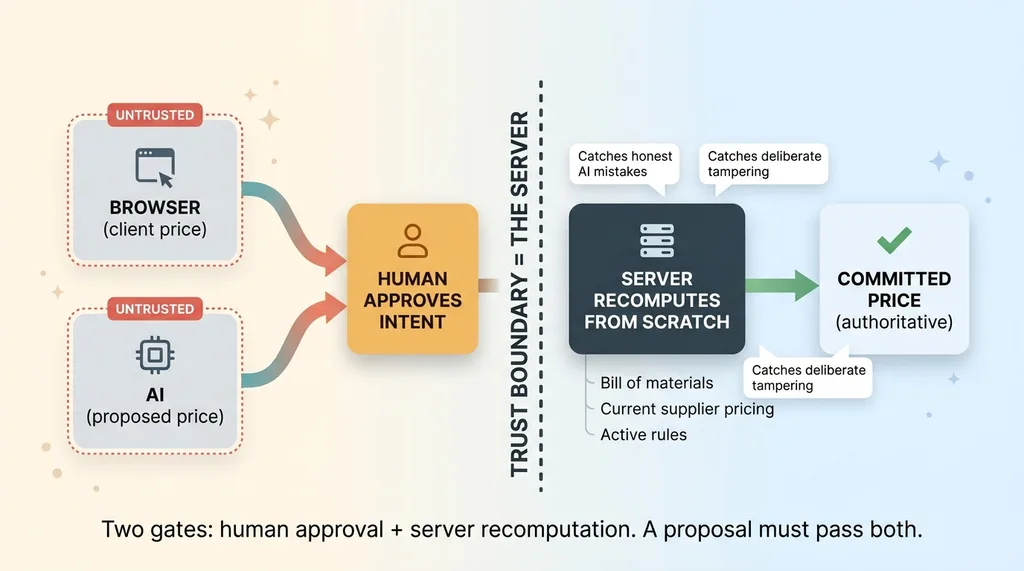 The server as the trust boundary, two gates between proposal and commit
This protects against two completely different threats at once: honest AI mistakes and deliberate manipulation. The same recomputation step catches a model that hallucinated a discount and a customer who tried to edit their own price. One guardrail, both problems.
This is the principle I wrote about in let the model judge, let the code compute. The model is great at judgment, language, and pattern-spotting. It's the wrong tool for arithmetic that has to be exactly right every time.
Put it all together and you have two gates between a proposal and a commitment. Approval is the human gate. Recomputation is the machine gate. A proposal has to pass both before it becomes real. The human catches what the math can't see. The math catches what the human waved through.
This Is Why the AI Gets Trusted in Production
Let me answer the buyer doubt straight, because it's the right doubt to have.
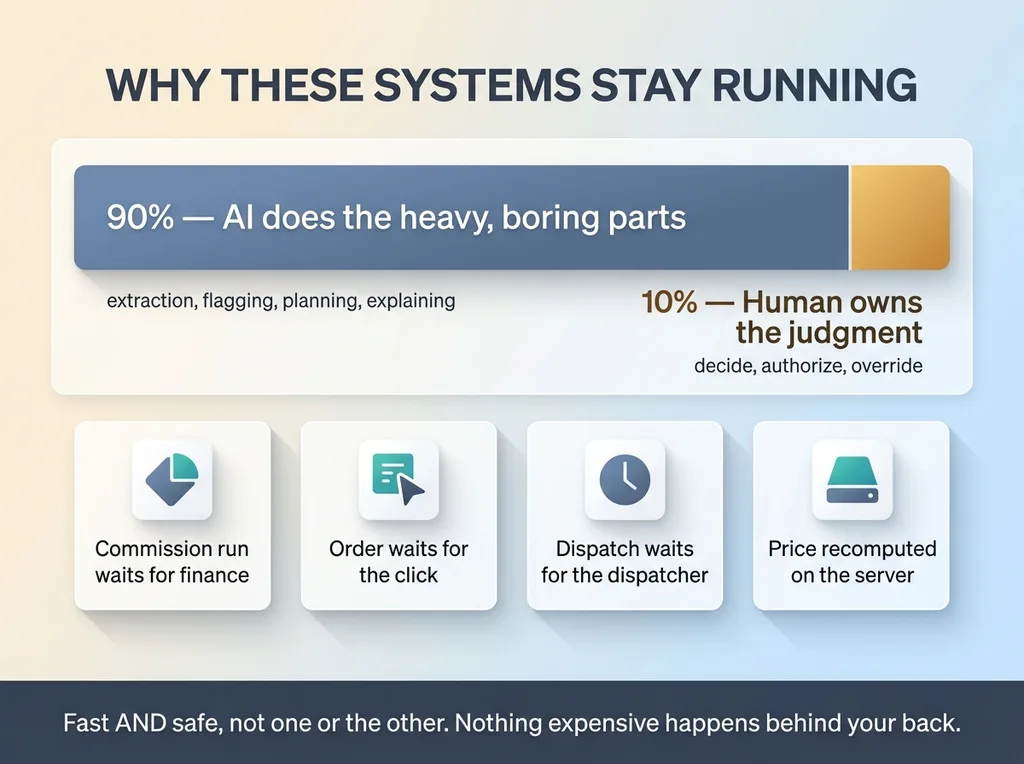 Why human-in-the-loop systems stay in production: speed plus safety
You don't earn trust with AI on money and orders by making the AI more autonomous. You earn it by making every consequential action stop for a human and then recompute on the server. That's the whole trick. It's not glamorous and it doesn't demo as well as "fully autonomous agent," but it's the version people actually keep using.
And that's the real result. The people running the business use these tools every day, because they know nothing expensive happens behind their back. The commission run waits for finance. The order waits for the click. The dispatch waits for the dispatcher. The price gets recomputed no matter who said what.
I'll be honest about the tradeoff. This means the AI is not fully autonomous. That is intentional, and I'd build it that way again every time. The speed comes from the AI doing the heavy, boring parts: the extraction, the flagging, the planning, the explaining. By the time a human looks, the work is 90 percent done and the 10 percent they own is the judgment only they can provide. Fast and safe, not one or the other.
If you've been burned, or you're just nervous about handing AI anything that touches a customer or a dollar, you're asking the right questions. I wrote more about exactly this in the biggest fears CEOs have about AI.
If you're weighing AI for a business where mistakes cost real money, the design question isn't "how smart is the AI." It's "where does the human gate sit, and where's the trust boundary." Get those two right and the rest is detail. That's the kind of system I build.
Want to explore what AI could do for your business?
Book a free 30-minute strategy call. No pitch deck, no sales team, just a real conversation about your operations and where AI actually fits.
Get AI insights for business leaders
Practical AI strategy from someone who built the systems — not just studied them. No spam, no fluff.
Hodgen.AI
Ready to automate your growth?
Book a free 30-minute strategy call with Hodgen.AI.
Book a Strategy Call