I Built a 5-Agent AI Finance Team for a DTC Brand
How I built an AI CFO finance automation system with 5 specialist agents, QuickBooks + Plaid integration, for a DTC brand going through restructuring.
By Mike Hodgen
Most people hear "AI CFO finance automation" and think of a chatbot that reads your bank statements. What I built for a DTC brand going through restructuring is nothing like that. It's a five-agent system where each agent handles a specific slice of financial operations — reconciliation, compliance, reporting, scenario modeling — and they work together like a team that never sleeps, never forgets a deadline, and costs less than a single month of a human CFO's salary.
Here's exactly how it works, what it cost, and what it can't do.
Why a DTC Brand Going Through Restructuring Needed an AI Finance Team
The Situation: Six Figures in Monthly Burn, No CFO
A DTC brand I was brought in to help was burning through six figures a month during a restructuring. No full-time CFO. Financial reporting was taking days, not hours. Grant compliance deadlines were slipping. The founder was making real decisions — headcount, vendor payments, debt restructuring timelines — off data that was already a week old by the time anyone compiled it.
Hiring a CFO would run $180K-$250K fully loaded. Even a solid part-time CFO engagement runs $5K-$8K/month. And neither option solves the problem fast enough. A human hire needs 60-90 days to onboard, learn the business, build their own reporting systems. This brand didn't have 90 days. Cash was moving daily and decisions couldn't wait for someone to get up to speed.
What We Were Actually Trying to Solve
I want to be clear about scope because this is where most AI finance projects go sideways. We were not trying to replace a CFO. A CFO handles strategy, bank relationships, investor conversations, tax planning, restructuring negotiations. No AI system does that.
What we were building was the operational layer underneath all of that — the data gathering, categorization, reconciliation, reporting, and compliance monitoring that eats 70% of a finance leader's time. The goal was simple: make sure any human with financial authority (the founder, the advisory CFO who came in biweekly) could walk into any meeting with current, accurate, formatted data and spend their time on decisions instead of spreadsheets. An AI finance team that handles the grunt work so humans can do the thinking.
The 5-Agent Architecture: Who Does What
I've written before about why multi-specialist AI architecture outperforms a single do-everything agent. Finance is a textbook case. One agent trying to handle reconciliation, compliance tracking, scenario modeling, and board reporting will fail at all of them. Each of these tasks requires different data sources, different reasoning patterns, and different output formats.
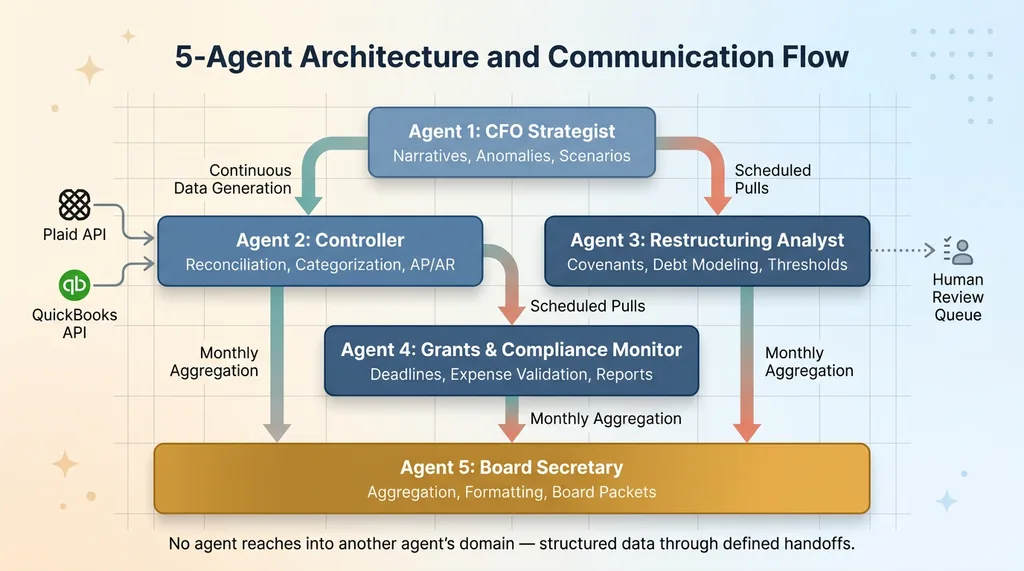 5-Agent Architecture and Communication Flow
So I built five agents, each with a narrow, well-defined scope.
Agent 1: CFO Strategist
This agent ingests cash flow data, revenue figures, and expense trends to generate weekly financial narratives. It flags anomalies — a vendor payment that's 40% higher than the 90-day average, revenue dropping in a category that should be growing. It also runs scenario models: what happens to runway if revenue drops 20% next month? What if we delay two AP payments by 15 days? The output is plain-language analysis, not raw numbers. It's the agent that turns data into something a decision-maker can act on.
Agent 2: Controller
The operational workhorse. This agent monitors reconciliation via the QuickBooks API, validates expense categorization against the chart of accounts, and tracks AP/AR aging. When a transaction comes in that doesn't match expected patterns, it flags it. When a receivable hits 45 days past due, it alerts. It doesn't make accounting entries — it watches, categorizes, and escalates.
Agent 3: Restructuring Analyst
Specific to this engagement, but the pattern applies to any business tracking complex financial agreements. This agent monitors debt covenants, models restructuring scenarios, and checks whether current financial performance stays within the terms of the restructuring agreement. When a covenant metric drifts within 10% of its threshold, the alert fires before it becomes a problem.
Agent 4: Grants & Compliance Monitor
Tracks grant deadlines, validates whether specific expenses qualify under grant terms, and generates compliance reports. Grant management is particularly brutal because the rules are dense, the deadlines are hard, and missing one can mean returning funds. This agent holds the rulebook and checks every expense against it.
Agent 5: Board Secretary
Compiles outputs from the other four agents into board-ready packets. Formats financial summaries, tracks action items from previous meetings, and ensures nothing falls through the cracks between board sessions. It's the orchestration layer that turns five agents' outputs into a single coherent picture.
The communication flow is straightforward: the Controller and Compliance Monitor generate data continuously. The CFO Strategist and Restructuring Analyst pull from that data on scheduled intervals. The Board Secretary aggregates everything on a monthly cycle. No agent reaches into another agent's domain — they pass structured data through defined handoffs.
Why Financial Operations Are the Hardest Thing to Automate With AI
The Precision Problem
Here's the thing most AI vendors won't tell you: an LLM that's 98% accurate on a blog post is impressive. An LLM that's 98% accurate on a bank reconciliation is a liability. Two percent error on a $500K monthly transaction volume means $10K in wrong numbers. Every month.
That's why every calculation in this system that touches actual dollars uses deterministic logic, not AI inference. The AI handles categorization, pattern recognition, narrative generation, and anomaly detection. The math is done by code that adds, subtracts, and compares the same way every single time. Using a multi-model approach means Claude handles the narrative analysis and natural language outputs while deterministic Python handles anything involving real numbers.
Audit Trails Aren't Optional
Every action the system takes — every categorization, every flag, every alert — gets logged with a timestamp, the source data it used, and the reasoning chain that produced the output. This isn't a feature I added for polish. It's a legal requirement. If someone asks in 18 months why a $3,200 expense was categorized as "professional services" instead of "marketing," the answer needs to be retrievable in seconds.
Immutable audit logs were built into the architecture from day one. Not bolted on later.
Regulatory Gravity
GAAP compliance, grant reporting requirements, restructuring covenants — these aren't suggestions you can approximate. They're rules with consequences. The single most important design principle in this system is that the AI knows what it doesn't know. When a transaction doesn't fit clearly into established patterns, it doesn't guess. It escalates to a human with the relevant context attached.
This is why most AI projects fail in finance — they trust AI with precision tasks it can't handle reliably, or they don't build in the escape hatch for edge cases. The edge cases in finance aren't edge cases. They're Tuesday.
QuickBooks + Plaid Integration: The Data Foundation
Real-Time Bank Feeds via Plaid
Plaid provides real-time transaction data from the brand's bank accounts. The agents see cash movement as it happens — not when someone exports a CSV on Friday afternoon. This alone changed the founder's relationship with their cash position. Instead of asking "where are we?" they could just look.
QuickBooks as the System of Record
QuickBooks remains the system of record. This is a critical design decision: the AI reads from QuickBooks, categorizes, flags, and recommends. It never writes directly to the books without human approval. Every suggested entry or categorization change goes into a review queue. A human clicks "approve" or "reject." The AI learns from both.
What the Integration Actually Looks Like
The data flow: Plaid pulls transactions → Controller agent categorizes and matches against QuickBooks records → flags discrepancies → CFO Strategist pulls weekly P&L and cash flow summaries → generates narrative analysis. Most of this required custom integration work. The APIs are well-documented, but mapping a specific brand's chart of accounts, vendor naming conventions, and transaction patterns to an automated system takes real configuration. Off-the-shelf AI accounting tools couldn't handle the grant compliance or restructuring covenant monitoring at all.
The results: reconciliation that took 4-6 hours weekly now takes 20 minutes of human review. Expense categorization accuracy hit 94% after two weeks of training on the brand's specific chart of accounts. That remaining 6% gets flagged for human review — the system doesn't assume.
What the AI Finance Team Actually Produces
Weekly CFO Brief
Every Monday morning, the founder gets a 2-page narrative document: current cash position, burn rate trend over the last 4 weeks, revenue vs. forecast by channel, AP/AR aging summary, and exactly 3 items requiring a human decision. Not 12 items. Not "here's everything." Three things that need attention this week, ranked by urgency.
This replaced a manual process that took 5+ hours every Monday. The founder used to spend half the morning pulling numbers from QuickBooks, cross-referencing bank statements, and trying to write a summary for themselves. Now they spend 15 minutes reading and deciding.
Monthly Board Packet
Compiled automatically from the month's data: P&L summary, cash flow statement, restructuring progress update, grant compliance status, and action item tracking from the previous board meeting. Formatted, consistent, and ready for human review in 30 minutes instead of the 2 full days it used to take.
Real-Time Alerts
Cash below threshold. Unusual transaction patterns. Grant deadlines approaching at 30, 15, and 7 days out. Covenant compliance metrics drifting toward limits. These go to Slack and email.
One specific example: the Controller agent caught a duplicate vendor payment of $12,400 that had been processed three days apart with slightly different reference numbers. Under normal reconciliation cadences, that would have taken weeks to surface. The agent flagged it within hours.
Honest limitations: the narrative summaries still need human review. The CFO Strategist occasionally over-interprets a trend that's actually just seasonal noise. The restructuring analysis requires a human to validate assumptions before acting on scenarios. This system augments judgment. It doesn't replace it.
The Numbers: Cost, Time Saved, and What We Didn't Automate
Build Cost vs. CFO Hire
Approximately 3 weeks of development time. Monthly run cost under $400 in API fees — QuickBooks, Plaid, Claude. Compare that to $15K-$20K/month for a full-time CFO or $5K-$8K/month for a part-time engagement. The system paid for itself in the first month.
Time Savings Breakdown
Roughly 25 hours per week of financial operations work — reconciliation, report building, compliance checking, board packet assembly — reduced to about 6 hours of human review and decision-making. That's 19 hours back every week for a founder who was already stretched thin.
What Still Requires a Human
Strategic financial decisions. Bank and investor relationships. Signing authority. Tax strategy. Complex restructuring negotiations. Anything that requires reading a room, building trust, or making a judgment call that could go either way.
The advisory CFO still meets biweekly. The difference is they now walk into meetings with everything prepared instead of spending half the engagement gathering data. Their value went up because the system removed the work that was beneath their expertise.
This honesty about limitations is what separates a real automated CFO deployment from a vendor pitch.
Building a Finance AI System That Survives an Audit
The real test of any AI financial operations system isn't the demo. It's the audit.
Every decision, categorization, and recommendation in this system is logged with the source data, the model's reasoning, and a timestamp. When — not if — someone asks why a transaction was categorized a certain way, the answer is there. Complete and retrievable in seconds.
This is where most AI finance projects die. They produce impressive dashboards but can't explain themselves. The system I built was designed to be questioned. Every output can be traced back to its inputs. Every alert can be justified with data.
That design philosophy — build for the auditor, not the demo — applies to any AI system handling regulated or high-stakes data. It's slower to build this way. It's less flashy. And it's the only approach that holds up when the stakes are real.
If you're running a business where financial operations are eating your time or your CFO's time, this pattern works. Not because AI is magic, but because 70% of financial ops is data gathering, formatting, and pattern recognition — exactly what AI handles well. The other 30% is judgment, relationships, and strategy — exactly what your human leadership should be spending all of their time on.
Want to See What This Looks Like for Your Business?
Not every company needs five finance agents. Some need two. Some need a completely different architecture. The starting point is understanding where your time actually goes and which of those tasks follow patterns that AI can reliably handle.
If you want to walk through what this looks like for your business, I'll spend 30 minutes on it with you. No pitch deck, no sales team — just a real conversation about your operations and where AI fits.
Get AI insights for business leaders
Practical AI strategy from someone who built the systems — not just studied them. No spam, no fluff.
Hodgen.AI
Ready to automate your growth?
Book a free 30-minute strategy call with Hodgen.AI.
Book a Strategy Call