Before I built LinkScout, I tracked my own outreach numbers obsessively. Over two months, I sent 214 manual emails pitching links to my DTC fashion brand's content. I got 3 links. That's a 1.4% conversion rate. Brutal, but not unusual — research consistently shows cold outreach response rates for AI backlink acquisition hover between 1% and 5%. Most people just don't talk about it.
I knew the problem wasn't outreach as a concept. It was how I was doing it.
Why 97% of Backlink Outreach Emails Get Ignored
The Generic Template Problem
You know the email. You've probably received it. "Hi [Name], I noticed you linked to [competitor article] in your post about [topic]. We recently published a comprehensive guide on [similar topic] that your readers might find valuable..."
Site owners in any established niche get dozens of these daily. They all look the same because they are the same. Slightly different variable fills plugged into the same template that's been circulating SEO forums since 2018. These emails aren't outreach. They're spam wearing a collared shirt.
The thing is, the underlying logic isn't wrong. Finding relevant sites that link to similar content and suggesting yours as an alternative — that's a sound strategy. The execution is what kills it. When every email reads like it was generated by the same mad lib, nobody responds.
Volume vs. Relevance: The Math That Doesn't Work
Here's the real bottleneck. Good personalization takes time. To write a genuinely personalized outreach email, you need to read the prospect's content, understand their angle, find a real connection point, and craft a pitch that respects their intelligence. That takes 15-20 minutes per email if you're doing it right.
At that pace, you max out at 10-15 quality emails per day. Call it 60-75 per week. At a 3% response rate, that's maybe 2 links per week. For an ecommerce brand competing against established players with thousands of referring domains, that pace doesn't move domain authority in any meaningful timeframe.
You need volume AND personalization. Those two things pull in opposite directions when humans are doing the work. That's the exact tension AI solves.
What LinkScout Actually Does: The Three-Stage Pipeline
I named the system LinkScout because that's what it does — it scouts for link opportunities, evaluates them, and acts on the best ones. The architecture is a three-stage pipeline, and each stage eliminates waste from the next.
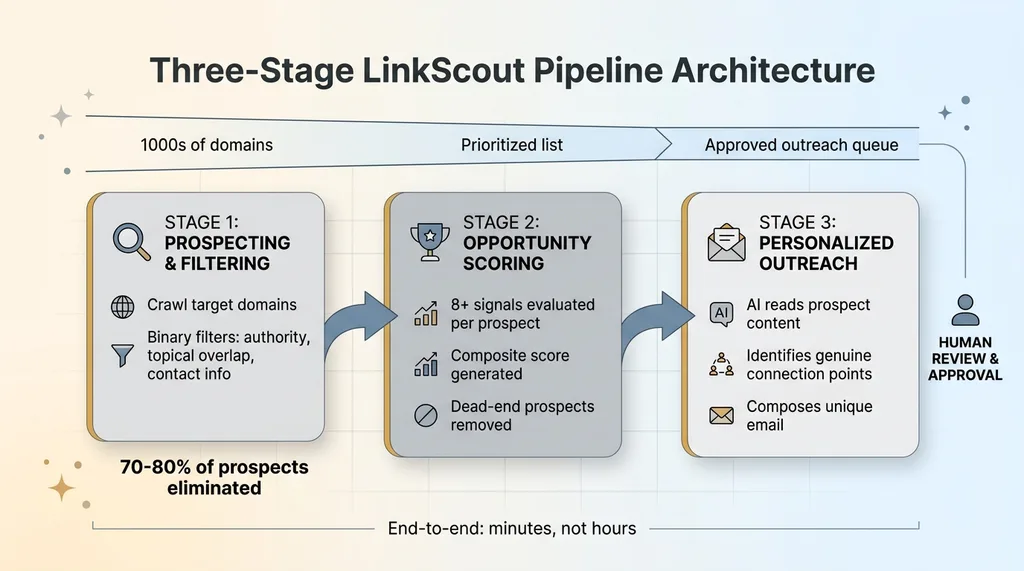 Three-Stage LinkScout Pipeline Architecture
Stage 1: Automated Prospecting and Filtering
LinkScout crawls and identifies potential link targets across four categories: topically relevant blogs, resource pages, niche directories, and broken link opportunities. It starts with a broad universe — thousands of potential domains in and around my niche — and filters aggressively.
The first-pass filters are binary. Does the domain meet a minimum authority threshold? Is there topical overlap with my content? Can we find a contact email or submission form? Sites that fail any of these get dropped immediately. No point scoring a site you can't reach.
This stage typically cuts the prospect universe by 70-80%. What's left is a prioritized list of sites worth evaluating.
Stage 2: Link Opportunity Scoring
Each surviving prospect gets scored on a composite metric. I'll go deeper on this in the next section because it's where the real value lives. The short version: the system evaluates multiple signals per prospect — authority, relevance, activity level, linking behavior, and more — to produce a single score that predicts whether this prospect is worth emailing.
This scoring is the key differentiator. It means I spend zero time on dead-end prospects. The system has already filtered them out before I ever see a name.
Stage 3: Personalized Outreach Composition
For prospects that score above the threshold, AI composes the outreach email. Not from a template. The system reads the prospect's actual content, identifies a specific piece they published, references something genuinely relevant from that piece, and connects it to my content naturally.
Each email is unique because each email is based on a different article written by a different person about a different angle on a related topic.
I use Claude for the writing stage specifically. I've tested multiple LLMs for outreach copy, and Claude produces the most natural, least robotic prose. It handles tone and nuance in a way that doesn't trigger the "this is AI-generated" alarm bells that site owners have developed. This is the same multi-LLM approach I use across my 14-skill AI ecommerce platform — different models for different jobs, chained together for cost efficiency and quality.
The whole pipeline, from raw prospect list to approved outreach queue, runs without me touching it. I review and approve the final emails. That's my involvement.
The Scoring System That Eliminates Wasted Outreach
What Gets Scored (And What Gets Filtered Out)
The scoring system evaluates 8+ signals per prospect. Here's what matters most:
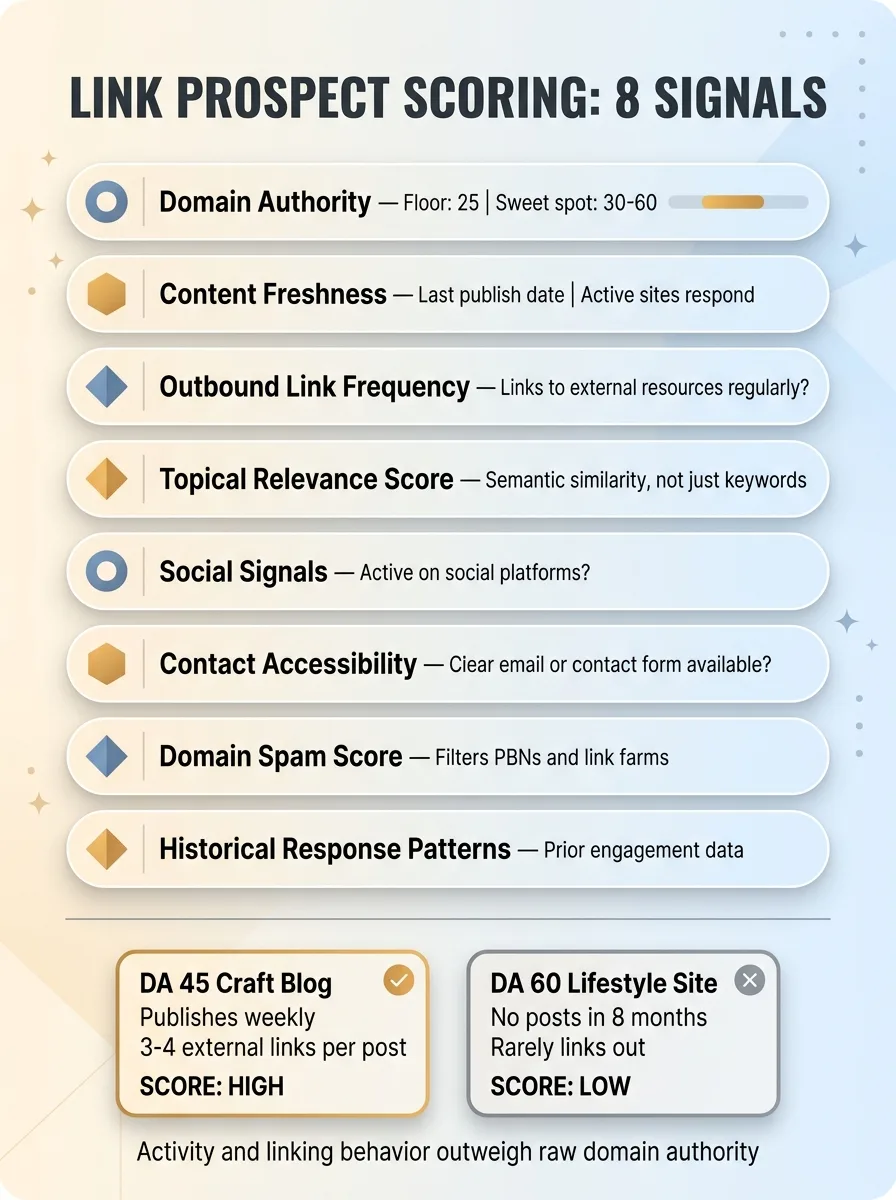 Composite Scoring System Signals
- Domain authority — floor of 25, sweet spot between 30-60
- Content freshness — when did they last publish? Active sites respond. Dormant sites don't.
- Outbound link frequency — do they link to external resources regularly, or is their content a walled garden?
- Topical relevance score — semantic similarity between their content and mine, not just keyword matching
- Social signals — are they active on social platforms? Indicates engagement likelihood.
- Contact accessibility — is there a clear email or contact form, or would I be guessing at info@ addresses?
- Domain spam score — filters out PBNs and low-quality link farms
- Historical response patterns — for domains I've contacted before, did they engage?
Here's a concrete example that illustrates why scoring matters. A DA 45 craft blog that publishes weekly and links out to 3-4 external resources per post scores significantly higher than a DA 60 lifestyle site that hasn't published in 8 months and rarely links externally. The first site is a live prospect with an editor who actively curates resources. The second is a wall. No amount of personalization gets through a wall.
How Scoring Changed My Hit Rate
Before the scoring system, I picked prospects that "looked good" based on gut feel and surface-level metrics. Response rate: ~1.5%.
After implementing composite scoring, response rates moved into the double digits. Not because the emails got dramatically better — though they did — but because I stopped wasting pitches on prospects who were never going to respond. The scoring system alone accounted for the majority of the improvement by concentrating effort on high-probability targets.
Even if you could manually evaluate all these signals, doing it for hundreds of prospects per week would take hours. LinkScout scores the entire queue in minutes.
AI Personalization at Scale: What 'Unique' Actually Means
Reading Before Writing
The personalization stage works because the AI actually reads before it writes. That sounds obvious, but it's the step most automated outreach skips entirely. Template-based systems don't read anything. They fill in variables.
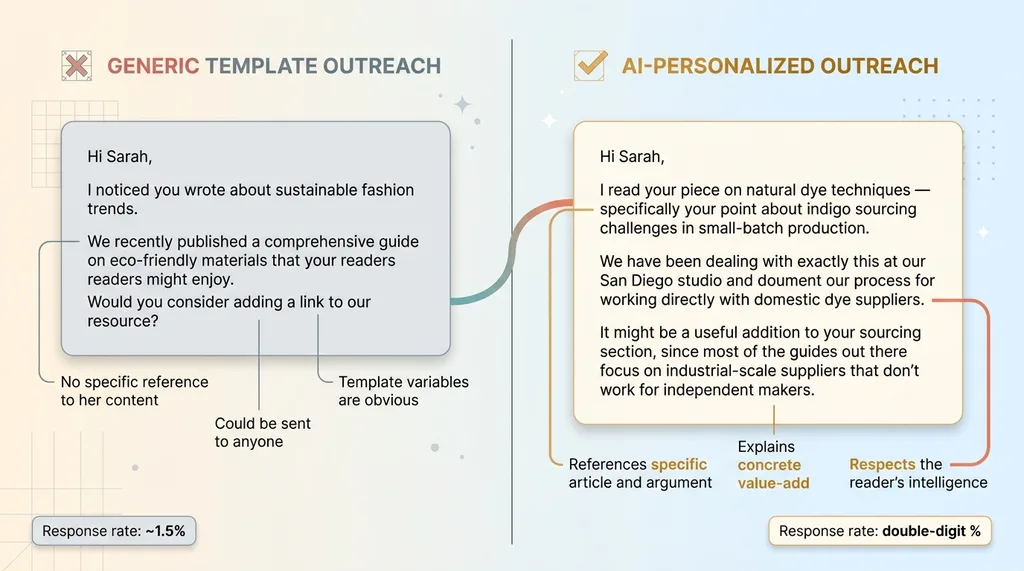 Generic vs AI-Personalized Outreach Email Comparison
LinkScout ingests the prospect's article, extracts key themes and arguments, identifies specific points the author made, and then finds genuine connection points to my content. Only then does it compose the email.
Here's what that looks like in practice:
Generic outreach (what most people send):
Hi Sarah, I noticed you wrote about sustainable fashion trends. We recently published a comprehensive guide on eco-friendly materials that your readers might enjoy. Would you consider adding a link to our resource?
AI-personalized outreach (what LinkScout produces):
Hi Sarah, I read your piece on natural dye techniques — specifically your point about indigo sourcing challenges in small-batch production. We've been dealing with exactly this at our San Diego studio and documented our process for working directly with domestic dye suppliers. It might be a useful addition to your sourcing section, since most of the guides out there focus on industrial-scale suppliers that don't work for independent makers.
The second email demonstrates that someone actually read Sarah's article. It references a specific argument. It explains why the linked content adds value to her specific piece. It respects her intelligence.
The Guardrails That Prevent Bad Personalization
Every outreach email gets a quality score before it enters my approval queue. If the system can't find a genuine connection point — if the topical overlap is too thin or the relevance feels forced — it flags the prospect for manual review or skips it entirely.
This matters because bad personalization is worse than no personalization. An email that tries to fake a connection and gets it wrong signals to the recipient that a bot just scraped their content. That burns the prospect permanently.
I use Claude for this stage specifically because it handles nuance and tone better than alternatives I've tested. The emails read like a thoughtful person wrote them, because the underlying reasoning process mimics what a thoughtful person would do — read, understand, connect.
Results: What the Numbers Actually Look Like
Response Rate and Link Acquisition Metrics
Here's the honest before/after:
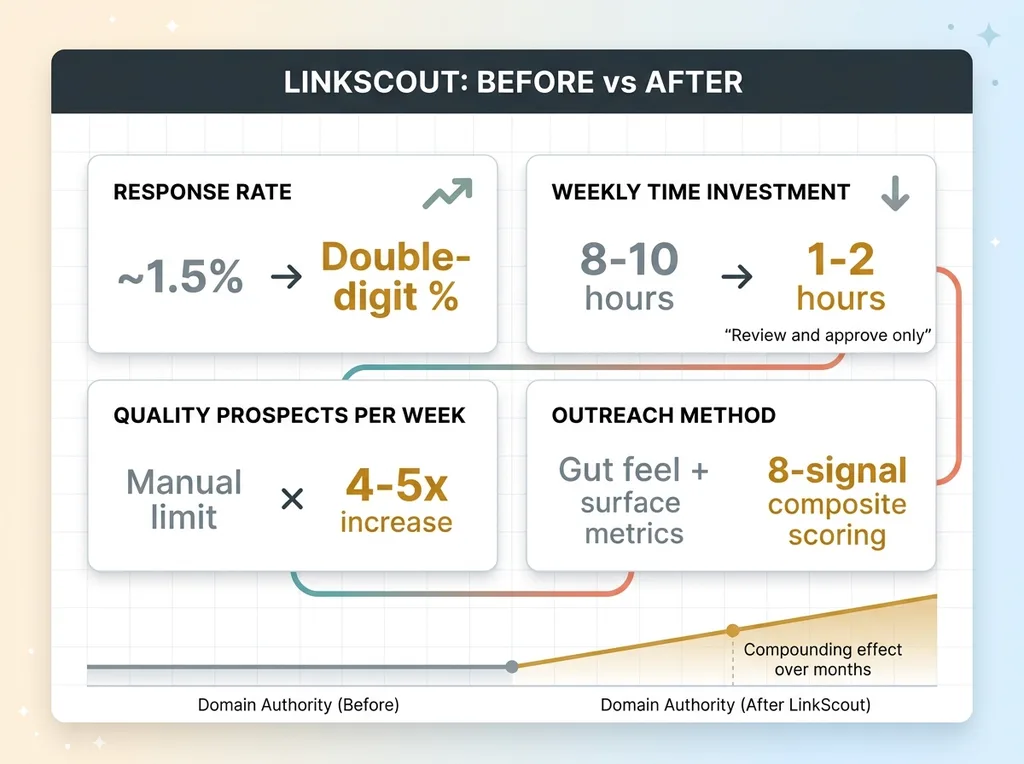 Before/After Performance Metrics
- Manual outreach response rate: ~1.5%
- AI-scored, AI-personalized outreach response rate: moved into double-digit percentages
- Time spent on link building per week: dropped from 8-10 hours of manual prospecting and emailing down to 1-2 hours of reviewing and approving the queue
- Quality prospects identified per week: 4-5x what I could find manually
I want to be transparent about what didn't work initially. Early versions over-personalized. The system would reference three or four specific details from a prospect's article, which felt less like "I read your content" and more like "I'm surveilling you." Creepy. We dialed it back to one or two specific references per email.
Some emails were too long. Site owners are busy. If your pitch takes four paragraphs to get to the point, they stop reading at paragraph two. We tightened the output to 4-6 sentences max.
Certain niches responded better than others. Craft, DIY, and lifestyle bloggers tend to be more receptive to outreach than finance or insurance sites, where owners have been hammered by aggressive SEO campaigns for years and default to ignoring everything.
Domain Authority Impact Over Time
Backlink acquisition is inherently a long game. Domain authority doesn't spike overnight. But the compounding effect of consistent, quality link acquisition over months is significant. The trajectory changed from flat to steadily climbing once the system was producing a reliable flow of quality links week over week.
The critical integration point: this system doesn't work without content worth linking to. I overhauled 463 blog articles with AI to create a content foundation that actually deserves links. And the AI-driven blog automation pipeline keeps producing new assets on a consistent schedule. LinkScout gets those assets linked. The systems feed each other.
What I'd Build Differently (And What's Coming Next)
Current Limitations
The system excels at first-touch outreach but doesn't yet handle follow-up sequences well. Timing a second email, adjusting tone appropriately, and knowing when to stop require nuance that's still being tuned. Broken link building also works meaningfully better through this system than guest post pitching — the value proposition is cleaner and easier for AI to articulate clearly.
The Relationship Layer
What's next is a relationship layer that tracks ongoing interactions with site owners across multiple touchpoints. Not just "send email, get link" but "engage with their content, leave genuine comments, then reach out." The warm approach.
I'm also exploring integration with social signals — engaging with prospects on X or LinkedIn before the email lands, building familiarity before making the ask.
One thing I want to be clear about: this system is designed to find and create genuine value connections. The scoring system actively prevents wasting people's time with irrelevant pitches. That's a feature I'm proud of. Automated link building should mean better outreach, not more spam.
Building SEO Systems That Compound
Backlink acquisition isn't a standalone tactic. It's one piece of a system. Content creation, on-page optimization, technical SEO, and link building all feed each other. Pull one out and the others underperform.
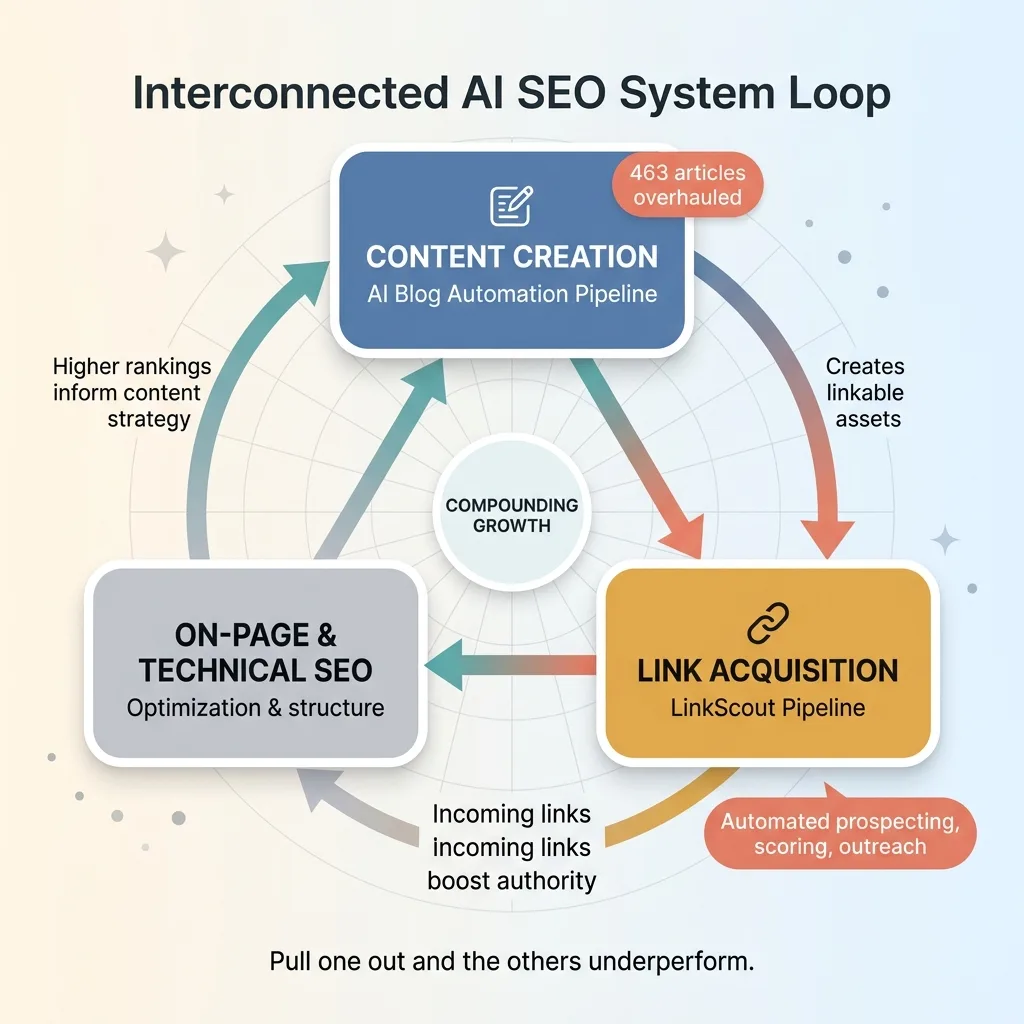 Interconnected AI SEO System Loop
The reason I built LinkScout wasn't to automate one task. It was to close the loop on an AI-powered SEO engine where every component runs without me being the bottleneck. For my DTC brand, that meant going from "I should probably do more outreach" to "the system handles it and I review the results."
Get the next build note.
I write up each system I build, including what broke. Subscribe to my newsletter and I'll send you the next one.