The 14-Skill AI Platform I Built to Run an Ecommerce Brand
How I replaced 14 SaaS tools with one AI ecommerce platform. 307 commits, 14 interconnected skills, one shared database. The full architecture breakdown.
By Mike Hodgen
Most ecommerce brands don't realize they're bleeding money on software until someone forces them to add it up. I forced myself to add it up. The number was ugly.
The $2,400/Month SaaS Problem Nobody Talks About
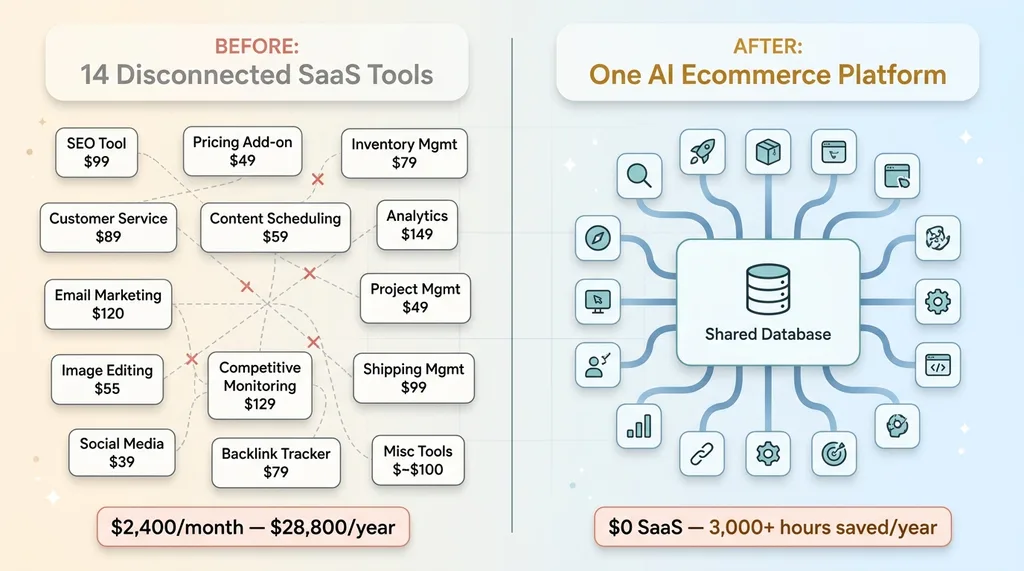 The $2,400/Month SaaS Sprawl vs. One Unified Platform
The real cost of tool sprawl
Before I built the AI ecommerce platform that runs my DTC fashion brand today, my monthly SaaS bill looked like this: SEO tool ($99), pricing spreadsheet add-on ($49), inventory management ($79), customer service platform ($89), content scheduling ($59), analytics dashboard ($149), email marketing ($120), project management ($49), image editing suite ($55), competitive monitoring ($129), shipping management ($99), social media scheduling ($39), backlink tracker ($79), and a handful of smaller tools that rounded it out. Total: roughly $2,400 a month. Nearly $29,000 a year.
But the dollar amount wasn't the real problem.
What breaks when 14 tools don't talk to each other
The real cost was the data silos. My pricing tool had no idea what my inventory system knew. So products that were about to sell out stayed at the same price as products I had 200 units of. My content tool had no clue what was actually selling, so I was writing blog posts about products that weren't moving instead of the ones gaining traction. My analytics dashboard showed me numbers that were already stale by the time I cross-referenced them with my email platform's metrics.
Every integration was duct tape. Every CSV export was a manual step someone had to remember. Every Zapier chain was another fragile connection waiting to break at 2 AM on a Friday.
This is the vendor sprawl tax. It compounds monthly. You're not just paying for 14 subscriptions — you're paying for the friction between them, the manual reconciliation, and the decisions you get wrong because your tools can't see what each other knows.
So I replaced all 14 with one platform. Built on one shared database. With skills that actually talk to each other. It took 307 commits over several months. Not a weekend project — a deliberate architecture decision that changed how the entire business operates.
What a "Skill" Is (And Why It's Not Just Another Automation)
Skills vs. scripts vs. agents
I call the architecture a "skill farm." It sounds fancy. It's not. It's a practical pattern born from failing at every other approach first.
A Zapier chain is brittle. It connects point A to point B, and when the API changes or the data format shifts, it breaks silently. A ChatGPT wrapper is a parlor trick — it answers questions but doesn't know your business. A fully autonomous agent sounds cool in a demo and then hallucinates your pricing into oblivion in production.
A skill sits in the middle. It's self-contained, domain-specific, and opinionated. But it's also aware of the broader system.
The anatomy of a single skill
Every skill in the platform has five components:
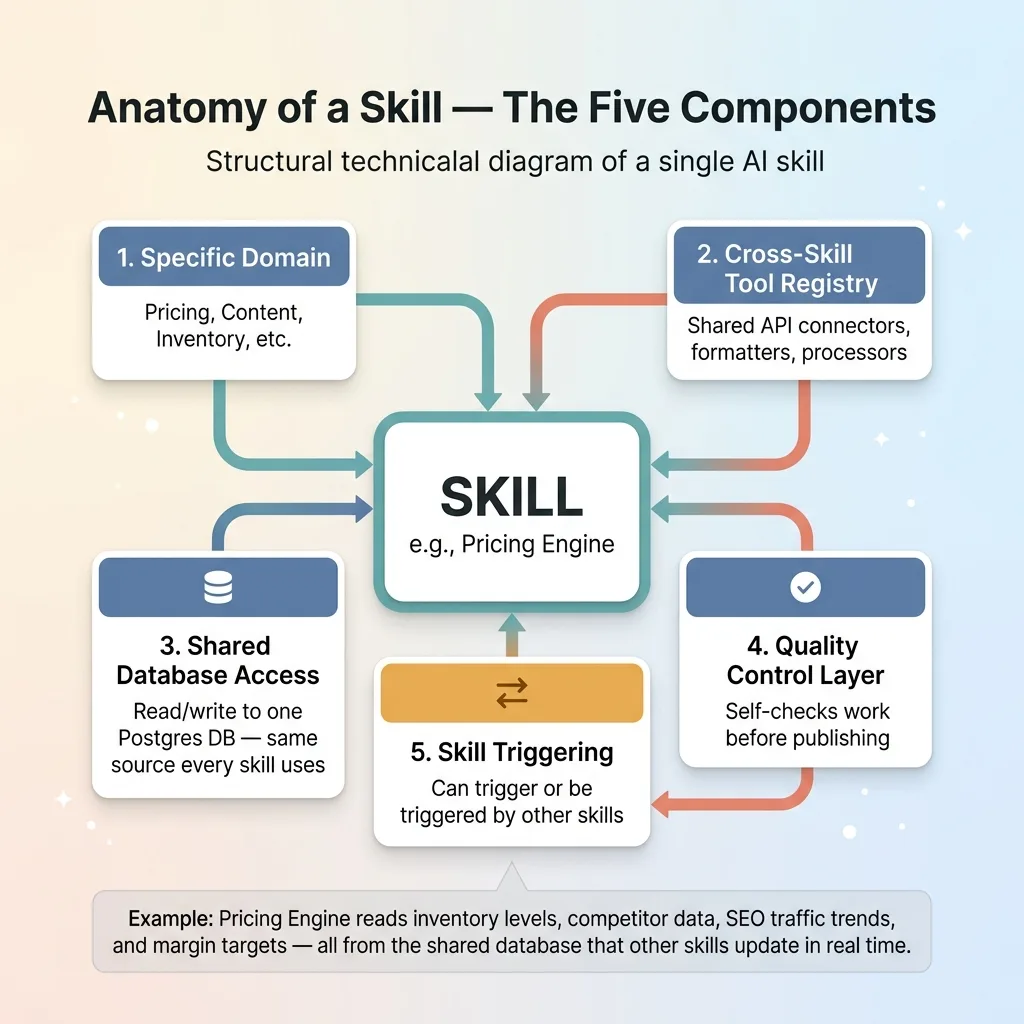 Anatomy of a Skill — The Five Components
- A specific domain — pricing, content, product creation, inventory, etc.
- Access to shared tools via a cross-skill tool registry
- Read/write access to a shared database — the same one every other skill uses
- Its own quality control layer — it checks its own work before publishing anything
- The ability to trigger or be triggered by other skills
Here's what that looks like in practice. The Pricing Intelligence skill doesn't just set prices. It reads current inventory levels, checks competitor pricing data, looks at each product's SEO performance and traffic trends, and factors in margin targets — all from the same database that the Inventory Tracker, the SEO Writer, and the Analytics skill are writing to simultaneously.
That interconnection is what makes this an AI ecommerce platform and not just a collection of scripts sitting in a folder. When skills share context, they make better decisions than any single tool could in isolation.
All 14 Skills: What Each One Does and What It Replaced
This is the full capability map. For each skill: what it does, what it replaced, and one real metric.
Product creation and listing management
Product Creator — Takes a concept and turns it into a complete Shopify listing with title, description, tags, variants, and metadata. Replaced the manual workflow that used to take me 3-4 hours per product. Now it's 20 minutes, concept to live. I wrote a full case study on the product pipeline that creates listings in 20 minutes.
Image Generator — Produces product photography and lifestyle imagery using AI, styled to match brand guidelines stored in the database. Replaced outsourced photography sessions that cost $150-300 per product and took weeks to schedule.
Listing Optimizer — Continuously audits live listings for SEO gaps, missing tags, and conversion copy issues. Replaced manual quarterly audits I used to do in a spreadsheet. Caught 47 listings with missing alt text in its first run alone.
Pricing intelligence and margin optimization
Pricing Engine — Dynamically prices 564+ products using a 4-tier ABC classification system. A-tier products (high volume, high margin) get different pricing logic than D-tier (long tail, low velocity). Replaced a spreadsheet I updated weekly — which means prices were always at least 7 days stale. The full breakdown of the dynamic pricing system that manages 564+ products is worth reading if pricing is a pain point for you.
Margin Analyzer — Runs nightly to flag products where costs have shifted enough to erode target margins. Replaced a manual COGS review I did monthly. It caught a supplier price increase I'd missed that was quietly eating 8% of margin on 23 products.
SEO and content generation
SEO Writer — Plans, drafts, and optimizes blog content based on keyword opportunities the Analytics skill identifies. Currently manages 313+ articles across the site. Replaced SurferSEO ($99/month) plus freelance writers ($200-500/article). The detail on this is in my writeup on the automated blog writing pipeline.
Backlink and Outreach Manager — Identifies link-building opportunities, drafts outreach emails, and tracks response rates. Replaced a separate backlink tracker and a lot of manual email work. Outreach response rate went from 3% (template emails) to 11% (personalized, context-aware drafts).
Customer service and communication
Customer Service Bot — Handles the top 80% of customer inquiries: order status, sizing questions, return policy, shipping estimates. Draws answers from actual order data, not canned responses. Replaced a Zendesk-style tool and about 15 hours a week of my team's time.
Email Campaign Manager — Builds and sends segmented email campaigns based on purchase history, browsing behavior, and inventory status. Replaced Klaviyo-level functionality. Abandoned cart recovery rate improved 23% because the emails now reference actual inventory scarcity — if there are only 4 left, the email says so, because it's reading from the same database the Inventory Tracker updates.
Inventory and production management
Inventory Tracker — Real-time stock awareness across all SKUs, with automatic low-stock alerts that factor in production lead times and current sales velocity. Replaced a separate inventory SaaS that was always slightly out of sync with Shopify.
Production Manager — Tracks every handmade product through the production pipeline: materials sourced, in production, quality check, ready to ship. Replaced Asana and Monday.com for production tracking. I wrote about how this AI production OS replaced four SaaS tools on its own.
Shipping and Fulfillment Coordinator — Selects optimal shipping methods based on package dimensions, destination, delivery promises, and cost. Replaced a manual shipping comparison process that added 5-10 minutes per order.
Analytics, reporting, and competitive intelligence
Analytics Dashboard — Unified metrics across all skills. Revenue per product, content performance, pricing effectiveness, customer service resolution rates — all in one view. Replaced Google Analytics plus three other reporting tools plus a lot of squinting at spreadsheets.
Competitive Intel — Monitors competitor pricing, new product launches, and content strategies. Surfaces actionable changes, not just raw data. Replaced manual competitor research that I was honestly doing once a quarter at best. Now it runs daily.
If you're looking at this list and mentally mapping it against your own tech stack, that's exactly the point. Most ecommerce operations have some version of all 14 needs. The question is whether those needs are being met by disconnected tools or by a system that shares context.
The Architecture That Makes It Work: Shared Database, Tool Registry, Skill Chaining
Three architectural decisions make this an AI ecommerce automation platform rather than 14 disconnected scripts.
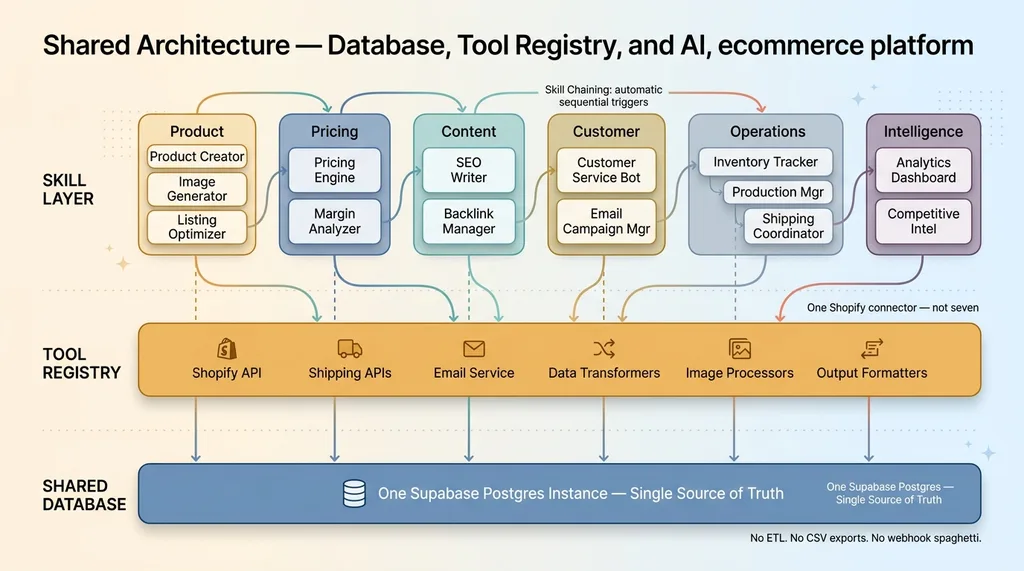 Shared Architecture — Database, Tool Registry, and Skill Chaining
One Supabase instance to rule them all
Every skill reads from and writes to the same Postgres database. When the Product Creator adds a new listing, the Pricing Engine sees it immediately. When the SEO Writer publishes content about a product, the Analytics skill starts tracking performance without any manual configuration. When the Inventory Tracker flags low stock, the Email Campaign Manager can reference it in the next send.
No ETL pipelines. No webhook spaghetti. No CSV exports that are out of date by the time someone downloads them. One source of truth.
This was the single most important architectural decision. If I'd built 14 skills with 14 separate data stores, I'd have recreated the exact vendor sprawl problem I was trying to solve.
The cross-skill tool registry
A centralized registry holds every shared capability: API connectors (Shopify, shipping carriers, email services), data transformers, output formatters, image processors. The Shopify API connector isn't owned by the Product Creator — it's in the registry. The Image Generator and the Listing Optimizer both access it.
This prevents duplication. It ensures consistency. And when Shopify changes their API (which they do), I update one connector, not seven.
How skills trigger other skills
Skill chaining is where the real platform behavior emerges. When a new product is created, the system automatically triggers the Pricing Engine, the Image Generator, the SEO Writer, and the Inventory Tracker — in sequence, with error handling at each step.
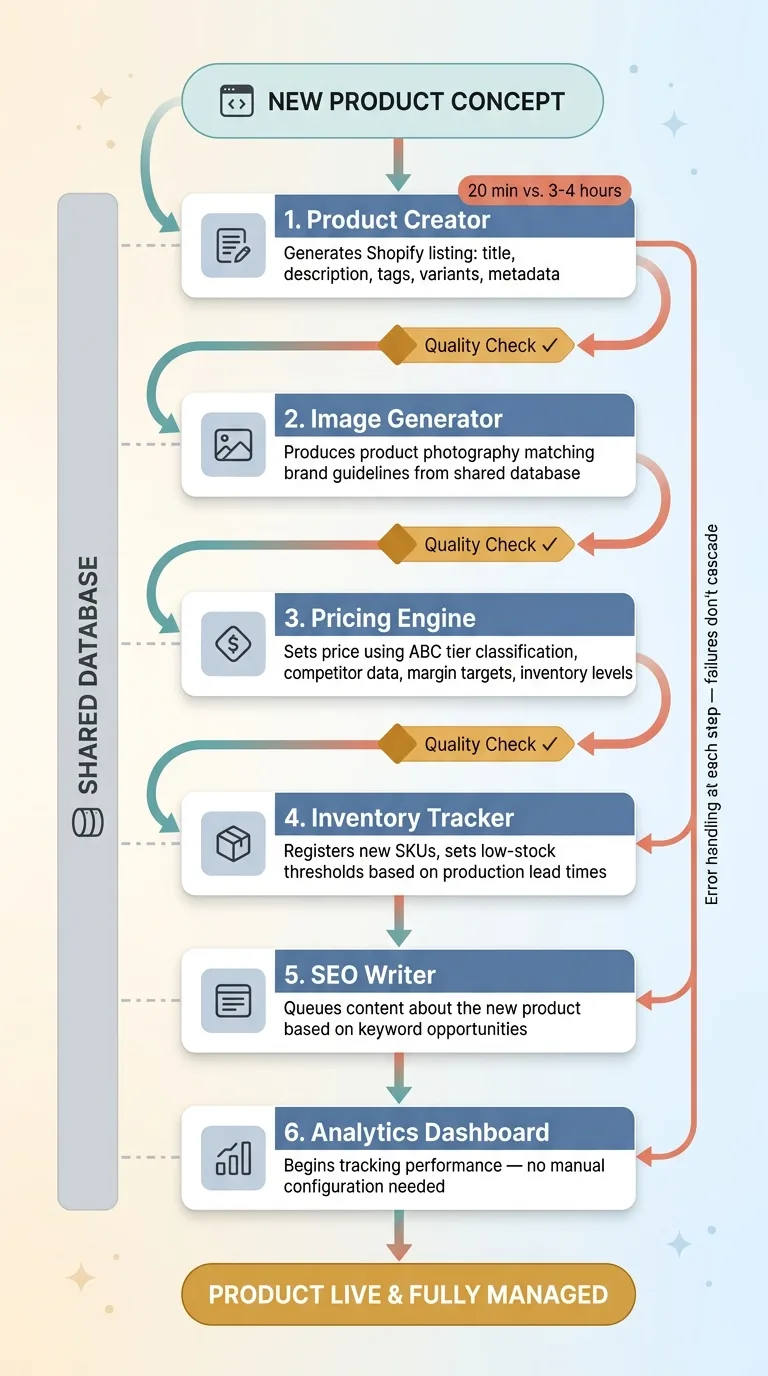 Skill Chaining in Action — New Product Creation Flow
Different skills use different LLMs based on the task. Claude handles long-form content. Gemini handles image generation. Cheaper models handle classification and routing tasks. I detailed the reasoning in my writeup on the multi-model architecture — it's as much a cost decision as a quality one.
The entire platform represents 22,000+ lines of custom Python. This isn't a no-code tool I stitched together in an afternoon. It's engineered. But every line exists because it solves a specific business problem, not because I wanted to write elegant code.
The Results: Revenue Per Employee, Time Saved, Tools Eliminated
The numbers after 12 months
- +38% revenue per employee — same team, dramatically more output
- -42% manual operations time — nearly half the busywork eliminated
- 3,000+ hours saved annually — that's roughly 1.5 full-time employees worth of work
- 14 SaaS subscriptions eliminated — approximately $28,800/year in direct savings
- 564+ products dynamically priced — updated daily instead of weekly
- 313 blog articles under AI management — planned, written, optimized, tracked
- Product creation: 3-4 hours → 20 minutes — per product, every single time
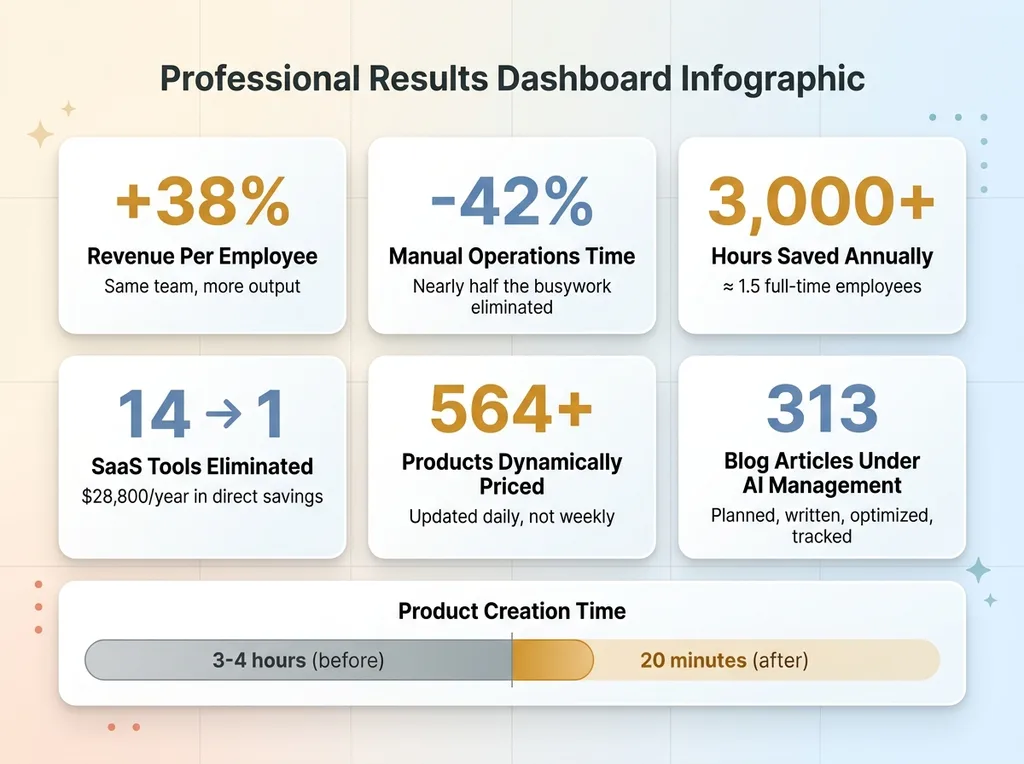 12-Month Results Dashboard
What surprised me
Not everything worked on the first try. That's worth saying.
Customer service was the hardest skill to get right. Nuance matters when someone is upset about a late order or confused about sizing. The first version was technically accurate but tonally off — it sounded helpful in the way that a DMV website is "helpful." It took three major iterations to get the tone calibrated to match how our team actually talks to customers.
The Quality Control layer was a necessary addition I didn't originally plan for. Early outputs from the SEO Writer and Product Creator had inconsistency problems — not wrong, but variable in quality. So I built a skill whose entire job is to reject bad work before it goes live. It scores outputs against brand standards and sends subpar work back for regeneration. That single addition improved the reliability of every other skill in the system.
The Pricing Engine needed four iterations before the ABC classification logic actually matched how my business works. The first version used textbook price optimization theory. My business doesn't operate in a textbook.
The point isn't that everything was easy. The point is that the compound effect of 14 interconnected skills far exceeds what any individual AI tool delivers. The value isn't in any single skill. It's in the connections between them.
The Skill Farm Pattern: Why This Matters Beyond My Brand
When to build a platform vs. keep buying tools
The skill farm architecture isn't specific to DTC fashion. It works for any business where:
- You're running 8+ SaaS tools that don't share data well. If you're constantly exporting from one system to import into another, you have a platform problem.
- You have repetitive knowledge work that follows predictable patterns. Pricing, content, customer responses, reporting — if a competent employee could document the decision-making process, a skill can learn it.
- The cost of wrong decisions compounds. Mispriced products, off-target content, delayed inventory responses, tone-deaf customer emails. These aren't catastrophic individually. They're corrosive over time.
Most businesses won't need all 14 skills. Some might start with 3-4 and grow. But the architectural decision to build on a shared database with a tool registry from day one is what matters. If you start with disconnected automations, you end up rebuilding later. I know because I did exactly that before building this platform.
The compounding advantage of shared context
The typical approach is "best of breed" — pick the best tool for each function. Klaviyo for email. SurferSEO for content. Zendesk for support. Shopify for commerce. Each one is optimized for its domain.
The skill farm optimizes the connections between domains. That's where the real advantage lives — when your pricing engine knows what your content team is writing about, when your inventory system informs your email campaigns, when your competitive intelligence shapes your product roadmap.
No amount of Zapier integrations replicates shared context. Integrations pass data. A shared database provides understanding.
What Building Your Own AI Platform Actually Requires
The honest prerequisites
This takes someone who understands both the business operations and the technical architecture. A developer alone will build elegant software that solves the wrong problems. A business consultant alone will write a strategy deck that never ships.
The 307 commits represent months of iteration — not a weekend hack. Be realistic about that.
But compare the investment to the alternative: $28,800/year in SaaS costs that climb every renewal cycle. Manual processes that never get faster. Data quality problems that make every tool in your stack slightly worse. And the opportunity cost of decisions made with incomplete information because your tools can't share what they know.
For most businesses in the $1M-$50M range, the ROI timeline is 3-6 months. That's been my experience building this for my brand and seeing similar patterns with clients.
Starting the conversation
The platform doesn't need to be 14 skills on day one. Start with the 2-3 skills that touch the most revenue or consume the most time. Build on the shared architecture from the beginning so you're not rebuilding when you add skills 4 through 10.
This is exactly what a Chief AI Officer engagement looks like. Not advising from the sidelines. Not producing a PDF of recommendations. Building the actual system with you, making architectural decisions that compound rather than constrain, and iterating until the numbers move.
If Your Tech Stack Feels Like It's Working Against You, It Probably Is
If you're running a business where tool sprawl, manual processes, and disconnected data are eating your margins, this conversation is worth having. I can walk through what this looks like for your business — which skills map to your biggest pain points, what the architecture should look like, and what realistic timelines and ROI look like.
No pitch deck. No sales team. Just a real conversation about your operations and where AI fits.
Get AI insights for business leaders
Practical AI strategy from someone who built the systems — not just studied them. No spam, no fluff.
Hodgen.AI
Ready to automate your growth?
Book a free 30-minute strategy call with Hodgen.AI.
Book a Strategy Call