The double-entry tax nobody budgets for
Picture a field rep at a window-covering company standing in someone's living room with a tape measure and a clipboard. He measures 15 windows. For each one he writes down the width, the height, the fabric, the mount type, the control side, all by hand on a paper measure sheet. Then he gets in his truck, drives back to the office, and types every single one of those numbers into a quoting tool.
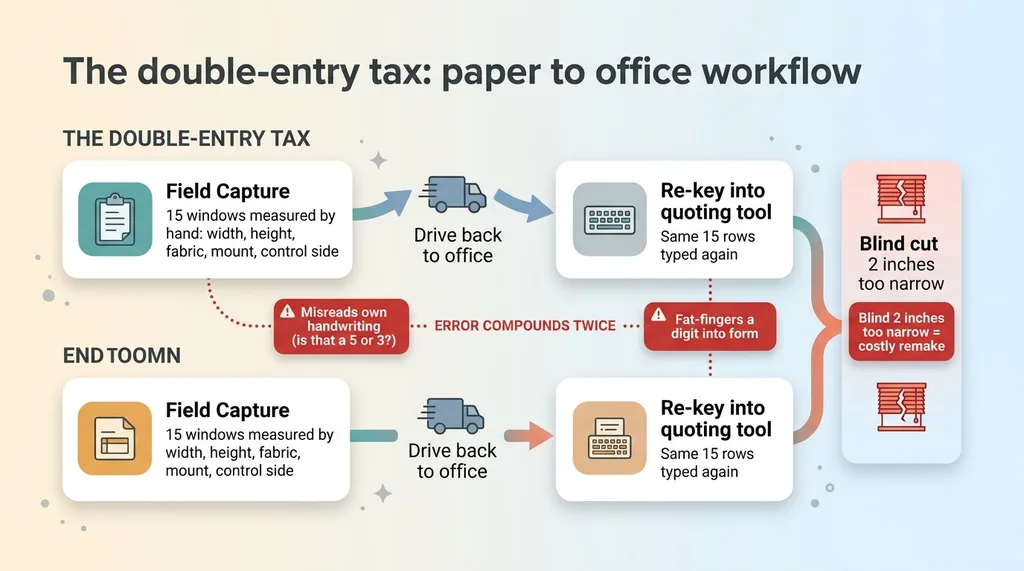 The double-entry tax: paper to office workflow
The work happens twice. That's the first problem.
The second problem is worse. The error rate compounds twice too. First when he reads his own handwriting hours after he wrote it ("is that a 5 or a 3?"), and again when he fat-fingers a digit into the form. A transposed measurement on window 9 doesn't show up until a blind is cut two inches too narrow and someone eats the cost of a remake.
This is the double-entry tax. Nobody puts it on a budget line, but it's real money. A rep doing 15 windows is hand-keying 15 rows of structured data, often late in the day, often tired, after he already captured all of it once on paper.
When this company came to me, the question they asked was the right one. Not "can AI do magic," but something sharper: could AI document data extraction read the messy paper sheet without quietly making numbers up?
That last part is the whole game. Reading the paper is easy. Plenty of tools will OCR a photo and hand you text. The hard part, the part that determines whether a field team will actually trust the thing, is making sure the system never presents a fabricated or impossible number as if it were real.
That's what this article is about. Here's how I built it so the AI proposes and the code vetoes.
What 'photo to structured data' actually means here
People hear "photo to structured data" and imagine you snap a picture and software figures out the rest. The reality is more disciplined than that, and the discipline is exactly what makes it trustworthy.
A schema, not a guess
The model is not asked an open-ended question like "what's on this page." Open questions invite open answers, and open answers are where AI starts inventing.
Instead, the extraction runs against a schema. Each window on the sheet becomes an object with defined fields: width, height, fabric, mount type, control side, and so on. The model's job is to fill known slots, not to summarize a document.
That constraint matters more than it sounds. When you force the model to populate a fixed structure, you force it to commit. It can't wave its hands. Either it found a width for window 7 or it didn't, and if it didn't, the schema makes that absence visible instead of letting it vanish into prose.
Per-field confidence, not one score for the page
Here's the part most extraction tools get wrong. They give you one confidence number for the whole document. That's useless.
A measure sheet is not uniformly readable. The printed header might be crisp while one handwritten fabric name is smudged to the point of guesswork. A single page-level score averages all of that into a number that tells you nothing about where to look.
So every field gets its own confidence score. A clean printed width can come back high-confidence while the smudged fabric name on the same line comes back low. The model is required to declare its uncertainty field by field instead of hiding it behind one optimistic average.
That granularity is what turns photo to structured data from a party trick into something a field data capture app can actually run on. You're not trusting the page. You're trusting, or not trusting, each value.
Deterministic clamps: where the model isn't allowed to be confident
Confidence scoring AI is a good start. It is not enough on its own.
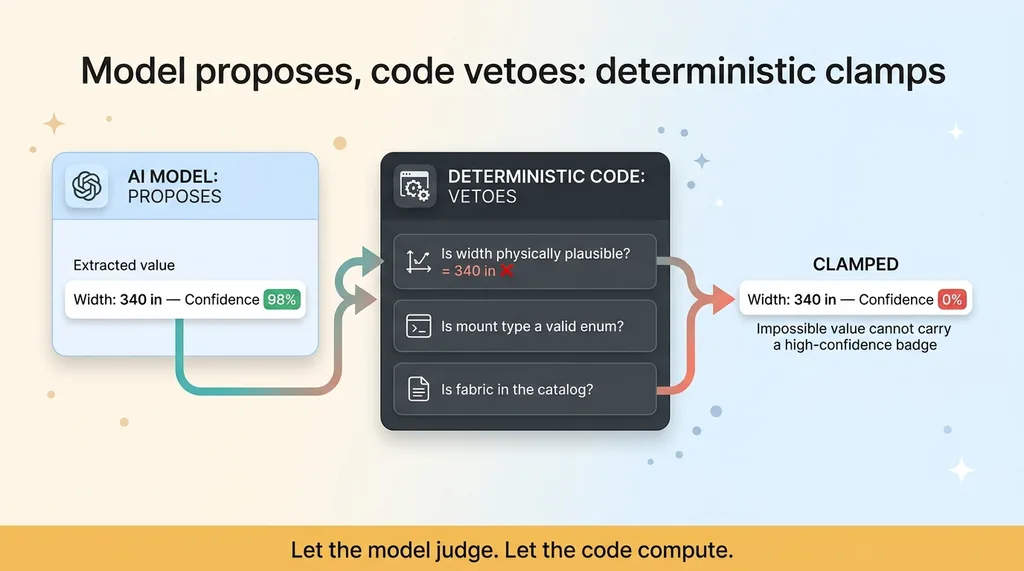 Model proposes, code vetoes: deterministic clamps
The model can be confidently wrong. It can read a smeared "8" as a "3," score it high because the digit looked clean to it, and hand you a wrong number wearing a green badge. If you stop at the model's self-assessment, you've just automated a new way to be confidently incorrect.
So after extraction, deterministic code checks every value against hard rules. Not AI judgment. Plain code with plain logic.
Is the width physically plausible, or did the model read a window as 340 inches wide? Is the mount type one of the actual mount types that exist, or an enum the system has never heard of? Is the fabric a real fabric in the catalog, or a hallucinated name?
Any value that fails one of these checks has its confidence dropped to zero. Automatically. No matter how sure the model claimed to be. A 340-inch window scored at 98% confidence gets clamped straight to zero, because no window is 340 inches wide and the code knows that even when the model doesn't.
This is the principle I keep coming back to: let the model judge, let the code compute. The model is good at reading messy handwriting. It is bad at knowing the limits of physical reality. So I let it propose, and I let deterministic rules veto.
For a buyer, here's the thing that should land. The system is structurally incapable of presenting an impossible number as trustworthy. It's not a matter of how good the model is on a given day. The clamps don't care about the model's mood. A value that breaks a rule cannot carry a high confidence badge through to a human, period.
That's the difference between hoping the AI is right and building something that can't pretend.
Matching fabrics and pricing through the same engine the configurator uses
Reading numbers is one thing. Turning them into a real order is another, and this is where a lot of extraction projects quietly fall apart.
First, fabric matching. The rep wrote a fabric name on the sheet, in his handwriting, possibly abbreviated, possibly misspelled. The model reads it. But that text is never accepted as-is. Every extracted fabric name is matched against the live catalog.
A clean match goes through. A near-miss gets flagged for review, not silently coerced into the closest guess. If the rep wrote something that resolves to two possible fabrics, the system surfaces that instead of picking one and hoping. This is locking the AI to the live catalog in practice. The catalog is the source of truth for what's orderable, and the AI doesn't get to invent products that don't exist.
Second, pricing. Once a line is configured, it gets priced through the same BOM and pricing engine the configurator already uses. Not a parallel estimate. Not a separate "AI pricing" path that might drift from the real one.
This matters more than it looks. The moment you have two pricing paths, you have two sources of truth, and two sources of truth always disagree eventually. A human builds a quote one way, the AI builds it another, and now your margins depend on which path a given order happened to take.
By running every extracted line through the exact same engine, there's one set of pricing rules whether a human typed the line or the AI read it off a photo. The rep ends up with priced, configured order lines. Not raw text. Not a draft someone still has to translate into a quote. Actual lines that match what the configurator would have produced if the rep had typed them by hand, minus the typing.
The review grid: green, amber, red, and the photo as evidence
Trust isn't a feeling. It's a workflow. So the output of all this lands in a review grid that a human can act on in seconds.
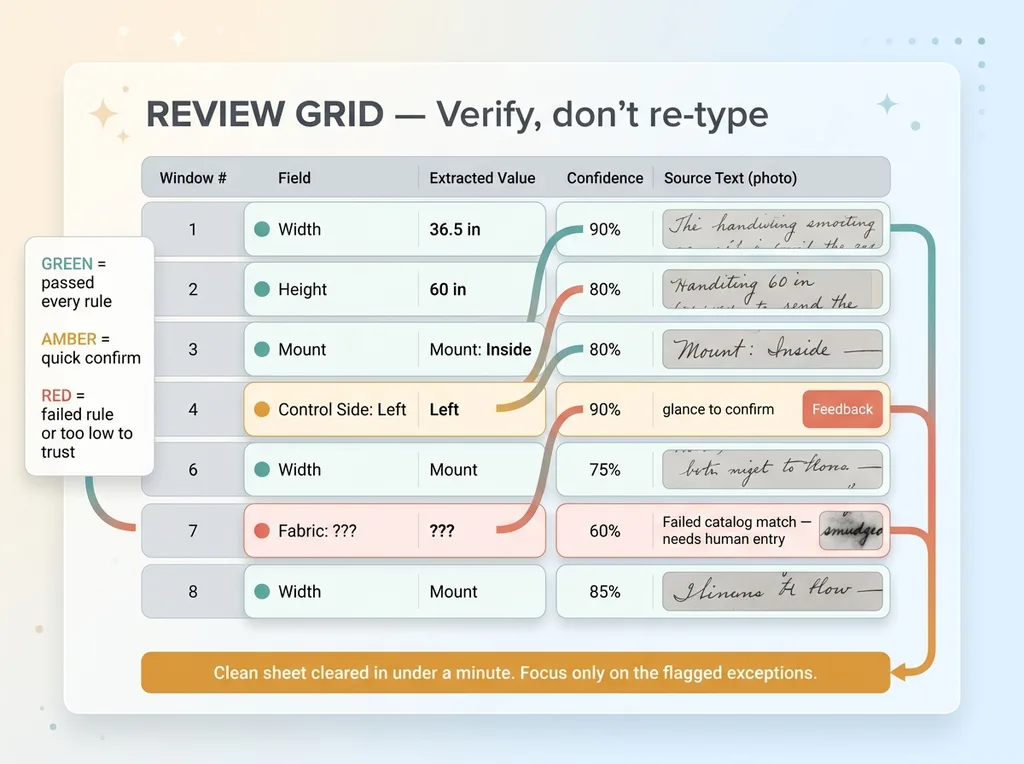 Green / amber / red review grid with photo evidence
Every extracted line shows up as a row. Each field carries a colored dot based on its confidence after the deterministic clamps have done their work.
Green means high-confidence and passed every rule. Amber means take a glance, it's probably fine but worth a beat. Red means it failed a hard rule or scored too low to trust. Red is the system saying "I'm not going to pretend on this one."
Next to each value sits the raw text the model read off the photo. That's the evidence. A reviewer can verify a value against what was actually written on the sheet without digging through a folder for the paper original or squinting at a separate image.
This is the move that changes the economics. A re-typing job becomes a verify-and-correct job. Instead of reading 15 rows off paper and keying 15 rows into software, the reviewer scans a grid where the green fields are already done, the amber fields get a quick confirm, and only the red fields need real attention.
A reviewer who knows the work can clear a clean sheet in under a minute and spend their actual focus on the three fields the system flagged. That's the inversion. The human stops transcribing everything and starts auditing the exceptions.
Confidence scoring AI is only worth anything if a human can act on it fast. A score buried in a log helps nobody. A green-amber-red dot next to the source text, in a grid built for clearing rows, is the difference between a feature and a tool people actually use.
Stateless extraction: nothing exists until a human clicks create
Here's the hard line, and it's the one I'd want to hear about first if I were the buyer.
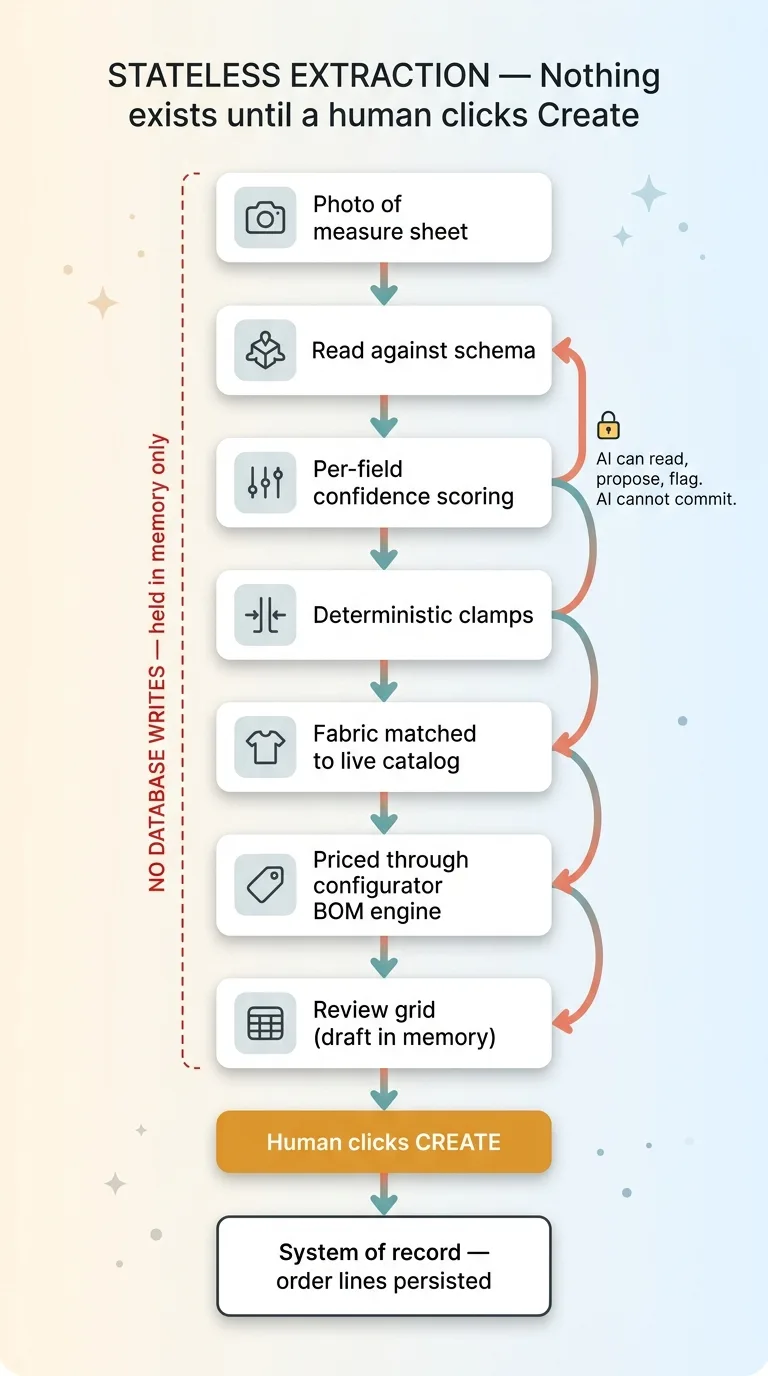 Stateless extraction pipeline: nothing persists until a human clicks create
The entire extraction is stateless. The photo gets read, scored, clamped, fabric-matched, priced, and displayed in the review grid. And through all of that, nothing is written to the database. No order. No line item. No record of any kind.
The grid you're looking at is a draft held in memory. It exists to be reviewed.
A human reads the grid, corrects the red fields, confirms the rest, and clicks create. Only then does anything persist. That click is the moment the work becomes real, and a person makes it every time.
This is the same principle I build everything on: every AI action stops for a human. The AI never has write access to the system of record. It can read, it can propose, it can flag. It cannot commit.
Let me address the buyer's real fear directly. The worst failure mode of AI document extraction isn't a wrong number. A wrong number you can catch. The worst failure mode is a fabricated value silently entering your system of record, where it sits looking just as legitimate as everything else until it costs you a remake or a refund.
By design, that cannot happen here. The AI has no path to write. There's no setting to flip, no edge case where it slips a record in unattended. The output is always a draft surfaced for approval. If a human never clicks create, nothing was ever created. That's not a policy. It's the architecture.
What this changes for a field team (and where it doesn't help)
Let me be straight about the outcome and the limits, because overpromising is how AI vendors lose trust.
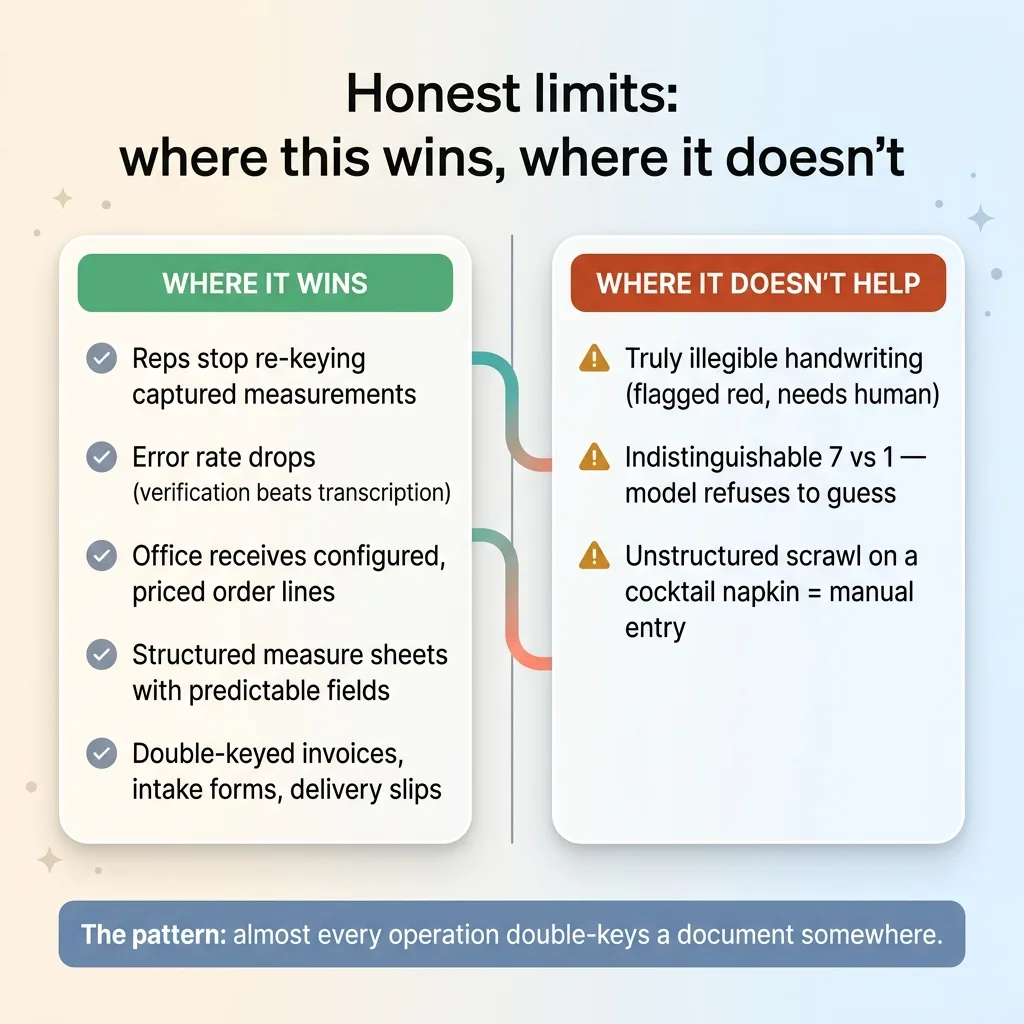 Where it helps vs where it doesn't
The win is concrete. Reps stop re-keying measurements they already captured once. The error rate drops, not because the AI is flawless, but because verification beats transcription. Checking a number against the photo next to it is faster and more reliable than reading paper and retyping it cold. The office stops receiving stacks of handwritten sheets and starts receiving configured, priced order lines.
Now the limits. Truly illegible handwriting still gets flagged red and still needs a human to enter it. The system does not read what a person genuinely can't read. If the rep's "7" and "1" are indistinguishable, the model will, correctly, refuse to be confident, and a human handles it. That's the system working, not failing.
It also works best when the measure sheet has predictable fields. Give it a structured form and it shines. Hand it a cocktail napkin with notes scrawled diagonally and you're back to manual entry.
But here's the pattern worth noticing. Almost every operation I walk into has at least one place where someone reads a document and types it into software. A measure sheet. An invoice. An intake form. A delivery slip. That double-keying is everywhere, and it's almost never on anyone's budget as a cost, even though it's burning hours and quietly injecting errors every week.
Get the next build note.
I write up each system I build, including what broke. Subscribe to my newsletter and I'll send you the next one.