A Regulatory Exposure Calculator That Generates Leads
How I built a regulatory exposure calculator for lead generation that quantifies a buyer's compliance cost in dollars and self-populates the CRM.
By Mike Hodgen
Most Lead Magnets Are PDFs Nobody Opens
A packaging distributor I worked with was running the standard playbook. New state producer-responsibility laws were coming, the kind that put packaging producers on the hook for the cost of recycling what they put into the market. The company had a real solution to sell. So they did what everyone does: they gated a whitepaper on EPR behind an email form.
The download rates were fine. The conversion to actual conversations was almost zero.
Here is why. A whitepaper explains a rule. It does not make the prospect feel personally on the hook. Someone downloads it, skims two pages, files it under "deal with later," and forgets your company exists. You traded a PDF for an email address that will never reply.
I will say the thesis flat out: fear of a specific dollar number converts better than education. "EPR laws are complicated" is a topic. "Your projected annual fee exposure is $214,000" is a problem with your name on it.
So I built a regulatory exposure calculator for them instead. Same audience, same regulation, completely different psychology. The prospect puts in their own numbers and the tool hands back a figure that is specifically, uncomfortably theirs.
That shift, from explaining a rule to pricing a buyer's personal exposure, is the entire move. Regulatory exposure calculator lead generation works because it stops being about the law and starts being about the prospect's money.
The rest of this article is how I built it. The inputs, the outputs, how I kept the numbers defensible, and how every single submission turned into an attributed lead in the CRM that sales could actually work.
Why a Calculator Beats a Whitepaper for Lead Generation
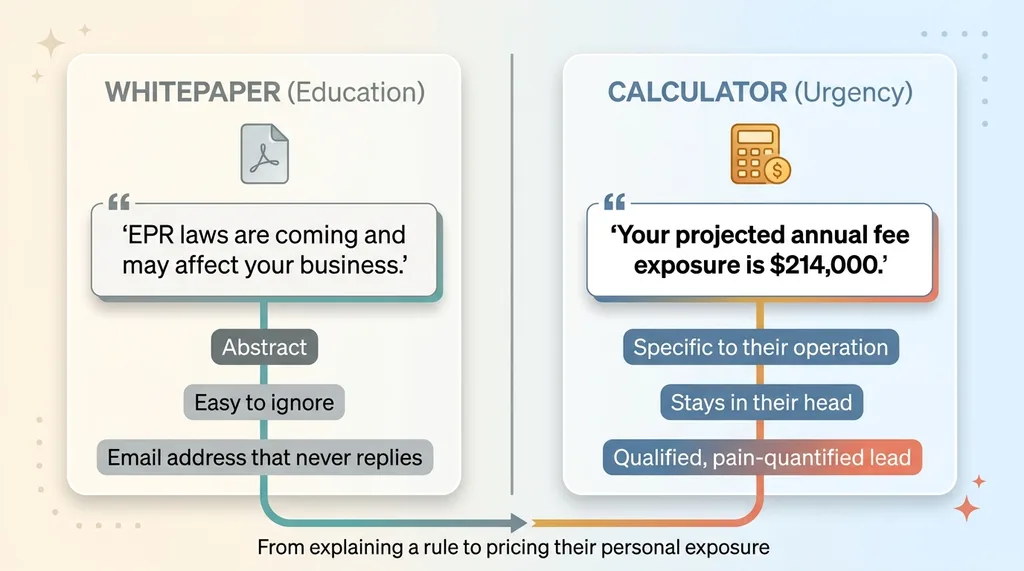 Whitepaper vs Calculator: Education vs Urgency
Specificity creates urgency
A whitepaper says "EPR laws are coming and may affect your business." A regulatory exposure calculator says "your projected annual fee exposure is $X and your per-day penalty risk is $Y."
The first sentence is abstract. You can nod at it and move on. The second is a number attached to your operation, and numbers attached to your operation do not leave your head.
That is the gap between education and urgency. Education informs. Urgency moves people to book a call.
The number does the selling
There is a second reason interactive lead magnets convert better, and it is pure buyer psychology. To get the number, the prospect has to put in their own data. Annual packaging volume. Which states their customers sell into.
Once someone has invested two minutes typing in their real figures, they want the answer. They have skin in it now. You are not asking them to read your opinion about a regulation, you are letting them discover their own exposure, which feels like their conclusion instead of your pitch.
People defend conclusions they reached themselves. That is the whole trick.
But there is a condition, and it is non-negotiable. This only works when the math is grounded in real, public fee schedules, not invented figures. The moment a prospect senses the number is made up, the urgency evaporates and you have lost them. A made-up EPR fee calculator is just a fancier whitepaper.
The number does the selling, but only if the number is real. That is what most people building interactive lead magnets get wrong. They focus on the form and the design and skip the part that actually creates trust: the math has to hold up.
What the EPR Fee Calculator Actually Does
Inputs: volume and states
The inputs are deliberately short. Friction kills completion rates, so I asked for the minimum that produces a defensible number.
First: annual packaging volume by material type. Plastic, paper, glass, metal. The distributor's customers already track this, so it is a number they can pull without leaving the page.
Second: which states their customers sell into. This is the variable that drives everything, because EPR fees are set state by state, not federally.
Outputs: annual exposure, penalty risk, recommended swaps
The calculator is grounded in the 2026 state fee schedules for California, Oregon, Colorado, Washington, Minnesota, Maryland, and Maine. Those are public. Those are the states with active or scheduled producer-responsibility programs, and the fee structures are published.
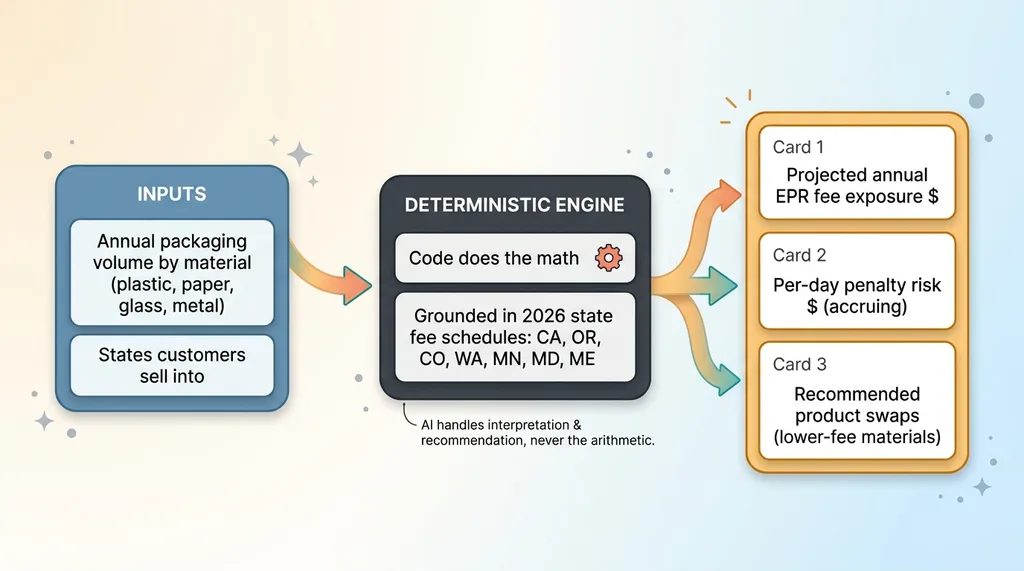 Calculator Inputs and Outputs Flow
From the inputs, the tool returns three things.
One: projected annual EPR fee exposure, summed across every state the prospect operates in, weighted by material type because plastic and glass do not carry the same fee.
Two: estimated per-day penalty risk for non-compliance. This is the number that creates urgency, because it reframes the deadline from "someday" to "this is accruing."
Three, and this is what makes it more than bad news: recommended product swaps. Lower-fee materials that would cut the exposure. The result is not just a problem, it is a problem with a path forward, and that path runs straight through the distributor's product line.
Here is the design rule I never break. The math is deterministic everywhere it touches dollars. Code does the arithmetic. The AI handles interpretation and recommendation, never the calculation. Letting code do the math and AI do the judgment is how you get a tool you can stand behind. Models are good at reasoning and terrible at being a calculator, so I never ask them to be one.
Grounding the Numbers So You Can Defend Them
A calculator that hallucinates fee numbers is worse than no calculator. I want to be blunt about that, because it is the part everyone skips.
 The Trust Layer: Hard-Coded Config vs AI Hallucination
If you ask a language model to recall California's 2026 EPR fee for plastic, it will give you a confident answer. Sometimes it is right. Sometimes it is off by 40 percent. You cannot tell which from the output, and neither can your prospect, until they get a real invoice and discover your number was fiction.
So I did not let the model touch the fee data at all. Every state's fee schedule was encoded as fixed config. Hard values, state by state, material by material, versioned in the codebase. The model never invents a dollar figure because the model never sees the question as a recall task. It only interprets numbers the code already computed from the config.
This is the trust layer, and it is the entire reason the calculator works as a lead magnet.
Think about the downside of getting it wrong. A prospect who later discovers the exposure number was inflated or fabricated is not a lukewarm lead. They are gone forever, and depending on how they used your number, you may have created a liability. The credibility you were trying to build is the exact thing you destroy.
Now the honest limitation. Fee schedules change. States publish new rates, add new material categories, push deadlines. The config has to be versioned and updated as that happens. This is maintenance, not set-and-forget.
That is a feature of doing it right, not a bug. The data is in one place, easy to audit, easy to update. When Oregon revises a rate, you change one config value and every future calculation reflects it. You are never chasing a hallucination through a black box.
Every Submission Becomes Attributed Pipeline
Auto-creating the CRM lead
Here is the part that answers the CEO's real doubt, which is not "does it look nice," it is "does this produce leads I can actually sell to."
Every public submission auto-creates a lead in the CRM I built to capture and tag leads. Not a spreadsheet row someone exports weekly. A live lead, the moment the prospect hits submit.
And it is not just a name and email. The lead is enriched with the exposure number the prospect just saw. Sales does not open a record that says "John, downloaded something." They open one that says "John, $214,000 in projected annual EPR exposure across three states, knows it, saw it five minutes ago."
That is a qualified, pain-quantified lead. The first sentence of the sales call writes itself.
Tagging by source
Every submission is tagged by source: calculator. That tag is not cosmetic, it is how you measure what the tool actually produced.
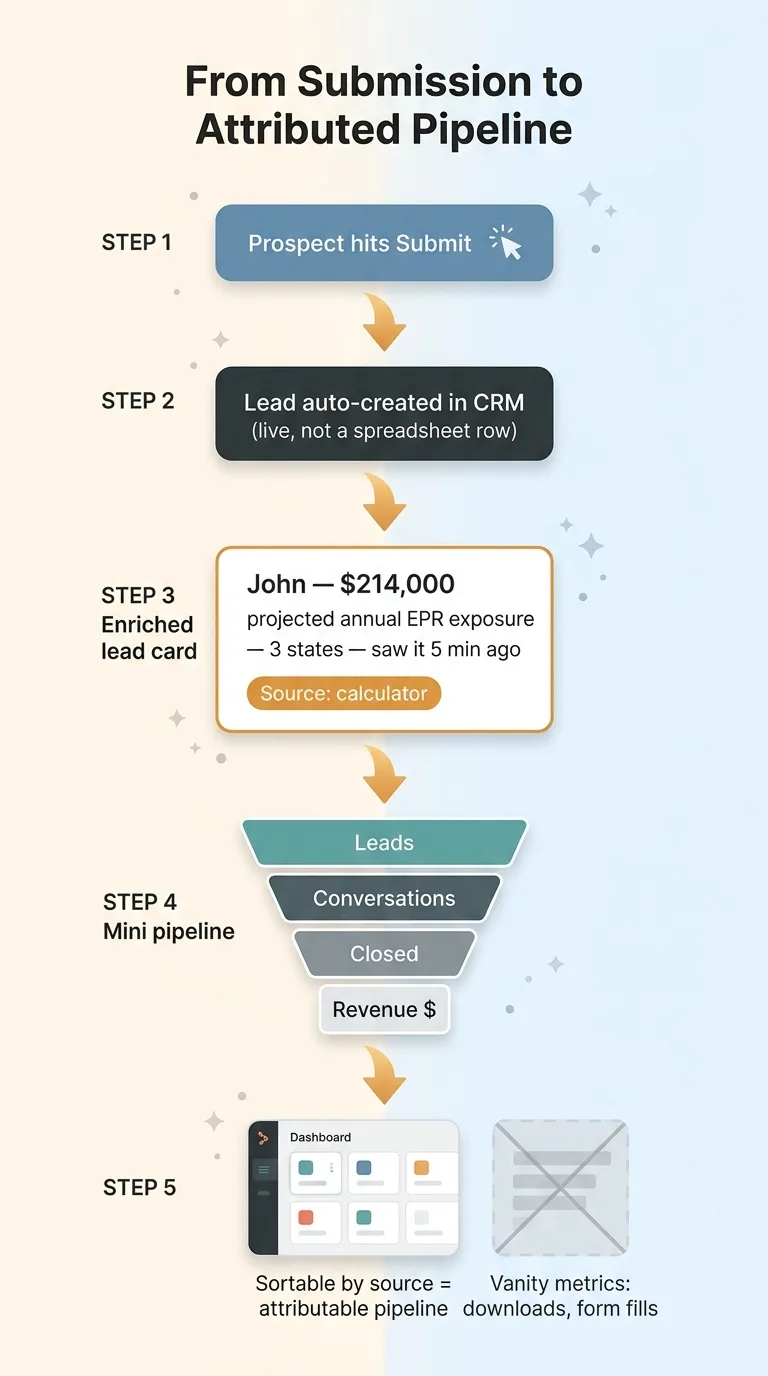 From Submission to Attributed Pipeline
Most lead magnets report a vanity number. Downloads. Form fills. Numbers that go up and tell you nothing about money. With source tagging, you can trace the calculator's output all the way through the pipeline. How many leads, how many became conversations, how many closed, and what that revenue was.
That is the difference between marketing fluff and attributable pipeline you can actually track. When the board asks what the AI work produced, you are not pointing at engagement. You are pointing at named deals with a source tag that says exactly where they came from.
This is measurable pipeline. Not brand awareness, not impressions. A column you can sort by source and put a dollar figure next to.
What I'd Tell a CEO Who Doubts AI Drives Leads
The objection I hear is "AI marketing is hype." Fair. I have seen the same overpromised demos you have.
But look at what this actually is. It is not a chatbot writing generic blog fluff that any competitor could produce in the same afternoon. It is a tool that quantifies a specific prospect's pain in dollars and self-populates the CRM with a tagged, qualified lead. The "AI" part is narrow and earns its place: interpretation and recommendation, sitting on top of deterministic math and hard-coded data.
If you are skeptical, good. Treat it the way I would. Not as a campaign promise but as a 90-day experiment instead of a marketing promise. Build one calculator, wire it to the CRM, run it for a quarter, and look at the source-tagged pipeline. If it produced nothing, you learned that cheaply. If it produced six qualified leads with quantified exposure, you have your answer and a template to repeat.
Now the honest part, because I would rather you trust me than oversell you.
This calculator will not close the deal. It hands sales a warm, quantified lead, and a human still has to do the work from there.
It will not fix a weak offer. If your product does not actually reduce the exposure the calculator surfaces, the tool just makes your weakness obvious faster.
And it needs maintenance. Fee schedules change, and stale data is dangerous data.
What it does do is real. It turns abstract regulatory dread, the vague "we should look into EPR someday," into named pipeline you can measure. That is not hype. That is a lead with a dollar sign and a source tag.
The Pattern Works for Any Coming Regulation
EPR is the example, but the playbook is general, and that is the part worth sitting with.
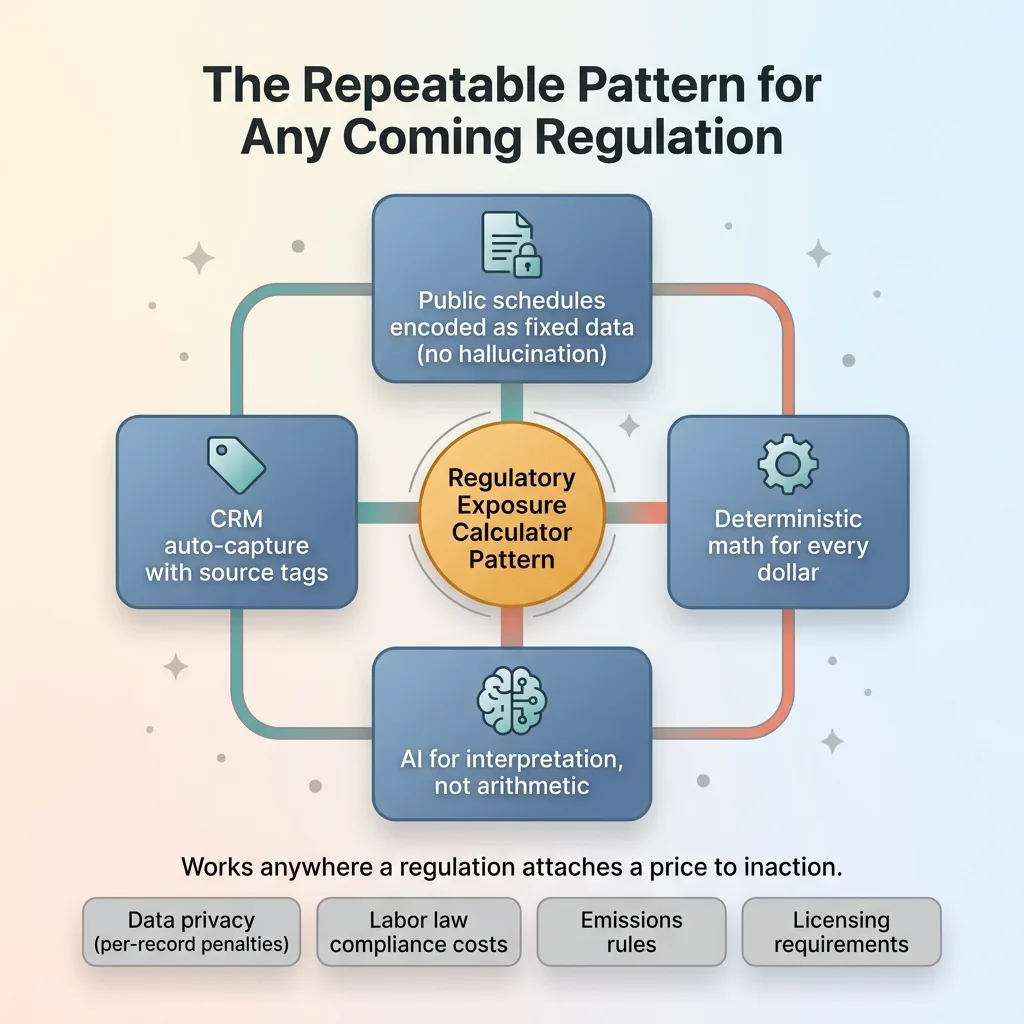 The Repeatable Pattern for Any Coming Regulation
Any industry facing a known, scheduled regulatory change can build a calculator that sizes a buyer's exposure in dollars and captures the lead. Data privacy laws with per-record penalties. Labor law changes with compliance costs. Emissions rules. Licensing requirements. Anywhere a regulation is about to attach a price to inaction, there is a calculator that prices it for a specific prospect.
The ingredients never change. Public schedules encoded as fixed data so nothing is hallucinated. Deterministic math for every dollar figure. AI for interpretation and recommendation, not arithmetic. CRM auto-capture with source tags so the pipeline is attributable.
If you sell a solution to a problem a regulation is about to create, you are sitting on a lead magnet you have not built yet. Your competitors are still gating whitepapers nobody opens. You could be the one handing prospects their exact exposure number and a path to reduce it. I have written more about turning a coming regulation into a lead magnet if you want to think through the angle for your own market.
The hard part is not the idea. It is encoding the schedules correctly, keeping the math defensible, and wiring the whole thing into your pipeline so it produces measurable leads instead of a nice demo. That is the kind of thing I build.
Thinking about AI for your business?
If this resonated, let's have a conversation. I do free 30-minute discovery calls where we look at your operations and find where AI could actually move the needle, not where it makes a good slide.
Get AI insights for business leaders
Practical AI strategy from someone who built the systems — not just studied them. No spam, no fluff.
Hodgen.AI
Ready to automate your growth?
Book a free 30-minute strategy call with Hodgen.AI.
Book a Strategy Call