How to Measure AI ROI: The Deliverables Log I Built
How to measure AI ROI with a deliverables log that tracks time saved, costs cut, and value created. Real system from a real client engagement.
By Mike Hodgen
Most AI initiatives die in the dark. Not because the technology failed, but because nobody built the infrastructure to prove it worked.
Here's the uncomfortable reality: somewhere between 70% and 80% of AI pilots never make it to production. The reasons are varied — bad scoping, wrong problems, immature data — but one of the most common killers is simpler than all of that. Leadership can't answer the question: what did we actually get for that money?
And if they can't answer it, the budget disappears.
I learned this early. When I started deploying AI systems — first in my own DTC fashion brand, then for clients — I realized that the measurement problem was just as important as the building problem. So I built a deliverables tracking system from week one of every engagement. Not as a nice-to-have. Not as a report I'd generate when someone asked. As infrastructure.
The thesis is simple: if you can't measure AI ROI, you don't have AI ROI. You have expenses and hope.
This measurement gap is one of the core reasons why most AI projects fail. Not a technical failure — an accountability failure. The AI might be doing exactly what it was designed to do, but if nobody's tracking the output against a baseline, there's no story to tell the board. No story means no continued investment. No continued investment means the project gets shelved, and the company adds "we tried AI" to its list of expensive lessons.
What follows is the blueprint for the system I built. It's not complex. It doesn't require a BI tool or a data engineering team. But it works, and it's the reason every engagement I run can answer the ROI question in under 60 seconds.
What Actually Gets Logged (And What Most People Miss)
The Three Categories of AI Value
Every deliverable I build gets logged into one of three value categories:
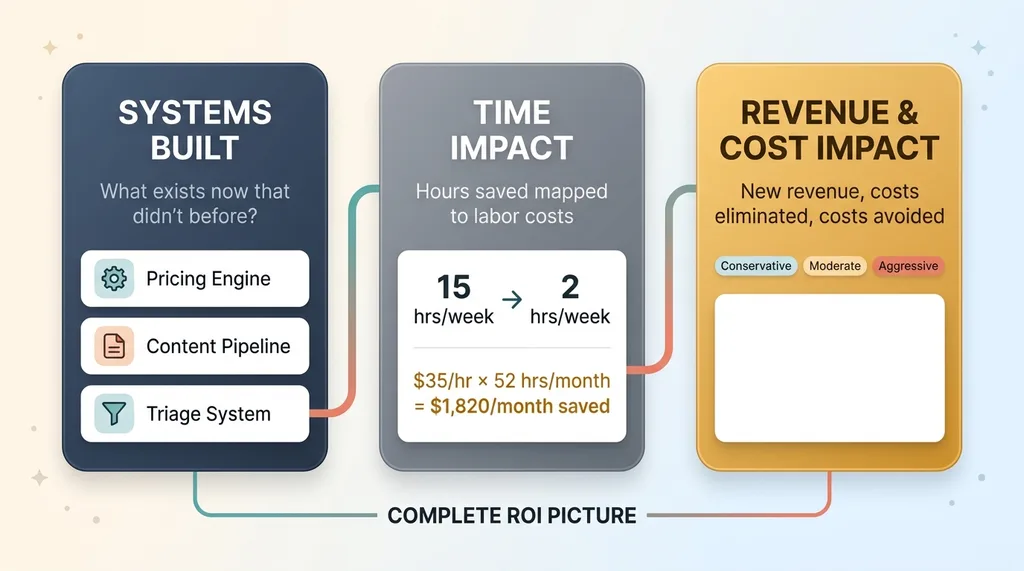 Three Categories of AI Value
1. Systems built. These are the actual tools, automations, and pipelines deployed. A pricing engine. An automated content pipeline. A customer service triage system. Each one gets a plain-English description and a current status. This category answers: what exists now that didn't exist before?
2. Time impact. Hours saved per week or month, mapped to specific roles and their labor costs. This is the most intuitive category for executives — they get it immediately. Someone used to spend 15 hours a week on this, now they spend 2.
3. Revenue and cost impact. New revenue enabled, costs eliminated, costs avoided. This is where the real numbers live, but also where people are most tempted to inflate. I keep these conservative and tag anything speculative as such.
These three categories together paint a complete picture. Most tracking I've seen only covers one — usually time savings — and that leaves massive gaps.
Why 'Hours Saved' Is Necessary But Not Sufficient
Hours saved is the gateway metric. It's easy to understand, easy to measure, and executives immediately translate it to dollars. But if that's all you're tracking, you're missing the majority of the value.
Here's why. Say I build an automated reporting dashboard for a client's operations team. The obvious metric: it saves an analyst 5 hours a week pulling data and building slides. That's real. Log it.
But the bigger value? That dashboard enables daily decisions that were previously monthly. The ops team catches inventory problems on Tuesday instead of at the end-of-month review. They adjust pricing in real-time instead of quarterly. The value of speed and capability dwarfs the 5 hours of analyst time.
If you're only counting hours saved, you're systematically undervaluing what AI actually does. A Chief AI Officer's job is building systems that create capabilities that didn't exist before — and the deliverables log needs to capture that full picture.
The Deliverables Log: Structure and Fields
Every Entry Captures Six Things
I keep the log deliberately simple. No complex scoring models. No weighted impact matrices. Six fields per entry:
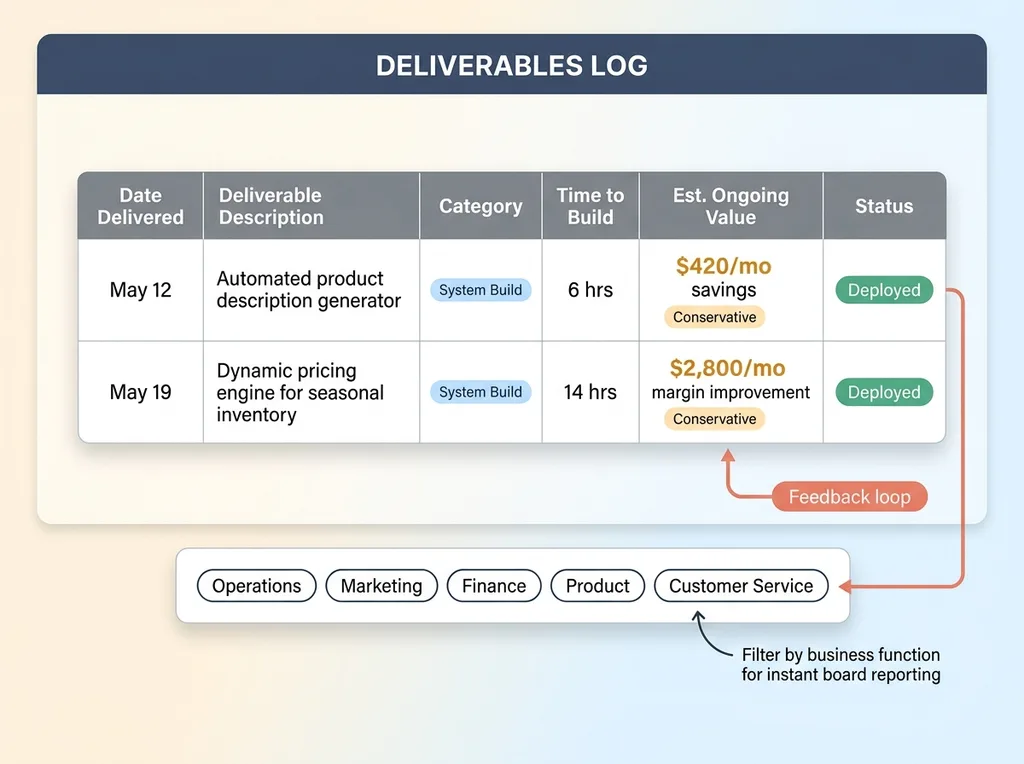 Deliverables Log Structure — Six Fields
- Date delivered — when it went live or was handed off
- Deliverable description — plain English, not technical jargon. "Automated weekly inventory report that pulls from Shopify and flags items below reorder threshold" not "Python script leveraging API integration for inventory analytics"
- Category — system build, optimization, automation, analysis, or training
- Time investment — how many hours this took me to build
- Estimated ongoing value — monthly hours saved or monthly cost impact, clearly labeled as conservative, moderate, or aggressive estimate
- Status — deployed, in testing, or deprecated
That's it. Each row is one deliverable, and the entire log lives in a structured spreadsheet. Not a dashboard. Not a custom app. A shared document that anyone can read.
Here's what a couple of rows look like in practice:
May 12 | Automated product description generator | System Build | 6 hrs to build | Saves ~12 hrs/month content writing at $35/hr = $420/month | Deployed
May 19 | Dynamic pricing engine for seasonal inventory | System Build | 14 hrs to build | Estimated $2,800/month in margin improvement (conservative) | Deployed
Categorization That Makes Board Reporting Easy
Each deliverable also gets tagged to a business function: operations, marketing, finance, product, or customer service. This tagging seems minor, but it solves a specific problem.
When a CEO walks into a board meeting and gets asked "what has AI done for our operations team?" — they filter the log by operations and have the answer in seconds. Total deliverables, total value, specific systems. No scrambling to prepare a deck.
This categorization also reveals patterns over time. If 80% of your AI value is coming from operations and 5% from marketing, that tells you something about where the next investment should go.
Time Tracking: The Before-and-After That Executives Understand
Baselining Before You Build
This is the step almost everyone skips, and it's the one that makes everything else credible.
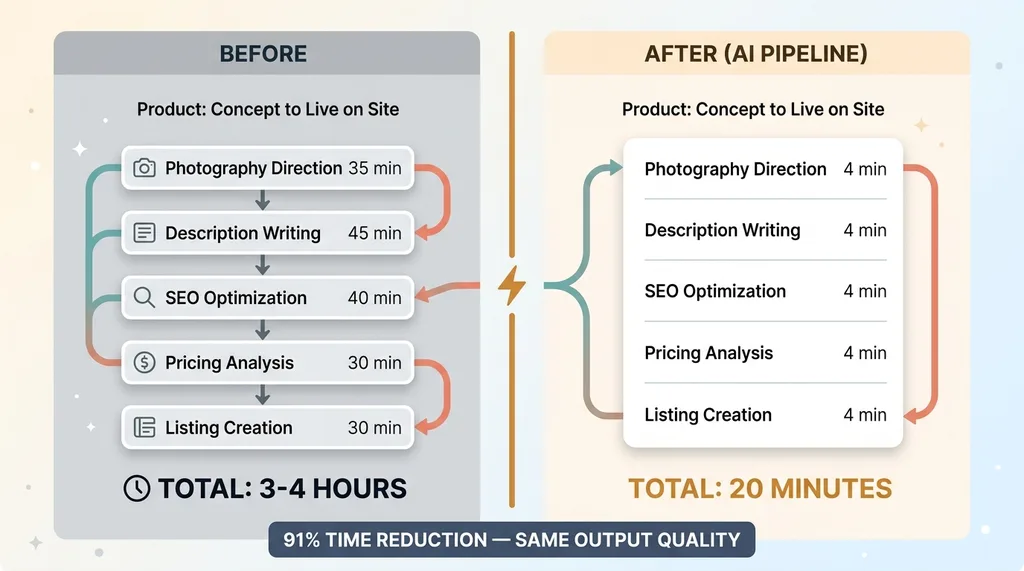 Before-and-After Baseline Comparison
Before I build any system, I measure what currently exists. Shadow the person doing the task, or interview them carefully. How long does this take? How often? What's the error rate? What decisions get delayed because of it?
You need the "before" to prove the "after." Without it, you're estimating retroactively, which is just a fancy word for guessing.
I document the baseline in the log alongside the deliverable. The product creation pipeline is a good example from my own brand. Before I built the AI pipeline, taking a product from concept to live on the site took 3 to 4 hours. Photography direction, description writing, SEO optimization, pricing analysis, listing creation — all manual. After deployment: 20 minutes. Same output quality. That's not a rough estimate. I timed both processes.
Converting Time to Dollars
The conversion formula is straightforward:
Monthly value = hours saved per month × fully loaded hourly cost of the person
Fully loaded means salary plus benefits plus overhead, not just their wage. A $60K/year employee actually costs the business $75-85K when you factor everything in. That's roughly $38-42/hour.
But here's where I have to be honest about something most ROI reports gloss over. Time savings are only real if the freed capacity actually gets used. If your operations manager saves 10 hours a week but fills that time with low-value busywork, the ROI is theoretical. It looks great on paper and changes nothing on the P&L.
Real ROI means one of two things: you either avoid a hire you would have needed as you scale, or you redirect that person's time to revenue-generating work. I track which one is happening and log it accordingly.
Across my own operations, this methodology showed a 42% reduction in manual operations time and a 38% increase in revenue per employee. Those numbers held up because I was rigorous about the baseline and honest about where the time actually went post-automation.
The ROI Calculator: Turning a Log Into a Number
Monthly Value vs. Cumulative Value
The deliverables log feeds into a simple calculation that anyone can understand.
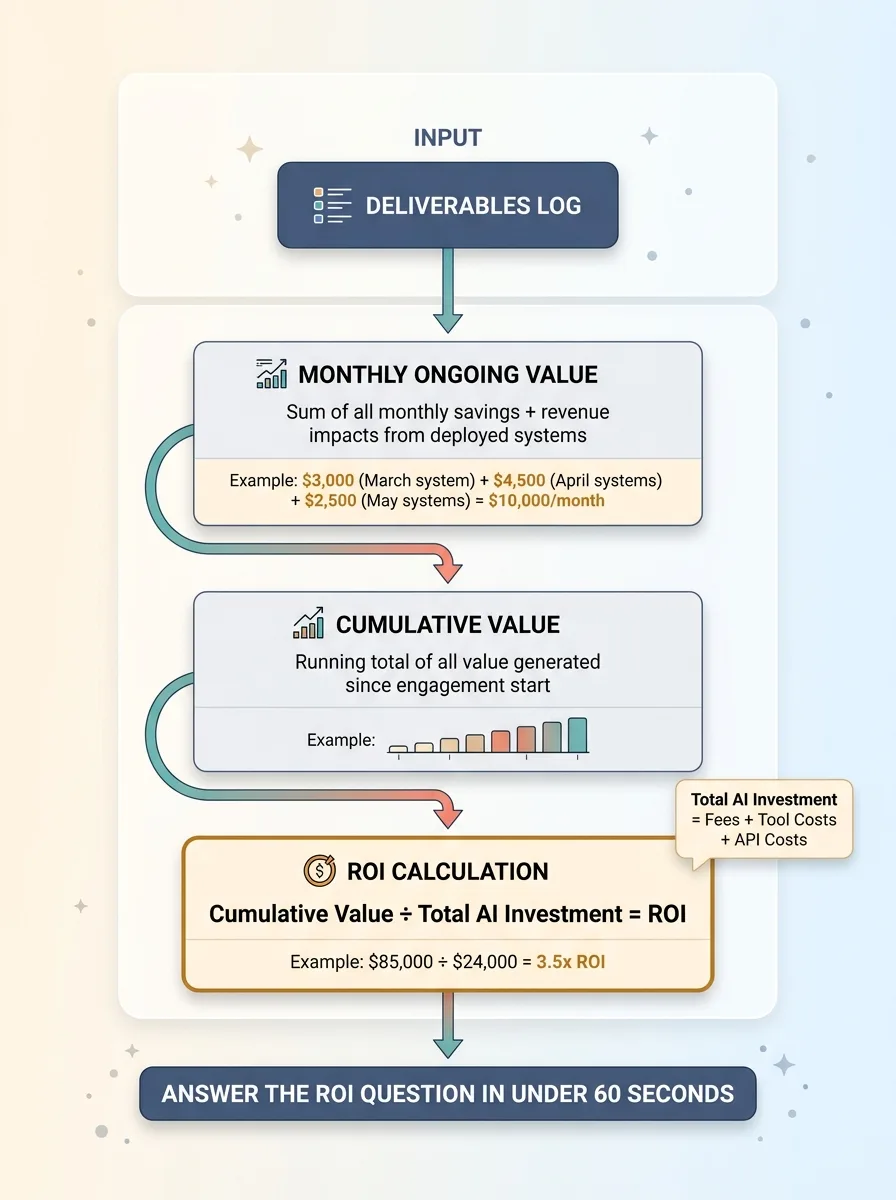 ROI Measurement Framework — From Log to Number
Monthly ongoing value = the sum of all monthly savings and revenue impacts from currently deployed deliverables. If I built a system in March that saves $3,000/month and it's still running in July, that $3,000 counts every month.
Cumulative value = the running total of all value generated since the engagement started.
ROI = cumulative value ÷ total cost of AI investment (my fees plus any tool or API costs).
That's the whole formula. It fits on a napkin.
The Compound Effect Most People Undercount
Here's what makes AI ROI fundamentally different from most business investments: systems compound.
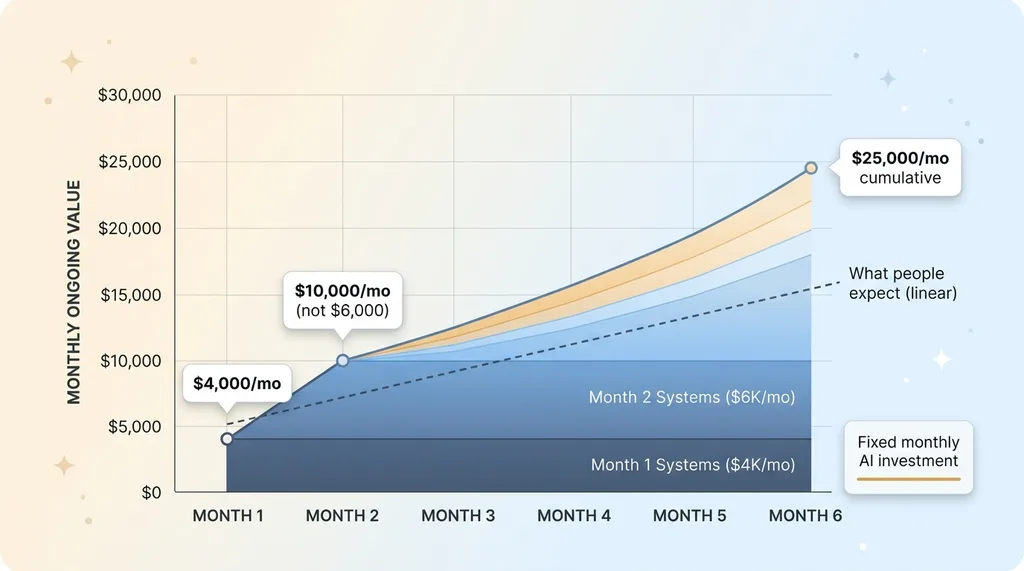 AI ROI Compound Effect Over Time
A system built in month 1 keeps generating value in months 2, 3, 4, and beyond. So the ROI curve doesn't move in a straight line — it accelerates.
Let me walk through a realistic example. Month 1 of an engagement, I deploy three systems that generate a combined $4,000/month in ongoing value. Month 2, I add deliverables worth another $6,000/month. The total monthly value is now $10,000, not $6,000 — because the month 1 systems are still running. By month 6, the portfolio of deployed systems might be generating $25,000/month in ongoing value against a fixed monthly investment.
This is where the ROI math gets compelling for executives. A 6-month engagement might show 3-5x ROI not because any single system is a moonshot, but because dozens of systems are quietly stacking value every month.
One warning here: resist the urge to inflate. Conservative estimates build more trust than aggressive ones. If a deliverable's value is hard to quantify — maybe it improved decision quality or reduced risk — call it a qualitative benefit and log it separately. Don't force a dollar sign on everything. Credibility comes from honesty, not from making every line item look like a 10x return.
What I Learned Running This System for a Real Client
Surprises in the Data
I ran this log system through a full client engagement — updated weekly, reviewed monthly — and the data surprised me in a few ways.
The highest-ROI deliverables were not the flashiest. A simple automated data reconciliation process — matching records across two systems that a team member had been doing manually every Friday — generated more measurable savings than a sophisticated AI analysis tool I spent twice as long building. The boring stuff won.
Some deliverables showed negative or negligible ROI. I logged those honestly. One automation I built took 8 hours to create and saved maybe 45 minutes a month. Not worth it. Having that in the log actually increased trust. The client could see I wasn't cherry-picking wins or selling a narrative. I was tracking reality.
The Log as a Prioritization Tool
The most unexpected benefit: the log became the strategic planning tool.
When the client could see which business function categories were generating the most value, it naturally directed where we should invest in the next sprint. Operations was showing 4x the return of marketing automations, so we doubled down on operations. That's not a gut call — it's data from our own log.
And when it came time to discuss renewing the engagement, the conversation was effortless. There was no "do we still need this?" The data was sitting in a shared document. The conversation became "where should we deploy next?" That's a fundamentally different negotiating position — for both sides.
Building Measurement Into AI Engagement From Day One
Whether you're hiring an AI consultant, building an internal team, or evaluating vendors, demand a deliverables log from day one. Not month three. Not "once we're in production." Day one.
If your AI partner can't articulate what they'll deliver, how long it'll take, and how value will be measured — that's a red flag. Not a complexity excuse. The work might be complex. The measurement shouldn't be.
Every engagement I run starts with the log. It's shared, updated weekly, and reviewed monthly with the client. It takes me maybe 15 minutes a week to maintain. That's not overhead — it's the backbone of a productive relationship. It keeps me accountable, keeps the client informed, and keeps the work focused on what actually moves the needle.
Want to Know What AI Could Actually Do for Your Business?
If you want an AI partner who builds measurement into the foundation — not as an afterthought when someone asks for justification — that conversation is worth having.
I do a free 30-minute strategy call. No pitch deck, no sales team. Just a direct conversation about your operations, where AI fits, and whether the math makes sense.
Get AI insights for business leaders
Practical AI strategy from someone who built the systems — not just studied them. No spam, no fluff.
Ready to automate your growth?
Book a free 30-minute strategy call with Hodgen.AI.
Book a Strategy Call