Marketing Engagement That Proves ROI: A 90-Day Test
A skeptical owner had been burned by an agency. I sold her a falsifiable 90-day marketing experiment that proves ROI, not a promise. Here is how it worked.
By Mike Hodgen
The Owner Who'd Already Been Burned
The first thing she said to me wasn't about marketing. It was an apology for being suspicious.
She runs a salon in the region. Before we talked, she'd spent the better part of a year paying an offshore agency a flat monthly fee. Every month she got a report. Impressions. Reach. Engagement rate. A dashboard with line graphs that all pointed up and to the right.
And she couldn't answer the one question that actually mattered. Did any of this make me more money? She didn't know. The agency never told her, because the agency never measured it.
She wasn't anti-marketing. That's important. She believed marketing could work. What she'd lost faith in was her ability to tell whether it was working, and in the people who kept assuring her it was.
That distrust is the correct default. I told her so directly. When someone has shown you a year of activity reports and zero proof of revenue, being skeptical isn't a flaw in your thinking. It's the right conclusion from the evidence in front of you. The skeptical CEO is usually right about the hype, and pretending otherwise would have been the first lie in a new relationship.
So I didn't try to sell her on confidence. Selling confidence to a person who'd just been burned by confidence would have made me sound exactly like the last vendor. More polish, same trap.
What she needed wasn't a better pitch. She needed marketing engagement that proves ROI, with a structure where the proof came from the numbers, not from me telling her to trust the process. That's the engagement I built. Here's how it worked.
Why Promises Don't Sell to Skeptics (Falsifiability Does)
A burned buyer has heard every confident promise there is. "We'll grow your revenue." "Our system is proven." "Just give it time." When you add more confidence on top of that pile, you don't stand out. You blend in with the people who already let her down.
So I stopped promising. I offered her something more useful: a test that could fail honestly.
Here's the difference, in plain language. I did not promise marketing would work for her business. I built a system designed to give her a truthful yes-or-no at day 90. If at day 90 the answer was no, she stops, and she's learned something real about her business that she can take forward forever.
That's falsifiability. A claim that can be proven wrong is worth more than a claim that can't. If my approach to her marketing only ever produces good news, the good news is worthless, because it's not connected to anything that could have produced bad news.
An honest "this might not work, and here's exactly how we'll know" is more persuasive to a skeptic than any guarantee. Guarantees are cheap. The last agency probably guaranteed things too. What it never offered was a structure where failure was visible and the agency paid for it.
Think about how the offshore model actually worked. They charged a flat retainer. They got paid whether she grew or shrank. Their incentive was to keep producing reports that looked like progress, because reports that looked like progress kept the retainer alive. Whether she made more money was, to them, beside the point.
A 90 day marketing experiment with a real pass-fail line flips that. The point becomes the only thing that matters: does this make her more money than she was already making? Everything else is noise dressed up as a metric.
How I Structured the 90-Day Marketing Experiment
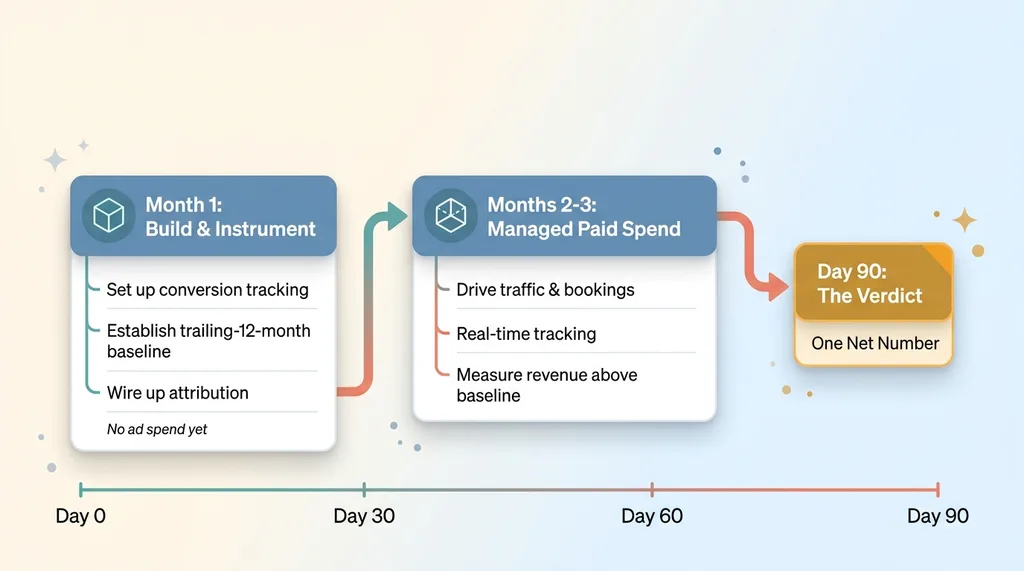
The engagement had two distinct phases, and the split matters because they're paid for differently and they do different jobs.
 The 90-Day Experiment Structure (Build, Spend, Verdict)
Month one: build and instrument
The first month, I didn't spend a dollar on her behalf trying to drive sales. I built the instrument first.
That meant setting up real conversion tracking, the kind that connects a marketing dollar to a booked appointment and the revenue that appointment produces. Not impressions. Not clicks. Booked, paid revenue.
It also meant establishing the baseline, and this is the whole game. I pulled her trailing-12-month revenue and made that the line everything would be measured against. Without a true trailing-12-month number, "growth" is just a story you tell. A good month could be seasonality. A good week could be a fluke. The baseline is what turns noise into signal.
Then I wired up attribution so that spend connected to that booked revenue, and built it as a deliverables log instrumented so the answer is provable. Every dollar in, every dollar out, traceable. The kind of record you can hand to an accountant.
Months two and three: managed paid spend
With the instrument running, months two and three were managed paid spend. This is where I actually drove traffic and bookings, with the tracking watching everything in real time.
 The Three Numbers That Determine the Verdict
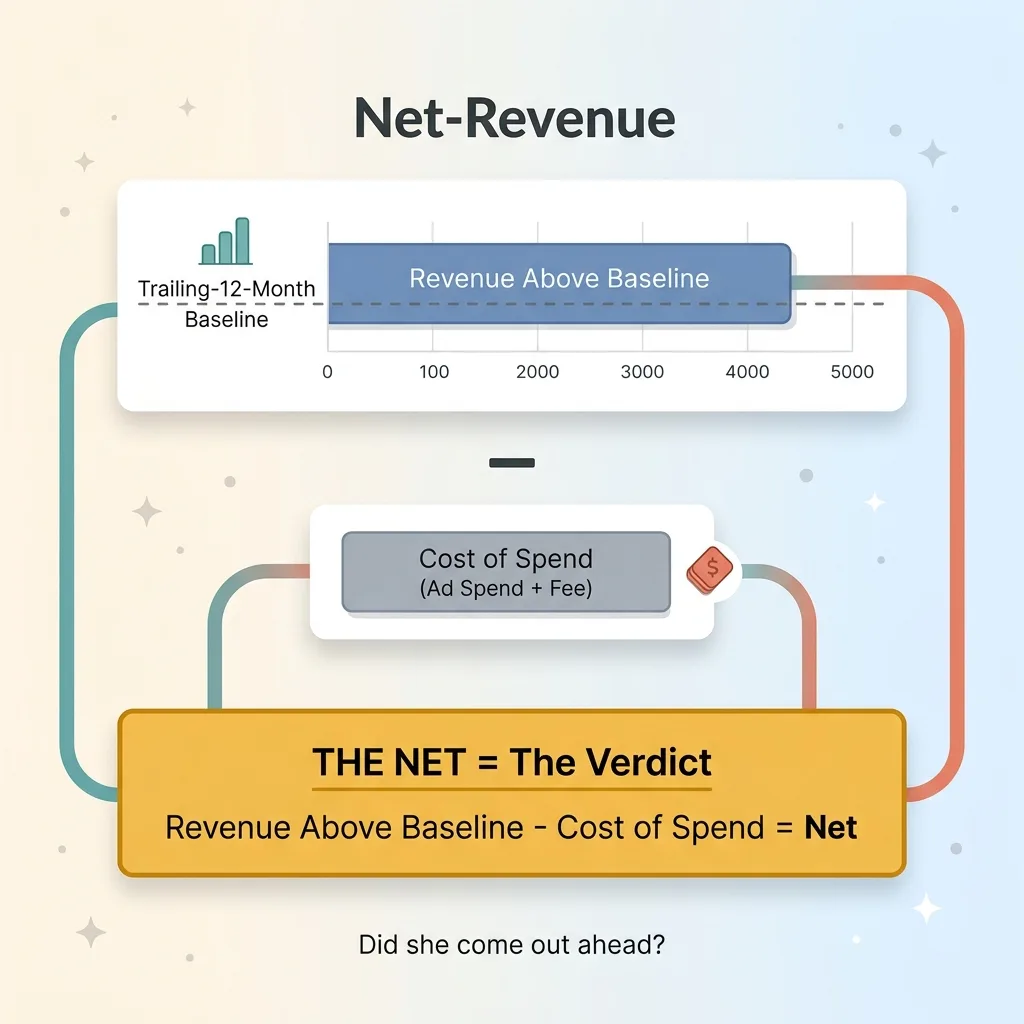
Three numbers got measured, and only three really mattered.
- Revenue above baseline. How much did she earn beyond her trailing-12-month line?
- Cost of the spend. What did we pay to get it, including ad spend and my fee?
- The net. Revenue above baseline minus the total cost. Did she come out ahead?
That third number is the verdict. Everything in months two and three existed to make it real and trustworthy.
I want to be clear that the build month is not a throwaway. It's the most important work in the entire engagement, because a measurement you can't trust makes the next two months meaningless. If the baseline is wrong or the attribution is sloppy, you can run perfect ad campaigns and still have no idea if they worked. Build first. Spend second. Measure the whole time.
The Fee Structure: Growth-Share Above Baseline
Here's where the incentives got honest.
 Flat Retainer vs Growth-Share Above Baseline
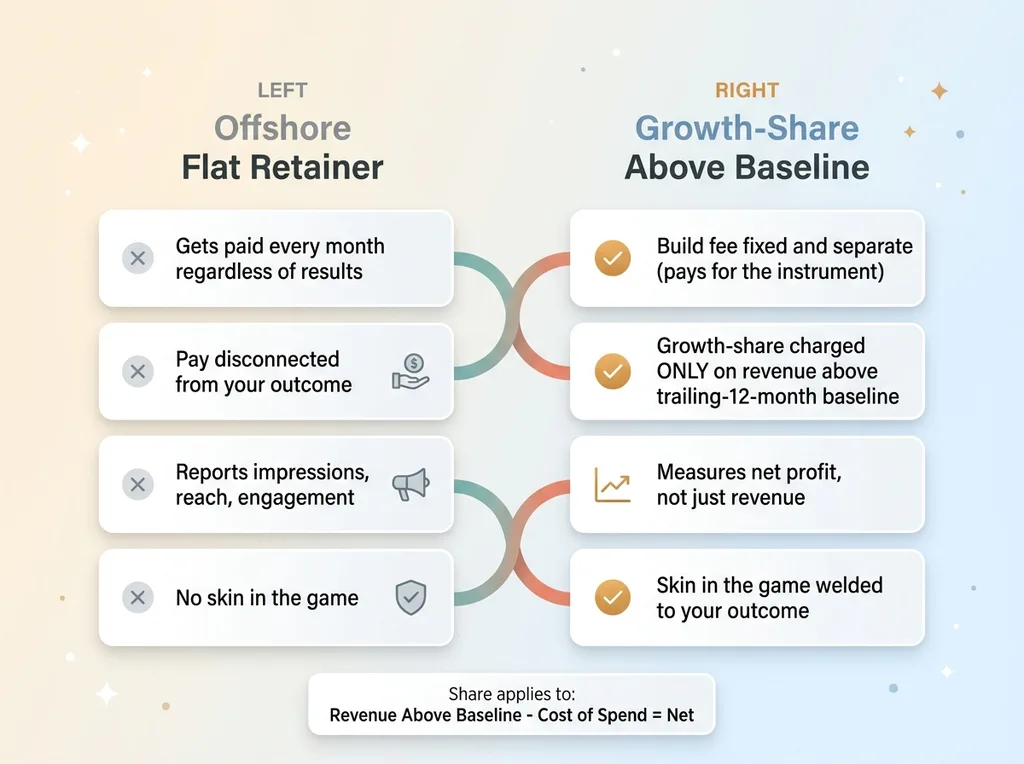
My fee for the spend phase was a growth-share, charged only on revenue above the trailing-12-month baseline. If her business didn't grow past where it already was, I didn't earn the growth share. Period.
Compare that to the offshore agency's flat retainer, which got paid in full whether she had her best quarter ever or her worst. Their pay was disconnected from her outcome. Mine was welded to it. That's the skin-in-the-game piece, and it's the part a skeptic can actually feel the weight of.
I was honest with her about one thing up front, because hiding it would have undermined the whole point. The build month is paid separately. Building real conversion tracking, establishing the baseline, and wiring up attribution is real work that takes real hours regardless of what the campaigns do later. You're paying for the instrument. That cost is fixed and fair.
The growth-share is different. That's paying for results. Keeping those two things separate matters: you pay me to build the measurement, and you pay me a share only of the growth the measurement proves I created. If there's no growth above baseline, there's no share to take.
There's a deeper point about what "growth" means here. I don't tie the share to topline revenue in a vacuum. Revenue you bought at a loss isn't growth, it's a more expensive way to go broke. The share is built around profitable growth, which means the cost of the spend comes out before anyone celebrates. This is profit, not just revenue, and it's the difference between a marketer who makes you feel busy and one who makes you money.
A performance-based marketing fee only means something if the performance is defined honestly and the baseline is real. Otherwise it's just a flat retainer wearing a costume.
Making the Answer Provable, Not Spinnable
Most marketing engagements end in an argument. Not because the marketing necessarily failed, but because nobody agreed up front on what "working" meant. So when the client asks "did this work," the marketer reaches for whatever metric happened to go up, and the client feels handled. Again.
 Honest Instrumentation vs Success Theater
I killed that on day one by defining the metric before any spending started. The metric was revenue above the trailing-12-month baseline, net of spend. One number. Agreed in advance. No moving it later.
That sounds simple. It's the most important sentence in the whole engagement. When the definition of success is locked before the work begins, there's nothing left to spin. The number is the number.
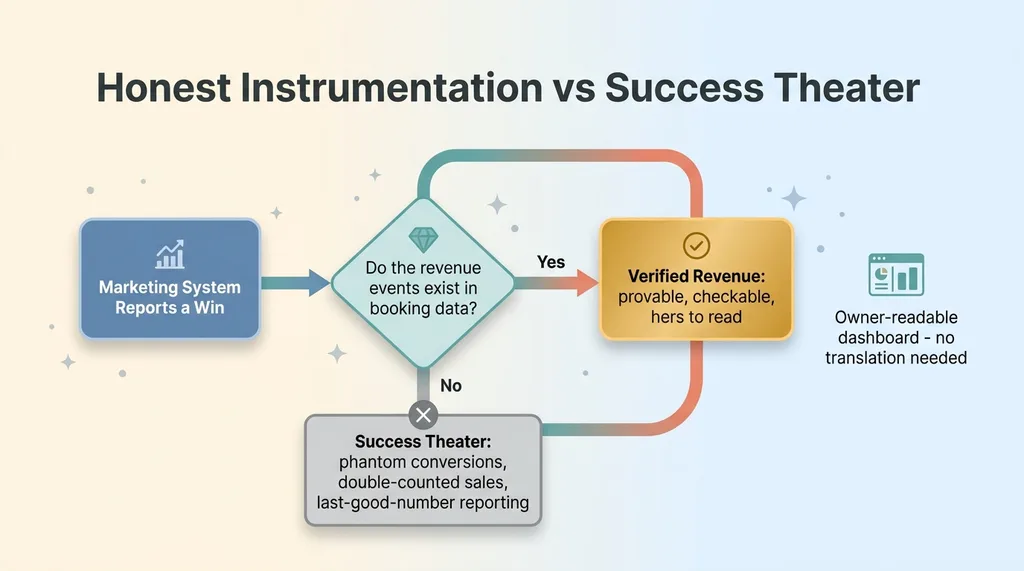
The tracking itself was built to be honest, and I mean that as a specific engineering choice, not a vibe. I've watched marketing systems lie about success all the time. I've seen automation report wins while quietly doing nothing, because the failure mode of a broken system is often to keep reporting the last good number. So I built the instrumentation to catch exactly that. If the system reports a win, the underlying revenue events have to actually exist in her booking data. No phantom conversions. No counting the same sale twice. No success theater.
She got a dashboard she could read herself, without me sitting next to her translating it. That independence is the point. If she needs me to explain why the numbers are good, the numbers aren't really hers, and she's right back to trusting a person instead of evidence.
At day 90, there would be a number. The number would be the verdict. No "brand awareness takes time." No "the funnel is warming up." A real net figure she could check against her own bank account.
What Day 90 Actually Told Us
The experiment produced a clear answer, which was the entire purpose.
What it told us was mixed in the most useful possible way. Some of the paid channels profitably grew her business above baseline. The net was positive there, clearly enough that she didn't need me to interpret it. Other spend didn't pull its weight, and the data said so plainly. One channel looked busy in the activity sense, the kind of busy her old agency would have celebrated, and produced almost nothing in booked revenue once we netted out the cost.
So the verdict wasn't a clean "marketing works" banner. It was better than that. It was "these specific channels work for your business and these don't, and here's the evidence for both." That let her keep spending where the money came back and stop spending where it didn't.
I'll be honest about the limits, because pretending there are none would betray the whole approach. Ninety days isn't forever. The answer is specific to her business, her market, and that window of time. It's not a universal proof that paid marketing works, and it's not a promise that the winning channels stay winners indefinitely. Markets shift. Costs change. The instrument has to keep running to keep being true.
But here's what she had at day 90 that she'd never had in a year with the previous agency: she knew. With evidence she could trust and check herself. For the first time, the question "did this make me more money" had an answer that wasn't a report full of impressions and a request to renew.
If You've Been Burned, You Should Want the Experiment
If a marketer won't structure the engagement so it can fail honestly, that tells you something. It tells you their pay isn't connected to your outcome, and that the good news they produce will always be safe, vague, and disconnected from your bank account.
The right test for a skeptical owner is the opposite of a promise. It's a structure where the marketer has skin in the game and the result is provable on a date you agree to in advance. Accountable marketing for a small business isn't a slogan. It's a fee tied to growth above a real baseline, an instrument built to catch its own lies, and a number at the end that settles the question.
If you've been burned, you shouldn't be looking for someone to win back your trust with a better pitch. You should be looking for someone who'll hand you the instrument and let the instrument earn it.
That's the whole idea. You don't have to trust me. You have to trust the number, and the number has to be built so it can tell you no. Start there, with a 90-day experiment that can fail honestly, not a guarantee that can't.
Ready to bring AI leadership into your company?
I work with a small number of companies at a time. If you're serious about AI, apply to work together and I'll review your application personally.
Get AI insights for business leaders
Practical AI strategy from someone who built the systems — not just studied them. No spam, no fluff.
Hodgen.AI
Ready to automate your growth?
Book a free 30-minute strategy call with Hodgen.AI.
Book a Strategy Call