Why Plausible Isn't Good Enough in a Tradition-Bound Sport
I built a learning platform for a martial-arts academy that operates inside a sport governed by an international federation. The first thing I learned is that ai content domain compliance in a community like this has almost nothing to do with whether the writing is good.
In these communities, rank and lineage are sacred. A belt isn't a badge. It's a statement about who you are, who trained you, and what authority signed off. People know the rulebook cold and they will notice the moment software steps out of line.
The AI I was working with could generate fluent, confident, plausible content all day long. That's the trap. Plausible is exactly what gets you in trouble here.
If the platform so much as implies it awards belts or ranks, it's not just factually wrong. It's an insult to the authority structure of the sport and a real legal exposure for the academy. A predecessor platform in this space learned that the hard way and paid for it in credibility.
Here's the part most people building AI tools miss. In a niche, tradition-heavy domain, correctness is not measured against whether the text reads well. It's measured against the community's rulebook. The community is the spec. The federation is the spec. Your prose quality is irrelevant if you violate either one.
So I had two distinct problems to solve, and they're the two halves of this article.
The first is terminology and positioning compliance. The software had to say what it was and never claim authority it didn't have. The second is factual verification of AI-generated quiz content, where a confident, wrong answer is a liability the moment it ships.
Both required understanding the domain before touching the code. Let me walk through how I handled each.
The Authority Structure Is the Spec
In regulated or tradition-bound niches, the domain comes with an authority structure that functions as a hard specification. You don't get to design around it. You design inside it.
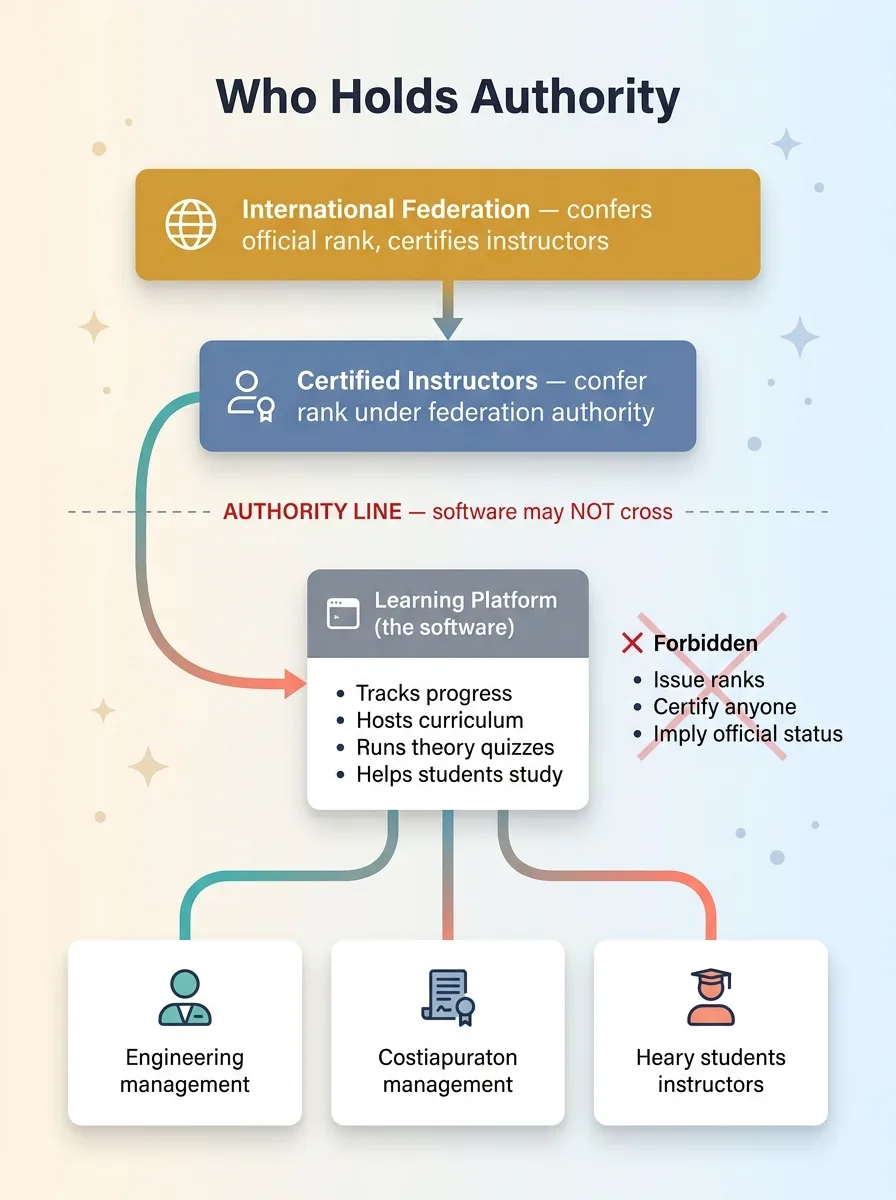 Where the platform sits in the authority hierarchy
Who is allowed to award rank
In this sport, only the federation and its certified instructors confer rank. Full stop. There is no other path. A piece of software completing a curriculum module does not, and can never, equal a belt promotion. That's not a UX opinion. It's the law of the community.
So before I wrote a single line of UI copy, I mapped the hierarchy. Who confers rank. Who certifies instructors. What the federation reserves exclusively for itself. That map became my constraint list.
Where the platform sits in that structure
Once I understood who held authority, I had to decide exactly where the software was allowed to sit. The answer turned out to be narrow and clear.
The platform tracks progress. It hosts curriculum. It runs theory quizzes. It helps a student study and helps an instructor see where someone is in their learning. That's the entire footprint.
It never crosses into conferring official status. It doesn't issue ranks, certify anyone, or imply that hitting a milestone in the app means anything official happened.
This is the argument I make to every buyer in a sensitive niche. Respecting AI in your domain starts with understanding your domain's authority, not the technology. Generic AI assumes it can do anything you prompt it to. A compliant build knows precisely what it is forbidden from claiming. That second thing is the harder engineering problem, and it's the one that protects you.
The Highest-Risk Artifact Was a Single Word
When I did the compliance pass, the single most dangerous artifact in the entire platform was one word. Not a feature. Not a flow. A word.
The word was promotions.
Renaming 'promotions' to 'progression'
In this sport, a promotion means one specific thing: the federation or a certified instructor awards you a new rank. So a button or a section labeled "promotions" inside the app quietly implies the software does the awarding. That one implication carried most of the legal and credibility risk in the build.
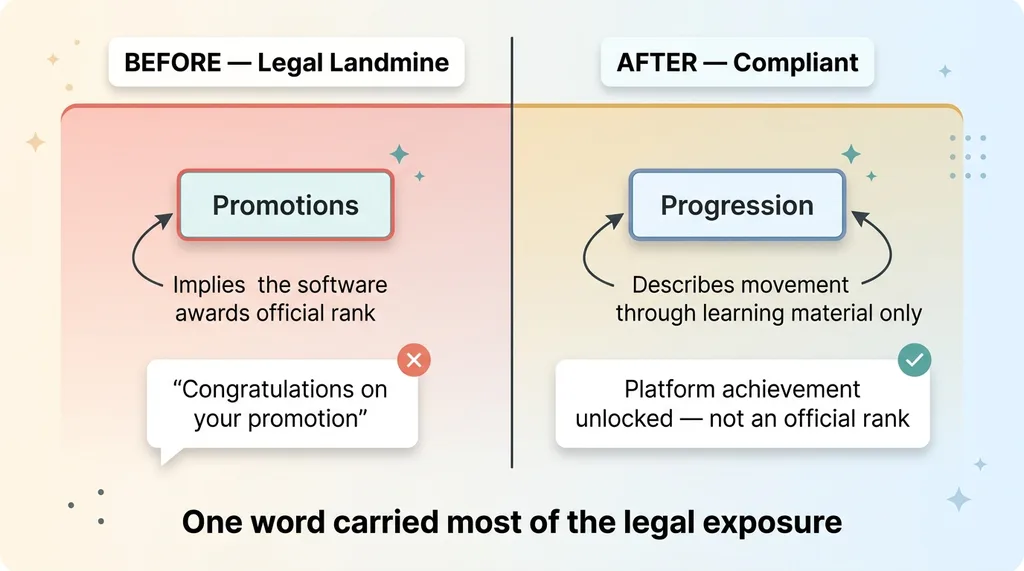 Renaming 'promotions' to 'progression'
I renamed it to progression. Progression describes movement through the learning material. It makes no claim about official rank. It's accurate to what the platform actually does.
That sounds like a tiny change. It was the most important change in the project.
Reframing milestones as platform achievements
From there I scrubbed every implication that completing the curriculum awards a belt. Anywhere the copy hinted that finishing a module meant you'd "earned" something official, I rewrote it.
Milestones inside the app got reframed as platform achievements. Explicitly distinct from official rank conferred by the federation. The language draws a bright line: this is a thing you accomplished in the software, and it is not a thing the sport recognizes as rank.
I also added policy and disclaimer pages stating plainly that the platform does not award rank and is a learning tool only. Boring pages. Critical pages.
The lesson here is the one I keep coming back to. One word carried most of the exposure, and finding it required understanding the domain, not reading the codebase. No linter flags "promotions." No test catches it. You catch it because you know what that word means to the people who'll use the app.
This is also where you have to lock the AI to a known source of truth and constrain its language to what you're allowed to say. A generic content tool will happily write "Congratulations on your promotion." It has no idea it just exposed you. That judgment is the work.
Fact-Checking Every AI-Generated Quiz Question
The second half of the problem was the quiz bank. The platform shipped with an AI-generated set of theory questions covering the sport's rules and history.
The questions read perfectly. Clean, confident, well-structured. That is exactly the danger.
Why a plausible quiz answer is a liability
A quiz answer that sounds right and is wrong is worse than one that obviously looks broken. A broken answer gets reported. A plausible-but-false answer gets believed, repeated, and trusted by students studying for a real graduation.
In a community where members can quote the rulebook from memory, a single wrong "correct" answer doesn't just confuse a student. It tells every knowledgeable user that the platform doesn't know the sport. That's the end of your credibility.
And AI loves to do this. It will state a confident falsehood with the exact same tone it uses for facts. There's no tell in the text. You cannot eyeball your way to trust.
Verifying against the federation's primary sources
So I treated the federation's published primary sources as ground truth and verified every question against them. Not a spot check. Every question.
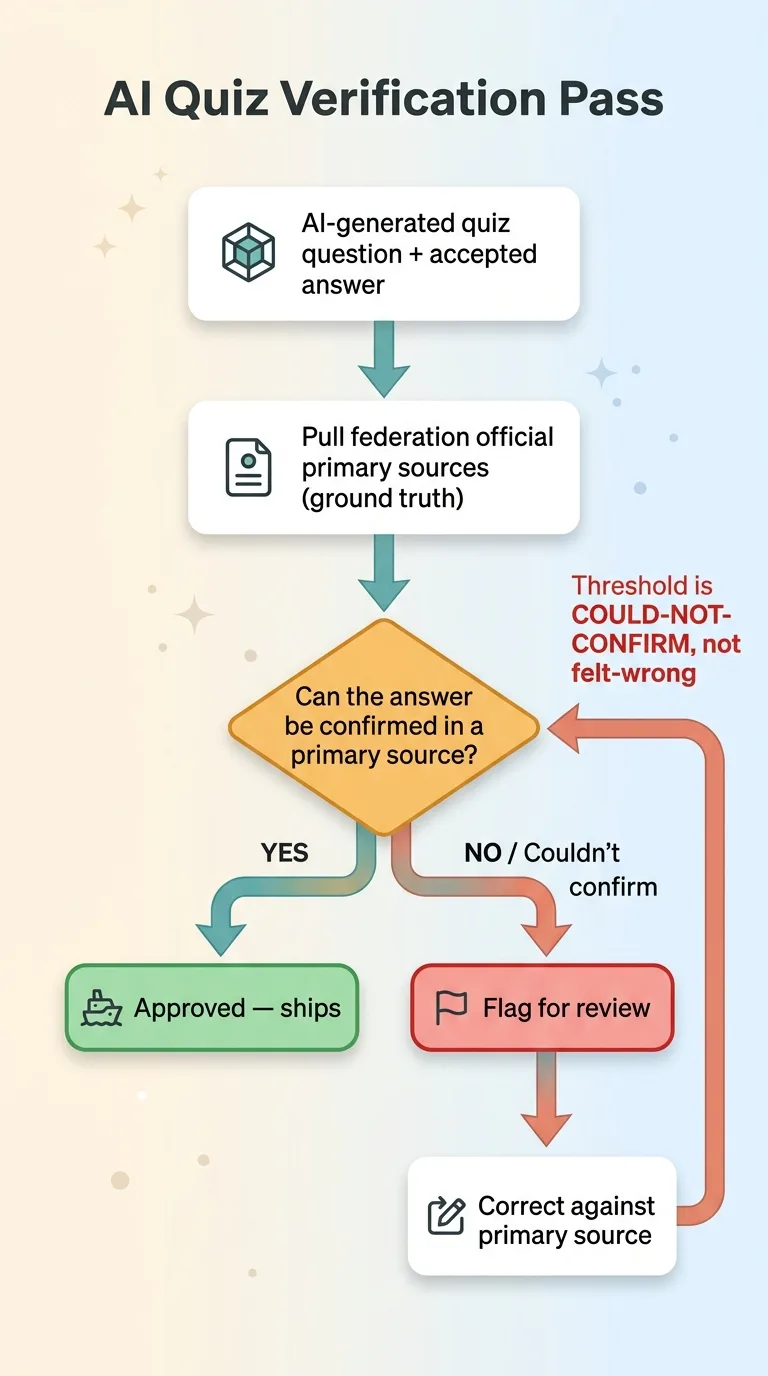 Quiz verification pipeline against primary sources
The process was straightforward and unglamorous. Pull the federation's official documents. Build a verification pass that checks each question and its accepted answer against those sources. Flag every question whose answer could not be confirmed in a primary source.
"Couldn't be confirmed" was the threshold, not "felt wrong." If I couldn't point to the source that made an answer correct, it got flagged for review. That's ai generated quiz verification treated as a discipline instead of a hope.
The flagged set is where things got interesting.
Three Questions Were Wrong (And Why That Matters)
Most of the flagged questions checked out fine once I traced them to a source. But three did not. Three were actually wrong.
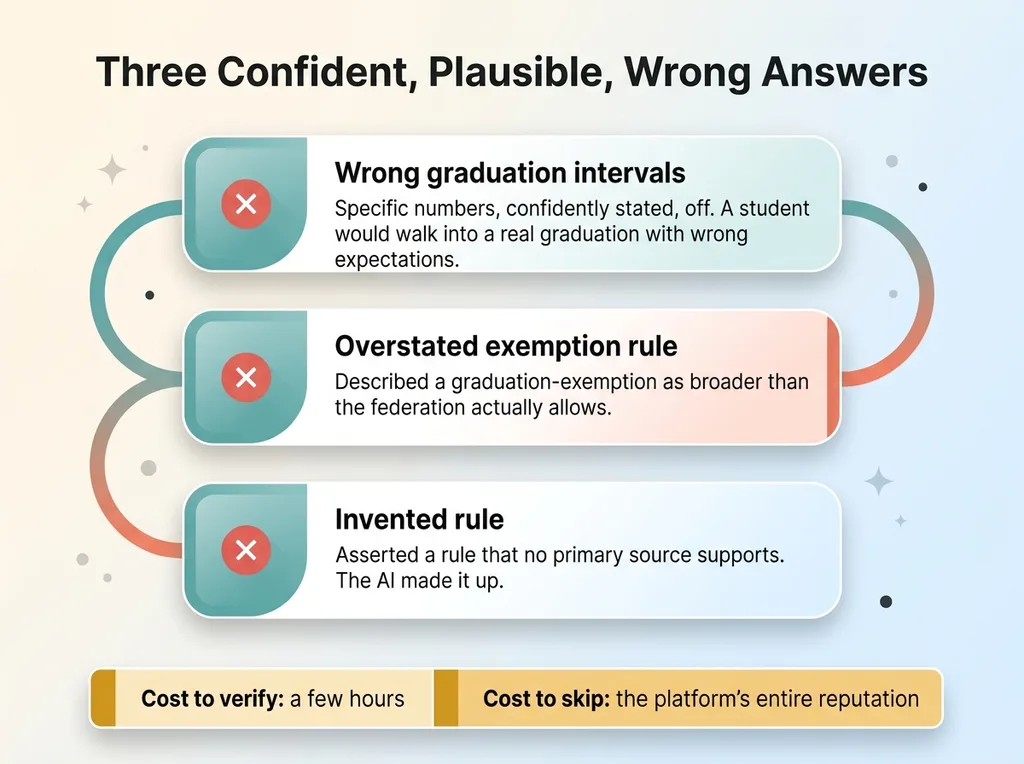 The three wrong quiz questions caught
One stated incorrect exact graduation intervals. The numbers were specific, confident, and off. A student studying that answer would have walked into a real graduation with the wrong expectation baked in.
One misstated the scope of a graduation-exemption rule. It described the exemption as broader than the federation's actual rule allows. Specific, plausible, and false in a way that would matter to anyone relying on it.
The third made a rule claim that couldn't be verified against any primary source at all. No document supported it. The AI had simply asserted a rule that, as far as the federation's published material was concerned, did not exist.
All three were corrected against the primary sources before anything shipped.
Here's what I want every buyer to sit with. None of these were obvious errors. They weren't broken or garbled. They were confident, specific, plausible answers that happened to be false. The kind you'd never catch by reading.
In a community where members know the rulebook cold, shipping any one of those destroys credibility on contact. The first knowledgeable user to spot it tells everyone. That's how trust dies in a niche.
The cost of verification was a few hours of my time. The cost of not verifying was the platform's entire reputation. That math is not close.
This is why I encode the facts the AI must never get wrong as a fixed ground-truth base rather than trusting the model to recall them. Niche domain ai accuracy and ai factual grounding aren't abstractions. They're three wrong questions you found before your users did.
A Repeatable Compliance Pass for Sensitive Domains
This wasn't a one-off trick for one martial-arts academy. It's a repeatable pass I run for any buyer operating in a tradition-heavy or regulated niche. Three steps.
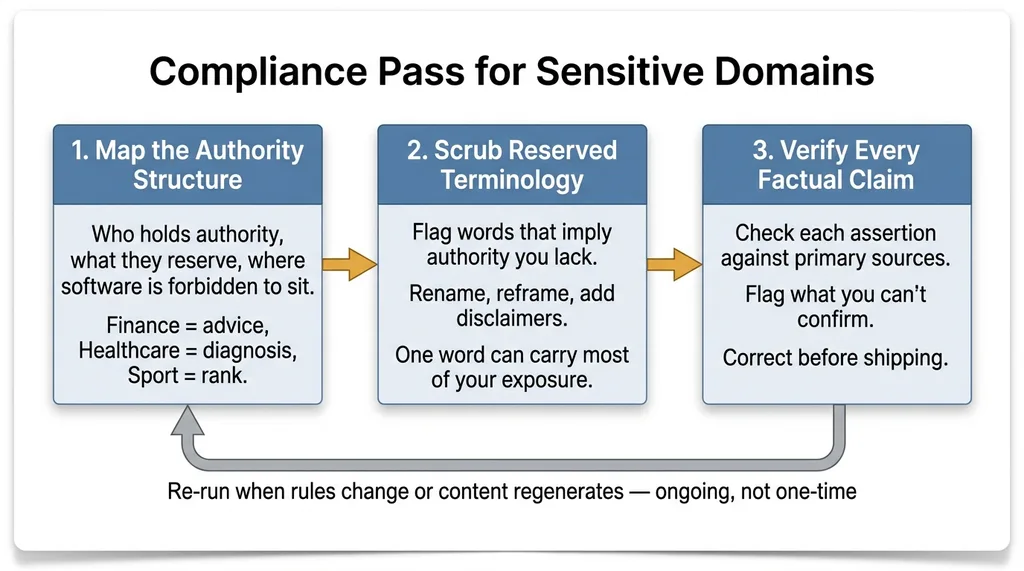 Repeatable three-step compliance pass
Map the authority structure first
Before any copy or content, map who holds authority in your domain and what they reserve exclusively. Then decide where your software is forbidden to sit. In a regulated finance context that might be giving advice. In healthcare it might be diagnosing. In this sport it was conferring rank. You can't constrain the AI until you know the lines it can't cross.
Scrub reserved terminology
Go through every word the product uses and flag anything that implies authority you don't have. "Promotions" was the landmine here. In your domain it'll be different words carrying the same risk. Rename, reframe, and add explicit disclaimers that state what the platform is and isn't. One word can carry most of your exposure.
Verify every factual claim against primary sources
Take every factual assertion the AI generates and check it against the domain's official primary sources before it ships. Flag anything you can't confirm. Correct it. This is the step people skip because the content looks fine, and it's the step that caught three wrong answers that looked completely fine.
Now the honest part. This is not a one-time pass. The federation can change a rule. You can regenerate the quiz bank. New content means new claims means a new verification run. Community sensitive software done responsibly treats this as an ongoing process, not a checkbox you tick at launch and forget.
If your domain's rules are stable, the pass is cheap to re-run. If they change often, you build the verification into your content pipeline so it runs automatically. Either way, you don't ship regenerated content unverified.
If Your Niche Has a Rulebook, the AI Has to Read It
Here's the core idea, stripped down. Every regulated or tradition-bound industry has an authority structure and a rulebook. AI that ignores either one will eventually say something that offends your community or exposes you legally. Usually both, eventually.
The work is not preventing the AI from writing. The AI writes beautifully. The work is constraining what it's allowed to claim, and verifying what it asserts against sources you trust.
That's a different skill than prompting. It starts with understanding the domain well enough to know which word is the landmine and which confident answer is a lie.
I do this across industries. Regulated finance where a single phrase reads as advice. Healthcare where a claim has compliance weight. Niche communities with their own customs and a membership that knows the rules better than any model does. Different domains, same discipline. If you want the broader version of this, I wrote up how I approach shipping AI content in a regulated space.
Get the next build note.
I write up each system I build, including what broke. Subscribe to my newsletter and I'll send you the next one.