AI Content in Regulated Industries: What Works
Everyone says you can't use AI content in regulated industries. After building 4 systems for a FINRA-regulated firm, I think regulation is where AI wins.
By Mike Hodgen
The Conventional Wisdom That Keeps Regulated Firms Stuck
Here is the question I get from every CEO in a regulated industry: isn't my business too regulated to use AI for anything customer-facing?
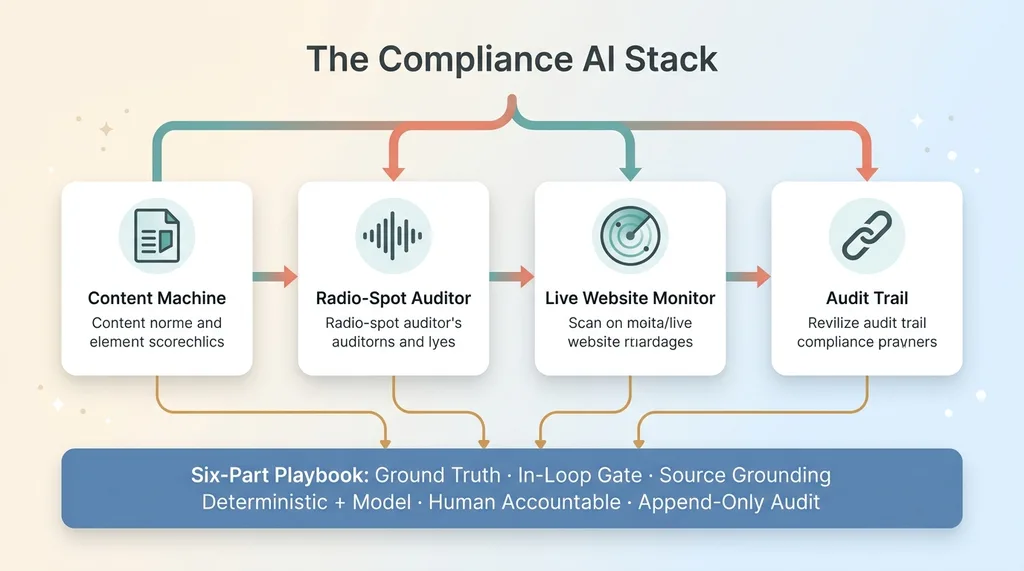 The Four Systems Built for the Regulated Firm
I understand the fear. In financial services, healthcare, and legal, one wrong word is a liability. A misstated return. An implied guarantee. A missing disclosure. An unsubstantiated health claim. The math is brutal: one slip can cost more than a year of marketing ever earned. So the default answer from most compliance teams is simple. No AI.
I want to argue the opposite. After building a full AI marketing stack for a FINRA/SEC-regulated financial advisory firm, I believe regulation is exactly where AI's discipline beats a human's, if you architect for it.
Think about why a human reviewer fails. They get tired by page 80. They skim the 50th disclosure of the day. They apply a slightly looser standard on a Friday at 5pm. The reason a human fails is the reason a well-built system wins: the system applies the same rulebook to page 1 and page 155, on every deploy, forever. It does not get tired. It does not have a bad week.
That is the whole thesis. AI content in regulated industries works when you stop using it as a creative free agent and start using it as a consistency engine wrapped in hard constraints.
In the financial firm's case, I built four systems to make this real: a content machine, a radio-spot auditor, a live website monitor, and an audit trail tying it all together. Underneath them sits a six-part playbook I'll walk through in this article.
None of it is magic. It is architecture. And it is the difference between a system you can defend in front of an examiner and one that quietly creates exposure you won't find until it's too late.
Why a Human Reviewer Is the Weakest Link, Not the Strongest
Manual compliance review feels safe because a licensed person signs off. There's a name on the approval. Someone is accountable. That feels like the strongest possible control.
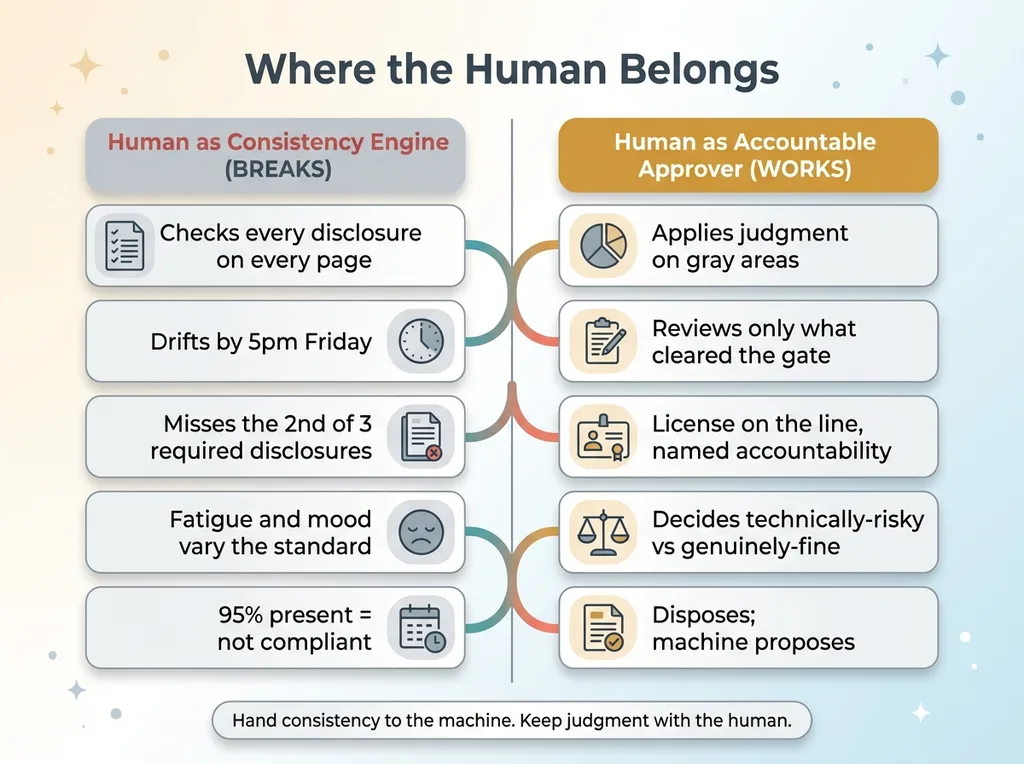 Human as Accountable Approver vs Human as Consistency Engine
It isn't. It's the weakest link, and here's why.
Humans are inconsistent. Not because they're careless, but because they're human. Fatigue, mood, time pressure, the deadline at end of quarter. The reviewer who reads carefully at 9am Monday is not the same reviewer at 5pm Friday after the 40th piece of the week. The standard drifts. It always drifts.
Here's a concrete example from the financial firm. They had long-form content where the same required disclosure language needed to appear in multiple contexts within a single piece. Once near a performance reference. Again near a product mention. Again in the footer. A tired human reviewer is exactly who misses the second one, because the first one read fine and the brain pattern-matches "I already saw that, it's handled."
The disclosure that's present 95% of the time is not compliant. It needs to be present 100% of the time. And 100% consistency, applied across thousands of pieces, is not a human strength. It's a machine strength.
This is not an argument that humans are bad at compliance. A licensed professional brings judgment a machine doesn't have, knowing when a gray-area phrasing is genuinely fine versus technically risky. That judgment is exactly what you want a human doing.
What you don't want is a human acting as the consistency engine. That's the part that breaks.
So the rest of this article is built on one reframe: keep the human as the accountable approver, the one with judgment and a license on the line. Stop using the human as the mechanism that checks whether the disclosure is present on every page, every time. Hand that to the machine.
Encode Your Non-Negotiable Legal Facts as Ground Truth
The first move is to stop letting the model improvise on anything that has a legal answer.
Most people approach AI in regulated fields by prompting a general model and hoping it stays inside the lines. "Write me a piece about our managed portfolios, and make sure it's compliant." That's a prayer, not a control. The model will improvise disclosure language, invent a plausible-sounding boilerplate, and soften a hedge into something that reads like a guarantee.
For the financial advisory firm, I did the opposite. I encoded the firm's non-negotiable facts as structured ground truth that the model is fed and cannot override. Required disclosures, word for word. Prohibited language, explicitly listed. What can and cannot be implied about performance. The exact regulatory boilerplate. These aren't suggestions in a prompt. They're constraints the system enforces.
The model writes around these facts. It does not invent them.
That's the key distinction. When the disclosure language is ground truth, the model doesn't generate a version of it. It uses the version. When "guarantee" is prohibited in performance contexts, that isn't a hope, it's a hard fact the system carries into every generation.
This turns "will the AI say something illegal" from a probability into a constraint. You're no longer rolling dice on each piece of content. You've removed the dice from the table for the legal facts.
It's the same pattern I use in my DTC fashion brand to keep AI from hallucinating products that don't exist. The model is locked to a real catalog of 564 products. It cannot describe a jacket we never made, because the catalog is ground truth and the model writes around it. Same principle, different stakes. In fashion a hallucinated product is embarrassing. In compliant AI automation for finance, it's a fine.
This is the foundation of the content machine I built for a financial advisory firm. Everything else sits on top of it.
Make Compliance an In-Loop Hard Gate, Not a Final Review
Most firms bolt compliance review onto the end of the process. Content gets created, polished, scheduled, and then sent to compliance as the last stop before it goes live.
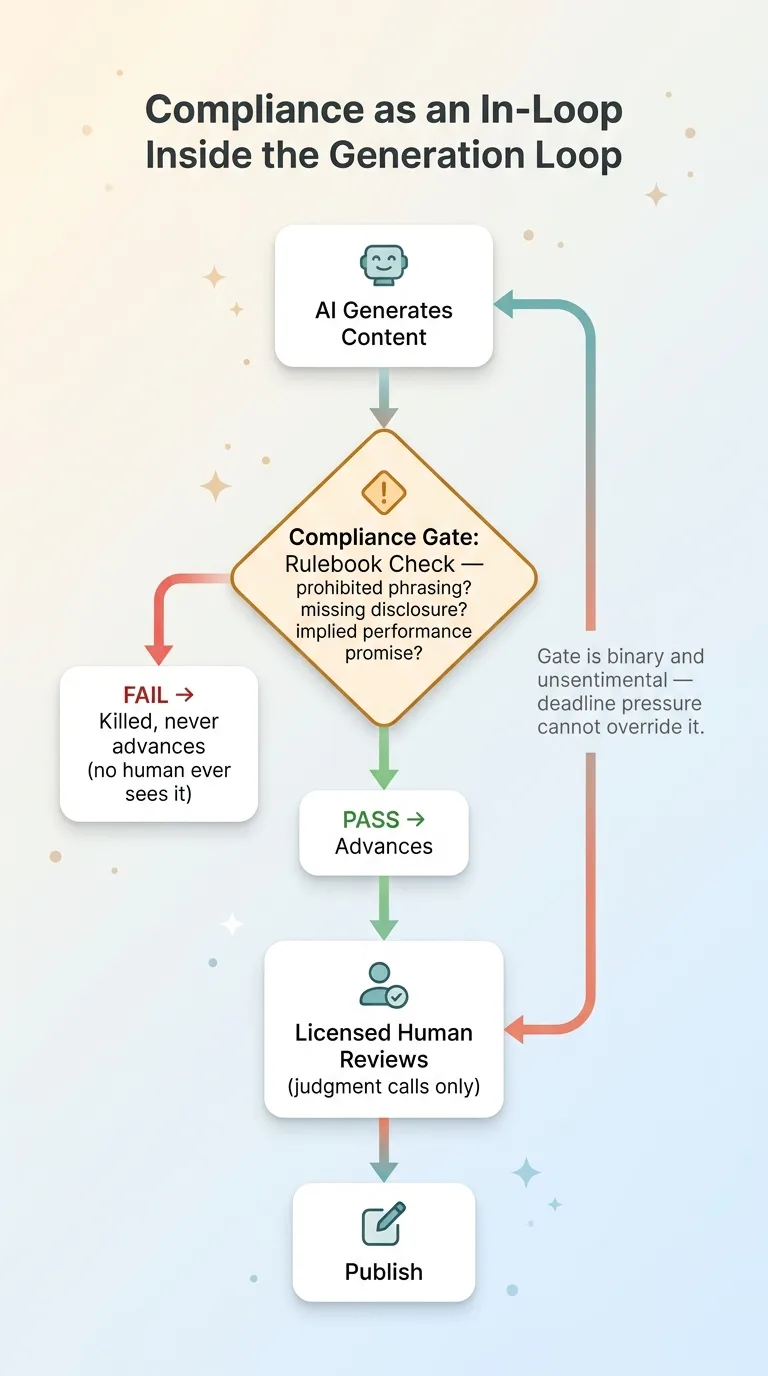 Compliance Hard Gate Inside the Generation Loop
That's exactly where it breaks. By the time something reaches final review, momentum is against you. The piece is done. The deadline is now. There's social pressure to approve, because rejecting it means redoing work and missing the date. Final review is where things get pushed through.
So I don't put compliance at the end. I build it as a hard gate inside the generation loop. Content that fails the gate does not advance to a human at all. It never gets to the stage where deadline pressure can override good judgment, because it's already dead.
The concrete example is the radio-spot auditor I built for the financial firm. They ran radio advertising, and radio is unforgiving, no footnotes, no fine print, just spoken words that either include the required disclosure or don't. The auditor checked every spot against the rulebook before any human ever heard it. Prohibited phrasing, flagged. Missing disclosure, flagged. Implied performance promise, flagged.
The gate is binary and unsentimental. It does not care that the spot is clever or that the deadline is tomorrow. If it fails the rulebook, it does not advance. Period.
What survives the gate is what a human reviews. So the licensed person isn't reviewing everything the system produces, they're reviewing the subset that already cleared the mechanical checks. Their attention goes to judgment calls, not to catching missing disclosures the machine should have caught.
This is part of a broader principle in how I build: every AI system I ship stops for a human. The difference is where it stops, and what it's already filtered before it gets there.
Ground Every Claim in a Real Source or Don't Make It
The fastest way to liability in a regulated field is an unsubstantiated factual claim.
A performance figure that isn't backed. A market statistic someone half-remembers. A regulatory reference that's close but not exact. Each of these is a citation waiting to happen, and the problem with general AI is that it produces them with total confidence. The model doesn't say "I'm not sure about this number." It states the number like it's gospel.
So the rule I build in is absolute: every factual or numerical claim must trace to a real, citable source, or the system is not allowed to make the claim. No source, no statement.
This kills the hallucination problem at the root. The danger with AI in healthcare, legal, and finance isn't bad grammar, it's confident invention. A model that fabricates a statistic that sounds right is far more dangerous than one that refuses to state it. By requiring a source for every claim, you remove the model's ability to invent.
For the financial advisory firm, this meant performance figures, market statistics, and regulatory references all had to trace back to something real. If the model wanted to cite a market return, it needed the source. If it couldn't ground the claim, it couldn't make it. It had to write around the gap instead of filling it with a plausible guess.
I'll be honest: this is harder than it sounds, and it's the work most vendors skip. Building the sourcing layer is real engineering, not a prompt tweak. It's also the difference between a system that's safe and one that just looks safe in a demo.
And yes, it slows content production slightly. Grounding every claim takes more than letting the model freewheel. In a regulated context, that tradeoff is correct. Slightly slower and defensible beats fast and exposed, every time.
Combine Deterministic Pattern Matching With Model Judgment
Here's where a lot of compliant AI automation falls apart. People pick one of two approaches, and both fail on their own.
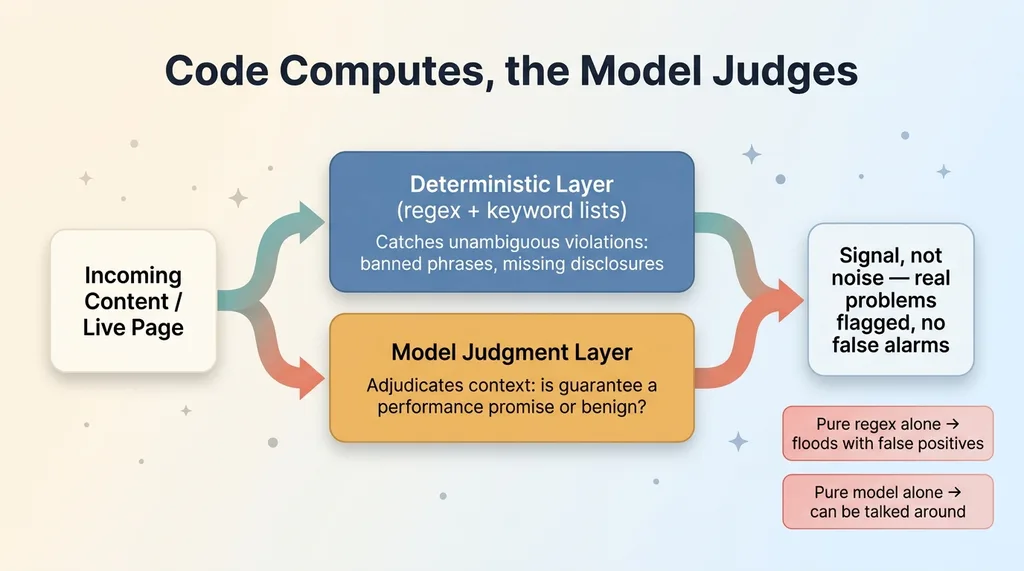 Deterministic Pattern Matching + Model Judgment Layering
Pure pattern matching, regex and keyword lists, catches the obvious stuff. A banned phrase is a banned phrase. But it floods you with false positives. It flags every use of "guarantee" including "we guarantee a response within 24 hours," which is completely benign. Drown the team in false alarms and they start ignoring the system, which defeats the point.
Pure model judgment is flexible and reads context well, but it can be talked around. Phrase something cleverly and the model rationalizes it through. Flexibility is also a hole.
The architecture that actually holds combines both. Deterministic checks catch the unambiguous violations, the things that are wrong no matter the context. The model adjudicates context, deciding whether "guarantee" is being used as a prohibited performance promise or in a benign sentence about response times. Code handles the black and white. The model handles the gray.
The clearest example is the website monitor I built for the financial firm. It watched their live pages continuously and flagged compliance drift, content that got edited over time and slid out of bounds. The deterministic layer caught banned phrasing and missing required disclosures. The model layer judged context, so the team didn't get paged every time the word "return" appeared in a sentence about returning a phone call.
The result was a monitor that surfaced real problems without crying wolf. Signal, not noise. That balance is the whole game, because a compliance tool nobody trusts is a compliance tool nobody uses.
This is the principle I come back to constantly: let the model judge and let the code compute. Use each layer for what it's actually good at. Don't ask regex to understand nuance, and don't ask a model to be deterministic.
Keep a Licensed Human Accountable, on the Record
Two things regulators care about above almost everything else: who is accountable, and can you prove what happened.
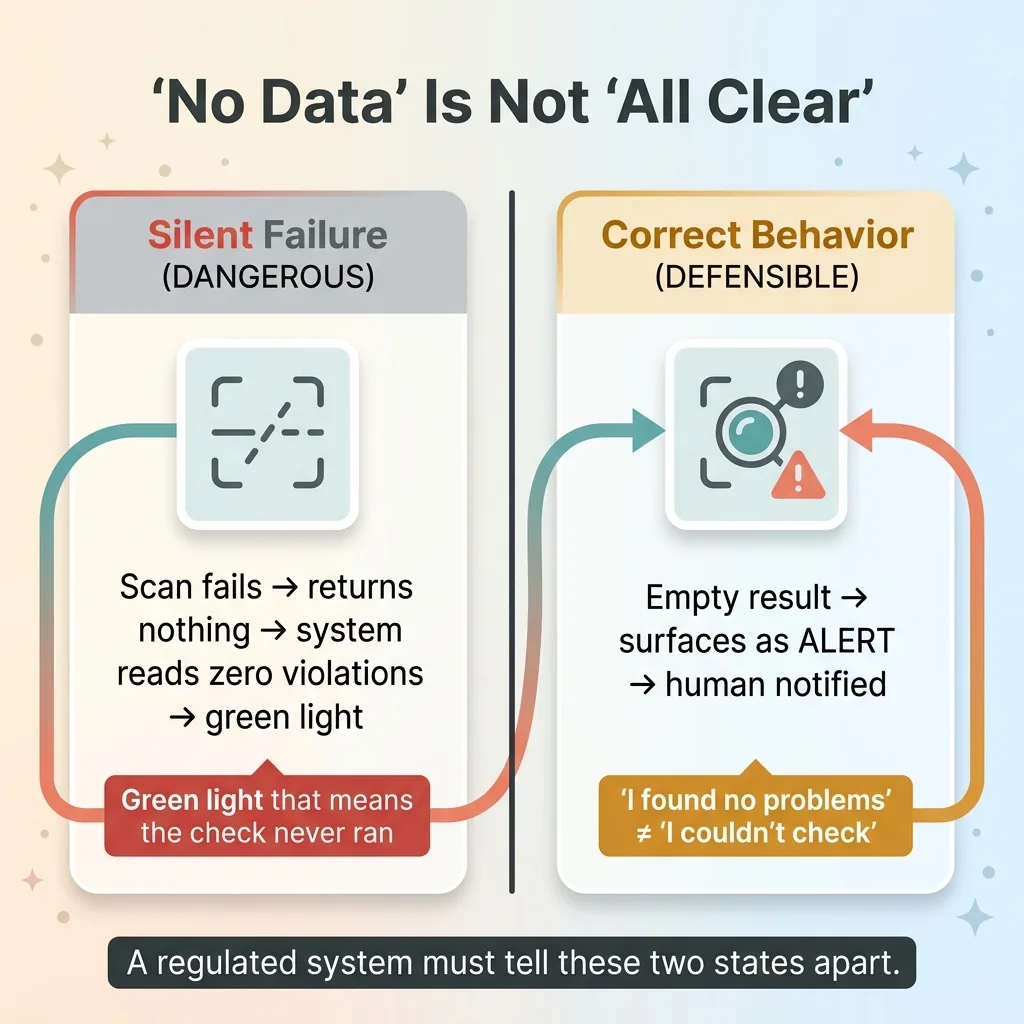 No Data vs Broken, Silent Failure Distinction
So I keep a licensed human as the final accountable approver. Every time. No exceptions. AI proposes, the licensed person disposes. The machine does the consistency work, applies the constraints, runs the gates, grounds the claims, and then a person with a license and judgment makes the call to publish. The accountability never leaves the human.
That's the answer to "who is accountable." The answer to "can you prove what happened" is an append-only audit trail.
Every generation, every gate decision, every source check, every human approval, timestamped and unchangeable. When an examiner asks "how did this piece get published," you don't reconstruct it from memory and email threads. You have the full chain. What was generated, what the gate decided, who approved it, and when. Append-only means nobody can quietly rewrite history after the fact. That's not a nice-to-have in a regulated field. It's the difference between a defensible record and a shrug.
There's one more rule that sits underneath all of this, and it's the one people forget. Never let an automated job confuse "no data" with "broken."
Picture a compliance monitor that's supposed to scan content. The scan fails silently, returns nothing, and the system reads zero violations as "all clear." Now you've got a green light that actually means the check didn't run. That's how an automated job that confuses 'no data' with 'broken' creates the exact exposure the system was built to prevent.
So an empty result must surface as an alert, not pass silently. "I found no problems" and "I couldn't check" are completely different states, and a regulated system has to tell them apart. This is the line between a system you can defend and one that quietly stops working while everyone assumes it's fine.
Regulation Is an Advantage You're Not Using
Here's the reframe I want to leave you with. The firms that win in regulated industries won't be the ones who avoided AI out of fear. They'll be the ones who used AI's consistency to enforce compliance better than a human ever could.
The playbook in two lines: encode your legal facts as ground truth, gate compliance inside the loop, ground every claim in a source, combine deterministic checks with model judgment, and keep a licensed human accountable over an unchangeable audit trail. That's not a prompt. That's an architecture.
Let me be honest about what this requires. It's real engineering work, not a chatbot you point at your brand guidelines. And the answer is never "turn it loose." Anyone who tells you AI for financial services marketing means full automation with no human is selling you a problem. The honest version is a tight system with hard gates and a human on the hook for every publish.
But that system does something your manual process can't: it proves consistency. It applies the same rulebook to the first page and the ten-thousandth, on a Monday and a Friday, forever.
So if your compliance team's instinct is "no," I'd push on a different question. The question isn't whether AI is too risky for your industry. It's whether your current manual process can actually prove the same consistency, page after page, reviewer after reviewer, year after year. Most can't. They just feel like they can because a person signed off.
If that landed, tell me what your compliance team is afraid of. The specific fear is usually where the right system starts.
Thinking about AI for your business?
If this resonated, let's have a conversation. I do free 30-minute discovery calls where we look at your operations and find where AI could actually move the needle, not in theory, in your real workflow.
Get AI insights for business leaders
Practical AI strategy from someone who built the systems — not just studied them. No spam, no fluff.
Hodgen.AI
Ready to automate your growth?
Book a free 30-minute strategy call with Hodgen.AI.
Book a Strategy Call