AI Phone Receptionist for Small Business: The Persona Problem
I built an AI phone receptionist for a small business that books appointments. The hardest part wasn't the tech, it was making it stop sounding like a bot.
By Mike Hodgen
The Salon Was Losing Money Every Time the Phone Rang
There's a hair salon in North County San Diego that was bleeding money every time a stylist had both hands in someone's hair. Which, if you've ever run a salon, is most of the day.
The phone rings. A new client wants to book. But every stylist is mid-color or mid-cut, and nobody can stop to pick up. The call goes to voicemail. Most people don't leave one. They just call the next salon on Google and book there instead.
That's the problem an AI phone receptionist for small business actually solves. Not "transforming the customer experience." Just answering the phone when a human can't.
Let me put real numbers on it. A new client booking at this salon is worth $80 to $150 on the first visit. If they come back, you're looking at lifetime value in the thousands. So every missed call isn't a $100 problem. It's a $1,000+ problem when you account for the repeat business that never happened.
During busy stretches, this salon was missing five to ten calls a day. Even if half of those were just appointment shuffles, that still leaves a few new-client calls walking straight to a competitor every single day.
The obvious fix is a human answering service. I looked at it. They're expensive, they charge per minute or per call, and here's the kicker: they have no idea who your stylists are, what your services cost, or what your availability looks like. They take a message. They don't book.
A message isn't a booking. By the time the front desk calls back, the client has already booked elsewhere.
This is the moment a small business owner finally stops ignoring AI. Not because of a board mandate or a trend piece. Because they can hear the money leaving.
What an AI Phone Receptionist Actually Does
Let me describe the actual system, because most people picture a chatbot widget and that's not what this is.
This is a real voice on a real phone line. The phone rings, the AI picks up, and the caller has a conversation with something that sounds like a person. No "press 1 for booking." No website pop-up. A voice.
The call flow
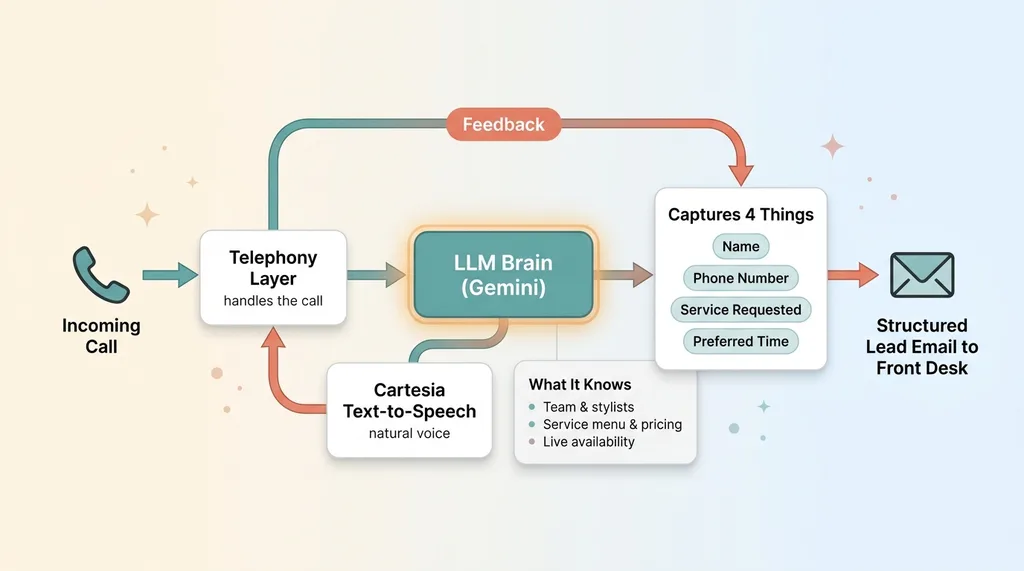
The caller dials in. The AI answers within a ring or two, greets them naturally, and asks how it can help. The caller says they want to book a haircut with a specific stylist next Tuesday. The AI handles it conversationally, the way a front desk person would, and captures the details it needs.
 AI Phone Receptionist Call Flow and System Architecture
By the end of the call, it has the four things that actually matter: name, phone number, service requested, and preferred time. That's the entire job. Everything else is noise.
I wrote more about how the underlying phone agent works in AI that answers your phone and books the job if you want the deeper build.
What it knows
The difference between this and a generic answering service is context. This system knows the business cold.
It knows the team and which stylist does what. It knows the full service menu and what each thing costs. It knows availability, so it isn't promising a Tuesday slot that doesn't exist.
The stack, at a high level: a telephony layer to handle the actual call, an LLM (I used Gemini) as the brain, and Cartesia for text-to-speech that doesn't sound robotic. That combination is what lets it hold a natural conversation instead of reading a script.
When the call ends, the system emails a clean, structured lead summary to the front desk. Name, number, service, requested time. A human reads it, confirms the slot, and the booking is locked.
The AI doesn't replace the front desk. It catches the calls the front desk physically can't get to.
The Default AI Voice Is Exactly What Makes It Feel Fake
Here's the thing nobody warns you about: the technology was the easy part. Getting it to answer the phone and understand the caller took a couple of days. Getting it to not sound like a chatbot took the rest of the project.
 Default AI Voice vs Engineered Persona (Before/After)
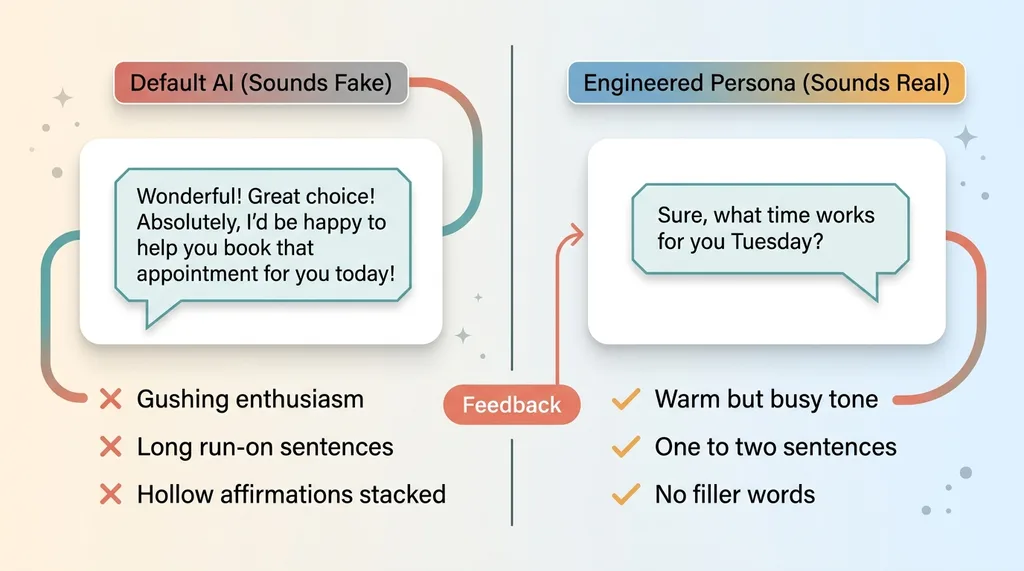
Out of the box, an LLM talks like a customer service bot on its first day. You ask for a haircut Tuesday and it comes back with: "Wonderful! Great choice! Absolutely, I'd be happy to help you book that appointment for you today!"
A real human hears that and instantly knows they're talking to software. And the moment they know, the business looks cheap. The gushing enthusiasm is the tell.
Think about how an actual front desk person talks. They're warm, but they're busy. They say "sure," not "absolutely." They don't tell you a haircut is a "great choice." They don't open every sentence with an exclamation. They keep it short because there's a line forming and a phone ringing on the other side.
The default AI does the opposite. Long, enthusiastic run-ons. Hollow affirmations stacked three deep. It's the verbal equivalent of a mascot waving at you.
I've written a whole piece on what I call the hollow-affirmation problem, because it shows up everywhere AI touches a customer. But it's worst on the phone, where there's nothing to hide behind. No interface, no branding. Just a voice. And the voice is either believable or it isn't.
So the real work wasn't the telephony or the LLM or the text-to-speech. It was the persona. That's where this project actually lived. The hardware that takes the call is a commodity. The thing that makes a caller trust they're talking to your salon and not a robot, that's the entire game.
How I Engineered a Persona That Sounds Like a Real Front Desk
Here's the part the buyer actually cares about: can it sound real? Yes. But not by accident. You have to engineer it, and I'll show you exactly how.
 Persona Engineering Rules
Ban the filler words
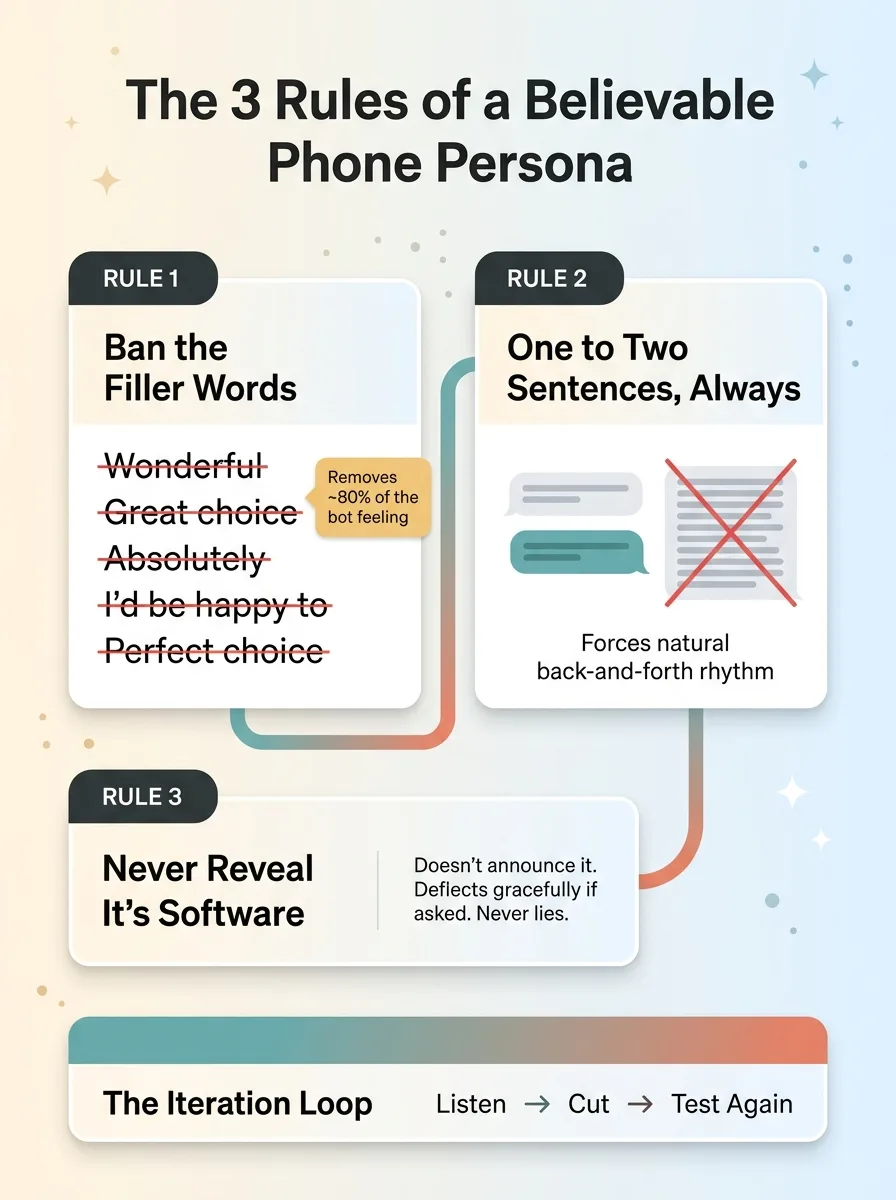
The first thing I did was build a banned-words list. Hard rules, baked into the persona, that the AI is never allowed to say.
- "Wonderful"
- "Great choice"
- "Absolutely"
- "I'd be happy to"
- "Perfect choice"
Every one of those is a hollow affirmation. They add nothing. A real receptionist doesn't tell you your haircut is wonderful. Cutting these words alone removed about 80% of the "I'm talking to a bot" feeling. It's that direct a lever.
One to two sentences, always
The second rule: a hard cap of one to two sentences per reply. No exceptions.
The default LLM wants to monologue. It'll explain, reassure, summarize, and confirm all in one breath. Real people don't do that on the phone. They say "Sure, what time works?" and then they wait.
Capping the length forces the conversation into a natural back-and-forth rhythm. Short turns. Quick exchanges. The way an actual booking call sounds. The moment a reply runs three or four sentences, the spell breaks and the caller hears software again.
Never reveal it's software
Third rule: the AI never volunteers that it's an AI, and it never lies if asked directly.
That sounds contradictory, so let me explain. It doesn't announce "I'm an automated assistant" at the top of the call, because that just primes the caller to be guarded and curt. But if someone flat-out asks "is this a robot?", I built it to deflect gracefully and keep things moving rather than fabricate. Warm, neutral, no drama.
The goal isn't deception. It's not making a thing of it. A good receptionist doesn't introduce themselves with their employment status. They just help you book.
The way I got all of this dialed in was boring and manual. I made test calls, listened to the recordings, and cut filler line by line. Every time it said something a real person wouldn't, I added a rule. I did this dozens of times until the recordings stopped sounding like a bot and started sounding like a slightly busy front desk on a Tuesday afternoon.
That iteration loop, listen, cut, test again, is the whole craft. There's no prompt you can copy off the internet that does it. The persona is specific to how this salon actually talks.
Why the Email Lead Summary Matters More Than the Booking
Here's a decision I made early that I'd defend to anyone: I did not let the AI silently commit bookings straight into the calendar with zero human oversight.
 Human-in-the-Loop Lead Handoff
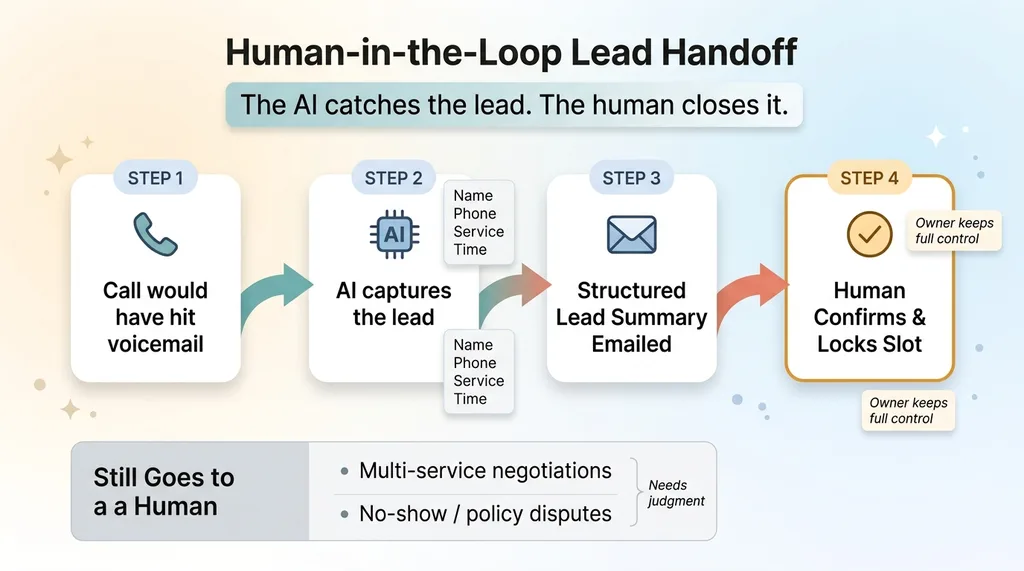
When the call ends, the system sends a structured summary to the front desk. Name, phone, service, requested time. Clean, scannable, ready to act on. Then a human confirms the slot and locks it in.
That's not a limitation I'm apologizing for. It's the design. Every system I ship works this way, and I wrote about why in every system I ship stops for a human.
For a small business, this is the right balance. The AI captures the lead that would otherwise have hit voicemail and disappeared. The owner keeps full control of the schedule. Nobody wakes up to a calendar full of bookings they didn't vet, or a double-booked Saturday because the AI got confused about availability.
The lead summary is the actual product. The booking is downstream of it. What this salon was losing wasn't bookings, it was leads, the chance to even have the conversation. The AI recovers that. The human closes it.
Let me be honest about what this system does not do yet. It doesn't handle complex multi-service negotiations, the "can I get a cut and color and a treatment but only if my stylist is free before noon" kind of call. And it doesn't manage no-show policy disputes or anything that needs judgment about a specific customer relationship. Those still go to a person.
That's fine. It's not supposed to be the whole front desk. It's supposed to catch the call nobody else could pick up.
What This Costs Versus What It Saves
Let me frame the money plainly, without inflating anything.
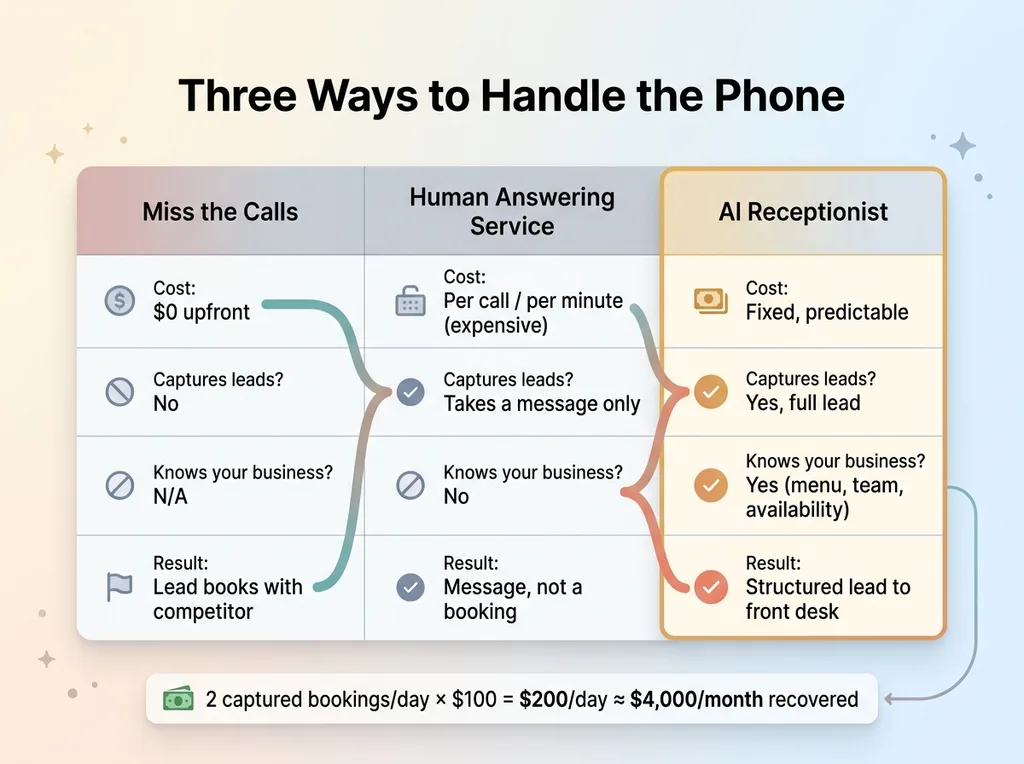 Three Options: Miss Calls vs Human Service vs AI Receptionist
You've got three options. Miss the calls entirely. Pay a human answering service. Or run an AI receptionist that knows your business.
The human service is expensive, charges by call or minute, and as I said, doesn't know your menu, so it takes messages instead of leads. Missing the calls costs you the bookings outright. The AI sits in between: a fixed, predictable cost that knows your services and captures the lead.
Here's the rough math. If a new booking is worth $100 and the AI captures even two of those a day that would otherwise have gone to voicemail, that's $200 a day, call it $4,000 a month, in revenue that was walking out the door. The running cost of the system is a small fraction of that.
But I want to be straight with you: the value depends entirely on call volume. A salon getting three calls a week won't see the same return as one missing ten a day. If your phone barely rings, this isn't your problem to solve right now.
This isn't a moonshot. It's plumbing. It recovers revenue that's already leaking out of a pipe you can hear dripping. The question isn't whether AI will "transform" your salon. It's whether you're tired of hearing the phone ring while your hands are full.
The Phone Is Probably Your Biggest Leak
Most small businesses lose more money to unanswered calls than to anything they're actively worrying about. Salons. Contractors. Clinics. Anyone whose people are heads-down on the actual work when the phone rings.
You'll obsess over your ad spend and your website conversion rate while a caller hits voicemail and books with your competitor. The leak is right there. It just doesn't show up on a dashboard.
The fix isn't a generic chatbot bolted onto your site. It's a voice agent on your actual phone line, engineered to sound like your actual front desk. And that persona work, the banned words, the short replies, the warm-but-busy tone, is the entire difference between a tool that helps and one that embarrasses you in front of a paying customer.
I build these end to end. The first thing I do isn't talk about AI. It's figure out where your calls are leaking and whether the volume even justifies a system. Sometimes it doesn't, and I'll tell you that.
If you want to find out, tell me where your business is leaking calls.
Thinking about AI for your business?
If this resonated, let's have a conversation. I do free 30-minute discovery calls where we look at your operations and find where AI could actually move the needle, not where it sounds impressive in a slide deck.
Get AI insights for business leaders
Practical AI strategy from someone who built the systems — not just studied them. No spam, no fluff.
Hodgen.AI
Ready to automate your growth?
Book a free 30-minute strategy call with Hodgen.AI.
Book a Strategy Call