AI Lead Generation Website: Two Sites, One Pipeline
An AI lead generation website does more than collect form fills. Here's how I built two brand sites with chat, voice, and image AI feeding one lead pipeline.
By Mike Hodgen
What an AI Lead Generation Website Actually Does
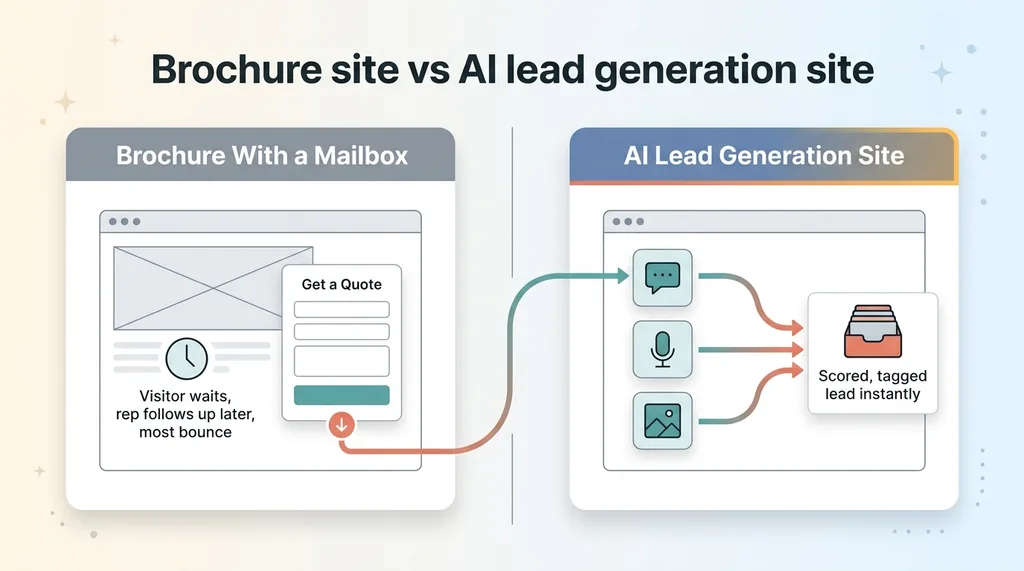
Let me say the quiet part out loud. Most marketing sites are glorified contact forms. You put up some nice photos, write some copy, drop a "Get a Quote" button at the bottom, and then you wait. A visitor lands, maybe fills out the form, and you hope a rep follows up before they forget your brand exists.
That's not a lead generation website. That's a brochure with a mailbox.
An AI lead generation website works differently. Instead of waiting for one specific action (the form fill), it gives every visitor live ways to engage the moment they want to, and it turns each of those interactions into a scored, tagged lead the second it happens. No rep refresh required. No "let me check the inbox" delay.
Beyond the form fill
The form fill is passive. It assumes the visitor knows exactly what they want, has the patience to type it all out, and trusts that someone will get back to them. Most won't. They bounce.
 Brochure site vs AI lead generation site
An AI-native site meets the visitor where they are. Some people want to type a question. Some want to talk. Some want to show you, not tell you. You build for all three.
Three ways a visitor can become a lead
Here's the setup I built, anonymized: a window-treatment manufacturer with two distinct businesses under one roof. A B2B dealer site for the manufacturing side, and a B2C homeowner site for its retail install arm.
 Three lead capture channels and their qualifying signals
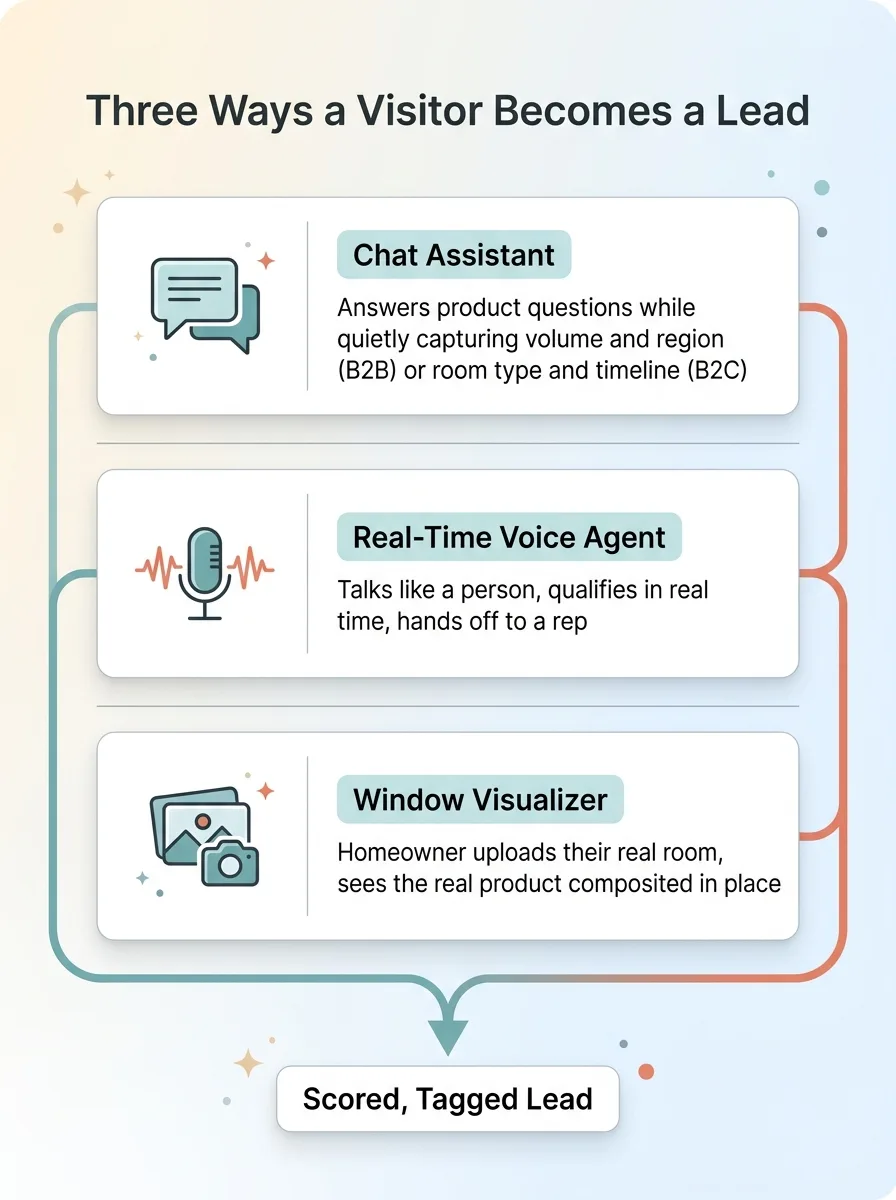
Across those two sites, a visitor can become a lead three ways: through a chat assistant, through a real-time voice agent, or by uploading a photo of their actual room. Each path captures different qualifying signals. Each one lands as work a rep can act on.
This article walks through exactly how that funnel works in production. No theory. The real architecture.
The Real Problem: Two Audiences, One Pipeline
The constraint here was clean, and it's one a lot of multi-brand companies face without naming it.
 Two front ends, one back end pipeline architecture
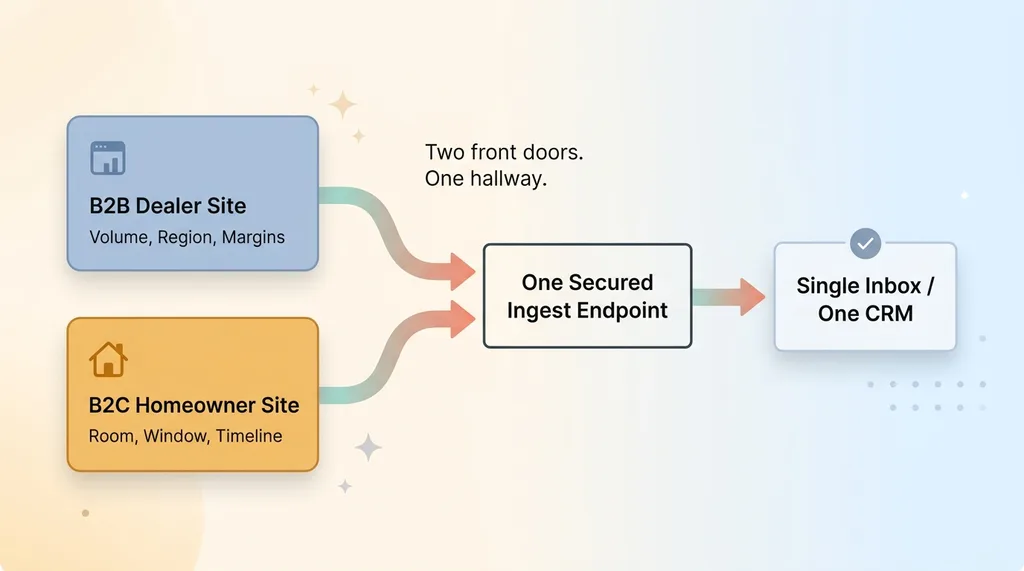
The manufacturer sells to dealers. That's a B2B conversation about volume, regions, margins, and supply. The retail arm sells installs to homeowners. That's a B2C conversation about which room, what the window looks like, and when the project needs to happen. Different audience, different voice, different brand entirely.
Why one site couldn't serve both
You cannot serve both of those audiences on one site without confusing both of them. A dealer landing on homeowner messaging thinks they're in the wrong place. A homeowner landing on dealer pricing tiers gets overwhelmed and leaves.
So they needed two separate front ends. Two brands. Two tones. That part was non-negotiable.
Why two CRMs was the wrong answer
Here's where most companies make the mistake. They figure two brands means two pipelines, two CRMs, two inboxes. Now the operations team is reconciling leads across two systems, deduplicating, and dropping follow-ups in the gaps.
The ops team here worked leads in one inbox. They could not afford to stand up and babysit two separate systems. The math doesn't work, and the leads fall through the cracks.
So the requirement was the interesting part: distinct front ends, single back end. Two brands' worth of experience, one secured ingest endpoint instead of two CRMs. Most companies get this exactly backward. They either cram both audiences onto one confusing site or they fragment their pipeline into pieces nobody can manage.
Two front doors. One hallway. That was the whole design problem.
Channel One and Two: Chat and a Real-Time Voice Agent
The first two channels are conversational lead capture. The visitor talks, the site listens, and qualifying signals get captured quietly in the background.
The chat assistant that qualifies as it answers
The chat assistant answers product questions like a knowledgeable rep would. What materials are available, how installs work, lead times, the basics. But while it's answering, it's also listening for the signals that tell a rep whether this is a real lead.
On the B2B dealer site, that's volume and region. Is this a shop ordering a handful of units a year or a regional distributor moving serious quantity? On the B2C homeowner site, it's room type and project timeline. A homeowner asking about a single bedroom shade next spring is a different lead than someone redoing their whole house next month.
The visitor never feels interrogated. They're getting answers. The qualification happens underneath the conversation.
The voice agent that talks like a person
Some visitors would rather talk than type. So there's a voice agent on the website that does the same job in real time. It answers, qualifies, and hands off.
The honest part: the hard problem with the voice agent was never the technology. The technology works. The hard part was tone. A voice agent that sounds like a bot kills trust in about four seconds. Getting it to stop sounding like a customer service robot, to actually sound like a person on the phone, took far more tuning than wiring it up did.
One thing both channels share: neither one auto-sells or quotes. They don't promise a price. They don't close a deal on the rep's behalf. They listen, qualify, and hand off. Every AI action stops for a human before anything goes out the door. The AI fills the rep's inbox with qualified, context-rich leads. The rep does the selling.
Channel Three: A Window Visualizer That Renders on a Real Photo
This is the B2C-only differentiator, and it's the clearest proof an AI site can do more than collect form fills.
Upload a room, see the treatment, show no price
A homeowner uploads a photo of their actual window or room. They get an instant render of the treatment in place, on their wall, in their light. Not a stock photo of a generic living room. Their living room.
Two design decisions mattered here.
First, no pricing. The render shows the product in the space, and that's it. Pricing on a window install depends on measurements, materials, and labor. Putting a number on a marketing page would either be wrong or would anchor the homeowner on a figure that doesn't apply to their job. Pricing is a conversation, not a number on a page. So the visualizer shows the look and routes the price discussion to a human.
Why I composited instead of generated
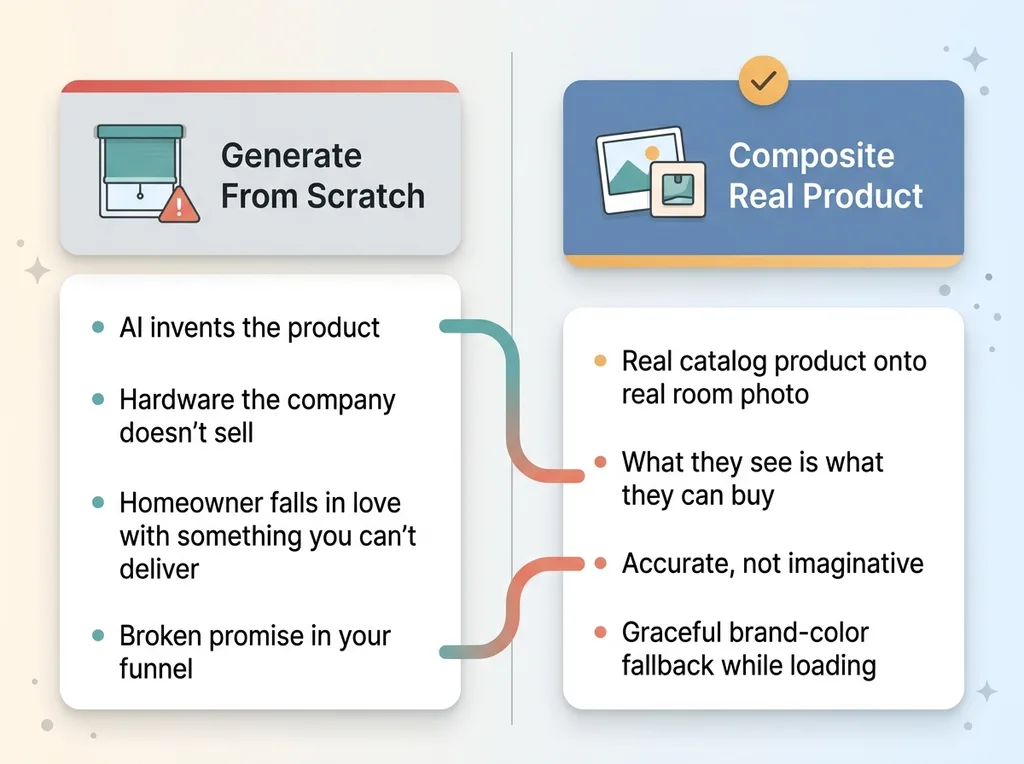
Second, and this is the one that matters technically: the visualizer composites the real product onto the real photo rather than letting AI generate a treatment from scratch.
 Composite real product vs AI-generate from scratch
If you let a generative model invent the product, it hallucinates. It'll render a beautiful shade that doesn't exist in the catalog, with hardware the company doesn't sell. Then a homeowner falls in love with something you can't deliver. That's a broken promise built into your funnel.
Compositing the real product onto the real room means what the homeowner sees is what they can actually buy. The render is accurate, not imaginative.
There's also a graceful fallback. While the AI image resolves, brand-color panels render in place first, so the page never looks broken or empty mid-load. The visualizer always looks finished.
And here's the part people miss: the upload itself is the lead. A homeowner who photographs their own window and uploads it has shown more buying intent than any form could capture. That's a hot lead, tagged and scored, before they ever type their name.
One Fail-Closed Endpoint: How Every Interaction Becomes a Scored Lead
This is the architectural heart of the whole thing.
All three channels, across both sites, funnel through one public ingest endpoint. Chat from the dealer site, voice from the homeowner site, a visualizer upload, all of it lands in the same place. That's how you get two brands' worth of distinct experience without two CRMs.
Shared secret and rate limit, fail closed
A public endpoint that takes leads is also a target. So it's guarded two ways.
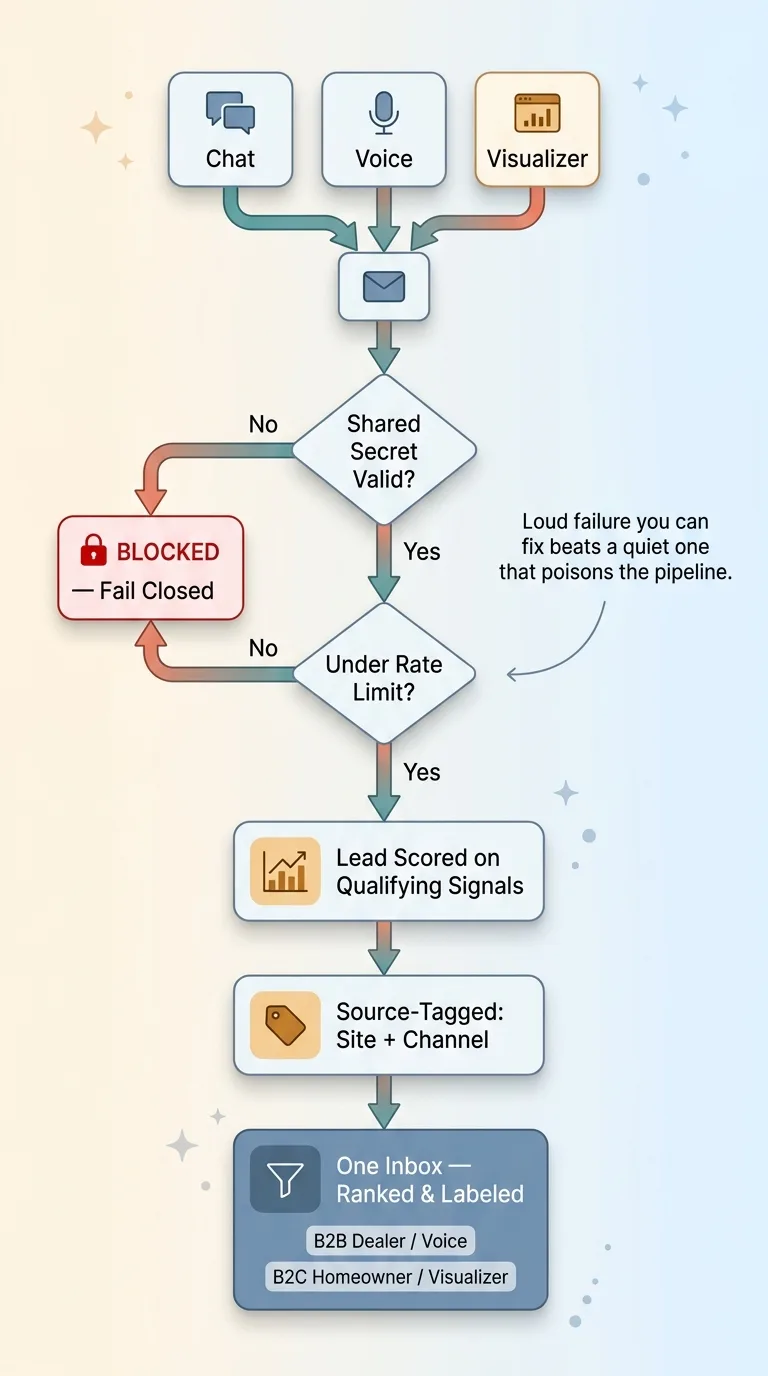 Fail-closed secured endpoint and lead scoring flow
First, a shared secret. The sites know it, the endpoint checks it, and nothing without it gets through. Second, a rate limit, so nobody can hammer the endpoint with junk.
The important word is fail closed. If the secret is wrong or the rate limit is hit, nothing passes. Not a degraded version, not a "let it through and sort it later." Nothing. The pipeline stays clean.
The honest tradeoff: fail-closed means if you misconfigure something, you lose leads instead of collecting garbage. That feels scary. But the alternative, fail-open, means the day something breaks you're silently dumping spam and malformed junk into the inbox your reps trust. I'd rather a loud failure I can fix than a quiet one that poisons the pipeline. Fail closed protects the thing that matters most: the rep trusting that everything in the inbox is real.
Scoring and source-tagging so reps work one inbox
Every lead that comes through gets scored on the qualifying signals captured and tagged with its source. Which site, which channel.
So a rep opens one inbox and sees "B2B dealer, voice" next to "B2C homeowner, visualizer." They know instantly who they're talking to, which brand the lead came from, and how warm it is, all before they open it. The dealer lead with high volume floats up. The homeowner who uploaded a photo of three windows and asked about next month floats up.
That's the payoff of one secured pipeline instead of fragmented systems. Two front doors, distinct experiences, and one inbox where every lead is already qualified and labeled. The ops team never reconciles anything. They just work the leads, top to bottom.
The Imagery: On-Brand AI Generation With a Graceful Fallback
Two brands meant two complete visual systems. Two sets of imagery, two tones, two looks. The old way to do that is two photo shoots, two creative budgets, two timelines.
I generated the imagery on-brand with AI instead. Both sites got full, distinct visual systems without commissioning separate shoots. That kept both sites looking finished without doubling the creative spend.
The practical detail worth knowing: the same fallback pattern from the visualizer runs site-wide. Brand-color panels show while AI renders resolve. The site is never visibly empty, never broken-looking mid-load. The visitor always sees something intentional, even in the half-second before the real image lands.
One limit I'll be straight about. AI imagery here is for marketing context. Mood, brand feel, the look of a finished space. It is not for representing the actual product a customer will receive. That's exactly why the visualizer composites the real product instead of generating one. Marketing imagery can be evocative. Product representation has to be accurate. Those are two different jobs, and you don't let the AI blur them.
What This Means for Your Marketing Site
Here's the shift, plainly. A marketing site does not have to be a passive form collector that waits and hopes.
It can qualify, score, and route leads through chat, voice, and image AI. Multiple brands can share one secured pipeline. And every visitor interaction, the chat, the call, the photo upload, lands as work a rep can act on immediately, already labeled and ranked.
The point was never the tech. The point is that nothing slips through. A visitor who would have bounced off a form now shows up in the inbox as a qualified, sourced lead with context attached.
Let me be honest about fit, because not everyone needs this. If you get five leads a month, a contact form is fine. Don't build a pipeline for a trickle.
But if you're losing leads to slow follow-up, if your reps are guessing at which inquiries are worth their time, or if you're running multiple brands off fragmented systems that nobody can reconcile, this is what an AI-native funnel actually looks like. Two front doors, one clean inbox, every interaction captured.
This is the kind of system I design, build, and run as a company's Chief AI Officer. Not slides about AI strategy. The actual working pipeline.
Thinking about AI for your business?
If this resonated, let's have a conversation. I do free 30-minute discovery calls where we look at your operations and find where AI could actually move the needle, not where it sounds good on a deck.
Get AI insights for business leaders
Practical AI strategy from someone who built the systems — not just studied them. No spam, no fluff.
Hodgen.AI
Ready to automate your growth?
Book a free 30-minute strategy call with Hodgen.AI.
Book a Strategy Call