Crowdfunded Pre-Orders: How I Validate Products Before Manufacturing
How I built a crowdfunded pre-orders ecommerce system that validates demand before manufacturing. Group-buy mechanics, auto-refunds, and real unit economics.
By Mike Hodgen
I spent $2,400 on materials for a product I was sure would sell. Hand-dyed gradient scarves in a colorway that was trending everywhere on Instagram. I made 80 units. Sold 23 at full price. Moved another 18 at 40% off. The remaining 39 sat in bins for five months before I donated them. When I added up the materials, labor, storage, and the margin I lost on markdowns, that single product decision cost me north of $4,000. And that wasn't even my worst miss.
This is the fundamental problem with traditional product-based ecommerce. You design something, you produce it, you list it, and you hope. The entire model is built on prediction — and prediction, even informed prediction, is wrong more often than most brand owners want to admit. For a handmade DTC fashion brand like mine in San Diego, where every unit involves real labor and real materials, wrong predictions don't just eat margin. They eat time I can never get back.
So I built a different system. Crowdfunded pre-orders in ecommerce — not on Kickstarter, not on some third-party platform, but native to my own store. Customers commit to a product before I manufacture it. If enough people want it, production starts. If they don't, everyone gets their money back and I've spent exactly $0 finding out that product wasn't worth making. Every unit I produce already has a buyer. Every dollar I spend on materials is already covered.
This isn't a theory. It's running in production right now, integrated into the same AI infrastructure that handles my pricing, my content, and my product pipeline.
How Crowdfunded Pre-Orders Actually Work in Ecommerce
Let me walk through the mechanics, because this is fundamentally different from slapping a "pre-order" button on a product page and making people wait.
The Group-Buy Mechanic
I run what I call Drop Campaigns. A new product concept goes live on the store with a campaign window — typically 14 days. There's a set price and a minimum order threshold. For most of my products, that threshold is 25 units.
Customers place their pre-order during the campaign window. Their payment is captured. As orders come in, the campaign page shows progress: "17 of 25 claimed." This is the group-buy mechanic in action — every new order adds social proof, which drives more orders. It creates a momentum loop that traditional product pages don't have.
The threshold isn't arbitrary. It's the minimum batch size where my unit economics work — where I can purchase materials at reasonable prices and schedule production efficiently. Below that number, the product doesn't make financial sense to produce.
Auto-Refund If Threshold Isn't Met
Here's what makes this different from a standard pre-order: if the campaign doesn't hit its threshold by the deadline, every customer gets an automatic refund. No questions, no delay, no customer service tickets. The system handles it.
This eliminates the biggest objection to pre-orders, which is trust. Traditional pre-orders ask customers to pay for something that doesn't exist yet, with no guarantee on timeline and no recourse if things go sideways. We've all backed a Kickstarter that delivered 14 months late, or never. My system inverts the risk. The customer's downside is zero. Either they get the product or they get their money back.
The Customer Experience
On the front end, customers see a progress bar showing how close the campaign is to funding. There's a countdown timer for the campaign window. They get email updates at key milestones — 50% funded, 75% funded, fully funded, production started, shipment incoming.
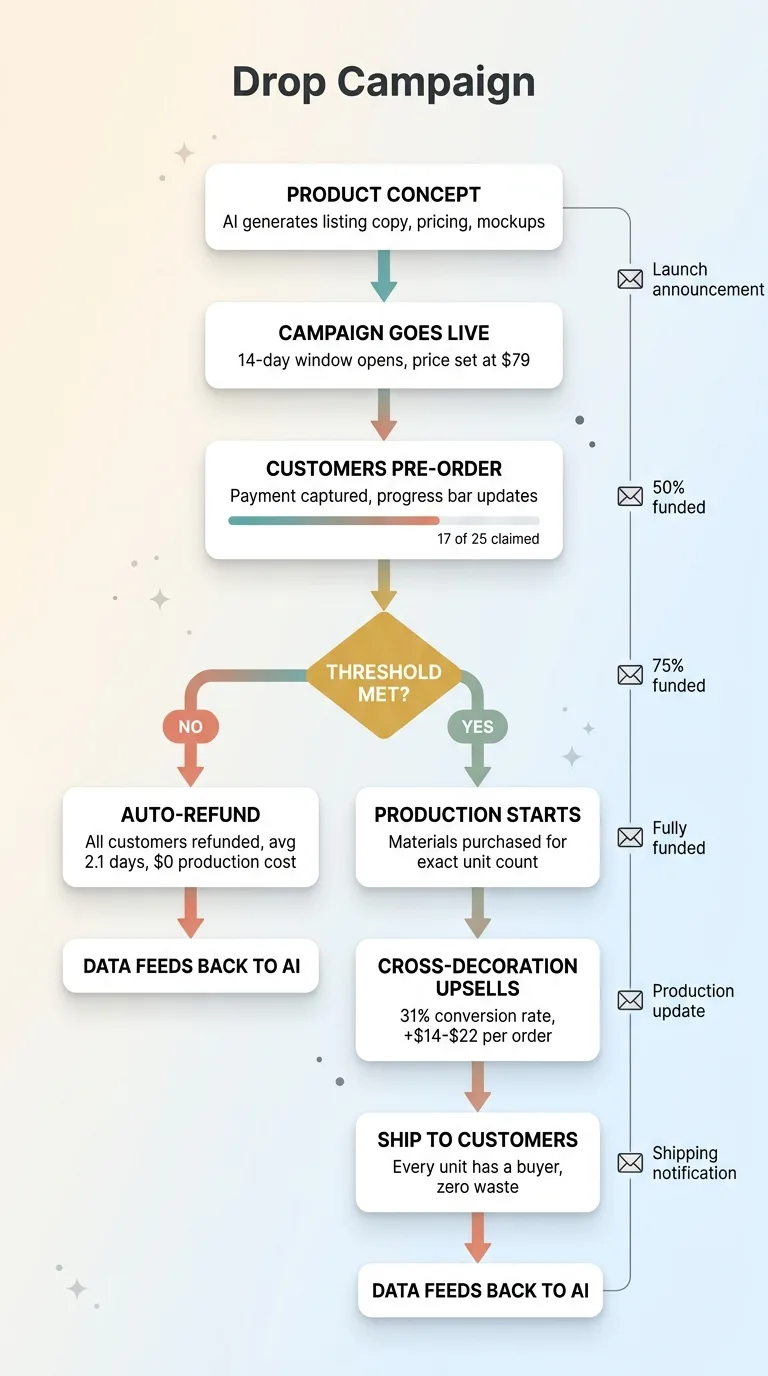 Drop Campaign Lifecycle Flow
This communication cadence does something subtle but important: it keeps customers engaged with the brand across multiple touchpoints without me sending a single promotional email. They opted into the journey. They're checking back. They're sharing with friends because they want the campaign to succeed.
The conversion psychology is meaningfully different from a standard product page. Scarcity, social proof, and commitment all compound. And because customers have skin in the game, they're more invested in the outcome — which translates to lower refund requests once the product ships and higher lifetime value downstream.
The Unit Economics: Made-to-Order vs. Inventory Risk
Numbers matter here more than concepts. Let me show you the actual math.
What Inventory Risk Actually Costs
Take a standard inventory-based product launch. I buy materials for 100 units at $18 per unit. Labor runs $22 per unit. Total production cost: $4,000. Retail price: $79.
Best case, I sell 65 at full price ($5,135 revenue), mark down 20 units at 40% off ($948 revenue), and write off 15 units entirely ($0 revenue). Total revenue: $6,083. Total cost: $4,000 plus storage, photography, listing time, and the opportunity cost of capital tied up in inventory.
Real margin after waste: roughly 34%. And that's a decent outcome. I've had launches where sell-through at full price was under 40%.
The hidden cost is the markdown. Every unit sold at 40% off doesn't just reduce revenue — it trains customers to wait for sales. It erodes brand positioning. And it takes up mental and operational bandwidth that could go toward products that are actually working.
The Made-to-Order Math
Now run the same product through a crowdfunded pre-order campaign. I list it at $79. The campaign funds at 30 units. I buy materials for exactly 30 units at $20 per unit (slightly higher because the batch is smaller). Labor is the same $22 per unit. Total production cost: $1,260. Total revenue: $2,370.
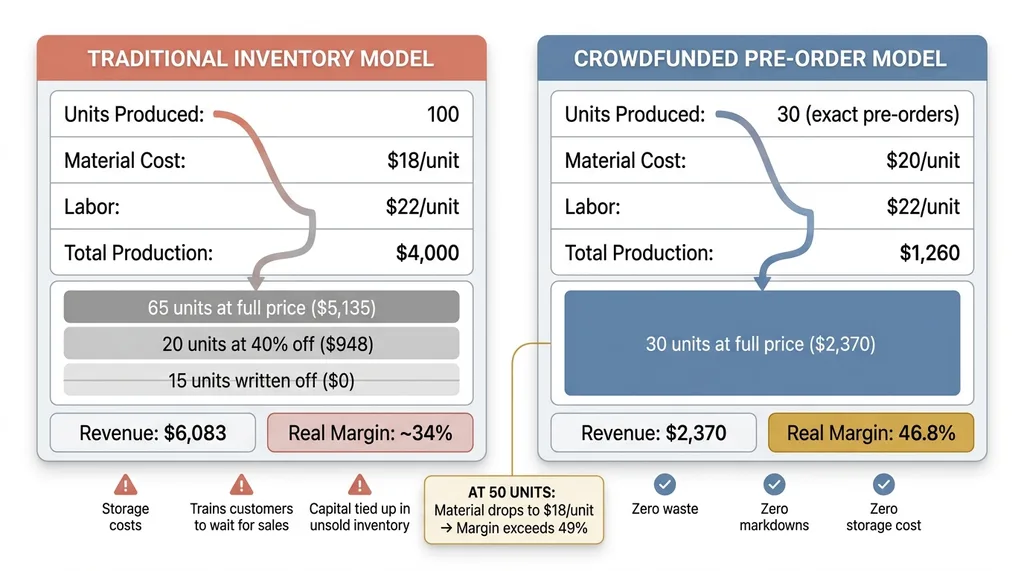 Unit Economics Comparison: Inventory Risk vs Made-to-Order
Margin: 46.8%. On a smaller revenue number, yes — but with zero waste, zero markdowns, zero write-offs, and zero storage cost. Every dollar of production cost was spent on a unit that already had a buyer.
If I scale up and the campaign funds at 50 units, my material cost drops back to $18 per unit and margins push past 49%.
The counterintuitive insight: smaller batches at slightly higher per-unit costs are more profitable than larger batches with inventory risk. Not theoretically. Actually. I've run both models side by side for six months and the made-to-order model wins on total profitability every time.
This pairs directly with my AI-powered dynamic pricing system, which optimizes the pre-order price point based on material costs, historical conversion rates, and competitor pricing. The AI doesn't just set a price — it models the relationship between price point and funding probability, so I can find the sweet spot where margin and conversion both work.
Cross-Decoration Upsells: Where the Real Margin Lives
Here's something most people miss about the pre-order model: the upsell opportunity during the campaign window is significantly better than on a standard product page.
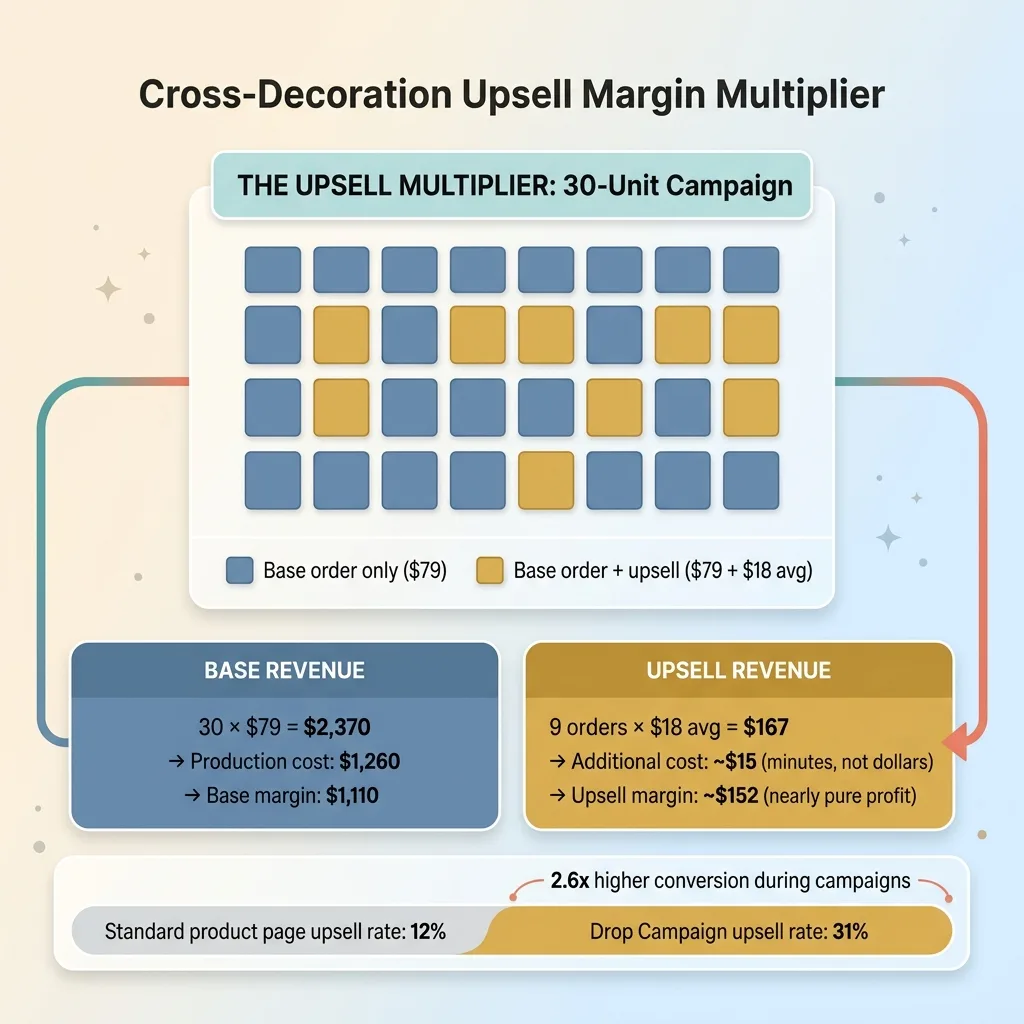 Cross-Decoration Upsell Margin Multiplier
The customer has already committed. They've put down money. They're emotionally invested in the product arriving. This is the exact moment to offer add-ons: custom embroidery, an alternative colorway, premium thread, personalized monogramming.
In my DTC brand, cross-decoration upsells during campaigns convert at 31% — versus 12% on standard product pages. The average upsell adds $14-$22 to the order. And because the base production is already locked in and funded, these add-ons carry disproportionately high margins. The embroidery machine is running anyway. An extra name or design costs me minutes, not dollars.
The math compounds. On a 30-unit campaign at $79 with a 31% upsell rate at an average of $18 per upsell, that's an extra $167 in nearly pure margin. Across multiple campaigns per month, it adds up fast.
This is also where the AI product pipeline that creates products in 20 minutes becomes a multiplier. Because I can generate campaign variants and decoration mockups rapidly, the upsell catalog is practically unlimited without me spending hours in design software. The AI generates the visuals, the copy, and the pricing recommendations. I review, approve, and publish.
What I Automated (And What I Didn't)
I want to be transparent here, because the "automate everything" narrative is usually dishonest.
AI-Assisted Campaign Creation
The campaign page generation is largely automated. When I decide to run a new Drop Campaign, the system pulls the product concept from the pipeline, generates the listing copy, creates the campaign page with progress tracking and countdown, sets up the email sequence (launch announcement, milestone updates, funded confirmation, production update, shipping notification, and the refund notification if it doesn't fund). That entire sequence is templated and triggered automatically based on campaign state.
Pricing recommendations come from the AI analyzing material costs, historical campaign data, and margin targets. The system knows that products in the $65-$85 range fund 40% more reliably than products above $100, for my specific audience. It factors that in.
Demand Signals and Threshold Calibration
The threshold — that minimum order number — isn't static. The AI calibrates it based on past campaign performance for similar product categories. A new hat design gets a lower threshold than a new jacket design because hats have historically funded faster with less audience hesitation. The system also looks at traffic patterns, email list engagement, and seasonal demand curves.
This is one of 29 automation modes running inside my 14-skill AI ecommerce platform. The Drop Campaign skill fits alongside dynamic pricing, SEO optimization, and inventory management as part of a unified system.
The Human Decisions That Still Matter
Here's what I don't automate: deciding which concepts get a campaign in the first place. The AI can tell me what's likely to convert based on historical patterns. But it can't tell me whether a new product direction aligns with where I want the brand to go. It can't judge whether a fabric feels right in hand. It can't decide that this is the season to push into a new category even if the data says it's risky.
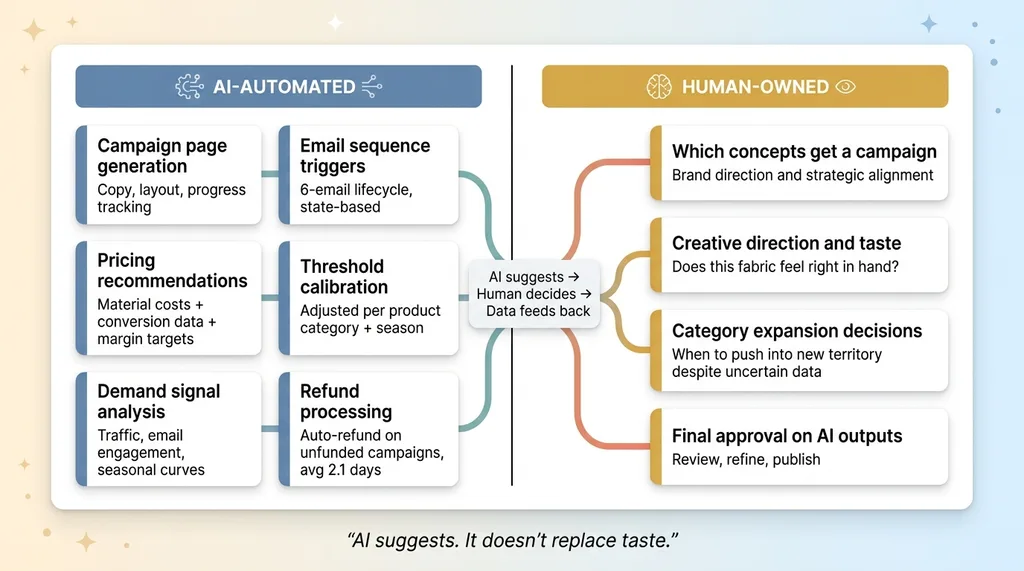 AI Automation vs Human Decision Boundary
AI suggests. It doesn't replace taste. And frankly, the brands that try to fully automate creative direction end up with catalogs that feel algorithmically generated — because they are. My customers can tell the difference. Yours can too.
Three Campaigns In: What the Data Says
I've run seven Drop Campaigns to date. Five funded. Two didn't.
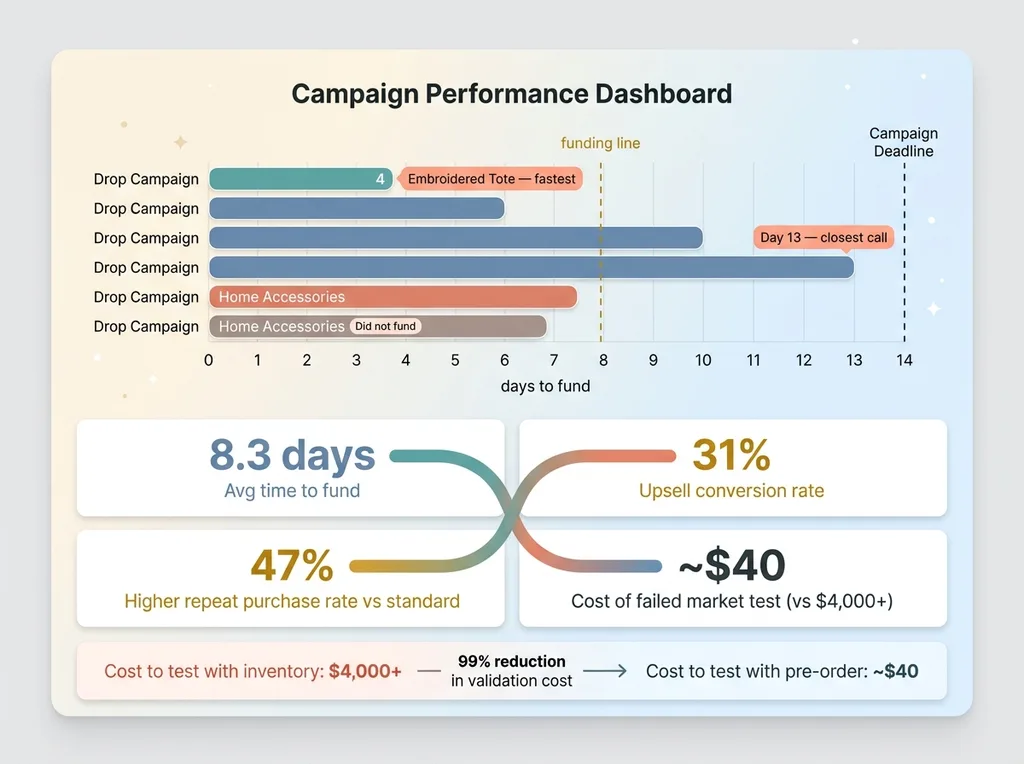 Campaign Performance Dashboard
Average time to fund: 8.3 days on a 14-day window. The fastest funded in 4 days — a limited-edition embroidered tote that caught traction when a local influencer shared it organically. The slowest funded on day 13, which was stressful but ultimately validated.
The two that didn't fund were both in a new product category I was testing — home accessories. Neither hit 60% of their threshold. Total cost of that market test: about $40 in ad spend to drive traffic to the campaign pages. Compare that to the $4,000+ I would have spent producing inventory to find out the same thing.
Refund processing on unfunded campaigns averaged 2.1 business days. Zero customer complaints. Several customers who were refunded came back and bought from a funded campaign later.
Here's the number that surprised me most: customers who buy through Drop Campaigns have a 47% higher repeat purchase rate than customers who buy standard products. My theory is that the campaign experience creates a stronger brand connection. They feel like participants, not just buyers.
Every campaign's data — funding velocity, conversion rate, upsell take rate, price sensitivity — feeds back into the AI system. Each campaign makes the next one smarter. The threshold recommendations get tighter. The pricing gets more precise. The email timing optimizes based on when customers actually convert during the window.
Building This for Your Brand (Or Having Someone Build It for You)
This model works for any product brand with production lead time. Fashion, home goods, specialty food, custom manufacturing, artisan anything. If you make things to sell and you're guessing at demand, you're leaving money on the table and lighting some of it on fire.
It's especially relevant for DTC brands in the $1M-$10M range, where a single bad inventory bet can wreck a quarter. You don't have the cash reserves to absorb mistakes the way a $100M brand does. But you also don't have to. The tooling to run crowdfunded pre-orders natively — campaign logic, payment hold and refund automation, threshold tracking, customer communication sequences — is buildable today. Add AI for pricing optimization and demand prediction, and you've got a system that gets smarter with every campaign.
If you're running a product brand and spending too much time guessing what to make, that's a solvable problem. The full approach — from pre-order validation to AI-driven pricing to automated production scheduling — fits into a broader AI playbook for DTC brands that I've been building and refining across my own business.
Want to Explore What AI Could Do for Your Brand?
I do a free 30-minute strategy call where we look at your operations and figure out where AI actually fits — and where it doesn't. No pitch deck. No sales team. Just a real conversation about what's costing you time and money, and whether any of it is automatable.
Get AI insights for business leaders
Practical AI strategy from someone who built the systems — not just studied them. No spam, no fluff.
Hodgen.AI
Ready to automate your growth?
Book a free 30-minute strategy call with Hodgen.AI.
Book a Strategy Call