AI for DTC Brands: The Playbook Nobody Else Is Writing
14 AI systems I built for my DTC fashion brand in San Diego. The real playbook for AI for DTC brands — what to build first, what to skip, and actual ROI.
By Mike Hodgen
I run a handmade DTC fashion brand in San Diego. Not a SaaS company. Not a dropship operation. Physical products sewn by real people, packed into real boxes, shipped to real customers who will absolutely email you if the sizing is off.
That context matters because most AI for DTC brands advice comes from people who've never touched inventory, dealt with a supplier delay, or stared at 500+ SKUs wondering which ones to reprice this week. I've done all of that — and then built AI systems to handle it.
Here's the playbook I wish someone had written for me 18 months ago.
14 AI Systems Running a DTC Fashion Brand in San Diego
What the Full Stack Looks Like
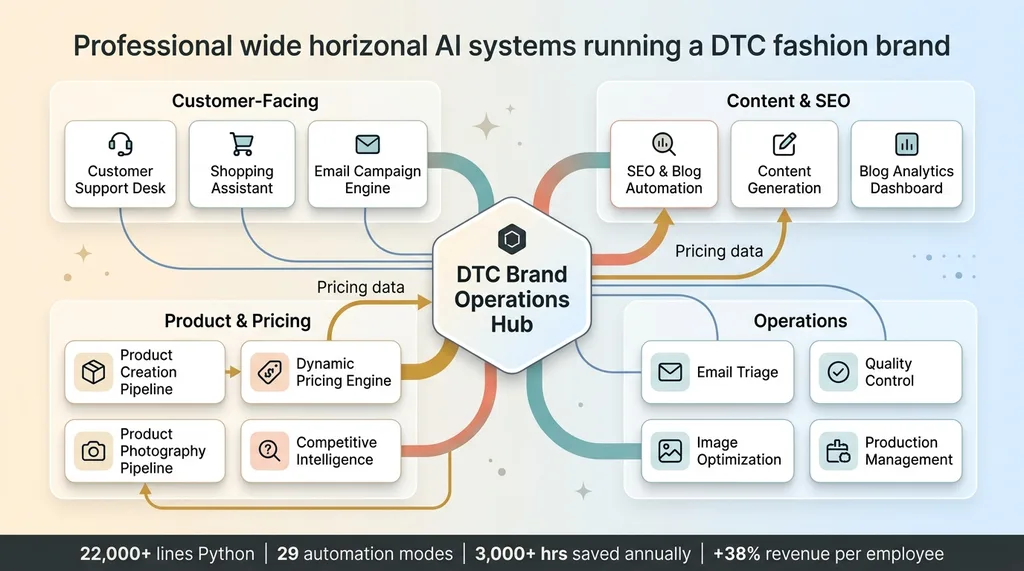
Right now, my brand runs 14 AI systems in production. Not experiments. Not proofs of concept. Systems that process real orders, write real content, and make real pricing decisions every day.
 14 AI Systems Architecture Map
Here's the scope: product creation pipeline, dynamic pricing engine, SEO and blog automation, customer support desk, email triage, shopping assistant, image optimization, quality control, competitive intelligence, content generation, analytics dashboard, production management, product photography pipeline, and email campaign engine.
Each one handles a specific job. Some run autonomously. Some run with human checkpoints. All of them talk to each other — which, as I'll explain later, is where the real advantage lives.
If you want the full technical breakdown of each system, I wrote a deep-dive on the full 14-skill AI platform. This article is about the strategy: what to build, in what order, and why.
The Numbers After 18 Months
Here's what the aggregate looks like across all 14 systems:
- +38% revenue per employee — same team, significantly more output
- -42% manual operations time — hours freed up for work that actually requires human judgment
- 3,000+ hours saved annually — that's roughly 1.5 full-time employees worth of labor
- 564+ products dynamically priced using a 4-tier ABC classification system
- 313 blog articles managed with AI-assisted SEO
- 22,000+ lines of custom Python powering the whole thing
- 29 automation modes running in production
These numbers didn't happen overnight. They compounded over 18 months of building, measuring, breaking things, and rebuilding. But they're real, and they come from a brand that ships physical products — not a tech company selling AI tools.
The Build Order That Actually Matters
This is the section most DTC founders need. Because the instinct is to start with the exciting stuff — AI-generated product designs, AI ad copy, AI everything. That instinct is wrong.
 3-Tier AI Build Order for DTC Brands
Start With Support and Email (Highest ROI, Lowest Risk)
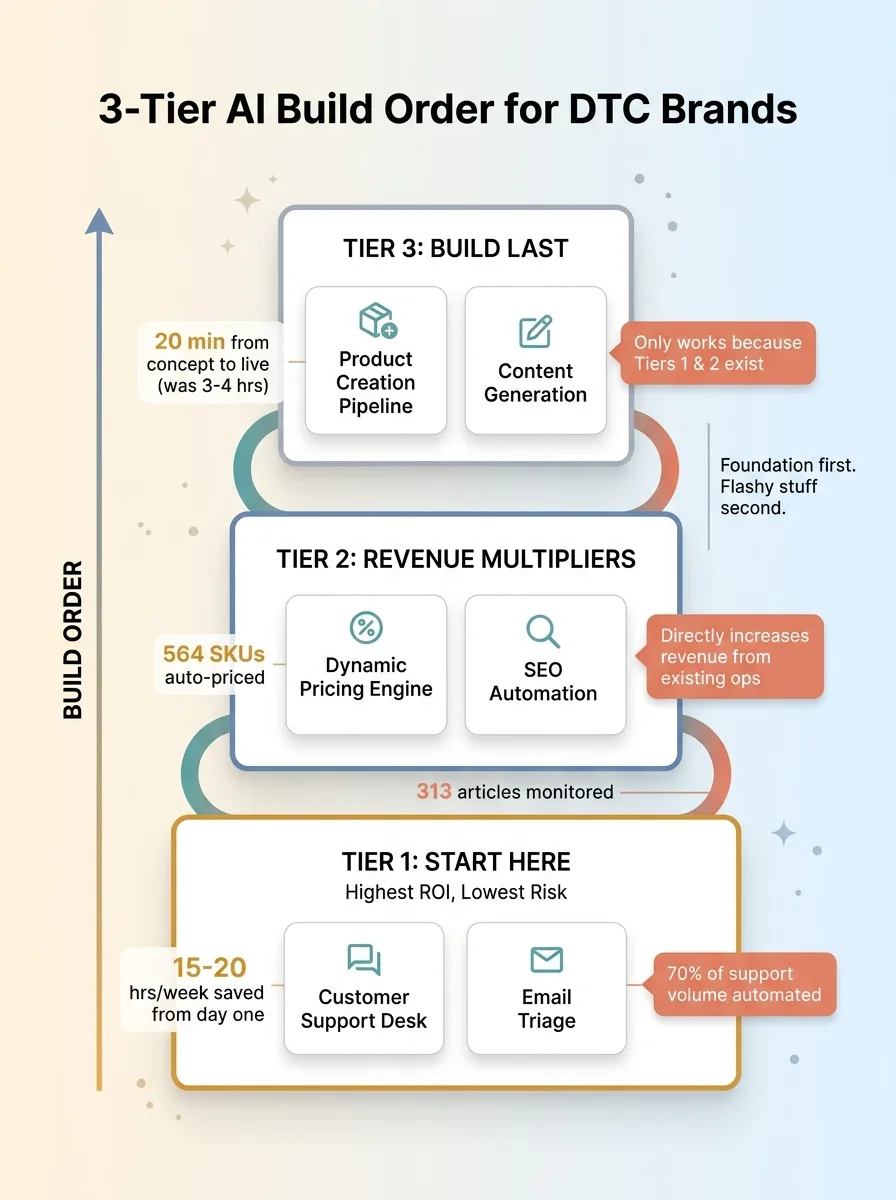
Tier 1: Customer support desk and email triage.
Why these first? Three reasons. They're high-volume. They're pattern-heavy. And they're low-risk — a slightly imperfect auto-response to a sizing question won't kill your brand.
My support desk handles returns, exchanges, shipping inquiries, and sizing questions. These represent about 70% of all inbound support volume, and the patterns are remarkably consistent. "Where's my order?" has about 15 variations. AI handles all of them.
The email triage system sorts, prioritizes, and drafts responses for my inbox. Before this existed, I spent 45 minutes every morning just figuring out what needed attention. Now I spend about 10.
Combined, these two systems saved 15-20 hours per week from day one. ROI was measurable within the first week, not the first quarter.
If you want the general framework before the DTC-specific version, I wrote about 5 AI systems every small business should build first.
Then Pricing and SEO (Revenue Multipliers)
Tier 2: Dynamic pricing and SEO automation.
Pricing 564 SKUs manually is a joke. I know because I tried. You end up repricing your bestsellers when you remember to and ignoring everything else. Meanwhile, your margins erode on products you're not watching.
The dynamic pricing engine uses a 4-tier ABC classification: top movers get repriced daily based on demand signals and competitor data. B-tier products get weekly adjustments. C and D tiers get monthly reviews. The system handles all of it while I sleep.
SEO automation across 313 blog articles is similar logic. Each article gets monitored for ranking changes, updated when performance dips, and new content gets planned based on actual search demand — not guesswork. This drives organic traffic without a dedicated content team.
These are revenue multipliers. They don't just save time — they directly increase what you earn from existing operations.
Product Creation and Content Come Third
Tier 3: Product creation pipeline and content generation.
The product creation pipeline takes a concept from idea to live on the site in about 20 minutes. That used to take 3-4 hours. It's genuinely impressive, and it's the system people ask about most.
But here's why it's Tier 3: creating products faster is pointless if your pricing is wrong and nobody can find them. The pipeline only generates real value because Tiers 1 and 2 are already running. New products get priced automatically, optimized for search automatically, and supported automatically.
Build the foundation first. The flashy stuff works because the infrastructure exists.
What Requires a Human (And Always Will)
I'm not going to pretend AI does everything. It doesn't. And being specific about the boundaries is more useful than pretending they don't exist.
Brand Voice and Creative Direction
AI writes first drafts. Good ones, usually. But anything customer-facing that carries real brand weight — the homepage, campaign messaging, product story pages — gets my final eye. AI doesn't understand why a particular word choice feels right for our customer. It approximates well. But "well enough" isn't the standard for brand voice at the top level.
I set the voice. AI scales it.
Supplier Relationships and Quality Judgment
Negotiating with fabric suppliers, evaluating material quality by feel, managing production timelines when a shipment is three weeks late and you have 200 orders pending — these are human judgment and relationship tasks. No AI system handles the phone call where you need to push back on a price increase while maintaining a relationship you've built over two years.
Physical quality control is similar. AI runs quality checks on digital outputs — images, copy, pricing logic. It even rejects its own bad work when outputs fall below threshold. But someone still touches every product before it ships. Fabric weight, stitch quality, color accuracy — those require hands.
The 80/20 of Human-AI Handoffs
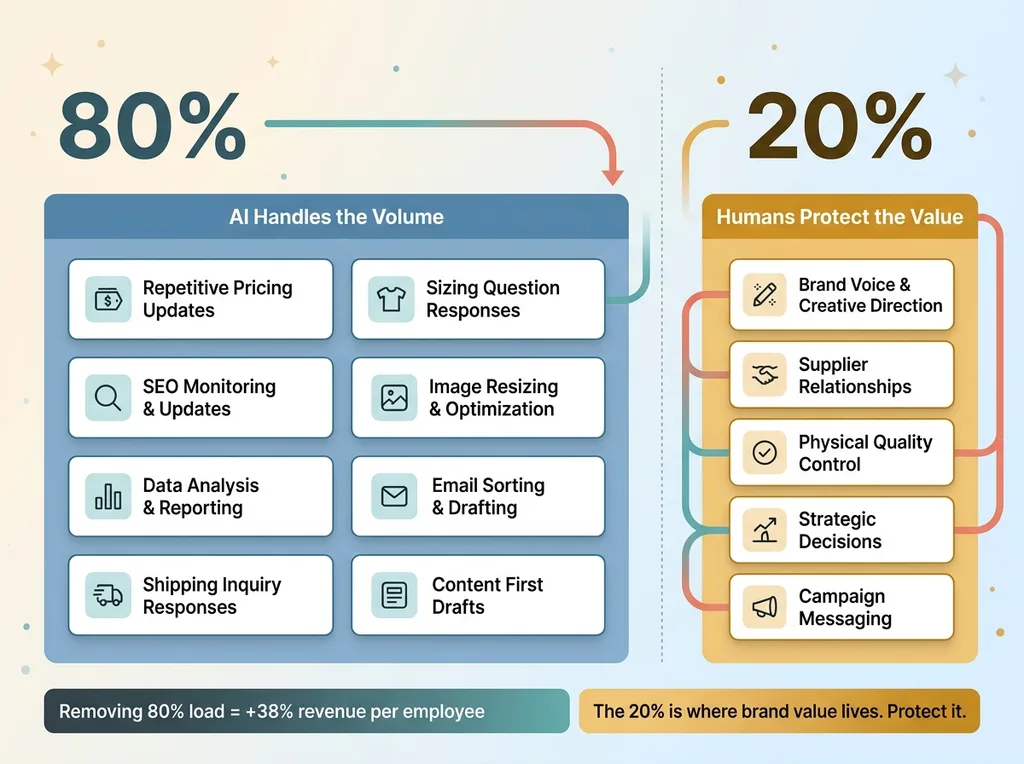
The real framework is this: AI handles 80% of the volume work so humans can focus on the 20% that requires taste, judgment, and relationships.
 Human vs AI Task Boundary (80/20 Framework)
That 80% is massive. It's the repetitive pricing updates, the sizing question responses, the SEO monitoring, the image resizing, the data analysis. Removing that load from the team is what created the +38% revenue per employee improvement.
But the 20% is where brand value lives. Protect it.
The Architecture Behind the Playbook
Multi-Model Strategy (Not One AI for Everything)
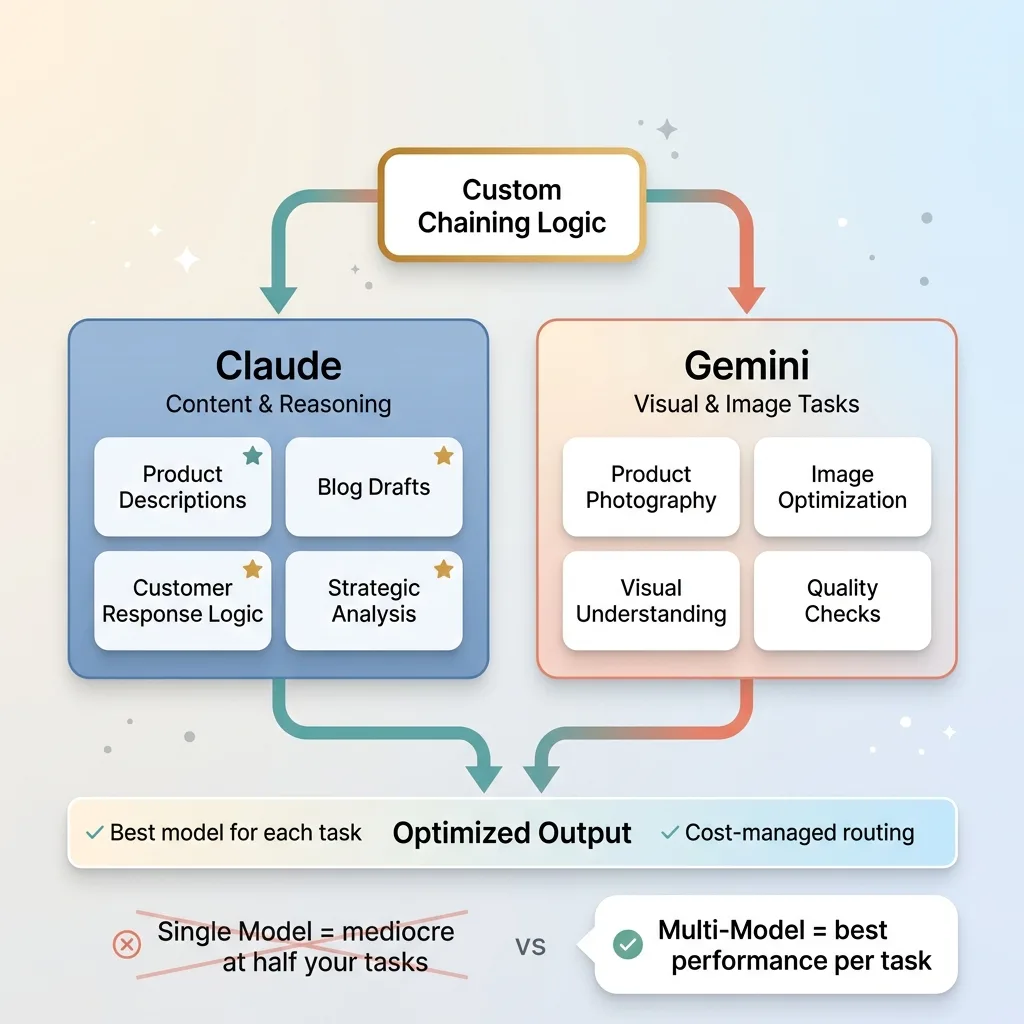
I don't use one AI model. I use several, each for what it does best.
 Multi-Model AI Strategy
Claude handles content and reasoning — product descriptions, blog drafts, customer response logic. Gemini handles images and visual tasks — product photography, image optimization. Custom chaining logic connects them, routes tasks to the right model, and keeps costs manageable.
Why not just pick one? Because each model has real, measurable strengths. Claude writes better product copy. Gemini handles visual understanding better. A single-model approach means you're accepting mediocre performance on half your tasks to avoid the complexity of multi-model routing.
I wrote a full breakdown of why I use 3 different AI models and how the cost optimization works.
22,000 Lines of Custom Python vs. Off-the-Shelf Tools
The natural question: why not just use Shopify apps?
Because off-the-shelf tools don't talk to each other. My pricing engine feeds data to my SEO system, which informs my content strategy, which drives my product creation priorities, which flow back into pricing. That interconnected loop is impossible with eight different SaaS tools, each sitting in its own data silo with its own API limitations.
The 22,000+ lines of custom Python exist because integration is the advantage. Not any single system — the connections between them.
But I'll be honest: this level of custom build isn't right for every brand. If you're under $1M in revenue, start with the best available tools and layer custom automation on top as you grow. The architecture should match your stage.
What DTC AI Looks Like at $2M, $10M, and $30M
This is where the DTC AI automation conversation gets practical. The answer to "what should I build?" depends entirely on where you are.
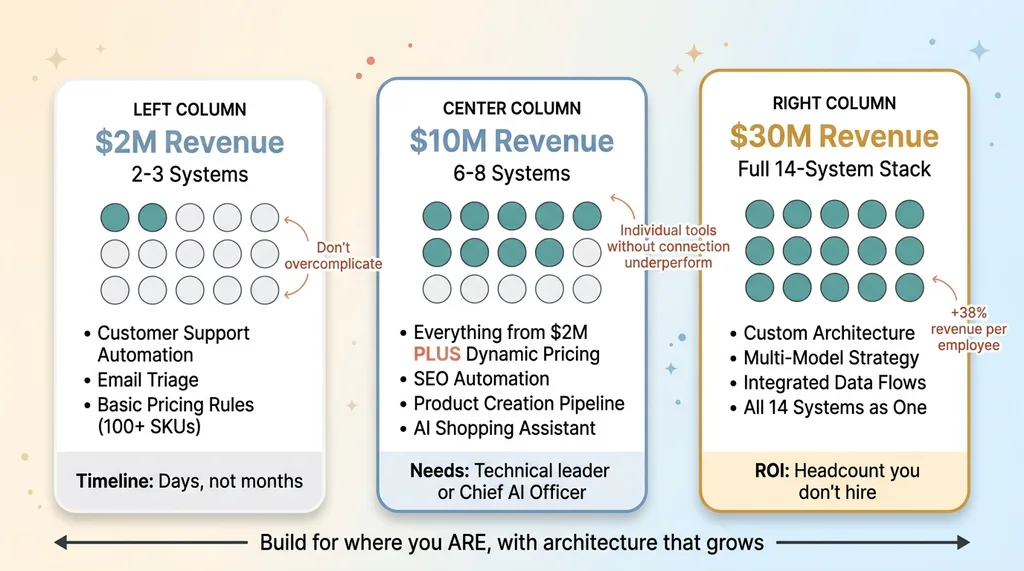 AI System Scale by Revenue Stage
At $2M revenue: You need 2-3 systems, maximum. Customer support automation and email triage are your highest-return starting points. Maybe basic pricing rules if you have more than 100 SKUs. Total investment: one focused build sprint measured in days, not a six-month project. Don't overcomplicate this.
At $10M revenue: You can support 6-8 systems. Add dynamic pricing, SEO automation, a product creation pipeline, and an AI shopping assistant that actually sells. At this stage, you need someone who can build and maintain these systems — either a technical cofounder with AI chops or a Chief AI Officer who's done it before. Individual tools without someone connecting them will underperform.
At $30M revenue: The full 14-system stack becomes justified. Custom architecture, multi-model strategy, integrated data flows across every operational function. The ROI at this level is measured in headcount you don't need to hire. My +38% revenue per employee came from this stage of system maturity — not from any single tool, but from the compounding effect of 14 systems working as one.
The key point: don't build for the stage you want to be at. Build for where you are, with architecture that can grow to where you're going. Over-building early wastes money. Under-building late costs you competitive ground you can't recover.
Why Nobody Else Is Writing This Playbook
AI consultants don't run DTC brands. DTC operators don't build AI systems.
I do both. That's why this perspective exists.
The AI advice landscape for direct to consumer brands is broken into three camps: vendor pitches disguised as content ("use our AI tool and watch sales soar"), generic business advice with "AI" sprinkled on top, and technical deep-dives written by engineers who've never shipped a physical product.
What's missing is someone who has eaten their own cooking. Built the systems, run them against real revenue, measured what worked, and fixed what broke at 2 AM when the pricing engine made a bad call on a bestseller.
That's what a Chief AI Officer does for a DTC brand. Not advise from the sideline. Build and operate real systems with real money on the line.
Getting From Zero to Your First AI System
If you've read this far and you're thinking about where to start, here's the practical version:
Step 1: Audit where your team spends time on repetitive work. If customer support and email management are eating 20+ hours a week, that's your starting point. If it's pricing updates or content creation, start there. Follow the pain.
Step 2: Pick one system with clear, measurable ROI. Not "we'll be more efficient." Specific: hours saved per week, response time reduced by X%, revenue per employee improved by Y%. If you can't define the metric before you build, you're not ready to build.
Step 3: Build it, measure it for 30 days, then decide whether to expand. One system, proven, before you touch the second.
Don't try to build 14 systems at once. I didn't. The first system took a week. The fourteenth took a day. That's the compounding effect of building on real architecture — each system makes the next one faster and cheaper.
Want to Know If AI Makes Sense for Your Brand Right Now?
I'll be straightforward: it might not. Some brands aren't at the stage where AI investment pays back. I'll tell you that honestly — it's a better use of both our time than pretending every business needs 14 AI systems tomorrow.
But if you're running a DTC brand, spending too many hours on work that feels repetitive, and watching competitors move faster — it's worth a conversation.
No pitch deck. No sales team. Just 30 minutes talking through your operations and where AI fits — or doesn't.
Get AI insights for business leaders
Practical AI strategy from someone who built the systems — not just studied them. No spam, no fluff.
Hodgen.AI
Ready to automate your growth?
Book a free 30-minute strategy call with Hodgen.AI.
Book a Strategy Call