The Misconception That Gets Founders Fined
Here's a sentence I've heard, almost word for word, from at least a dozen CEOs building health and fintech products: "We encrypt everything, so we're compliant."
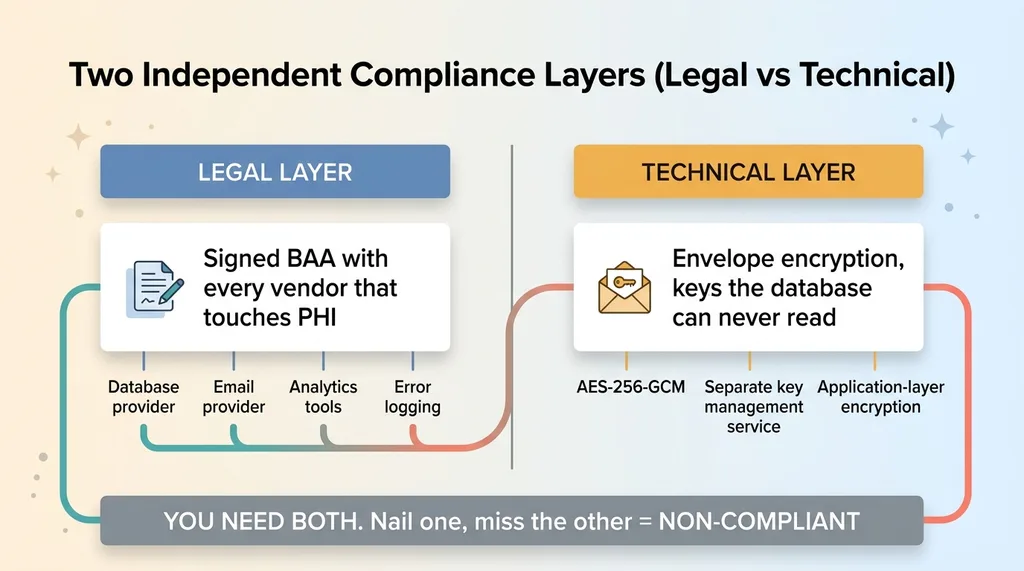 Two Independent Compliance Layers (Legal vs Technical)
It's wrong. And it's the kind of wrong that doesn't show up until a breach, an audit, or a partner's due diligence team tears your stack apart. By then it's expensive.
The confusion is understandable. Encryption feels like the hard part, the technical part, the part that sounds like security. So once you've checked that box, it feels done. But the question of encryption vs HIPAA compliance isn't a comparison of two competing approaches. They're not the same kind of thing at all.
Encryption is a technical control. It's also a breach safe-harbor, which I'll explain. HIPAA compliance is a legal and operational framework, and encryption is one small piece of it.
I've made these decisions on real projects this year. Across the health and wellness apps I build, I've had to sit down and answer the actual question: what does this data require, legally and technically, before it goes live? Not "is it encrypted." That's the easy part.
The thing that trips founders up is that compliance has two independent layers, and you need both:
- The legal layer: signed agreements with every vendor that can touch your protected health information.
- The technical layer: encryption done correctly, with keys the database itself can never read.
You can nail one and completely miss the other. I've seen products with beautiful AES-256 encryption and zero legal coverage. I've seen the reverse too. Both are non-compliant.
Let me walk through what each layer actually does, what it costs, and the rule I use to avoid overpaying on prototypes while still being airtight at launch.
What Encryption Actually Does (and Doesn't Do) Under HIPAA
AES-256 is a safe-harbor, not a free pass
AES-256 is good. I'm not knocking it. Under the HIPAA Security Rule, encryption is an "addressable" specification, which means you either implement it or document why you didn't. In practice, you implement it.
But the real value is the breach notification safe-harbor. If encrypted PHI gets lost or stolen, and you held the decryption keys separately so the thief got nothing but ciphertext, it may not count as a reportable breach at all. That's enormous. A reportable breach means notifying patients, notifying HHS, sometimes notifying the media. The safe-harbor is the difference between a bad day and a catastrophe.
So encryption buys you something concrete. It is not theater.
Holding ciphertext still makes you a business associate
Here's the part that gets people fined.
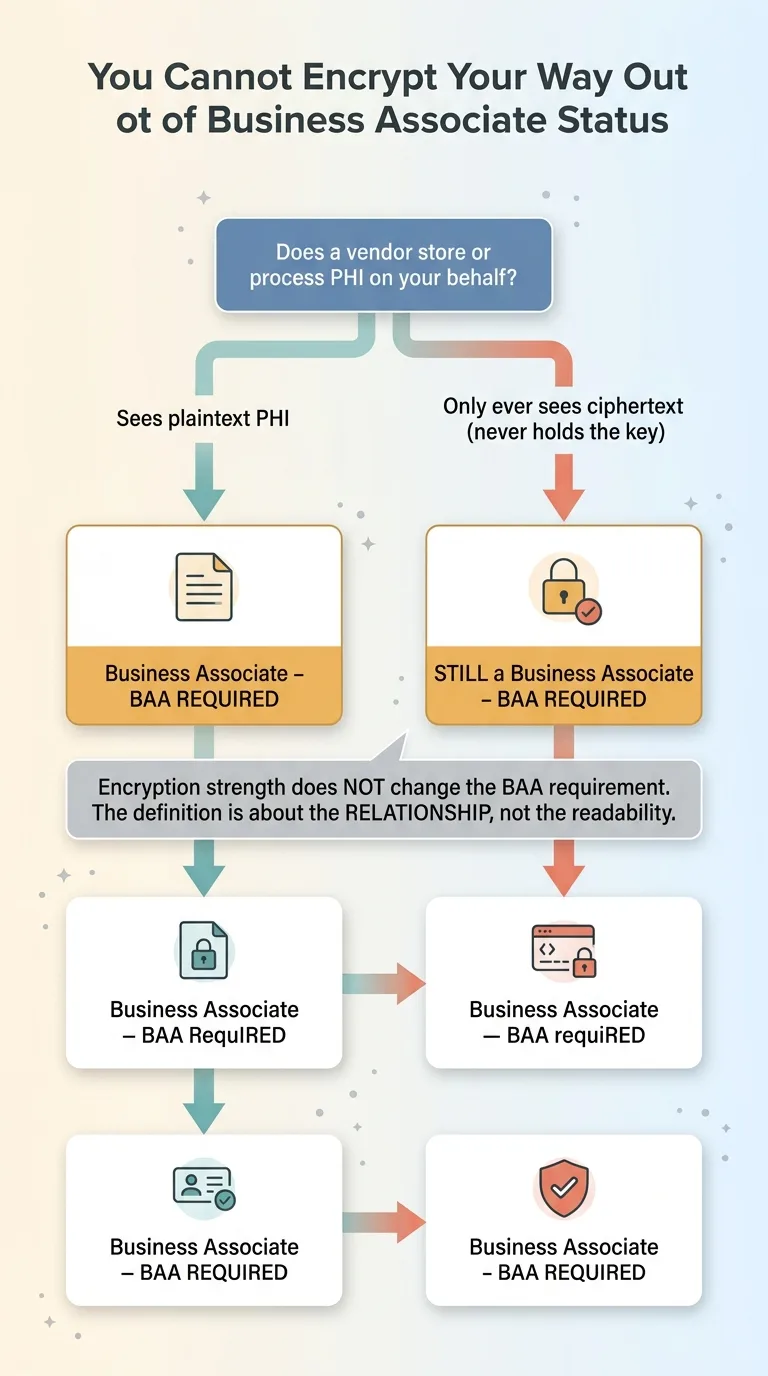 You Cannot Encrypt Your Way Out of Business Associate Status
The federal guidance is explicit: if a vendor stores or processes PHI, it is a business associate. It does not matter that the vendor only ever sees ciphertext and never holds the key. Holding encrypted PHI still makes you a business associate.
Read that again, because it's the sharpest point in this entire piece. You cannot encrypt your way out of being a business associate.
This is where the "we encrypt everything" logic falls apart. Founders assume that if the data is unreadable to the vendor, the vendor isn't really handling PHI. But the regulatory definition of a business associate is about the relationship, not the readability. A company that processes or stores PHI on your behalf is a business associate the moment it touches that data, encrypted or not.
The reason this matters: business associate status triggers a legal obligation. That vendor needs a signed agreement with you, accepting the same HIPAA obligations you carry. No encryption strength changes that requirement.
Technical safeguards and the regulatory definition of who's on the hook are two different axes. Encryption sits on one. Business associate status sits on the other. Confuse them and you'll build something that's technically secure and legally exposed.
The Legal Layer Everyone Forgets: The BAA
What a business associate agreement actually obligates
A business associate agreement, or BAA, is a contract. In plain terms, it legally binds any vendor handling your PHI to the same HIPAA obligations you carry.
It spells out how the vendor will safeguard the data, what they'll do if there's a breach, how they'll handle data deletion, and what their own sub-processors are required to do. When you sign a BAA, you're not just buying a security feature. You're extending your legal accountability into that vendor's operations, with a paper trail.
Without a signed BAA, the vendor relationship itself is non-compliant. Full stop. The encryption doesn't save you here, because the violation isn't a technical one.
Every vendor that touches PHI needs one
This is where the scope balloons on founders who haven't thought it through. The BAA requirement applies to every vendor that can see or handle PHI, not just your database.
That means:
- Your hosted database provider
- Your email provider, if PHI ever lands in an email
- Your analytics tool, if it captures any PHI
- Your error-logging and monitoring tools, which quietly capture more than you think
- Any third party that can see the data in the clear, or even handle it encrypted
The chain matters too. You sign a BAA with each vendor. They, in turn, sign BAAs with their own sub-processors. The legal coverage has to run all the way down.
Here's the classic trap. A founder spins up a standard cloud database tier, the cheap one, with no BAA available. They encrypt all the PHI carefully. They feel covered. They are not. The vendor relationship is non-compliant from the start because there's no signed agreement, and encryption doesn't change the BAA requirement.
The smartest move I've found is to reduce how many vendors can touch PHI in the first place. The fewer vendors in scope, the fewer BAAs you need to sign and maintain. I wrote about how to shrink your HIPAA exposure by 70% using exactly this approach, keeping PHI from spreading across your stack so the legal surface stays small.
The Technical Layer Done Right: Keys the Database Never Holds
Envelope encryption and key separation
Now the technical layer, done properly.
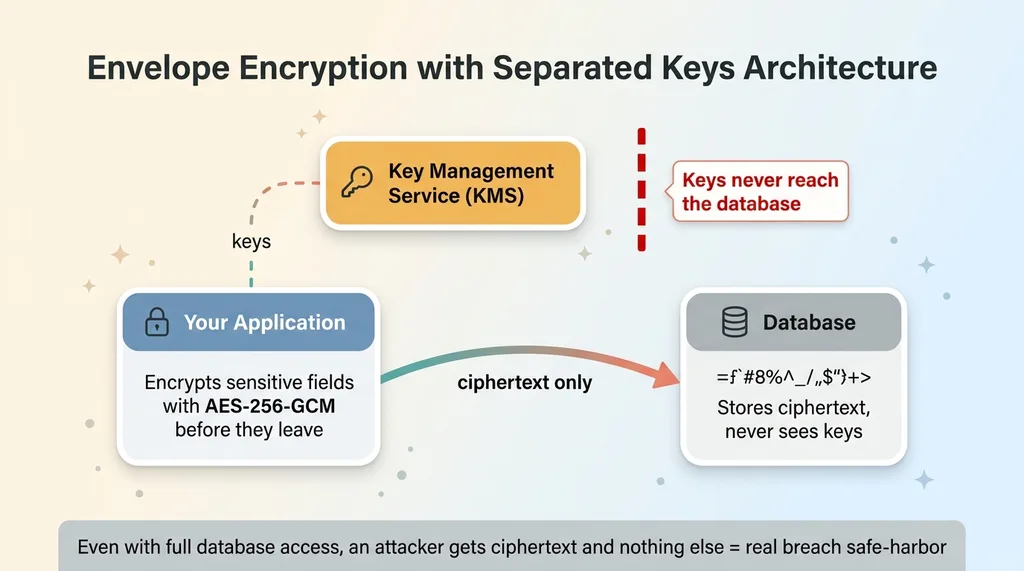 Envelope Encryption with Separated Keys Architecture
Encryption at rest from your database vendor is table stakes. Necessary, but weak on its own, because in many configurations the vendor holds the key. If they hold the key, the safe-harbor logic gets shaky, and a compromise on their end can expose your data in the clear.
The stronger pattern is application-layer envelope encryption. You encrypt the sensitive fields in your own application before they ever reach the database. The keys live in a separate key management service that the database can never read. So even if someone got full access to the database, they'd have ciphertext and nothing else.
That's what makes the breach safe-harbor real instead of aspirational. The keys aren't sitting next to the data.
Why where the key lives is the whole game
I use AES-256-GCM for this, with keys held in a dedicated key management service, fully separated from the data store. I broke down the exact implementation in envelope encryption with keys the database never holds, if you want the technical detail.
There's an adjacent mistake worth naming. You can do envelope encryption perfectly and still leak PHI through the side door. It ends up in git history, in application logs, in your analytics events, in a Slack message from an error alert. I've seen plaintext PHI committed to a repo because a developer pasted a test record. If you're handling regulated data, read stop letting customer data leak into places it doesn't belong before you ship.
Here's the framing that keeps me honest: technical controls and legal controls are independent axes. You can have flawless encryption and zero compliance, or a signed BAA and sloppy encryption. Neither one covers for the other. You need both, deliberately.
A Per-Data-Class Compliance Baseline (So You Don't Over- or Under-Buy)
Map each data class to its actual obligation
This is the practical part. Not all data is regulated, and pre-buying expensive compliance tiers on projects that don't need them is just wasted money. I've watched founders burn budget locking down a prototype that holds nothing sensitive.
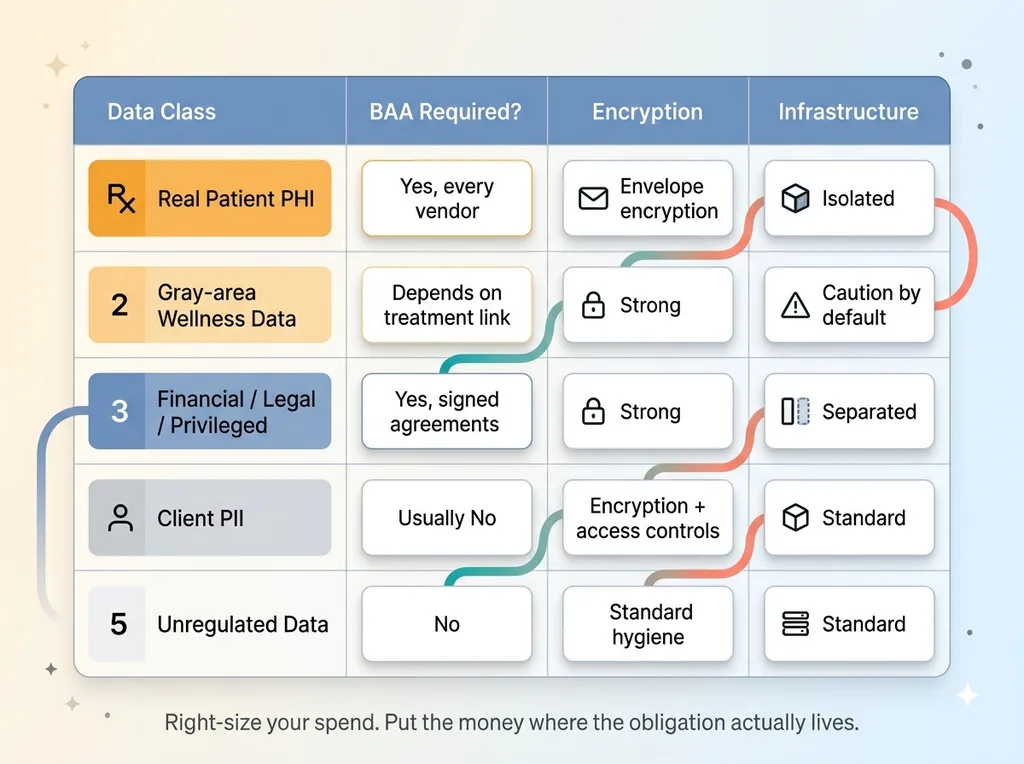 Per-Data-Class Compliance Baseline Matrix
Map your data to obligations:
- Real patient PHI: full HIPAA. BAA with every vendor, envelope encryption, isolated infrastructure. No shortcuts.
- Gray-area wellness data: it depends on whether it's tied to treatment or a covered entity. Step counts in a consumer app are usually fine. The same data flowing to a clinic is a different story. When in doubt, default to caution.
- Financial, legal, or privileged data: different regulatory regimes, but the same underlying logic. Signed agreements plus strong encryption.
- Client PII: encryption and access controls, but a lighter obligation than PHI. No BAA chain in most cases.
- Unregulated data: standard security hygiene. Don't gold-plate it.
The point is to right-size. Spend the money where the obligation actually lives.
The real monthly costs, verified
People want numbers, so here are the real ones I've verified building on these platforms.
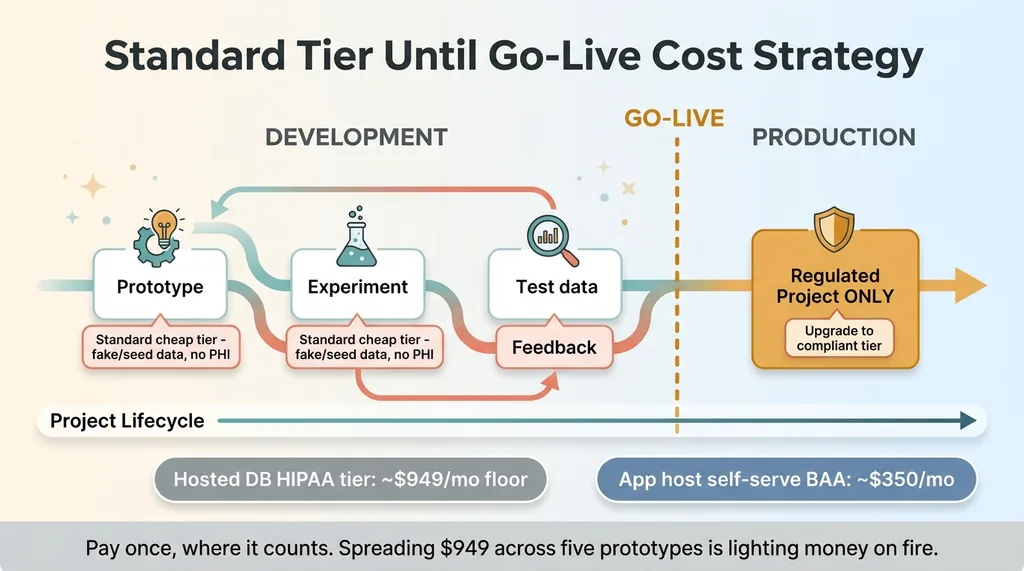
A major hosted database provider's HIPAA-eligible tier, plus the necessary add-on, plus the signed agreement, runs roughly $949 per month as a floor. That's the entry price to hold real PHI compliantly on that platform. Not nothing, which is exactly why you don't want it active on every prototype.
A common app host that used to gate compliance behind enterprise sales now offers a self-serve agreement at around $350 per month. That's a meaningful shift. The compliant tier is no longer enterprise-only, which lowers the floor for an early-stage health or fintech startup.
These numbers do two things. They tell you compliance has a real, recurring cost, so you plan for it. And they tell you that cost is contained to the regulated piece, not your whole stack, if you architect it right. A HIPAA startup that spreads the $949 tier across five prototypes is lighting money on fire. One that isolates the single regulated project pays once, where it counts.
The Rule I Build By: Standard Tier Until Go-Live
Here's my operating rule, clean and simple.
 Standard Tier Until Go-Live Cost Strategy
Build on the standard, cheap tier during development. Upgrade only the single isolated project to the compliant tier, and only at go-live, when it will actually hold real regulated data.
Don't spread expensive compliance across every experiment. Most of what you build during development uses fake data, seed data, or test records. There's no PHI in a prototype, so there's nothing to be compliant about yet. Paying $949 a month to protect dummy records is pure waste.
But don't isolate too late, either. The regulated project needs to live in its own infrastructure from early on, so that when go-live arrives, flipping to the compliant tier is a contained change, not a stack-wide migration. Isolation is what keeps your compliance scope and cost bounded. Without it, real PHI in one corner drags your entire stack into HIPAA territory, and now everything is in scope.
The calculus shifts by data class. I've built a longevity startup where the data was wellness-oriented and gray-area, which gave more room to move during development. I've also built a child-development app where the data leaned pediatric and sensitive, so I treated it cautiously from day one. Same operating rule, different threshold for when caution kicks in.
This ties straight back to the thin-architecture idea. The smaller your PHI footprint, the less you have to encrypt and the fewer BAAs you have to sign and maintain. Less regulated data flowing through fewer vendors means a cheaper, simpler, more defensible compliance posture.
Getting This Right Before You Ship
If you're a CEO building a health or fintech product, and your mental model is "we encrypt everything, we're compliant," you have a gap. It won't surface today. It'll surface during a breach, an audit, or a partner's due diligence review, and that's the worst possible time to discover it. The cleanup is expensive and the timing is never yours to choose.
The fix is cheap and fast if you do it before launch. Map your data classes. Sign the right agreements with every vendor that touches PHI. Separate your keys from your data. Isolate the regulated project so the scope stays contained.
None of this is theory for me. I've built and made these exact decisions across six regulated industries I rebuilt this year, from health to financial services. The pattern holds: two layers, both required, right-sized to the data.
The teams that get this wrong almost always got it wrong by doing too little on the legal side while feeling secure on the technical side. Encryption gave them false confidence. The BAA requirement was the thing nobody owned.
If you're standing up something that touches regulated data and you want the compliance baseline set correctly before go-live instead of after, that's the kind of work I do as your Chief AI Officer. Getting it right early is a few decisions and a few signatures. Getting it right late is a fire drill.
Get the next build note.
I write up each system I build, including what broke. Subscribe to my newsletter and I'll send you the next one.