Why Most Internal Tools Die When You Try to Sell Them
I build tools to solve my own problems. Running a DTC fashion brand in San Diego generates a steady stream of annoyances, and my default response is to write code until the annoyance goes away. Some of those tools turn out to be good. Good enough that I start wondering whether other people would pay for them.
That's the dangerous moment. The instinct is to slap a pricing page on it, write "SaaS" in your head, and start telling people you have a product. I've felt that pull more than once. The honest answer to whether you can turn an internal tool into a SaaS product is yes, but almost never the way you first imagine.
Here's the problem. An internal tool is built for exactly one trusted user. That user is you. It runs on one set of data, yours, and it carries a feature list padded with things you "meant to finish." None of those assumptions survive first contact with a paying stranger.
I've taken three of my own tools through this. A document-signing tool I built because I was tired of the existing options. A brand-building tool for my own marketing. An AI CRM I built to manage my own contacts. Each one started as a single-user shortcut. Each one needed real work before I could let anyone else near it.
This article is the conversion pass I run now. Three parts. First, security and ownership, because single-user code leaks everyone's data. Second, honest pricing, because most solo SaaS lists features that don't exist. Third, dropping the unfinished stuff instead of describing it on a sales page.
If you want the deeper companion to this, I wrote the honest way to turn an internal tool into a paid product. This piece is the field version.
The Single-User Assumption Is a Security Bomb
When you build for yourself, you skip the boring parts. That's not laziness. It's rational. You're the only user, so why build the machinery that keeps users apart?
Auth built for you alone leaks everyone's data
There's no row-level isolation in a single-user tool because there's only one row owner. There's no real authentication because there's only one login, and it's yours. You probably hardcoded a session or skipped auth entirely behind a private URL.
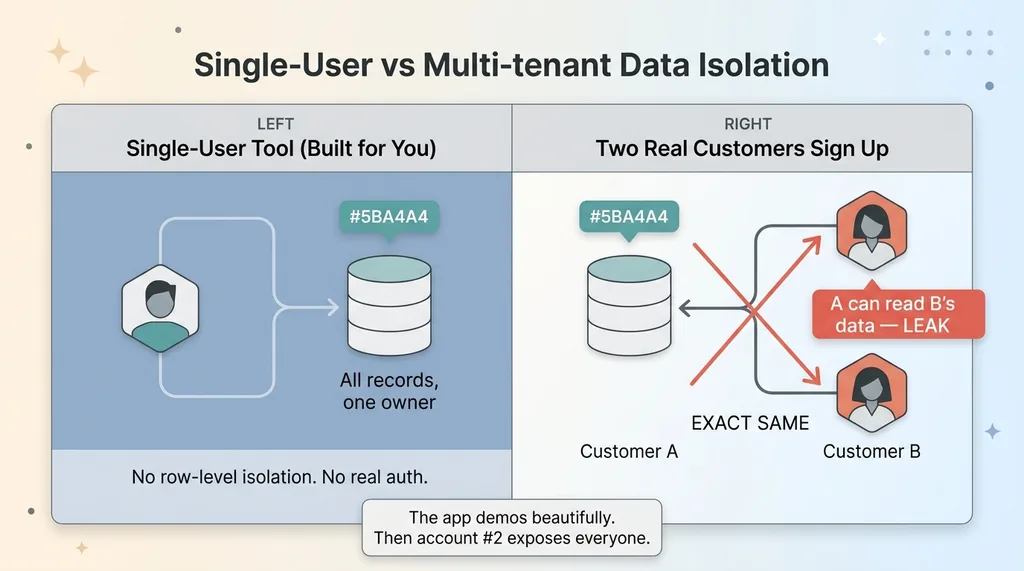 Single-user vs multi-tenant data isolation
That works perfectly until a second customer exists. The moment account number two creates a record, every record in your database can be read by every account unless you've explicitly stopped it. Your tool doesn't know whose data is whose. It was never asked to.
This is the single most common way I see AI-built SaaS fail. The app demos beautifully. Then two real users sign up and customer A can see customer B's contacts.
Ownership and isolation before you take a dollar
On the document-signing tool, the requirement was blunt. A signed document cannot be readable by the wrong account, and it cannot be deleted by anyone except its owner. That's not a feature. That's the floor. Hitting it required a real ownership model, where every document is tied to an owner and the database itself enforces who can touch it.
The AI CRM was worse. I'd built it to manage my own contacts, with zero thought to isolation. Before it could touch anyone else's data, I had to harden every read and write path so one customer's contacts could never surface in another customer's account.
The rule is simple. Harden auth, ownership, and data isolation before the pricing page goes live. Not after the first support ticket about a data leak. By then you've already burned the customer who found it.
This is the line between productizing a tool and exposing your customers. Data isolation should be a default, not a feature you add later. If it isn't enforced at the database layer, it isn't enforced.
Price Only What Ships Today: Kill the Vapor Tier
The most common dishonest move in solo SaaS, and in a lot of AI builds I get asked to review, lives on the pricing page.
Aspirational tiers describe features that don't exist
You've seen the pattern. Three tiers. The top one reads "Enterprise: SSO, advanced analytics, priority support, custom integrations." None of which exist. You haven't built SSO. You don't have advanced analytics. Priority support is you, the same as standard support, because you're one person.
So why is it there? Because it makes the middle tier look reasonable. It anchors the price. It's a psychological trick, and it works on the buyer's brain.
It's also vaporware with a price tag. You're describing software you have not written and inviting people to pay around it.
Drop it, don't list it
My rule across every product I converted is the same. Every tier exists today. Every feature listed is something a customer can use the minute they pay. If a capability isn't built, it doesn't go on the page, even when listing it would anchor the pricing better.
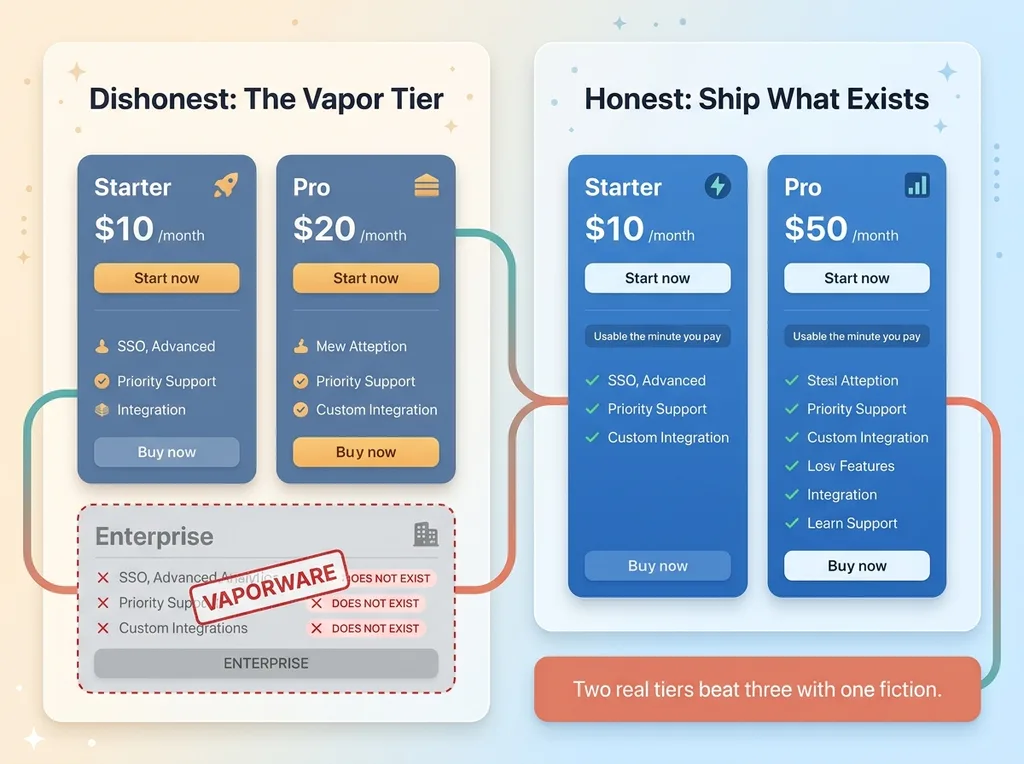 Honest pricing vs vapor tier pricing page
I'd rather ship two real tiers than three with one fiction in it.
On the brand-building tool, I had a whole third tier planned. Team features, shared workspaces, the works. None of it was built. The honest move was to kill the tier entirely rather than describe it as if it were live. So the page launched with what actually worked, and the planned tier stayed off until it was real.
This is partly a credibility play, and a long one. A customer who pays, then later discovers the top tier was empty all along, never trusts you again. They tell people. You traded a one-time pricing optimization for a permanent reputation cost.
I cover the full version of this in the honest way to productize a tool. Honest pricing isn't a nice-to-have. It's the thing that keeps customers after they buy.
The Conversion Pass: A Repeatable Gate, Not a Pricing Page
Turning an internal tool into a paid product is a deliberate decision, not a weekend pricing-page exercise. Here's the actual sequence I run.
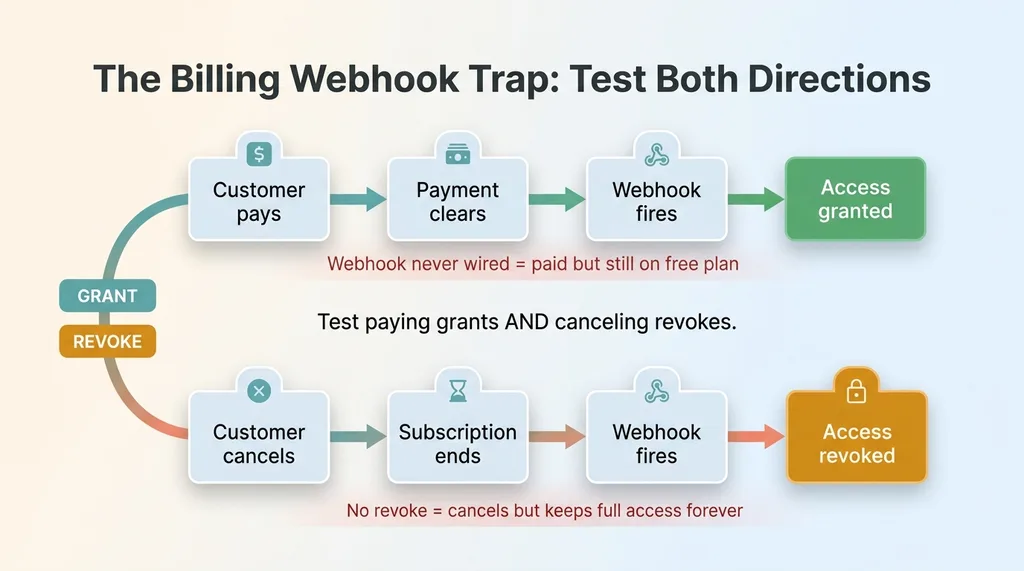 Billing webhook grants and revokes access loop
The checklist I run before charging anyone
- Auth and session security hardened for untrusted users. Assume the next signup is hostile, not your friend. Real login, real sessions, no hardcoded shortcuts.
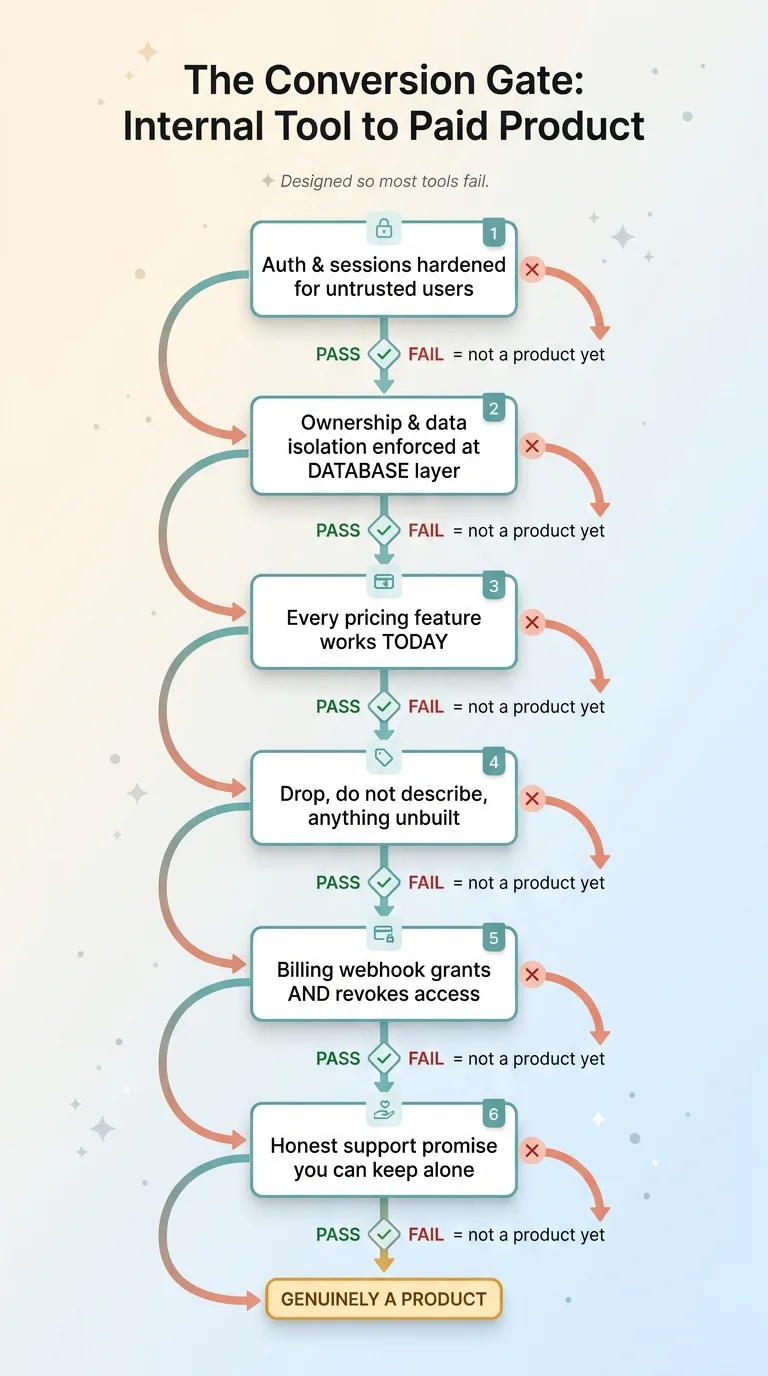 The 6-Step Conversion Gate Checklist
-
Ownership and data isolation enforced at the database layer. Every record has an owner. The database refuses cross-account reads. Not the application code, the database. App-layer checks get bypassed.
-
Every feature in the pricing table actually works today. Open the page next to the product. If something is listed but not live, it fails.
-
Drop, don't describe, anything unbuilt. No aspirational tiers. No "coming soon" sitting next to a price.
-
A billing webhook that actually grants and revokes access. This is the trap that gets everyone. People pay, the payment clears, and they stay on the free plan because the webhook was never wired up. Or worse, they cancel and keep full access forever. Test both directions: paying grants, canceling revokes.
-
An honest support promise you can keep alone. If you're one person, don't promise one-hour response times. Promise what's true.
Treat internal-to-commercial as a deliberate decision
Here's the part most people get backwards. This gate is designed so most tools fail it.
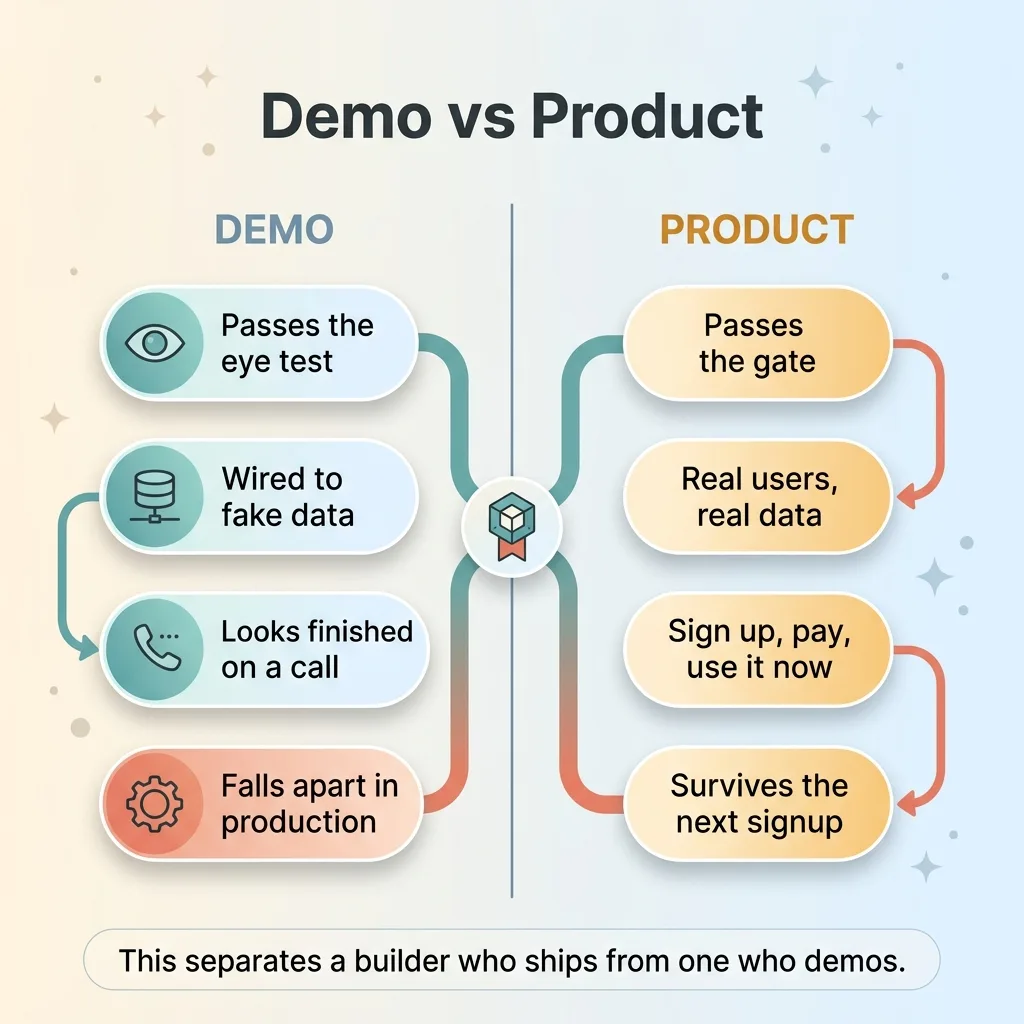 Demo vs Product distinction
I build 15-plus AI systems and the goal is not to monetize all of them. The point of the gate is to be high enough that the things I do sell are real. A tool that survives all six steps is genuinely a product. A tool that can't get past step two was never close.
This is what separates a builder who ships from one who demos. Demos pass the eye test. Products pass the gate.
Why This Matters to a CEO Evaluating AI Builders
If you've been burned by an AI vendor before, this whole conversion philosophy is the tell you should be looking for.
You know the pattern. Someone demos slick software in a call. It looks finished. You sign. Then it falls apart in production, or it turns out half of what you saw was a mockup wired to fake data. The demo existed. The product didn't.
A builder who only prices what ships, who hardens security before charging a dollar, who kills their own vapor tiers rather than describe them, is a builder who won't sell you vaporware either. The discipline is the same in both directions. The way someone treats their own products is exactly how they'll treat your build.
I run a real DTC brand on these tools. My +38% revenue per employee and -42% manual operations time came from systems I put my own money and my own customers behind. When I converted a tool to something other people could pay for, I was the first one exposed if it broke. That changes how carefully you build.
The skeptical CEO is usually right about vaporware. Your instinct to distrust the slick demo is correct. The honest version of "I built X" isn't a screen recording. It's being able to show it works, charge for it, and watch it survive real users.
That's the standard I hold my own products to. It's the same standard I'd hold your build to. If I tell you something is done, you can sign up, pay, and use it that minute. If it isn't, I'll tell you that too.
What I'd Build, and What I'd Refuse to Sell, for You
Maybe you have an internal tool. Maybe it's a spreadsheet someone on your team runs in their head, or a process you've always wished you could package and sell. The temptation is to ask "can we add a pricing page."
That's the wrong question. The real questions are whether the thing is secure enough, real enough, and honest enough to charge for. And if it isn't yet, what the conversion pass actually requires to get there.
I've done this across several of my own products. Built each one for myself first, used it daily, then ran it through the gate. The document-signing tool passed. The AI CRM passed after real hardening. Others I refused to sell, because the security wasn't there or the feature set was still half-imagined. Refusing to sell is part of the discipline, not a failure of it.
I'll run that same honest pass on whatever you've got. Sometimes the answer is "this is closer than you think, here's the three-week path to charging for it." Sometimes it's "this leaks data and should not touch a paying customer until it's fixed." Either way you get the truth, not a sales pitch.
Get the next build note.
I write up each system I build, including what broke. Subscribe to my newsletter and I'll send you the next one.