Your AI Skepticism Is Mostly Correct
Let me start by agreeing with you. If you've been wondering whether AI hype is real for business, the honest answer is that most of what you've been pitched is garbage. You're right to doubt it.
The pitches you've been hearing are tools looking for a problem
I've sat through the same demos you have. The salesperson leads with the technology. "Our platform uses a proprietary multi-agent orchestration layer." Cool. What problem does it solve in my business? Silence, or worse, a vague answer about efficiency.
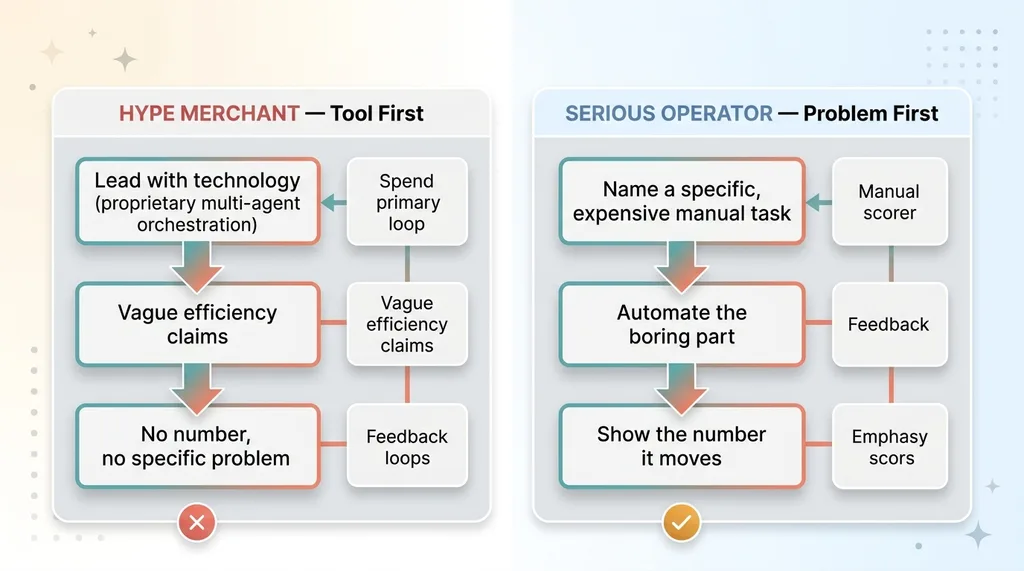 Pitch order: tool-looking-for-problem vs problem-first
That's backwards. A tool looking for a problem is not a solution. It's a line item.
The right order is simple: here's a specific, expensive thing you do by hand, here's how I'd automate the boring part of it, here's the number it moves. When a pitch doesn't open with your problem, it's because the vendor doesn't actually know your problem. They know their product.
Demos lie, and you know it
Every demo you've seen was rigged. Not maliciously, necessarily, but rigged. Cherry-picked inputs. Clean data. No edge cases. No failure modes. The model performs because it was given a tee-ball to hit.
Real data is filthy. Real volume breaks things. Real edge cases show up on a Tuesday afternoon when nobody's watching.
Here's the question that ends most demos: "What happens when the model hallucinates a price, or sends the wrong email to the wrong customer?" Watch the answer. A serious operator has a crisp response. A hype merchant gets uncomfortable, because "full autonomy" was the entire pitch and they never built for the moment it's wrong.
Being skeptical of this isn't a weakness. It's pattern recognition. If you've been burned by a vendor who overpromised, you learned the right lesson about vendors.
But here's the trap. You might be learning the wrong lesson about the underlying capability. Those are two different things, and confusing them costs real money. That's what the rest of this article is about.
Where the Hype Is Genuinely Garbage
Let me be specific about what doesn't work, because vague promises cut both ways.
The autonomy fantasy
Full autonomy is mostly fiction in production. I run more than 15 AI systems across my own DTC fashion brand and for clients, and every single one has a human checkpoint or a deterministic guardrail somewhere in the loop. On purpose.
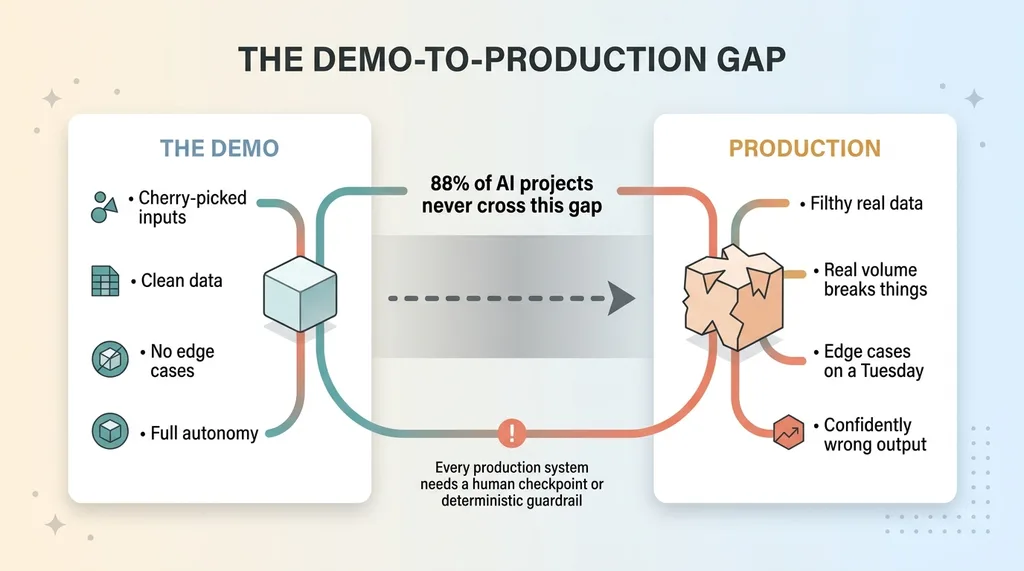 Demo vs Production reality gap
AI still produces confidently wrong output. It will give you a beautifully formatted, completely fabricated answer and not blink. Safety filters block legitimate work, I've had image models refuse perfectly ordinary product requests for reasons no human could explain. And "set it and forget it" is the exact mindset that produces a six-figure mistake while you're at lunch.
The autonomy you see in the keynote collapses under real data, real volume, and real edge cases. It's not that the technology is fake. It's that the gap between the polished agent in the demo and what actually ships to production is enormous.
This is why 88% of AI projects fail to make it into real use. It's not a hardware problem. It's the distance between a clean demo and a messy business.
The 'AI will transform your business' non-promise
"AI will transform your business" is a non-statement. It's the consultant equivalent of a restaurant saying "our food is delicious." Of course you'd say that. It costs nothing and means nothing.
Transform it how? By how much? Which process? At what cost? What breaks along the way?
If a vendor can't answer those, they're selling a feeling, not a result. The whole category is drowning in this kind of empty language, and it's a big reason serious CEOs have checked out.
So yes, a lot of the hype is exactly as hollow as you suspected. Now here's where it gets expensive.
The Expensive Mistake Hiding Inside Good Skepticism
Doubting the pitch vs. doubting the capability
The mistake isn't being skeptical of vendors. The mistake is letting that skepticism harden into doubt about the underlying capability.
The pitch is garbage. The shift is real. Both things are true at the same time.
When you've been lied to by enough demos, it's natural to conclude the whole thing is smoke. I understand the instinct. But that conclusion is wrong, and it's the most expensive wrong conclusion a careful CEO can make.
Let me give you numbers from my own operation, not projections from a slide. After deploying AI across my DTC brand, revenue per employee went up 38 percent. Manual operations time dropped 42 percent. I save more than 3,000 hours a year. My product creation pipeline went from 3 to 4 hours per product down to about 20 minutes, concept to live.
Those are shipped. Not pilots. Not someday. Running right now, on a real business with real customers and real inventory.
I'm not telling you this to brag. I'm telling you because it's evidence that the capability is real even when the marketing is fake. The AI didn't replace my judgment. It replaced the typing, not the strategy. I still decide what to make and how to price it. AI does the grinding work in between.
What your tech-forward competitor is quietly doing
Here's the part that should keep you up at night. While you correctly ignore the noise, somewhere a competitor with a serious operator is compounding small wins every week.
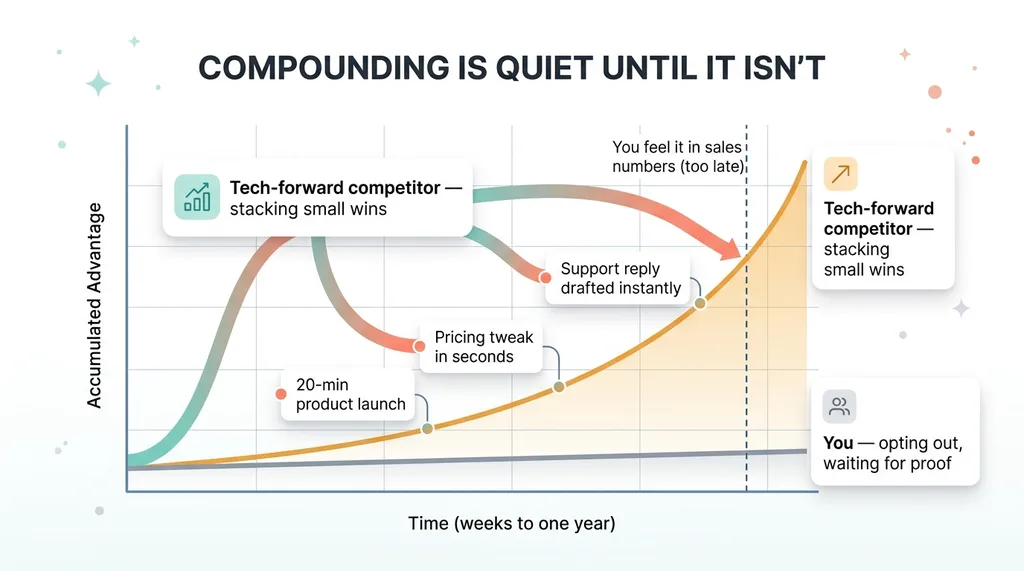 Compounding small AI wins over time
Not a big-bang transformation. A 20-minute product launch instead of a half-day. A pricing tweak that used to take an analyst a week. A support response drafted in seconds. Each one small. All of them stacking.
Compounding is quiet until it isn't. Losing a deal to a tech-forward competitor isn't the first warning sign. It's the late one. By the time you feel it in the sales numbers, they've had a year of accumulated advantage you can't buy back overnight.
You can be right about the hype and still lose the race.
How to Tell a Serious Operator From a Hype Merchant
So how do you point your skepticism at the right target? Here's the practical filter I'd use. Three tells.
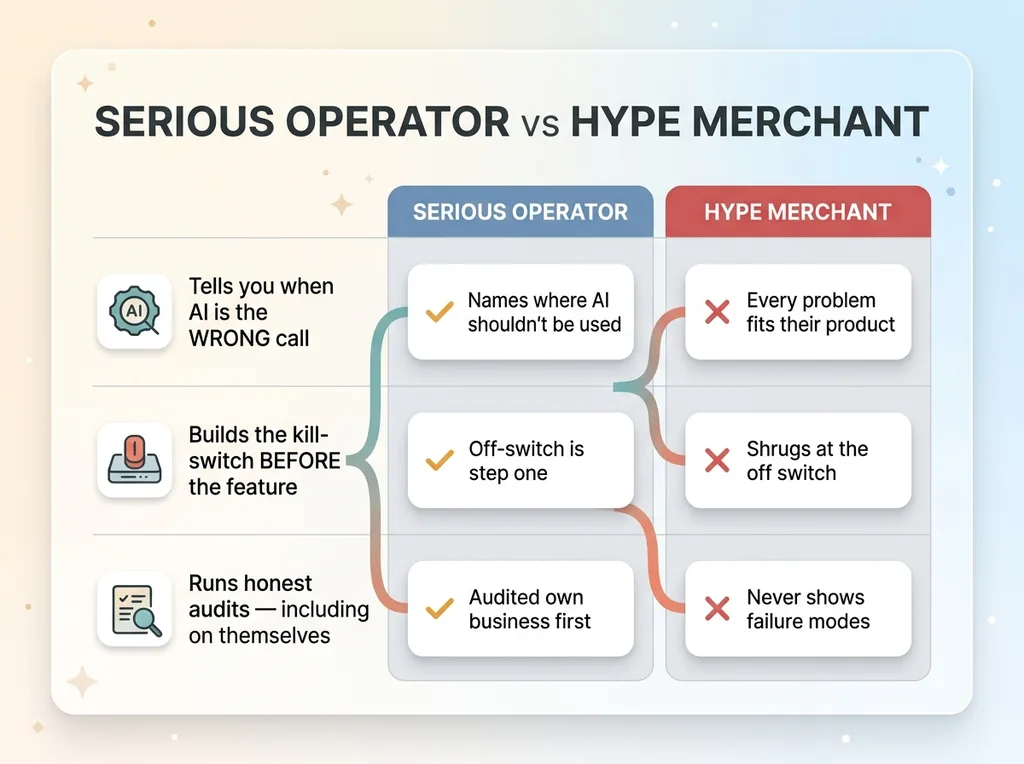 Three tells of a serious operator vs hype merchant
They tell you when AI is the wrong call
A serious operator will tell you, unprompted, where AI shouldn't be used.
I'll give you an example from my own systems. I built an AI trading tool to solve a problem of my own, and the actual risk management in it is fully deterministic. No AI allowed. Hard rules, written in plain code, that the model cannot override no matter how confident it sounds.
Why? Because risk is exactly the place where a confidently wrong answer wipes you out. The intelligence belongs in the analysis. The guardrails belong in code.
A hype merchant never tells you no. Every problem you describe is somehow the perfect fit for their product. That's not enthusiasm. That's a tell.
They build kill-switches before they build features
Anyone serious builds the shutoff before they build the feature.
Every production system I run has a kill-switch and a human checkpoint somewhere in the loop. Before I let an automation touch anything that matters, pricing, customer communication, money, I build the way to stop it. These are the kill-switches I build into every system, and they're not an afterthought. They're step one.
Ask any vendor where the off switch is. If the answer is a shrug, you have your answer about how much real production experience is behind the pitch.
They run honest audits, including on themselves
The third tell is the hardest to fake. A serious operator audits honestly, and that includes auditing their own work.
When I do an AI audit for a company, I run the same process on my own operation that I run on a client's. The first time I pointed my audit swarm at a business, it was my own. It surfaced what was broken before anyone paid me for the answer, processes I thought were efficient that weren't, automations that looked clever but added risk, places I was spending on AI where a simple rule would've done the job for free.
If you won't run the audit on yourself, you have no business running it on someone else.
A hype merchant never shows you the failure modes, never tells you no, and never turns the audit on their own claims. A serious operator does all three without being asked. That contrast tells you almost everything.
The Same Person Who Agrees With You Is the One Shipping
Here's the resolution to the tension. The operator who agrees the hype is garbage is exactly the one quietly shipping real systems.
Skeptics make the best builders
Skepticism is a feature in a builder, not a bug. It forces honest scoping. It forces real guardrails. It forces shipped results over slide decks.
I don't trust the demo either. That's precisely why the things I build actually work in production. A skeptic only ships what survives contact with real data, because a skeptic assumes it'll break and builds for that. The believer ships the happy path and gets surprised on Tuesday.
The people most immune to AI hype tend to be the ones who've spent the most time wrestling with what AI actually does and doesn't do.
Proof over slides
So instead of a slide, here's what skepticism builds when you turn it loose.
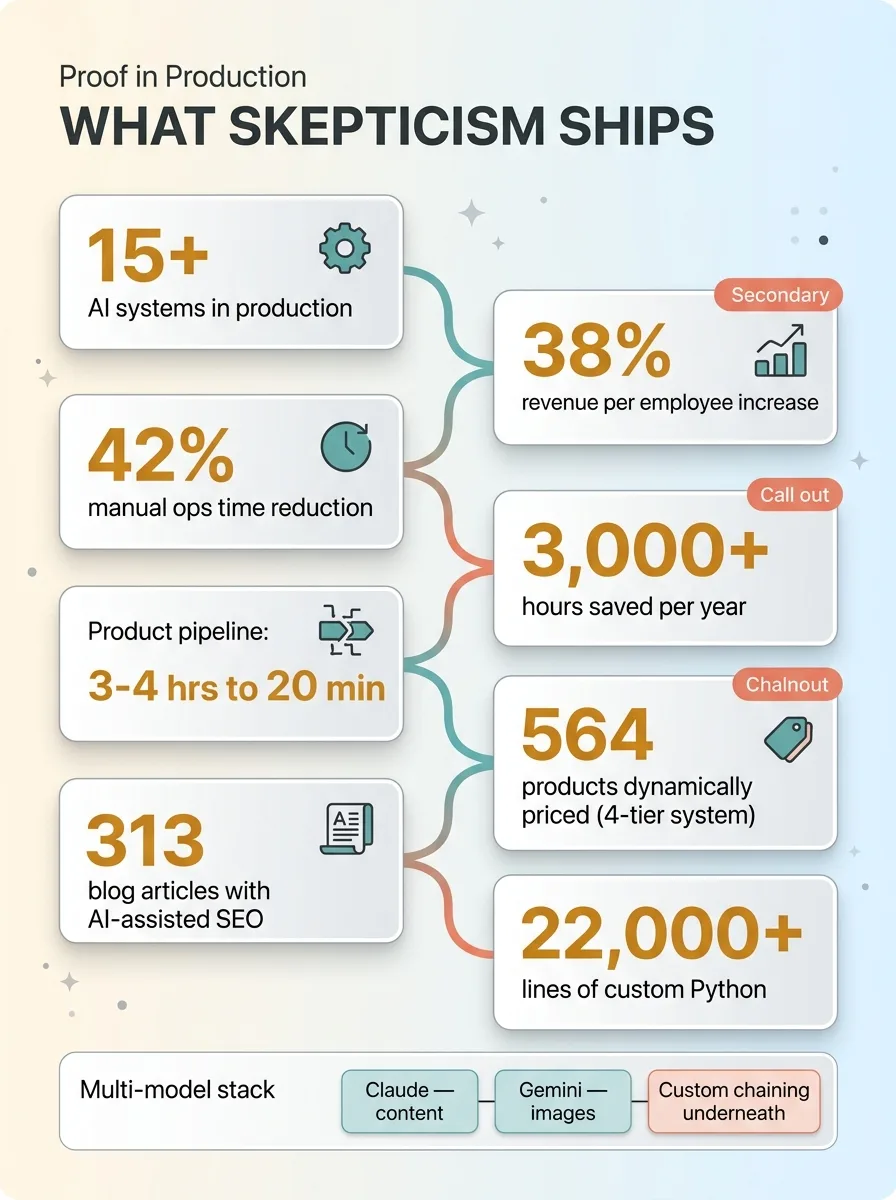 Proof in production, Mike's shipped AI systems by the numbers
More than 15 AI systems in production. 564 products dynamically priced with a four-tier classification system that updates without me touching it. 313 blog articles managed with AI-assisted SEO. Over 22,000 lines of custom Python holding the whole toolkit together. A multi-model setup, Claude for content, Gemini for images, custom chaining underneath, chosen because it's cheaper and more reliable, not because the names sound impressive.
None of that exists because I believed the hype. It exists because I didn't, and I kept building until I had something that worked at real volume.
This is why the skeptical CEO should listen to the person who shares the skepticism, not the one trying to sell past it. The salesman needs you to believe. The builder just needs the thing to work.
What to Do With Justified Skepticism
Keep the skepticism. Just point it at the right target.
The target isn't the capability. It's the people selling it. So put any AI vendor through a simple test. Ask them to show you the failure modes. Ask them where the kill-switch is. Ask them to name one place in your business where they'd tell you not to use AI at all.
If they can't answer all three, walk. A serious operator has those answers ready before you finish the question. A hype merchant fumbles, because their entire pitch depends on you not asking.
The way I work is straightforward: I build it, I don't just advise. There's a real difference between building AI and advising on it, and most of the people in this space have never shipped a system that had to survive real customers. I have, on my own business, where the downside lands on me.
The natural first step is an honest audit. A clear-eyed look at where AI genuinely helps your operation and where it would be a waste of money, from someone who shares your doubts and has no incentive to oversell you. I'll tell you the places it's worth doing. I'll also tell you the places where a spreadsheet and a rule would beat any model, because plenty of those exist too.
The right move for a skeptic isn't to opt out. The hype is real garbage and the capability is real value, both at once, and opting out only protects you from one of them. The right move is to find the one person who'll tell you the truth about what AI can and can't do for your specific business.
Get the next build note.
I write up each system I build, including what broke. Subscribe to my newsletter and I'll send you the next one.