CAC LTV Payback Analysis: Why I Killed the Hot Channel
A CAC LTV payback analysis showed paid social cost $929 to acquire a $605 customer. Here's how I ran the numbers and launched organic-first instead.
By Mike Hodgen
The Channel Everyone Wanted to Pour Money Into
A longevity and telehealth membership was getting ready to launch, and everyone agreed on the obvious first move. Pour money into paid social on the hottest category in the space: weight-loss and GLP-1.
It made sense on paper. That category has the search volume. The demand. The urgency. People are typing those terms into Google at midnight with a credit card already out. The advisors said scale fast. The team said scale fast. The founder's gut said scale fast. Outbid everyone, grab share, figure out the rest later.
I ran the unit economics before we spent a dollar, and the numbers said don't.
Not "be careful." Not "watch your spend." They said the fully-loaded cost to acquire a customer on that channel exceeded that customer's entire lifetime value. Every order would be a guaranteed loss, and scaling the channel would just make us lose money faster.
This is the analysis I run before any paid channel gets a budget. It's a CAC LTV payback analysis, and it's the difference between growth and a well-funded bleed. If you're about to scale a paid channel because the demand looks obvious, this is the math you run first.
Building this kind of business is hard enough on its own. I wrote separately about standing up a regulated telehealth brand and how much overhead the medical and compliance layer adds. That overhead matters here, because it's part of what made the obvious channel a trap.
Here's how I knew, and what we did instead.
What a CAC LTV Payback Analysis Actually Measures
A CAC LTV payback analysis compares the fully-loaded cost to acquire a customer against the gross-margin lifetime value that customer generates, then asks how long before they pay you back. Three numbers decide everything.
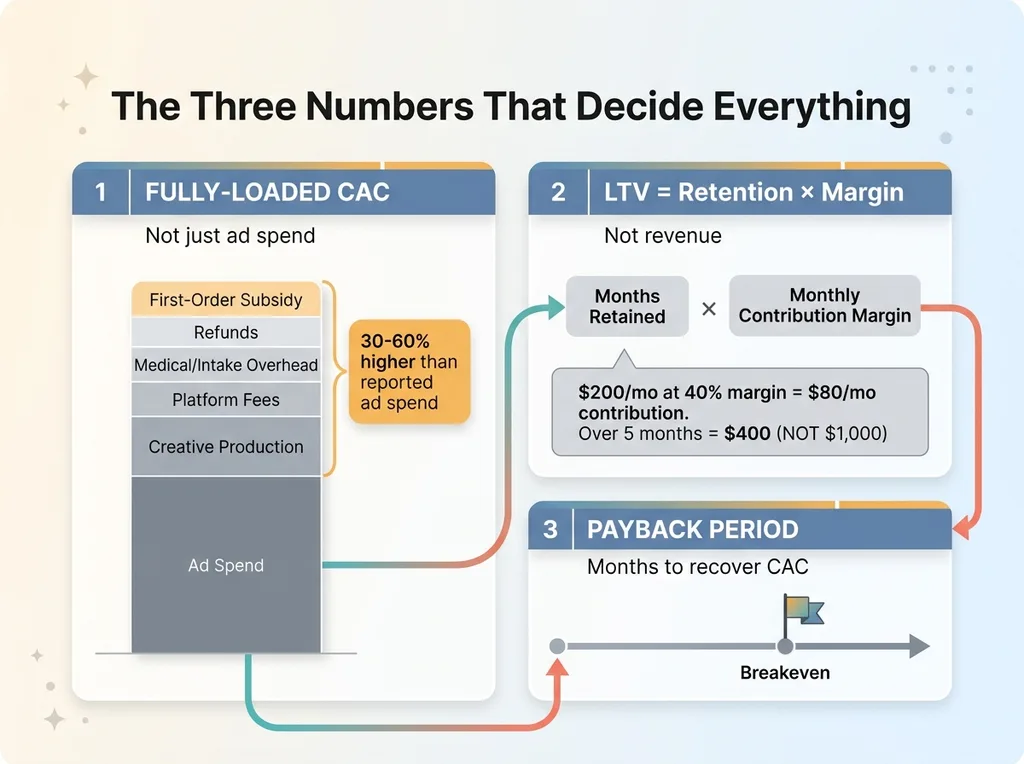 The Three-Number Anatomy of CAC LTV Payback
Fully-loaded CAC, not just ad spend
Most founders count ad spend and stop. That's not your real cost to acquire.
Fully-loaded CAC is ad spend plus the landed cost of the entire funnel. Creative production. Platform fees. In a regulated vertical, the medical and intake overhead per signup. Refunds. The first-order subsidy you offer to get someone in the door.
When you add it all up, the number is usually 30 to 60 percent higher than the ad spend you were reporting to yourself. That gap is where founders quietly go broke.
I made this exact mistake on my own ad systems before I fixed it. I wrote about why I switched my ad bot from ROAS to profit, because blended ROAS hides the costs that actually determine whether you're winning.
LTV is retention times margin, not revenue
The second number people inflate is LTV. They take topline revenue and call it lifetime value. Wrong.
LTV is months retained multiplied by monthly contribution margin. Not revenue. The margin you actually keep after cost of goods, fulfillment, and the recurring cost to serve.
A customer paying $200 a month at a 40 percent margin isn't worth $200. They're worth $80 a month in contribution. Over five months that's $400, not $1,000.
The third number is the payback period: how many months to recover your fully-loaded CAC. The discipline here is refusing to count revenue you don't keep and refusing to pretend acquisition costs aren't acquisition costs.
Running the Numbers on the Hot Category
Here's the actual math, anonymized.
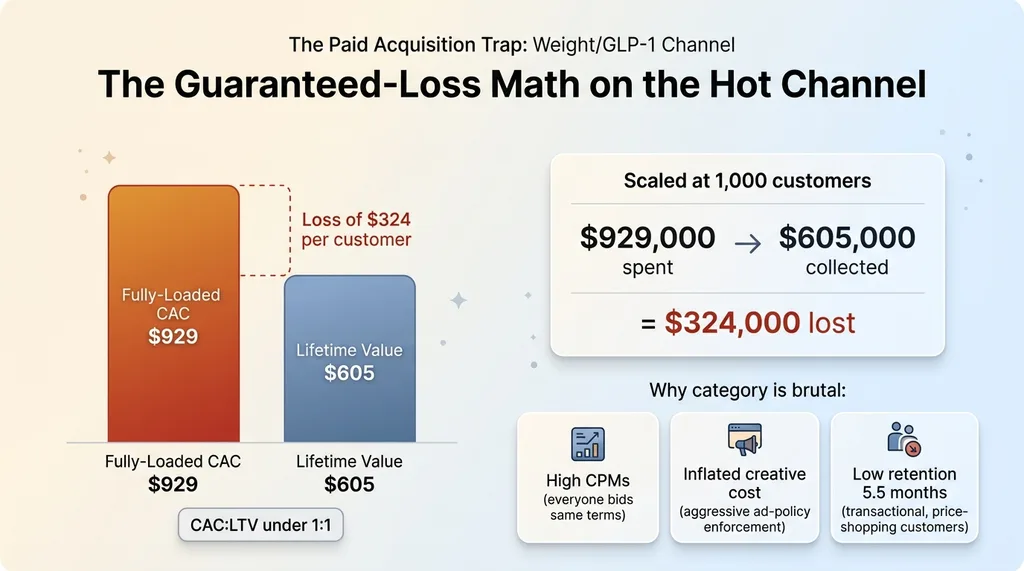 The Guaranteed-Loss Math on the Hot Channel
Paid social CAC on the trendiest weight category ran roughly $929 fully loaded. High CPMs because everyone in the space was bidding on the same terms. Inflated creative cost because the ad platforms police that category hard, so you burn budget on rejected ads and constant rework.
That cohort retained a mean of about 5.5 months. At their monthly contribution margin, that produced a lifetime value of roughly $605.
Read those two numbers together. I would pay $929 to acquire a customer who, over their entire relationship with the brand, hands me $605 in margin and then leaves. The ratio is under 1:1. The payback period is longer than the customer stays.
That's not a thin margin. That's a guaranteed loss on every single order. Acquire 1,000 customers this way and you've spent $929,000 to collect $605,000. Scaling that channel doesn't grow the business. It accelerates the bleed.
This is what I call the paid acquisition trap. The channel looks healthy because the clicks are cheap relative to your topline revenue per customer. The dashboard shows volume. The signups roll in. It feels like momentum.
But the category is brutal for three specific reasons. CPMs are sky-high because every competitor is chasing the same intent. Creative cost is inflated by aggressive ad-policy enforcement in the health and weight space. And retention is low because these customers are transactional. They came for a result, they shop on price, and they leave the moment a competitor undercuts you by ten dollars.
High cost to acquire, high cost to convince, low loyalty. That's the worst possible combination, and it's exactly the channel everyone wanted to pour money into.
Churn Was the Real Killer, Not CAC
The instinct, once you see a bad CAC number, is to fix CAC. Better creative. Cheaper clicks. Tighter targeting. Squeeze the $929 down.
That instinct is wrong here, and seeing why is the whole game.
Why short retention destroys payback
Suppose I'm brilliant and I cut CAC in half, down to $465. The customer still retains 5.5 months and still generates $605 in lifetime margin. Now I'm marginally profitable, barely, with zero room for error and no margin to reinvest.
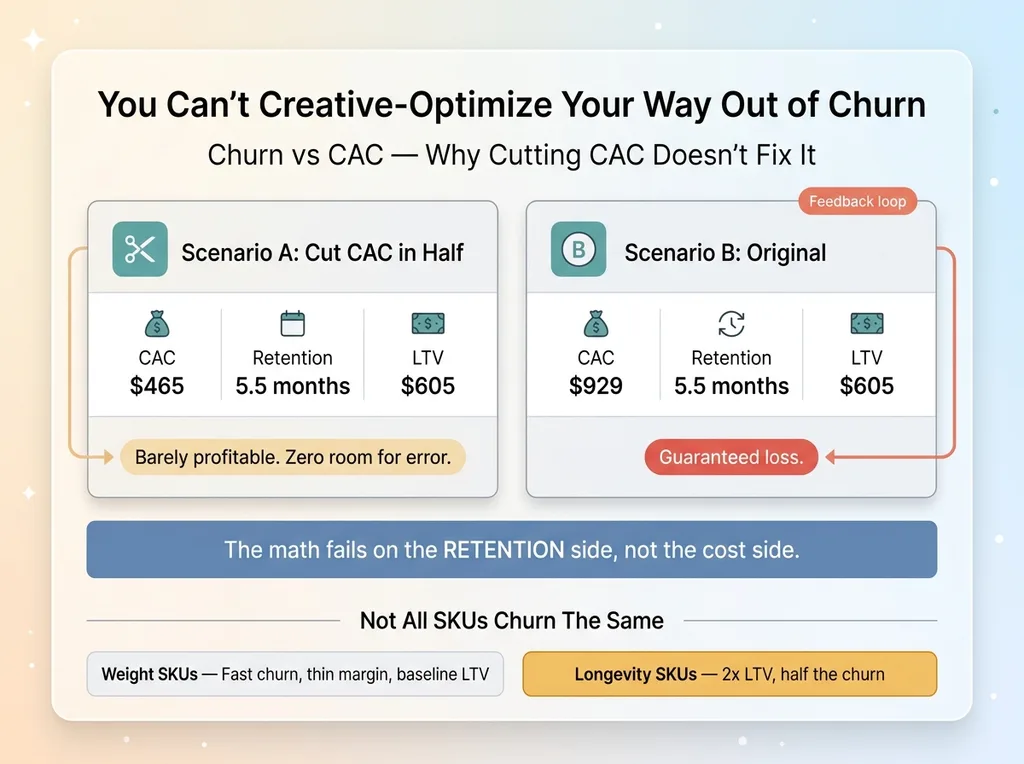 Churn vs CAC, Why Cutting CAC Doesn't Fix It
A 5.5-month customer barely works no matter what you pay to acquire them. The math fails on the retention side, not the cost side. Churn vs LTV is the relationship that decides the outcome, and you can't creative-optimize your way out of customers who leave.
Not all SKUs churn the same
Here's the insight that changed the entire launch plan: churn isn't uniform across the catalog.
The weight category churned fast and carried thin margin. But the longevity SKUs in the same membership, sold through the same funnel, carried roughly double the LTV and half the churn. Those customers stayed longer and paid back comfortably.
Same business. Same brand. Same checkout. Completely different unit economics depending on which product the customer walks in through.
That's the lever most founders miss. You don't only optimize the channel. You steer who you acquire. The product a customer enters through predicts how long they stay and how much they're worth, and that prediction often matters more than the cost of the click.
The Disciplined Answer: Organic-First and Steer the Catalog
Once the math was clear, the decision was clear. We didn't run paid at launch. Not a dollar.
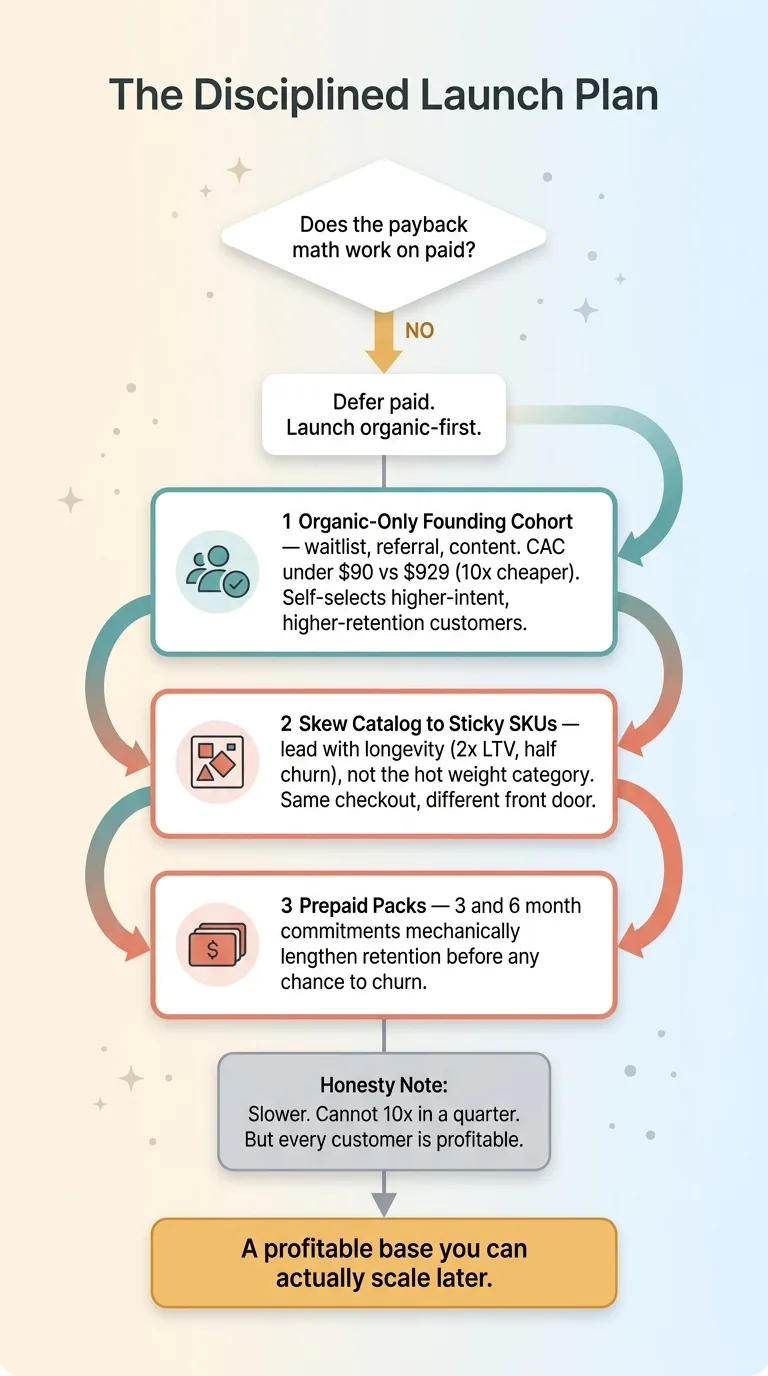 The Organic-First Decision and Three Disciplined Moves
Launch the founding cohort organic-only
The founding cohort came in organic-only: waitlist, referral, content marketing. CAC came in under $90 instead of $929.
That's a 10x difference in acquisition cost, but the cheaper number isn't even the best part. An organic-first launch strategy self-selects. People who join a waitlist or come through a referral are higher-intent and higher-retention by nature. They didn't get interrupted by an ad chasing a quick result. They sought you out. They stay longer.
So organic didn't just lower the cost. It improved the quality of the cohort on the exact dimension, retention, that was breaking the paid math.
Skew acquisition toward the sticky SKUs
The second move was to deliberately skew the messaging and the catalog toward the longevity SKUs, the higher-LTV, lower-churn products, instead of leading with the hot weight category everyone expected.
The weight category still existed in the catalog. We just stopped using it as the front door. We led with the products that produced customers worth keeping.
Prepaid packs to lengthen lifetime
The third move was prepaid packs, 3-month and 6-month commitments, instead of pure month-to-month.
When a customer prepays six months, you've mechanically lengthened their retention and improved your payback before they've had a single chance to churn. It moves the LTV number on the spreadsheet because it moves the actual behavior.
Now the honest part. Organic is slower. You cannot 10x in a quarter on waitlist and referral. There were quarters where paid would have produced more raw signups. But every organic customer was profitable, and a profitable base is something you can actually scale later. A base bleeding $324 a head is not.
I ran every one of these scenarios through a model. Every CAC, every retention curve, every prepaid mix. But the model didn't make the call to walk away from the obvious channel. That was judgment. I wrote about this exact distinction in AI replaced the typing, not the strategy. The tool runs the math. Deciding to ignore the channel everyone in the room wanted is strategy, and no model spits that out for you.
When Paid Acquisition Actually Becomes Worth It
This wasn't anti-paid dogma. Paid was deferred, not banned.
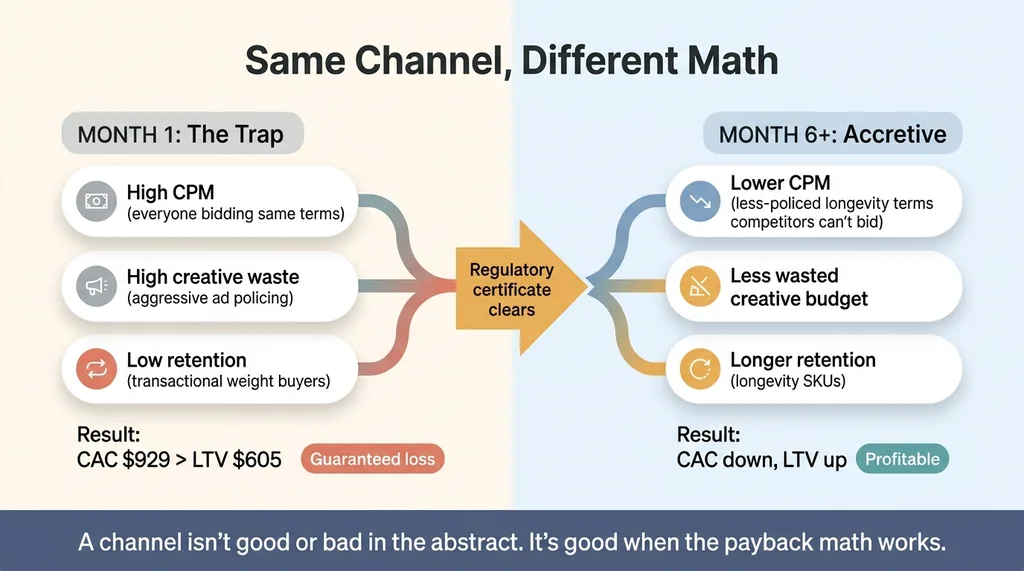 When the Same Channel Flips From Trap to Winner
The plan had a specific trigger. Once a regulatory certificate cleared, it would unlock cheaper, less-policed longevity search terms, a credential that lets you advertise on terms your competitors legally can't touch, at far lower CPM, with much less ad-policy friction.
At that point the entire CAC math flips. Lower CPM means lower acquisition cost. Less policing means less wasted creative budget. Steering toward longevity SKUs means longer retention and higher LTV. The same paid motion that was a guaranteed loss in month one becomes accretive.
That's the principle worth keeping. A channel isn't good or bad in the abstract. It's good when the payback math works. The exact same channel can be a trap today and a winner in six months because one cost input changed.
Here's the test I give every founder. Would you take this trade with your own money, one customer at a time? Not blended, not averaged across a thousand orders where the winners hide the losers. One customer. You hand over $929 and you get $605 back over the next five months. Would you do that deal, by hand, repeatedly?
If the answer is no, scaling it doesn't fix it. Scaling a money-losing trade just means you do the bad deal more times. Volume never rescues unit economics. It only multiplies them.
Run the Math Before You Run the Ads
So should you pour money into paid ads to grow fast? Only if a fully-loaded CAC LTV payback analysis says the customer pays back inside their lifetime. That's the whole answer.
Most founders scale on blended ROAS. They watch a number that mixes winners and losers and feel like they're winning, while quietly losing money on a meaningful share of every order. The dashboard looks great right up until the cash runs out.
The discipline that beat the obvious channel here was boring. Count every cost, including the funnel overhead and the first-order subsidy nobody wants to count. Count only the margin you actually keep, not topline revenue. And let your worst-case cohort, not your blended average, decide whether you spend. Worst-case discipline is what kept this brand from launching straight into a loss.
I build the unit-economics models and the dashboards that surface this before a dollar leaves the door. The CAC math, the retention curves by SKU, the payback periods, the scenario tests on every channel. And I'll tell you when the answer is don't, because that answer is worth more than any campaign I could help you scale.
If you're staring at a hot channel and everyone's telling you to pour money in, have me run the unit economics before you scale.
Ready to bring AI leadership into your company?
I work with a small number of companies at a time. If you're serious about AI, apply to work together and I'll review your application personally.
Get AI insights for business leaders
Practical AI strategy from someone who built the systems — not just studied them. No spam, no fluff.
Hodgen.AI
Ready to automate your growth?
Book a free 30-minute strategy call with Hodgen.AI.
Book a Strategy Call