AI for Custom Manufacturing: Quote-to-Cash, Rebuilt
How AI for custom manufacturing replaces paper measurements, rented quoting tools, and spreadsheet commissions with one shared bill-of-materials brain.
By Mike Hodgen
What a Custom Quote Used to Cost You (Before AI)
Picture a custom window-treatment business. A rep drives to a customer's house, measures every window with a tape and a clipboard, and writes the numbers down on paper. Then she drives back to the office and retypes those measurements into a quoting tool the company rents by the seat. A tool that, by the way, owns the customer data she just entered.
That's link one in the chain. There are four more.
The relay of manual handoffs
Once the quote gets accepted, someone reads the order and hand-builds a packing list, line item by line item. Then they eyeball install routes against a wall calendar, trying to remember which jobs are near each other so the crew doesn't burn half a day driving. At the end of the month, one person tallies commissions in a five-tab spreadsheet that nobody else fully understands.
Every one of these steps is a retype, a re-read, or a re-key. And every retype is a chance to fat-finger a measurement. In a made-to-order business, a measurement that's off by an inch becomes a wrong-sized product nobody can return. That's not a billing dispute. That's scrapped material and a furious customer.
The single point of failure
Here's the part that should keep you up at night. The whole chain depends on one or two people who hold the process in their heads. The person who knows how the commission spreadsheet works. The person who knows which install routes make sense. If they quit, the knowledge walks out the door with them.
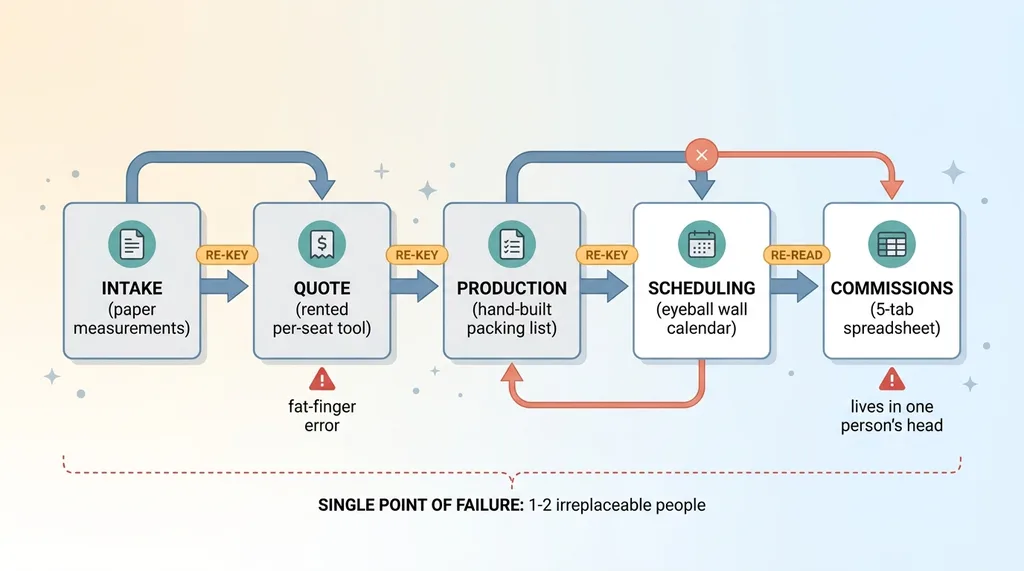 The five-link manual handoff chain vs single point of failure
This is how most custom manufacturers and trades actually run. It's a relay of manual handoffs held together by a couple of irreplaceable people.
The good news: each link in this chain has an AI-native replacement. And they all share one thing. A single source of truth.
The One Thing That Fixes the Whole Chain: a Shared BOM Brain
Before I walk through rebuilding each link, you need the architectural idea that makes the whole thing work. Because if you get this wrong, you just buy five disconnected tools and create five new places for data to drift.
Why the data has to live in one place
In a made-to-order business, every single step is downstream of the same thing: the bill of materials. The quote is computed from the BOM. The packing list is the BOM. The parts demand rollup is a sum of BOMs across open orders. The commission is a percentage of the BOM-derived price.
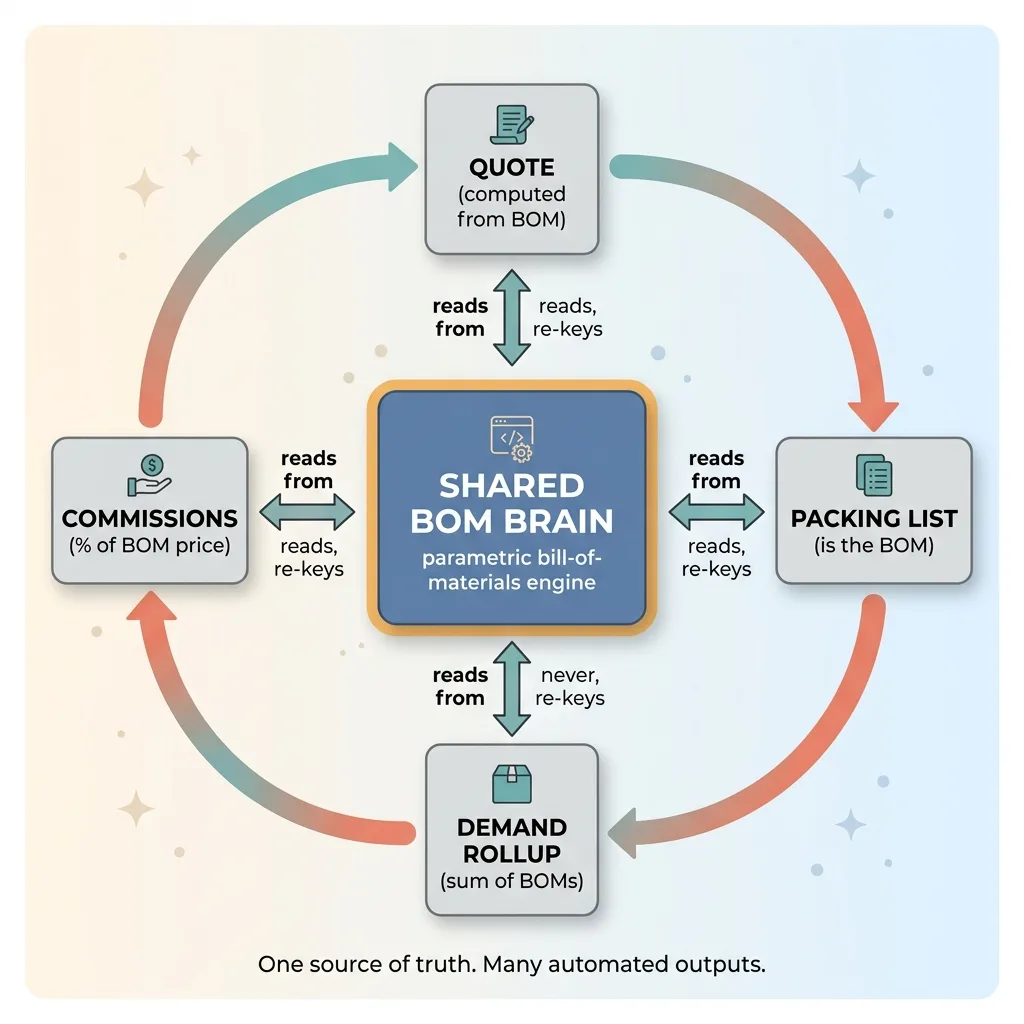 Shared BOM brain as single source of truth feeding all downstream systems
The old failure mode was that the data lived in a rented quoting tool and got re-entered everywhere else. Five steps, five copies, five chances for them to disagree.
The fix is one shared BOM brain that every other system reads from. You build a parametric bill-of-materials calculator as the engine, and every downstream system reads from it instead of re-keying. Quote, packing, scheduling, commissions. All reading the same numbers.
Code does the math, AI handles the messy input
Here's the line I draw, and it matters. AI is excellent at parsing messy real-world input: a photo of a window, a spoken measurement, a scrawled note. But AI does not compute your materials, costs, and quantities. Deterministic code does.
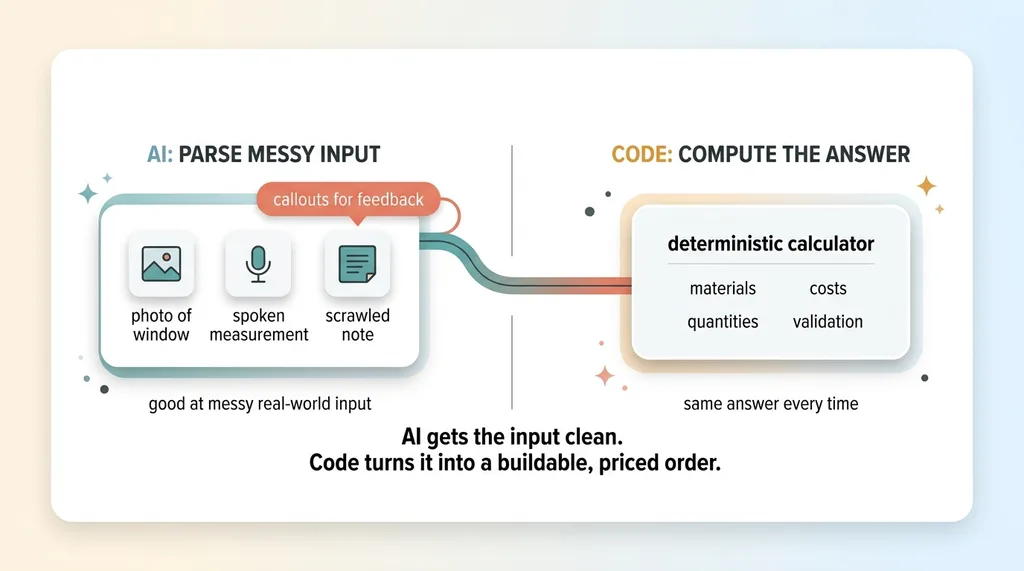 AI parses messy input, deterministic code does the math
A quote that's off by an inch isn't a creative problem. It's a math problem, and math problems get solved by code that produces the same answer every time. AI gets the raw input clean. Code turns it into a buildable, priced order.
That division of labor is the spine the rest of this article hangs on. Now let's rebuild the chain, one link at a time.
Intake: From Paper Measurements to Photo and Voice
The first link is the clipboard. Let's get rid of it.
Snap a photo, speak the numbers
Instead of writing measurements on paper and retyping them at the office, the rep captures them where the work happens. A photo of the window and the dimensions spoken out loud feed straight into the configurator. No paper. No drive back. No retype.
This is how field quoting actually works when you build it right. The measurement goes from the customer's living room into the system once, and only once. Every retype you eliminate is a fat-finger error you'll never make.
Server-side validation catches errors at the source
Here's the part that changes the economics. Validation happens at the source, not three steps later.
When the rep enters a measurement that can't physically produce a valid product, the system flags it before she leaves the customer's home. Not after the wrong product gets manufactured. Not when the install crew shows up with a blind that doesn't fit.
In the old chain, an impossible measurement traveled all the way through quoting, production, and packing before anyone noticed. By then you've cut material and burned a week. Catching it at intake means the rep re-measures while she's still standing in front of the window.
This is the same principle whether you're measuring windows, fabricating countertops, or sizing any field-measured made-to-order product. Get it right where the work happens, and the rest of the chain stops inheriting your mistakes.
Quote and Configure: The Tool You Own vs. the Tool You Rent
Now the rep has clean measurements in the system. Next she needs a quote. This is where most businesses make a quiet, expensive decision: they rent.
Server-validated configuration
A rented per-seat quoting tool will happily let you configure a product that can't actually be built. It doesn't know your BOM rules. It just collects fields and spits out a number.
An owned configurator that reads from the shared BOM brain validates every combination against the rules. You can't quote a product that can't be built or priced, because the same engine that computes the materials also decides whether the configuration is valid. Quote-time and build-time use the same logic. They can't disagree.
Owning your data instead of leasing it
The build-versus-rent question comes down to two things: cost and control.
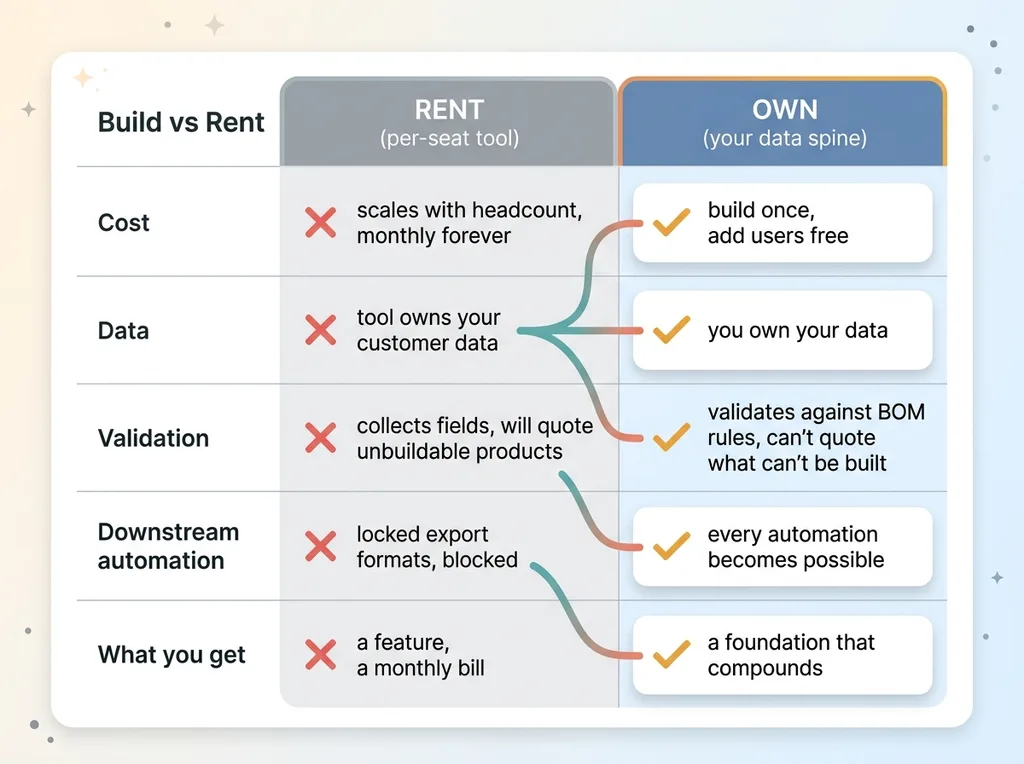 Build vs Rent comparison for quoting tools
Per-seat licensing scales with your headcount. Every rep you hire is another seat you pay for, every month, forever. An owned system doesn't work that way. You build it once and add users without adding rent.
But the bigger issue is the data. The rented tool owns your customer data and locks you into its export formats. That sounds like a minor inconvenience until you try to build anything downstream from it. You can't automate packing, routing, or commissions off data you can't freely access.
When the data stays in your system, every downstream automation becomes possible. That's the real difference. Renting software gives you a feature. Owning your data spine gives you a foundation that compounds. One is digital transformation. The other is just a monthly bill.
Production and Packing: Automated Demand Rollups, No Hand-Built Lists
Now we're in the middle of the chain, where the spreadsheets and the head-knowledge really pile up.
Rolling demand up across every open order
The old way: someone reads each order and mentally rolls up parts demand across all the open jobs. How many brackets do we need this week? How much fabric? It lives in a spreadsheet, or worse, in someone's head.
Because every order now shares the same BOM brain, the system rolls parts demand up across all open jobs automatically. Every bracket, every yard of fabric, every component, summed across every active order in real time. This is the core of quote-to-order automation: the order isn't a piece of paper someone interprets, it's structured data the system already understands.
You stop guessing what to order. The system already knows, because it knows every BOM behind every open job.
Packing lists that build themselves
The packing list is just the BOM, presented for the warehouse. So it builds itself from the same data the quote came from.
No re-keying. No missed line item. No "we forgot to order the brackets for Tuesday's install."
That last error is the one that hurts. A hand-built packing list that misses a single component stalls an entire install day. The crew drives out, opens the box, and the bracket isn't there. Now you've burned a truck roll, a crew's morning, and a customer's patience over one line item someone forgot to type.
When the list builds itself from the order data, that error class disappears. The packing list can't forget a component, because it isn't being assembled by hand. It's being read from the same source of truth as everything else.
Scheduling and Commissions: The Spreadsheet That Could Quit
The last two links are where the "one or two irreplaceable people" risk lives. Let's address it directly.
AI plus routing for install scheduling
Eyeballing a wall calendar to plan install routes is exactly the kind of work that looks like judgment but is mostly geography. Which jobs are near each other? Which order minimizes drive time?
An AI-plus-routing scheduler clusters installs by location and proposes routes that cut windshield time. It looks at every open install, the crew's availability, and the map, and it suggests a plan.
But it suggests. A human still approves the final routes. The scheduler doesn't know that one customer asked for a morning slot, or that a crew lead has a dentist appointment. So a human approves at every gate. AI proposes the efficient route. The operator adjusts and confirms. That's the right division of labor.
The commission engine that doesn't live in one person's head
Then there's the five-tab commission spreadsheet, calculated every month by the one person who understands it. That person is a single point of failure wearing a friendly face.
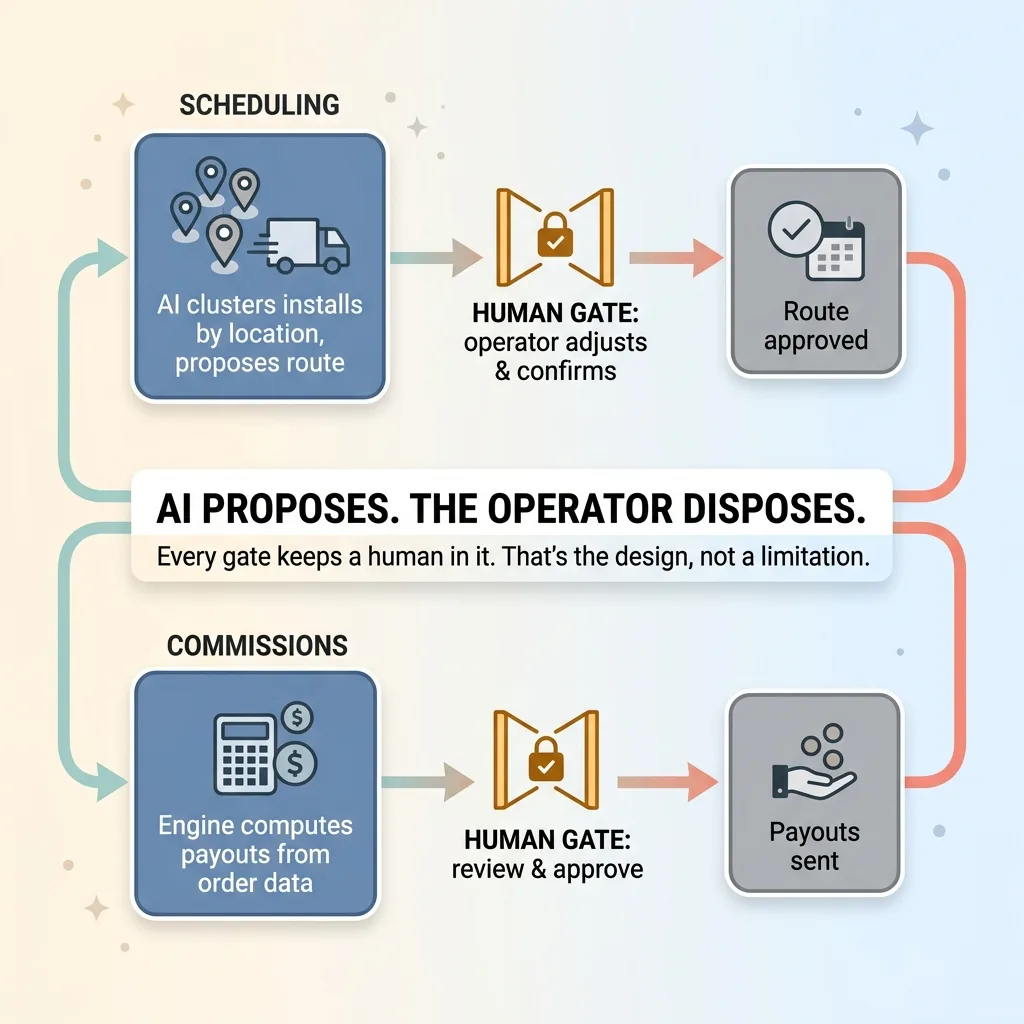 AI proposes, human disposes, human-in-the-loop gates
I've watched this exact problem get solved by automating the commission process. The commission engine computes payouts from the same order data the quote and packing list came from. The rules live in code, not in someone's memory. When that person takes a vacation, or quits, or just gets sick during a payroll week, the numbers still come out.
This is the heart of the fix. The knowledge moves out of someone's head and into a system anyone can read, audit, and trust. You stop being held hostage by who knows the spreadsheet.
And just like scheduling, commissions still have a human sign-off before payouts go out. The engine computes, a person reviews and approves. AI proposes, the operator disposes. Every gate keeps a human in it, and that's not a limitation. That's the design.
The Pattern Any Made-to-Order Business Can Copy
Step back and the lifecycle is the same for almost every custom manufacturer or trade I've seen. Intake, configure, produce, schedule, pay. A relay of five handoffs.
One source of truth, many automated outputs
The unlock isn't five clever tools. It's one shared BOM brain underneath all of it, so each step reads instead of re-keys.
The quote reads it. The packing list reads it. The demand rollup sums it. The commission engine prices off it. When the data spine is right, every downstream step becomes an automated output of the same source of truth. That's what AI in the trades actually looks like when it works: not a chatbot bolted onto an old process, but a clean data spine that lets each link automate off the one before it.
Where to start if you're held together by spreadsheets
Here's the honest part. Modernizing a spreadsheet-held quote-to-cash process does not mean ripping everything out at once. It means replacing the data spine first, then letting each downstream step automate off it.
You build the shared BOM brain. Then intake. Then quoting. Then packing, scheduling, commissions, in whatever order hurts most. Each step is real engineering, not a plug-in you download. And the human-in-the-loop gates aren't a sign it's unfinished. They're the point.
If your quote-to-cash chain lives in a rented tool, a stack of spreadsheets, and a couple of people's heads, that's exactly the situation this pattern was built for. Here's what modernizing your quote-to-cash chain actually looks like.
Thinking about AI for your business?
If this resonated, let's talk. I run free 30-minute discovery calls where we look at how your operations actually run today and find the places where AI could genuinely move the needle. No slides, no pitch. Just a straight look at your process and where it's costing you.
Get AI insights for business leaders
Practical AI strategy from someone who built the systems — not just studied them. No spam, no fluff.
Hodgen.AI
Ready to automate your growth?
Book a free 30-minute strategy call with Hodgen.AI.
Book a Strategy Call