AI Compliance Review Speed: Days to One Email
How AI compliance review speed collapses the days-long marketing approval loop in regulated firms, without replacing the licensed reviewer who signs off.
By Mike Hodgen
The Compliance Loop That Strangles Marketing
I watched a financial advisory firm try to grow its content output and fail for one reason: ai compliance review speed, or rather the total lack of it. Their marketing wasn't bad. Their reviewers weren't slow thinkers. The loop between them was just broken by design.
How the old review loop actually works
Here's how it went, every single time.
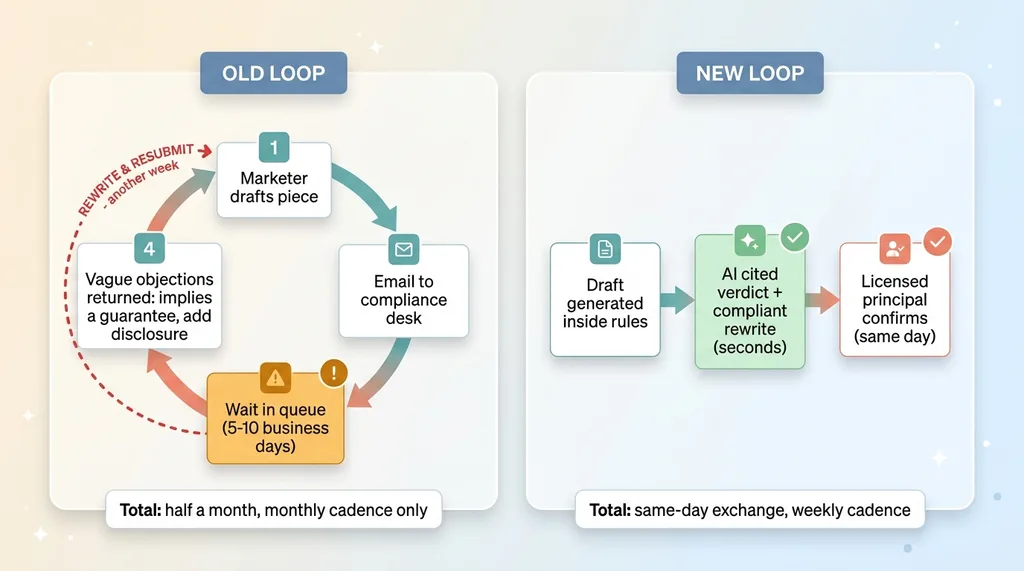 Old vs New Compliance Review Loop
A marketer drafts a radio spot, or a landing page, or a paid ad. They email it to the home-office compliance desk. Then they wait. The piece sits in a queue behind everyone else's submissions for three, five, sometimes ten business days.
Eventually it comes back with terse objections. "This implies a guarantee." "Add a disclosure." "Reword the performance claim." No citation, no specific rule, just a gut-level flag from a licensed principal who's processed forty of these that week.
So the marketer rewrites, guesses at what the reviewer meant, resubmits, and waits again. The piece goes back into the same queue. Round two adds another week.
Why the wait kills content cadence
The firm wanted to publish weekly. They could only ship monthly.
Do the math. If a single piece eats 5 to 10 business days of round-trips, and most pieces need two passes, you've burned half a month before anything goes live. Weekly cadence is physically impossible when each item locks up that long.
And cadence is the whole game in marketing. The firm that publishes 50 pieces a year beats the one that publishes 12, even if the 12 are slightly better written.
Here's the tension nobody wants to say out loud. Marketing needs cadence to grow. Compliance exists to keep the firm out of regulatory trouble, which is non-negotiable. The loop pits those two truths against each other, and the queue wins by default. The bottleneck was never the reviewer's judgment. It was the latency and the vagueness of the back-and-forth.
The Buyer's Real Doubt: Doesn't AI Just Add Another Step?
Every time I bring this up with a skeptical COO, I get the same question. "So you're going to add a robot review before the same slow human review? How does that speed anything up? Sounds like one more step."
It's a fair doubt, and I'll answer it straight.
AI does not remove the licensed principal's sign-off. It can't, and it shouldn't. A licensed human carries the liability and the regulator-facing accountability. Pretending software can absorb that is itself a compliance failure. If anyone sells you "AI compliance approval," walk away.
So what does AI actually change? The shape of the loop, not the authority.
Go back to where the time went. The slow part was never the human reading the document. A licensed reviewer can read a radio spot in ninety seconds. The slow part was the queue, the multiple round-trips, and both sides arguing from instinct instead of from the rulebook.
AI collapses the wait by handing both sides a precise, cited starting point in seconds. Instead of the reviewer opening a raw draft and starting a discovery process, they open a draft that already arrives with the risky phrases flagged, the rules cited, and a compliant rewrite attached.
The human review stops being a discovery exercise and becomes a confirmation. That's the entire trick. You don't remove the human. You remove the part of the human's job that was slow guesswork, and you leave the part that requires a license exactly where it is.
What "AI Compliance Review Speed" Actually Means
Let me define the mechanism without the jargon, because this is where people get the wrong picture.
The AI does not approve anything. Say it twice. It produces an assessment.
A cited verdict, not a yes/no
A useful AI compliance check doesn't say "looks risky." That's worthless. A reviewer can't act on a vibe.
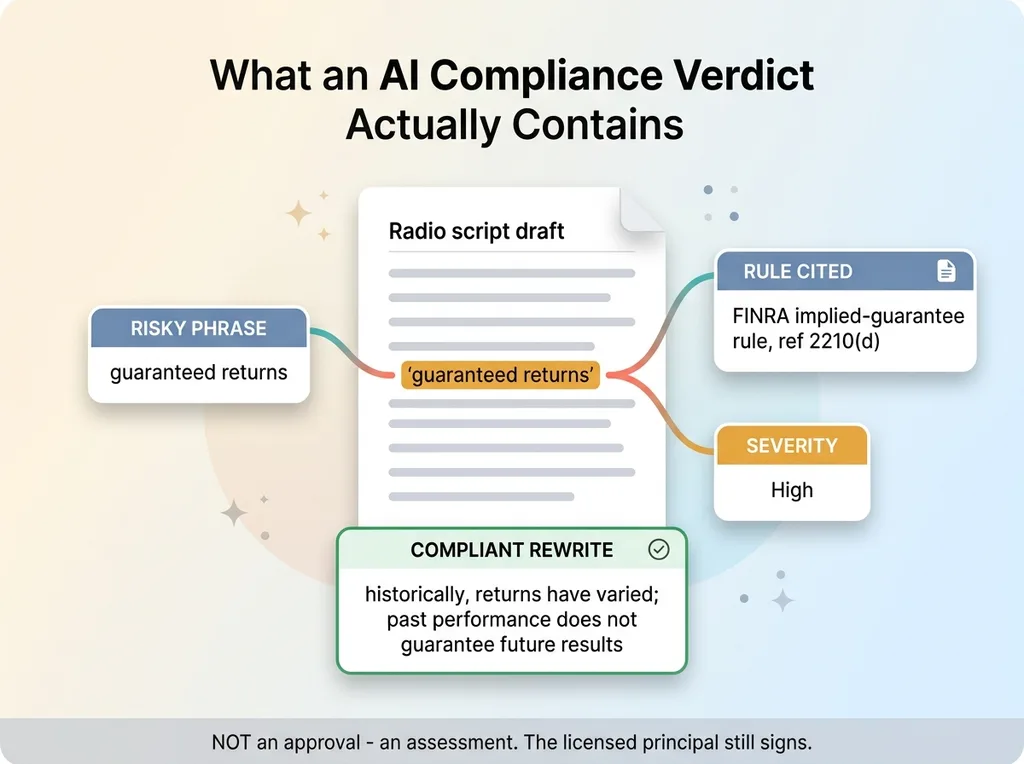 What an AI Compliance Verdict Actually Contains
What it produces is a classified, citation-backed verdict. Here are the specific phrases that risk a violation. Here is the exact rule each phrase maps to. Here is the severity. A verdict that cites the rule is reviewable. A verdict that just says "I have a bad feeling about this" is not.
That distinction is everything. When the licensed reviewer disagrees with the AI, they can point at the cited rule and say "no, that clause doesn't apply here, and here's why." Now you have a real conversation grounded in the same document, not an email tennis match.
A compliant rewrite, before submission
The second half is the rewrite. The AI doesn't just flag "this implies a guarantee." It proposes a version that preserves the marketing intent while removing the implied guarantee.
So when the radio spot reaches the licensed principal, it already arrives with the problems flagged and fixed against the actual rulebook. The reviewer isn't starting from a blank objection. They're confirming or adjusting a draft that's already 90% of the way there.
This is the same discipline I use when shipping AI content in a regulated industry. The constraints have to live inside the generation, not get bolted on afterward. Both sides argue from one precise document instead of from gut feel and terse email objections.
The speed comes from precision. Vague feedback creates round-trips. Cited feedback ends them.
Three Places the Loop Got Faster
For the financial advisory firm, the change showed up across three real surfaces. Same human authority, completely different turnaround.
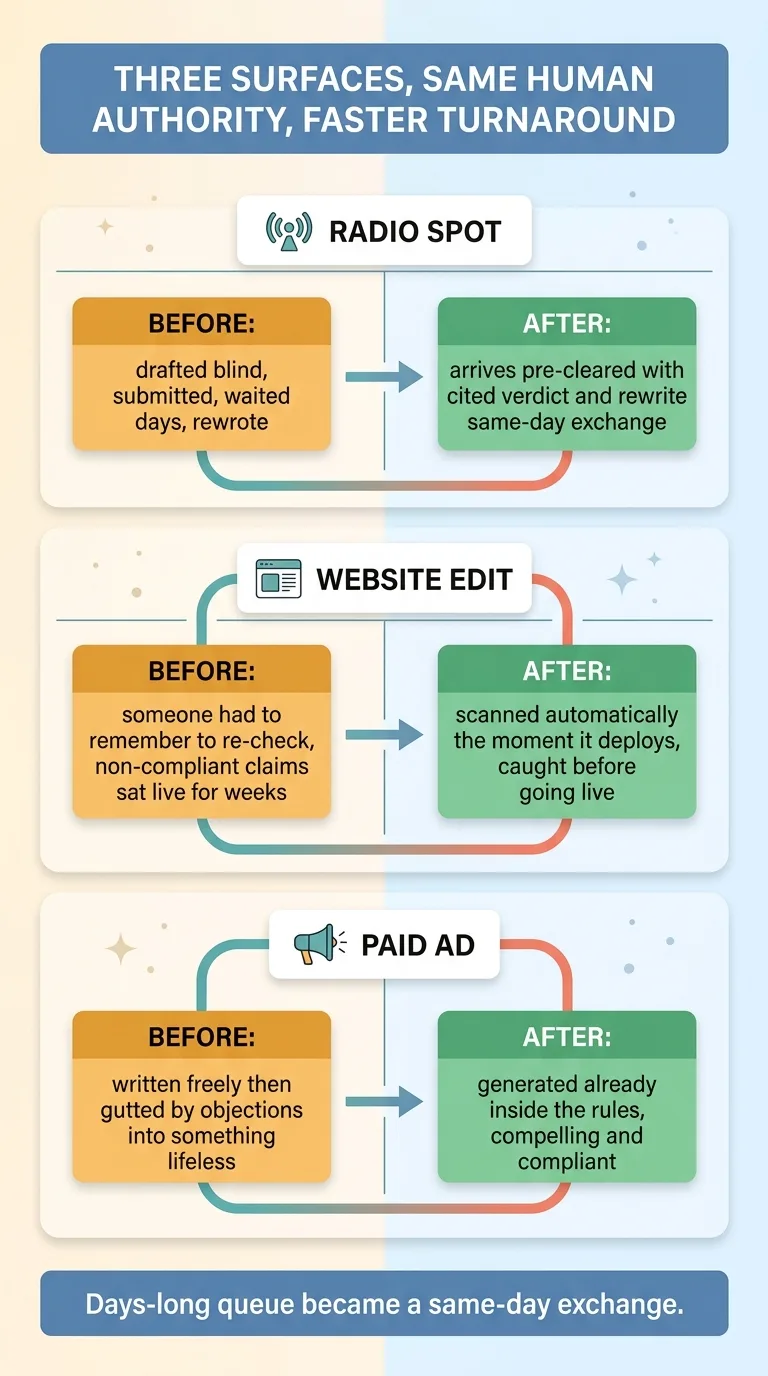 Three Surfaces Where the Loop Got Faster
The radio spot that arrives pre-cleared
Before: the marketer drafted the spot blind, with no idea which phrases would trip a flag. Submitted it. Waited days. Got objections. Rewrote. Waited again.
After: the spot gets a classified, cited verdict plus a compliant rewrite before it ever reaches the principal. The marketer sees "the phrase 'guaranteed returns' risks an implied-guarantee violation, here's the rule, here's a compliant version" in seconds. They fix it, then submit a clean draft. The principal confirms instead of discovering.
The days-long blind submission became a same-day exchange.
The website edit scanned the moment it deploys
Before: someone had to remember to re-check pages after edits. A copywriter would tweak a headline on a service page, and nobody flagged that the new wording introduced a performance claim. It sat live, non-compliant, until a manual audit caught it weeks later. If it ever did.
After: the page is scanned automatically the moment it deploys. A newly-introduced risky claim gets caught before it's live in front of a single prospect. No human had to remember anything.
That's the kind of always-on check that human-only review can't physically provide. People forget. Software doesn't.
The ad that's generated already inside the rules
Before: ads were written freely, in full creative flow, then chopped down by objections until the punchy version was gutted into something safe and lifeless.
After: the ad is generated already inside the rules. The constraints shape the draft from the first word instead of butchering it afterward. You get copy that's both compelling and compliant, because the model was working within the guardrails the whole time, not getting censored at the end.
The throughline across all three: the days-long queue became a same-day exchange. This was one piece of a larger build, a content machine for a financial advisory firm where the compliance layer was the thing that made the volume possible in the first place. Cadence without compliance is reckless. Compliance without speed is paralysis. You need both, and that's exactly what collapsing the loop delivers.
AI vs Manual Compliance: What Each Side Is Good At
The whole "ai vs manual compliance" debate gets framed wrong. People treat it as a contest, like one has to win. It's not a contest. It's a relay.
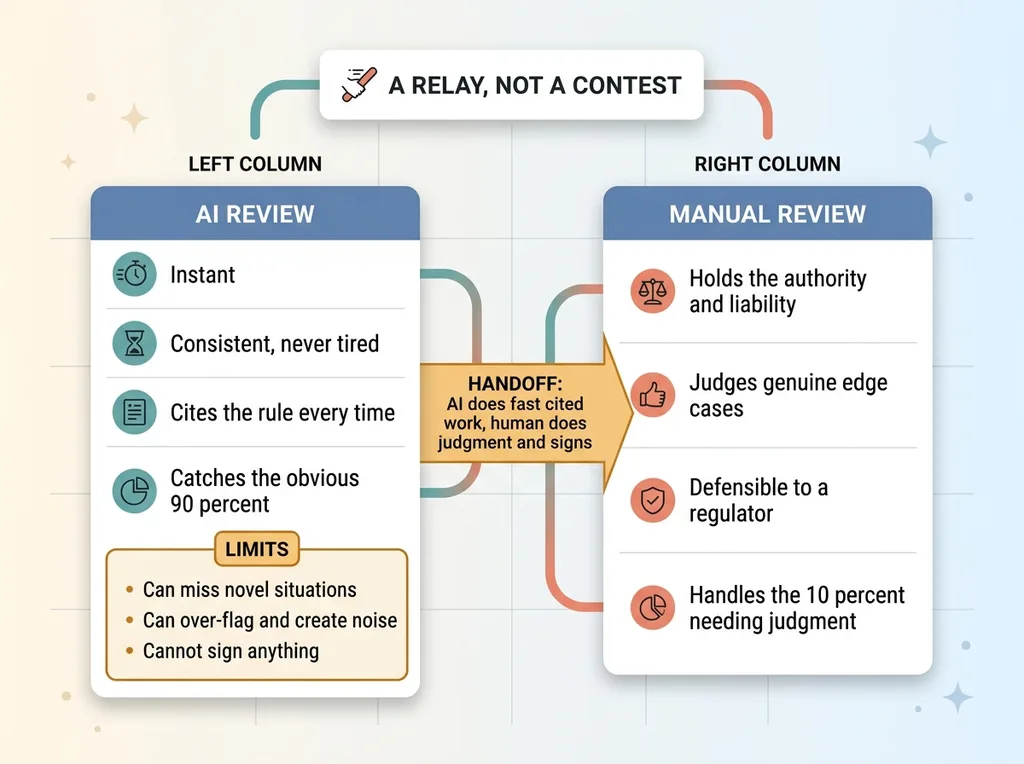 AI vs Manual Compliance Relay (not a contest)
Here's what manual review is genuinely good at.
It holds the authority. The reviewer carries the license and the liability. They make the judgment call on genuine edge cases, the situations where the rule is ambiguous and you need a human who understands the spirit of the regulation, not just the letter. And critically, a human sign-off is defensible in front of a regulator. "A licensed principal reviewed and approved this" is a sentence that holds up. "Our software approved it" is not.
Here's what AI review is good at.
It's instant. It's consistent, it never gets tired at 4pm on a Friday, it never skims. It cites the rule every time. And it catches the obvious 90%, the implied guarantees, the missing disclosures, the unsubstantiated performance claims, so the human spends their limited time on the genuine 10% that actually requires judgment.
The mistake is treating them as substitutes. They're not. They handle different parts of the same job.
Now the honest limits, because I'd rather you trust me than oversell you. AI can miss novel situations it's never seen patterned before. It can over-flag and create noise if it's tuned too aggressively. And it absolutely cannot sign anything.
That's why the licensed principal still signs off, every single time. Every AI system I ship stops for a human at the point where authority and liability live. Not because the AI failed, but because that's where it's supposed to stop. The AI does the fast, consistent, cited work. The human does the judgment and carries the accountability. Take either one out and the system breaks.
Why This Pattern Repeats in Every Regulated Industry
Financial advisory is just where I saw it most clearly. The exact same loop exists everywhere a licensed person has to bless the output before it ships.
Healthcare marketing. Legal advertising. Insurance. Supplements and anything making health claims. Mortgage and lending. In every one of these, a draft goes to someone with credentials, sits in a queue, comes back with vague objections, gets rewritten, and waits again. Different rulebook, identical bottleneck.
And the fix is structurally identical too. You don't replace the human authority. You collapse the wait by handing both sides a cited starting point. Encode the actual rules the reviewers use, generate cited verdicts and compliant rewrites at the draft stage, and leave the licensed sign-off untouched.
The firms winning in regulated verticals aren't the ones that found a way around compliance. Those firms get fined. The winners are the ones that stopped letting the queue set their content cadence. They publish weekly because the loop runs in hours, not days, while staying just as defensible as before.
I've built this across multiple regulated verticals now, and the same pattern shows up across regulated industries every time. The vocabulary changes. The structure of the problem doesn't. Slow queue, vague feedback, killed cadence. Cited verdict, fast confirmation, restored cadence.
Where to Start If Your Marketing Is Stuck in the Queue
If your content is bottlenecked behind compliance review, here's the honest first move, and it isn't buying a tool.
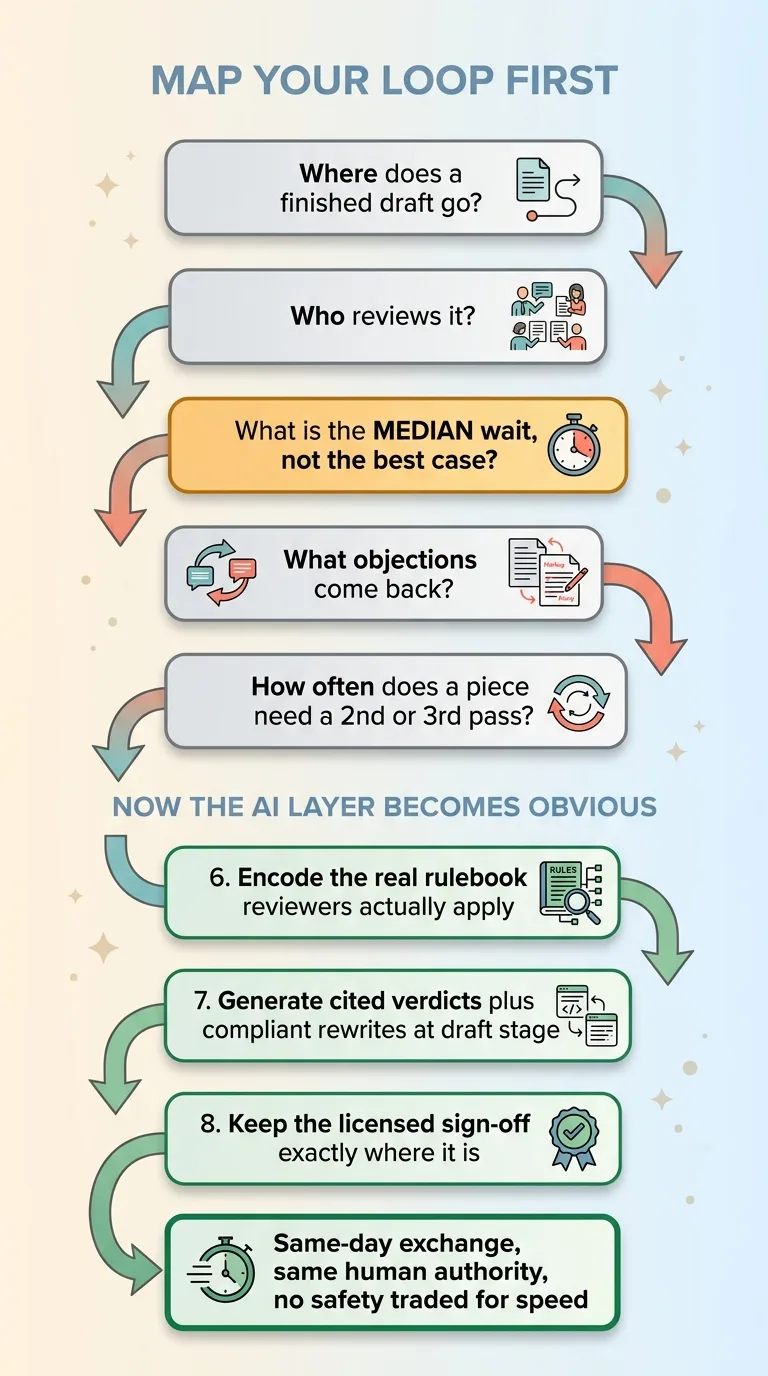 How to Map Your Compliance Loop Before Buying Anything
It's mapping your actual loop.
Where does a draft go when it's done? Who reviews it? What's the median wait, not the best case, the median? What kind of objections come back, and how often does a piece need a second or third pass? Most firms have never measured any of this. They feel the slowness but can't point at it.
Once you can see the loop, the AI layer becomes obvious. You encode the rulebook your reviewers actually apply, the real one they use, not a generic template. You generate cited verdicts and compliant rewrites at the draft stage. And you keep the licensed sign-off exactly where it is, because that's the part that protects you.
The result is a same-day exchange instead of a multi-day queue, with the same human authority fully intact. You don't trade safety for speed. You get both, because the slow part was never the safety. It was the queue and the guesswork.
This is exactly the kind of system I build as a Chief AI Officer for hire. Not a slide deck about AI strategy, an actual working layer that turns your compliance bottleneck into a same-day step. I've done it for my own DTC brand's content pipeline and for clients in regulated verticals where the rules are far stricter than fashion.
If your marketing cadence is set by a queue instead of by your team, that's a fixable problem, and usually faster to fix than people expect.
Thinking about AI for your business?
If this resonated, let's have a conversation. I do free 30-minute discovery calls where we look at your operations and figure out where AI could actually move the needle, not where it sounds impressive.
Get AI insights for business leaders
Practical AI strategy from someone who built the systems — not just studied them. No spam, no fluff.
Hodgen.AI
Ready to automate your growth?
Book a free 30-minute strategy call with Hodgen.AI.
Book a Strategy Call