AI Consultant Portfolio Proof: I Built for Family
The best ai consultant portfolio proof isn't a case study. It's working software I built for people I can't disappoint. Here's why family projects win clients.
By Mike Hodgen
The AI Consultant Problem: Everyone Has Slides, Nobody Has Software
Go to any AI consultant's website and you'll find the same thing. A maturity framework. A four-phase roadmap. A grid of logos from companies that may or may not still use whatever was built. A deck that promises to "reimagine your operations with AI."
Here's the uncomfortable truth: most of that material could be generated by a ChatGPT prompt in about ninety seconds. The strategy slides, the vision statements, the "AI transformation journey" diagrams. None of it requires the person to have ever shipped a line of working code.
If you're a skeptical CEO who has been burned before, your instinct to distrust this is correct. I've watched vendors walk into rooms, present beautiful frameworks, collect a retainer, and deliver nothing that actually runs in production. The slide deck was the product.
So when people ask me for ai consultant portfolio proof, I don't reach for case studies first. Case studies can be ghostwritten. Logos can be borrowed. The real proof that an AI consultant ships is working software you can put your hands on, software that someone uses every day and would complain about the moment it broke.
I write more about this distinction in I don't just advise on AI, I build it. The short version: advisors talk, builders ship.
But here's the part that surprised me. My most convincing proof of work isn't anything I built for a paying client. It's the handful of apps I built for my own family. The people I literally cannot disappoint. My relatives. My closest friends. A baby.
You can fudge a client demo. You cannot fudge a tool your mother relies on. That's where the real bar lives, and it's higher than most client work ever forces you to clear.
Why Building for Family Sets a Higher Bar Than Client Work
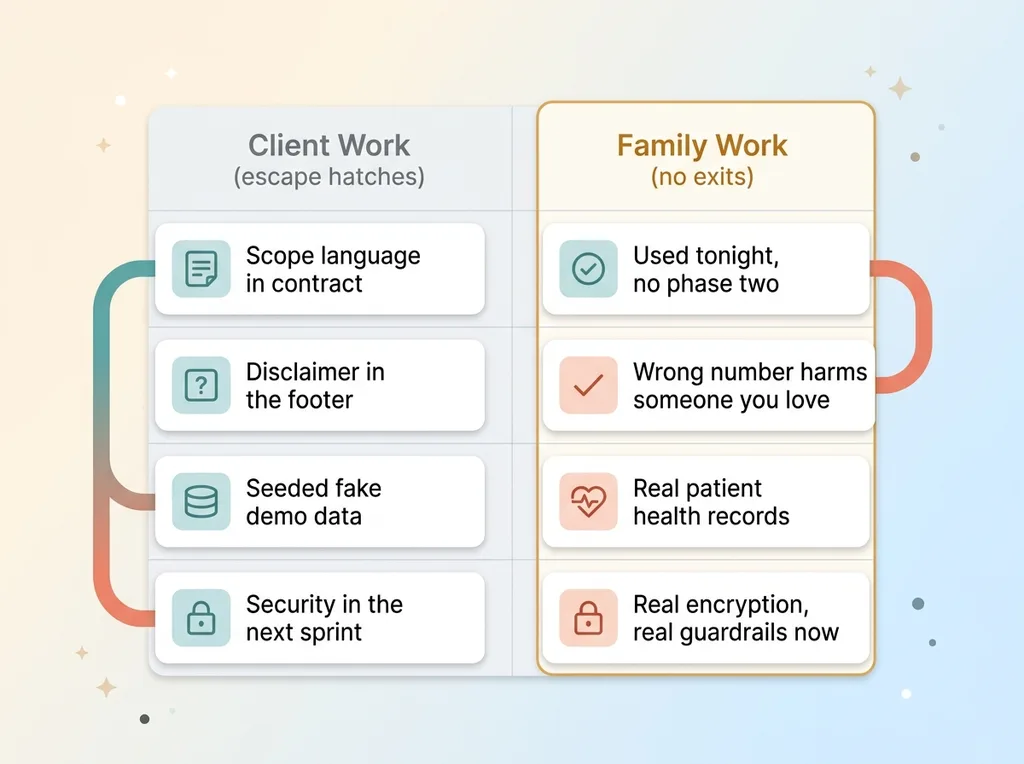 Building for Family vs Building for Clients (Higher Bar)
You can't ship vaporware to your own mother
When you build for a paying client, you have escape hatches. A contract with scope language. A disclaimer buried in the footer. A "phase two" you can quietly push to next quarter. A demo with seeded fake data that looks great and proves nothing.
Build for family and every one of those exits disappears. There is no phase two when your relative is using the thing tonight. There is no fake demo data when the data is your actual family member's actual life.
If a health dashboard I built surfaces a wrong number to someone I love, that's not a support ticket. That's real harm to a real person at my own dinner table. The accountability is total and it's personal.
The safety and privacy stakes are personal
The data in these projects is not test fixtures. It's real patient health records. Real baby development milestones. Real daily nutrition logs. There is no "we'll handle security in the next sprint" when the breach would expose your own family's medical history.
That forces a discipline most client engagements never demand. Real encryption, not a promise of it. Real guardrails, not a roadmap item. Hard limits on what the AI is allowed to conclude, because a hallucination here doesn't cost a click-through rate, it could affect a health decision.
This is exactly the discipline I bring to client systems. Every system I ship stops for a human at the points that matter, which I break down in every system I ship stops for a human. I didn't invent that habit for clients. I learned it building for people I can't afford to let down.
A Multi-Agent Health Dashboard for a Relative
A family member of mine manages a chronic health condition. That means a constant stream of data: lab results, symptoms, medication notes, doctor visits. Most of it sits in PDFs and patient portals that don't talk to each other.
I built a system that pulls this together and helps make sense of it. But the interesting part isn't the dashboard. It's how I made the AI behave.
Why one AI wasn't enough
A single chatbot looking at health data is a hallucination waiting to happen. Ask one model a medical question and it will give you a confident answer, right or wrong, with no second opinion.
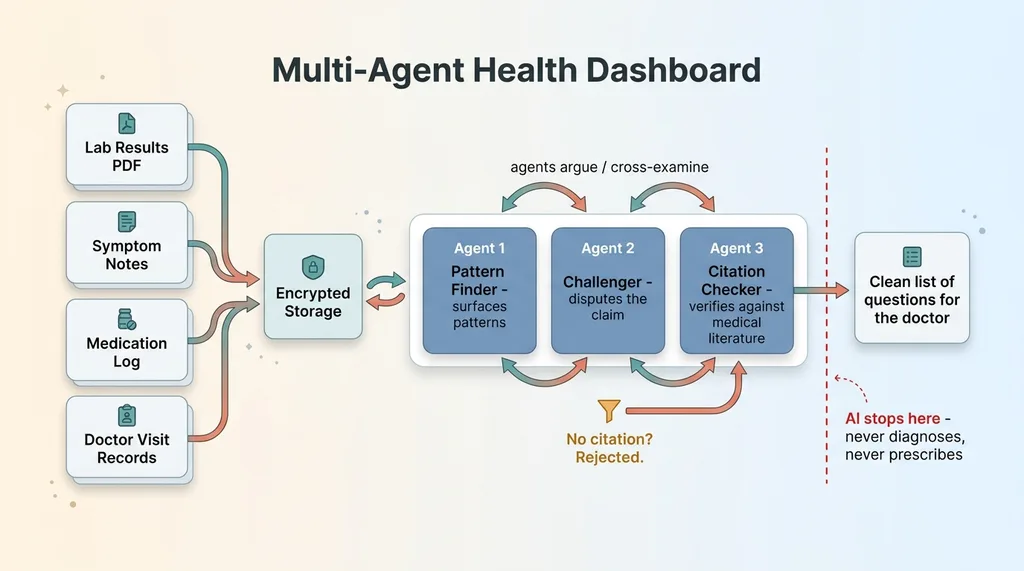 Multi-Agent Health Dashboard Architecture
So I built a multi-specialist setup instead. Several AI roles that review the same data from different angles, then argue with each other before anything reaches the screen. One surfaces a pattern, another challenges it, a third checks whether the claim is actually grounded in medical literature or just plausible-sounding text.
If a claim can't be backed by a real citation, it doesn't make the cut. Making the AI fight itself and prove its sources is the antidote to a single confident model that's quietly wrong.
Where I refused to let AI decide
This is the line I will not cross. The system never diagnoses. It never prescribes. It never tells my relative what's wrong or what to take.
What it does is summarize, organize, and prepare. It turns a messy data pile into a clean set of questions to bring to the actual doctor. The AI's job ends at "here's what you might want to ask your physician about." The human in the white coat makes the calls.
All of it runs on encrypted storage because this is real health data, not a demo. Getting the privacy right wasn't optional. It was the whole point.
A Development Tracker for a Baby in the Family
There's a young child in my family, and like every parent, mine were handed the paper milestone checklist. Is the baby tracking objects, responding to sounds, hitting motor milestones on schedule. A clipboard and a pen.
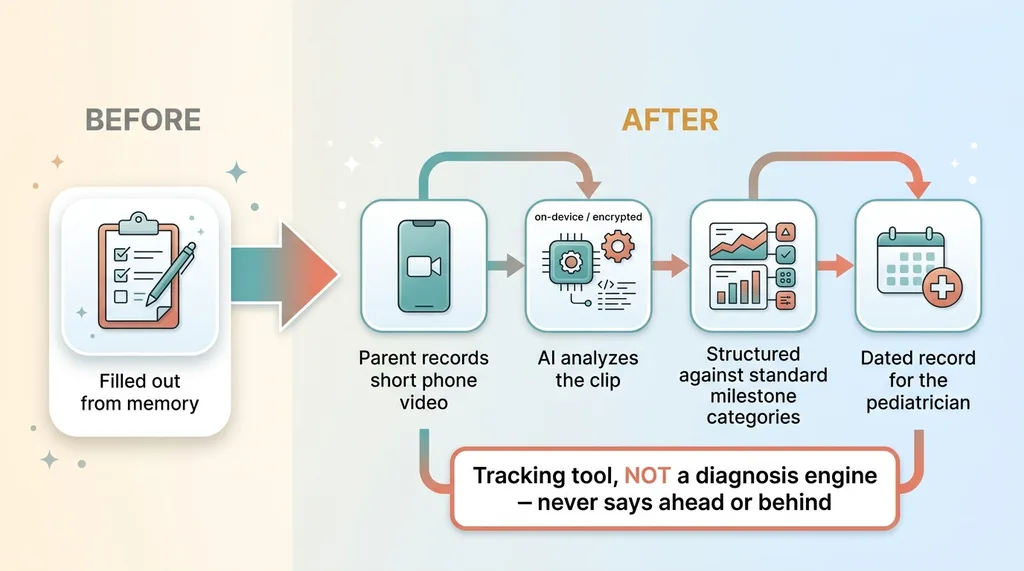 Baby Development Tracker: Paper Checklist to Video Analysis
I replaced the clipboard with software that watches a video.
A parent records a short clip on their phone. The AI analyzes it and turns it into a structured development assessment, organized against the standard milestone categories. Instead of a parent squinting at a checklist trying to remember if last week counted, they get a clear, dated record they can actually bring to the pediatrician.
Here's the honest limitation, and I say this loudly: this is a note-taking and tracking tool, not a diagnosis engine. It does not tell anyone their child is behind or ahead. It does not produce medical conclusions. It organizes observations so the conversation with the real doctor is better informed.
That restraint was deliberate. The easy version of this product would slap a confident "assessment" on a baby and call it a feature. The responsible version knows exactly where its authority ends.
Building this for a real baby meant getting the safety classification right and keeping the data tight, processed on-device or encrypted wherever possible. The contrast is the whole story: we went from a paper checklist a parent fills out from memory to software that actually watches the video and structures what it sees, while still leaving every medical judgment to the professional.
A Nutrition Logger for a Friend
A close friend wanted to track what they eat without the misery of typing every meal into a clunky app. So I built a scanner. Point your phone at a barcode, a nutrition label, or just the food itself, and it turns the photo into structured nutrition data.
The AI part was the easy part. The hard part was everything around it.
Cameras fail in bad lighting. Barcodes misread. The food database has gaps, so a scan comes back with nothing or, worse, the wrong product. A polished demo hides all of this because you control the lighting and you scan the one barcode you tested. A friend using it daily, in a real kitchen, exposes every rough edge in the first week.
That's the lesson. Real-world reliability, not the AI magic, is what makes software trustworthy. Anyone can build a scanner that works in a demo. Building one that works when your friend is tired, the light is bad, and the database is missing their favorite snack, that's the actual job.
I'll mention a related detail that signals the same instinct. On another project that needed audio, I chose human recordings over AI-generated voice. The synthetic version was cheaper and faster. The human touch mattered more for that use case, so I used real recordings. Knowing when not to reach for the flashy option is part of the work.
What These Projects Prove That a Case Study Can't
Shipped beats polished
A case study is a story someone wrote about software. It can be exaggerated. It can be ghostwritten by a marketing team. It can describe a system built by people who have since left and a codebase that no longer runs.
A working app that your relative opens every morning is unfalsifiable. It either works or your family tells you it doesn't. That's the kind of ai consultant proof of work that can't be faked.
When a CEO asks "does my AI consultant actually ship," this is the honest answer. Not a portfolio of logos. Software in someone's hands that survives daily use.
Restraint is a feature
Put together, these projects prove four specific things. I ship working software, not slideware. I handle genuinely sensitive data correctly, with real encryption. I know where to put guardrails so the AI can't overstep. And I know when not to let AI decide at all, which is the rarest skill of the four.
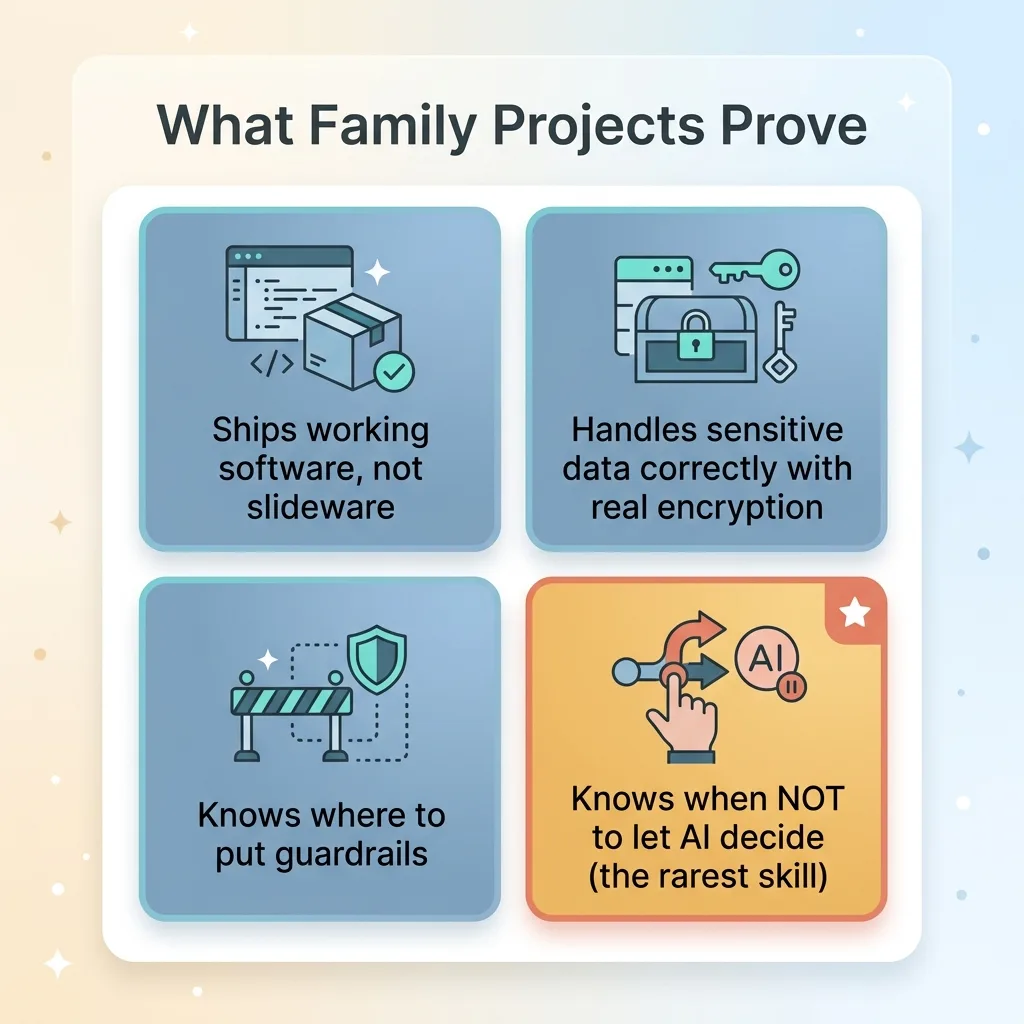 Four Things These Projects Prove
This is why I show working systems instead of decks. The skeptical CEO who's been burned isn't wrong to ask for proof. They're asking the right question.
Most AI projects never get this far. I've written about why 88% of AI projects fail, and the pattern is consistent: the failures almost never ship anything real. They die in strategy phase, in pilot purgatory, in a deck that gets presented and shelved. The 12% that work are the ones that ship something small, watch it run, and iterate. Vaporware is the default outcome. Shipped software is the exception.
What This Means for Your Business
The bar I hold for my own family is the same bar I hold for your company. That's the whole point.
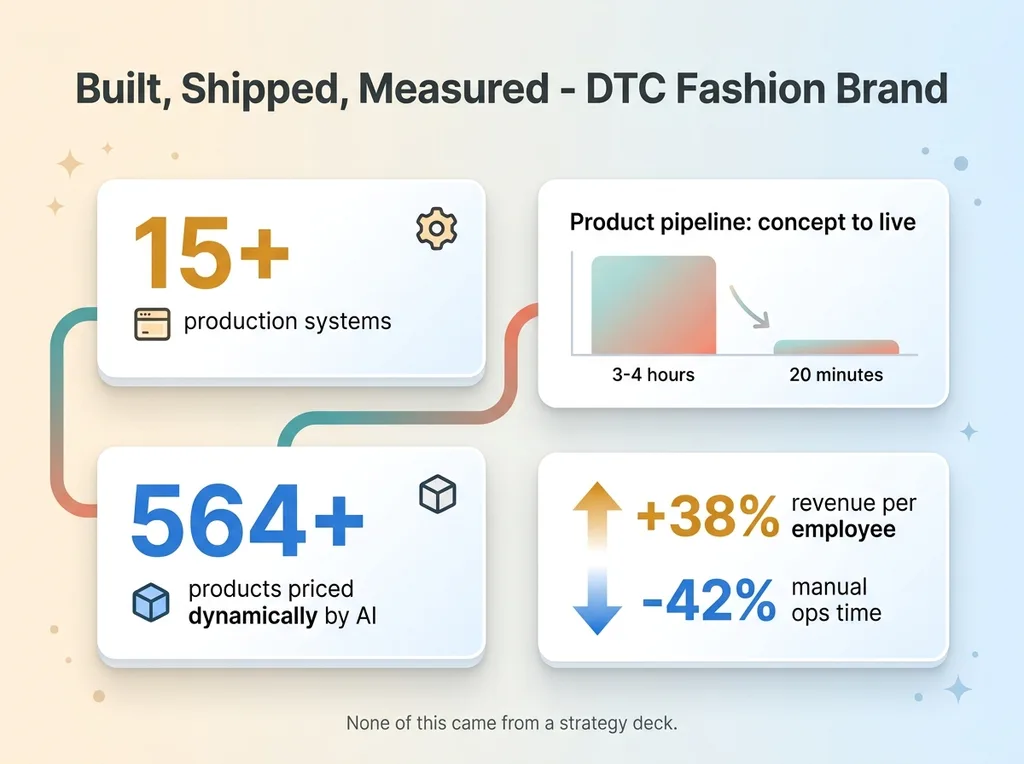 DTC Brand Results from Building, Not Decks
If I'll encrypt my own relative's health records and build guardrails so an AI can never harm someone I love, you can trust me with your customer data, your operations, and your revenue systems. The discipline doesn't change when the project becomes commercial. It's the same instinct: ship something real, protect the data, and put hard limits on where the AI is allowed to act on its own.
In my own DTC fashion brand I've taken that same approach across 15-plus production systems, from a product pipeline that took concept to live in 20 minutes down from 3-4 hours, to 564-plus products priced dynamically by AI. Revenue per employee is up 38 percent and manual ops time is down 42 percent. None of that came from a strategy deck. It came from building, shipping, and fixing what broke.
The difference between an AI consultant who builds and one who advises comes down to one question. When the engagement ends, is anything actually running? With most, the answer is a folder of PDFs. With me, it's software your team uses on Monday.
If you want to see what that looks like for your specific operation, see what I can build for your business. No framework presentation. We'll look at what you actually do every day and find the parts where AI would genuinely help.
Thinking about AI for your business?
If this resonated, let's have a conversation. I do free 30-minute discovery calls where we look at your operations and identify where AI could actually move the needle.
Get AI insights for business leaders
Practical AI strategy from someone who built the systems — not just studied them. No spam, no fluff.
Hodgen.AI
Ready to automate your growth?
Book a free 30-minute strategy call with Hodgen.AI.
Book a Strategy Call