Why Most Lead Magnets Underperform (And Annoy People)
Most lead magnets are broken in the same two ways, and I see it constantly. The problem isn't the offer. It's the plumbing behind instant lead magnet delivery that almost nobody gets right.
The delivery-by-email trap
Here's the standard flow. A visitor reads your blog post, likes it, and hits a form to grab your free guide. They enter their email. Then they wait.
And wait.
The guide is supposed to arrive in their inbox. Maybe it does. Maybe it lands in spam. Maybe your email vendor isn't fully wired up yet and the automation silently fails. Maybe the deliverability on your domain is bad because you sent one cold campaign last year.
Either way, the value you promised is now sitting on the other side of an email system the visitor can't see and you can't fully trust. The reader's intent was hot at the moment they submitted. By the time the email shows up (if it shows up), they've moved on.
I watched this happen on a health brand's blog funnels. Great content, decent traffic, and a capture rate that made no sense given how engaged the readers were. The capture wasn't the problem. The delivery was.
The forever-popup problem
The second failure is worse because it actively annoys people. The funnel has no memory. So someone who already downloaded your guide gets hit with the exact same popup on their next visit. And the one after that.
You're nagging people who already converted. That's not lead gen. That's friction.
The core insight is this: delivery and email got coupled together when they should never have been. Two separate jobs glued into one fragile dependency.
So if you're asking why your lead magnets underperform, or how to capture leads before your email infrastructure is even ready, the answer to both is the same. Decouple delivery from email.
Decoupling Delivery From Email: The Core Move
The architectural decision is simple to say and surprisingly rare to actually build. Hand over the value the moment someone captures, not after.
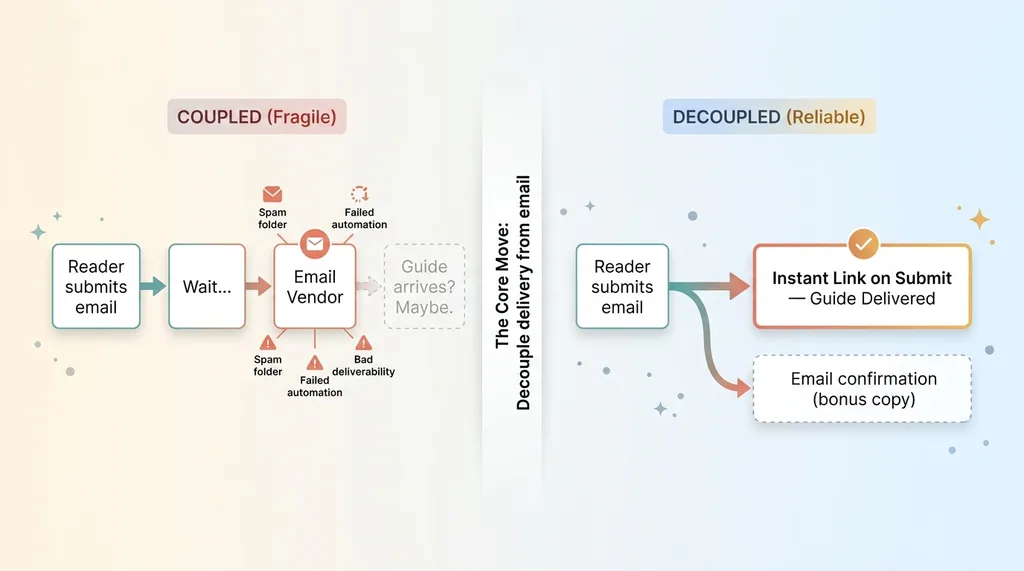 Email-coupled delivery vs decoupled instant delivery
Hand over the value on capture, not after
When a visitor submits their email, the success state itself delivers the guide. A direct link, right there, the instant they hit submit. No waiting. No spam folder. No dependency on whether your email vendor is connected, configured, or behaving.
The reader gives you their email and gets the guide in the same breath. That's it.
This means the entire funnel works today, with zero email infrastructure connected. You can launch capture and delivery before you've picked an email platform, before you've warmed a sending domain, before any of that exists. The value flows on its own path.
Email confirmation becomes a bonus, not a dependency
If you do have email wired up, great. The confirmation email becomes a second copy of the guide, a nice-to-have follow-up. Not the only copy. Not the thing the whole experience hangs on.
That's the shift. Email goes from being the delivery mechanism to being an additive layer. The failure mode disappears because the critical path no longer touches email at all.
And this lifts conversion, not just reliability. The value lands while intent is still hot. The reader doesn't have to switch tabs, check their inbox, hunt through promotions. They click and they have it. That immediacy is worth real percentage points on capture-to-consumption.
The unit of value here is the content upgrade. A specific, relevant asset offered at a specific moment, delivered instantly. That's the building block everything else sits on top of.
Where the Capture Happens: Content Upgrade Cards
The best place to capture an engaged reader is at the end of the thing they were engaged with.
End-of-article placement
I run a content upgrade funnel built around end-of-article cards. A reader finishes the post, and right there at the bottom is a relevant guide offered as the next step. They just invested five minutes reading. Their intent is at its peak. That's the moment to make an offer.
This beats a top-of-page interruption every time for engaged readers. A popup that fires the second someone lands hasn't earned anything yet. The reader hasn't gotten value, so why would they trade an email? The end-of-article card has the opposite dynamic. The value already landed, and the card is the natural continuation.
Matching the upgrade to the article
The card has to match the article. A post about regulatory risk gets a regulatory guide, not a generic newsletter signup. I built turning a regulation into a lead magnet on exactly that logic, where the content upgrade is a calculator that answers the question the article raised.
Contextual matching is what makes the card convert. Generic offers get generic results.
These cards live inside the blog content that feeds these funnels, the SEO content engine I use to produce articles at scale. Every article gets a matched upgrade. And every capture carries granular per-source tagging, so I know which article drove which lead.
The mechanic is dead simple. Card, email field, instant link on submit. No magic. Just the boring plumbing done right.
Catching the Leavers: Exit Intent and Scroll Triggers
The end-of-article card is for people who finish. Most people don't finish. So you need surfaces that catch the leavers, and each one targets a different behavior.
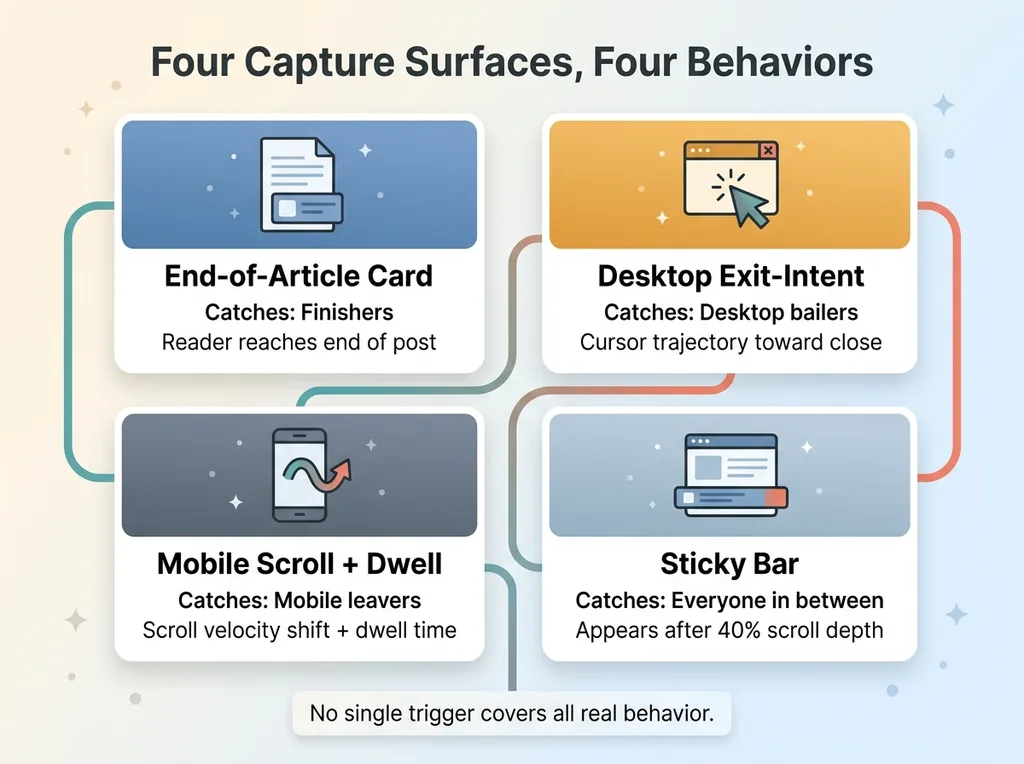 Four capture surfaces mapped to visitor behavior
Desktop exit-intent
On desktop, I use classic exit-intent. The cursor heads toward the close button or the back arrow, the browser detects that trajectory, and the offer fires before they're gone. This is your last shot at someone who's bailing.
Exit-intent popup conversion is real when the offer matches the page. The visitor was leaving anyway, so a relevant guide at that exact moment is pure upside. You're not interrupting reading. You're catching a departure.
Mobile scroll-plus-dwell
Mobile has no cursor, so exit-intent doesn't exist there. People just swipe away or hit back, and there's no trajectory to read.
So I use a proxy. Scroll velocity plus dwell time. If someone has been reading steadily and then their scroll behavior shifts in a way that suggests they're done, or they've dwelled long enough on a section to signal real engagement, the offer fires. It's not perfect, but it's a reasonable stand-in for the leaving signal you can't directly detect on touch devices.
The sticky bar after 40% scroll
The third surface is a sticky bar that appears after a reader passes 40% scroll depth. It's persistent but non-blocking. It sits there as a quiet, always-available offer for anyone who's read enough to be interested but hasn't hit a trigger or reached the end.
The 40% threshold matters. Fire too early and you're interrupting someone who hasn't committed. Wait until 40% and you know they're actually reading.
Here's the point. A single popup misses most of your traffic. Different visitors leave in different ways at different moments. End-of-article catches finishers, exit-intent catches desktop bailers, scroll-plus-dwell catches mobile leavers, and the sticky bar catches everyone in between. You need all four because no single trigger covers the spread of real behavior.
Not Annoying People: Frequency Caps and Lead Suppression
All these surfaces solve the capture problem. Now you have to solve the annoyance problem, or you've just built a more aggressive way to irritate people.
Frequency capping per visitor
Every surface is frequency-capped. A visitor doesn't get hit repeatedly in a single session, and they don't get hammered across visits. Frequency capped popups are the difference between a helpful offer and a vendor that follows you around the room.
If the exit-intent fired once, it doesn't fire again ten seconds later. If the sticky bar showed and got dismissed, it stays dismissed for a while. The cap respects that a no is a no, at least for now.
Suppressing known leads with localStorage
The bigger fix is lead capture suppression for people who already converted. The moment someone captures, I write a flag to localStorage in their browser. Every surface checks that flag before it fires. If the visitor is already a known lead, the popups stay off entirely.
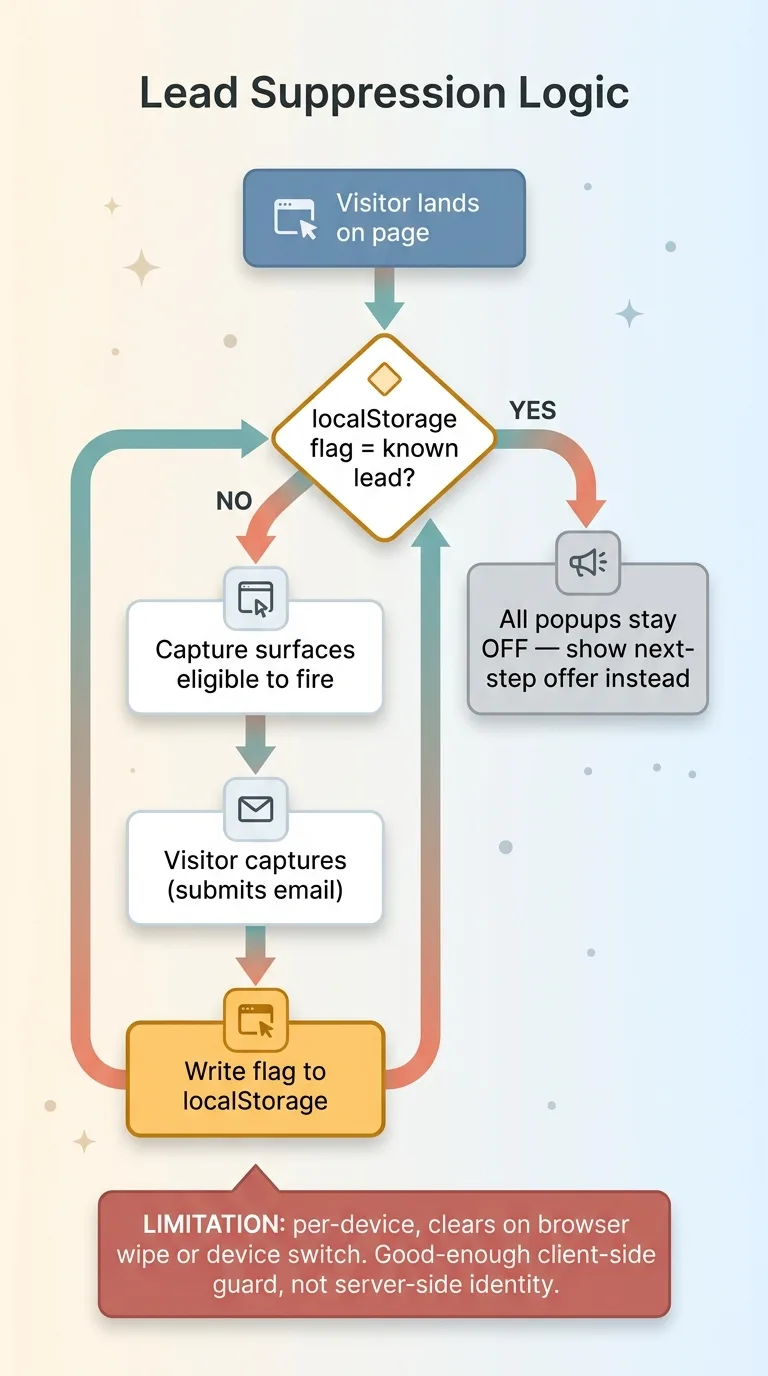 Lead suppression flow using localStorage flag
This is what kills the forever-popup problem. Someone who downloaded your guide last week shouldn't be asked to download it again. Nagging a converted lead erodes trust and wastes the surface, because that surface could be showing them a next-step offer instead of the thing they already have.
I'll be honest about the limitation. localStorage is per-device and it clears. If someone switches phones, uses a different browser, or wipes their data, the memory is gone and they look like a fresh visitor again. So this is a good-enough client-side guard, not a server-side identity system. For a real cross-device identity layer you need server-side state tied to the email itself.
But for the job it does, suppressing repeat nags for the same person on the same device, localStorage is exactly right. It's cheap, it's fast, and it works without any backend. Most funnels skip this entirely and just annoy everyone forever. The client-side guard catches the overwhelming majority of the cases that matter.
Clean Attribution: Per-Source Tagging That Actually Tells You What Works
Here's the question most funnels can't answer: is your exit popup doing the work, or is your content card? If you don't know, you can't optimize.
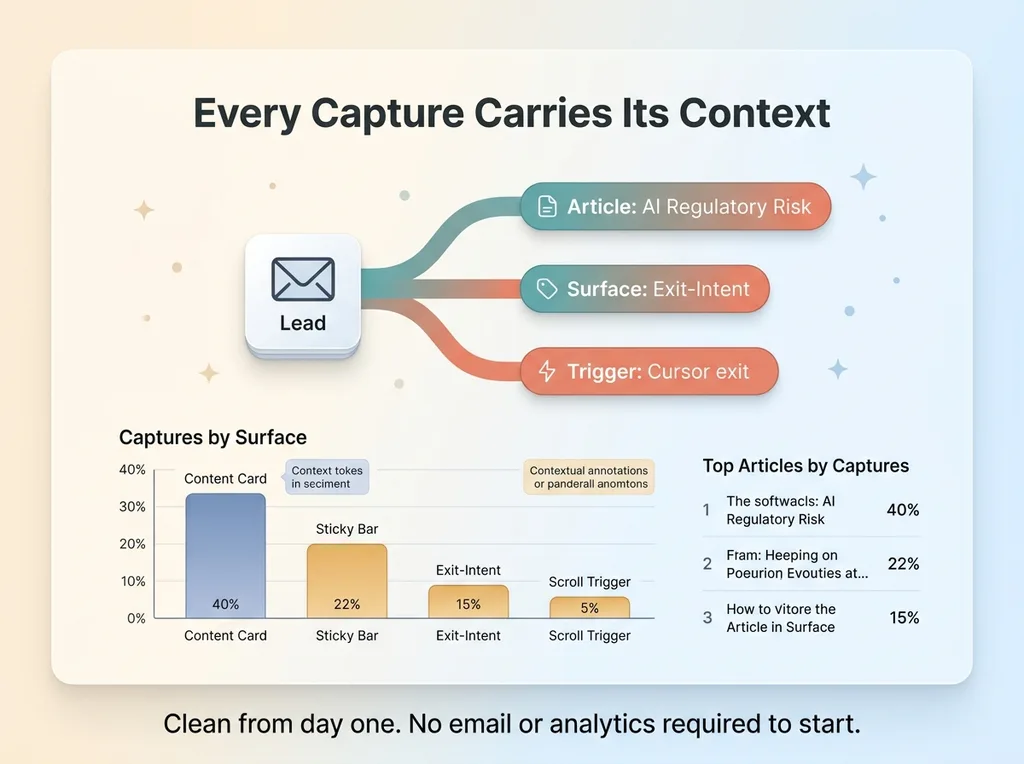 Per-source tagging attribution metadata
Every capture in my system carries its full context. Which article the reader was on. Which surface fired (card, exit-intent, sticky bar, or scroll trigger). And which behavior triggered it. That metadata rides along with the email from the moment of capture.
This granular per-source tagging means attribution is clean from day one, even before you've connected email or analytics. When you do wire those up later, you're not retrofitting. The data was structured correctly the whole time.
And clean attribution lets you do the one thing that actually improves a funnel: kill what doesn't work. If the exit-intent popup converts at a third the rate of the content card, you find out, and you adjust. If one article drives forty percent of your captures, you know to write more like it. Without per-source tagging, all your captures land in one undifferentiated pile and every optimization is a guess.
Downstream, this feeds into clean attribution across sources, where I tie capture data into unified analytics across GA4, Search Console, and ad spend. The capture layer being tagged correctly is what makes that downstream measurement honest.
I measure first-party signals, the data my own system captures directly, not whatever a vendor dashboard decides to show me. That's the only attribution you can fully trust.
Why This Works Before Your Email Vendor Is Even Connected
Step back and look at what this funnel does. It captures across four surfaces. It delivers value instantly on submit. It respects the visitor with frequency caps and lead suppression. And it tags every source for clean attribution.
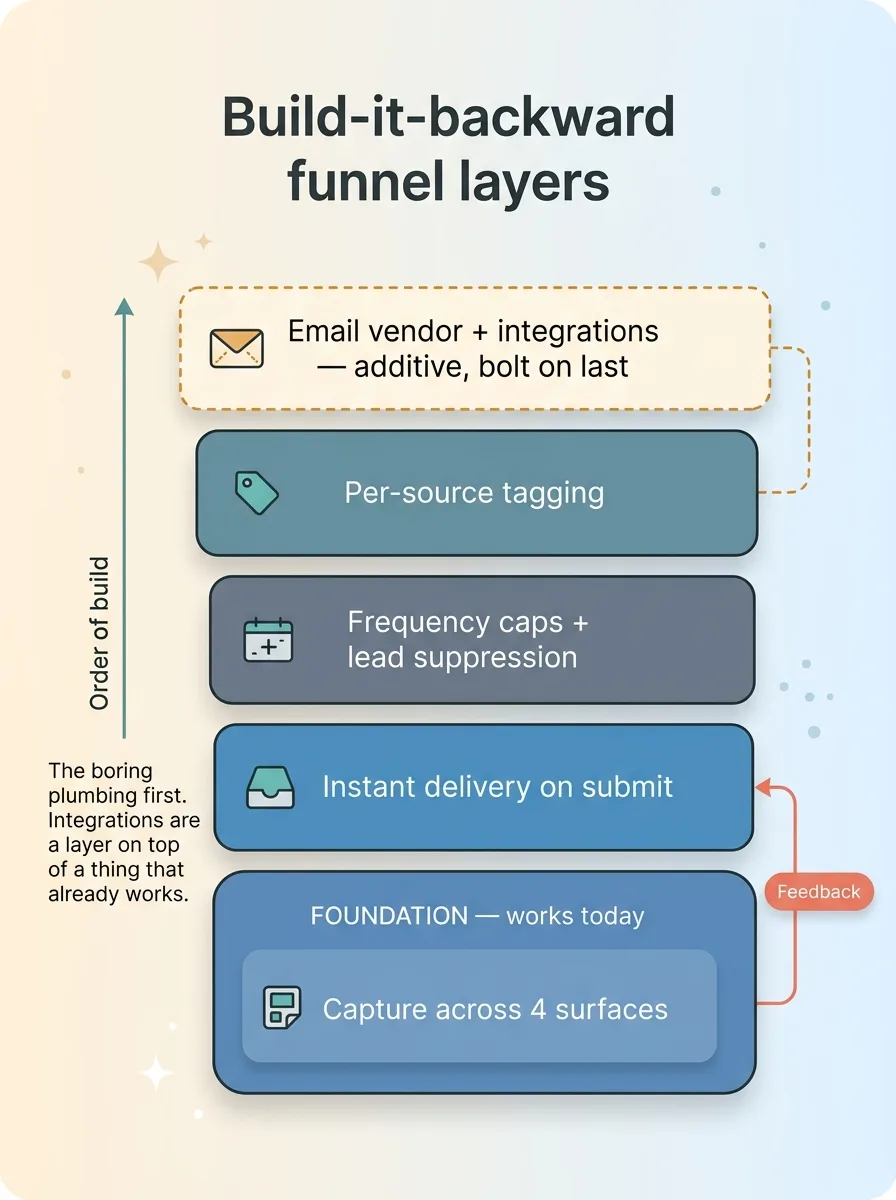 Build-it-backward funnel layers (plumbing first, integrations last)
All of that runs without a single email integration live.
The email layer is additive. You bolt it on when you're ready, and it makes things better, but it was never the launch blocker. That's the whole point. Most teams stall their lead gen for months waiting on email infrastructure, deliverability warming, and vendor setup, when the funnel could have been capturing leads the entire time.
This is the broader pattern in how I build. The boring plumbing first. Capture, delivery, suppression, tagging. The integrations come last, as a layer on top of a thing that already works. Build it backward and you get a fragile funnel that breaks the moment one vendor hiccups.
If your lead magnets are sitting behind half-wired email infra and converting poorly, the fix isn't a new email vendor. It's decoupling delivery from email so the value lands the instant someone captures. That's a one-time architectural move, and it works today.
Get the next build note.
I write up each system I build, including what broke. Subscribe to my newsletter and I'll send you the next one.