AI SEO Content for Local Business: A Salon Case Study
I built six AI-written, AI-illustrated SEO articles for a local salon, targeting the exact questions customers search. Here's the AI SEO content for local business playbook.
By Mike Hodgen
A Local Salon Doesn't Need a Content Team. It Needs to Answer Six Questions.
A salon owner came to me with a problem that sounds familiar to anyone running a local service business. Zero organic content. No blog. No realistic way to show up when someone in the area searched for the thing she does for a living.
She assumed the fix was the obvious one: hire a writer, commit to a content calendar, and publish forever. That's the model everyone sells. It's also the wrong model for a local business, and it's the reason most of them never start. AI SEO content for local business doesn't mean cranking out fifty articles a month. It means answering the small set of questions your customers actually type before they book.
Here's the part most people miss. Customers don't search vanity topics. Nobody booking a colorist is reading "Top 10 Hair Trends of 2025." They have a specific worry, a specific question, and they search it once or twice before they decide where to spend $200 on their hair.
The whole game is answering those questions well, for a geography you can actually win in. Not "balayage," which the entire internet is fighting over. Something scoped tight enough that a single salon in San Diego County has a real shot at page one.
Volume is a trap. Relevance plus local winnability is the move.
So we didn't build a content machine. We built six articles. Six questions, each one a real thing a customer searches, each one mapped to either a booking or to catching someone earlier in their decision. That was the entire project. And it works better than the sixty-article treadmill she was dreading.
Let me walk you through how we picked the six and why this approach beats the usual playbook.
Why Most Local SEO Content Fails Before It Starts
Most service businesses do one of two things with SEO content. They do nothing, or they do the wrong thing. Both end in the same place: no rankings, no traffic, no bookings.
Chasing volume instead of intent
The first failure mode is targeting keywords you'll never win. A salon writes a post optimized for "balayage" or "hair extensions" because those have huge search volume. Then it sits on page eight forever, because it's competing with national brands, beauty publications, and every salon in every city at once.
Big volume keywords are big precisely because everyone wants them. You're not entering a race. You're entering a race that ended years ago.
The flip side is just as bad: generic filler. "Top 10 hair care tips." "How to maintain healthy hair." This content matches nothing a buyer actually types because buyers don't type vague things. They type specific worries. Generic content ranks for generic queries, and generic queries don't lead to bookings.
Ignoring local winnability
This is the concept that changes everything. There's a difference between a keyword you want and a keyword you can take.
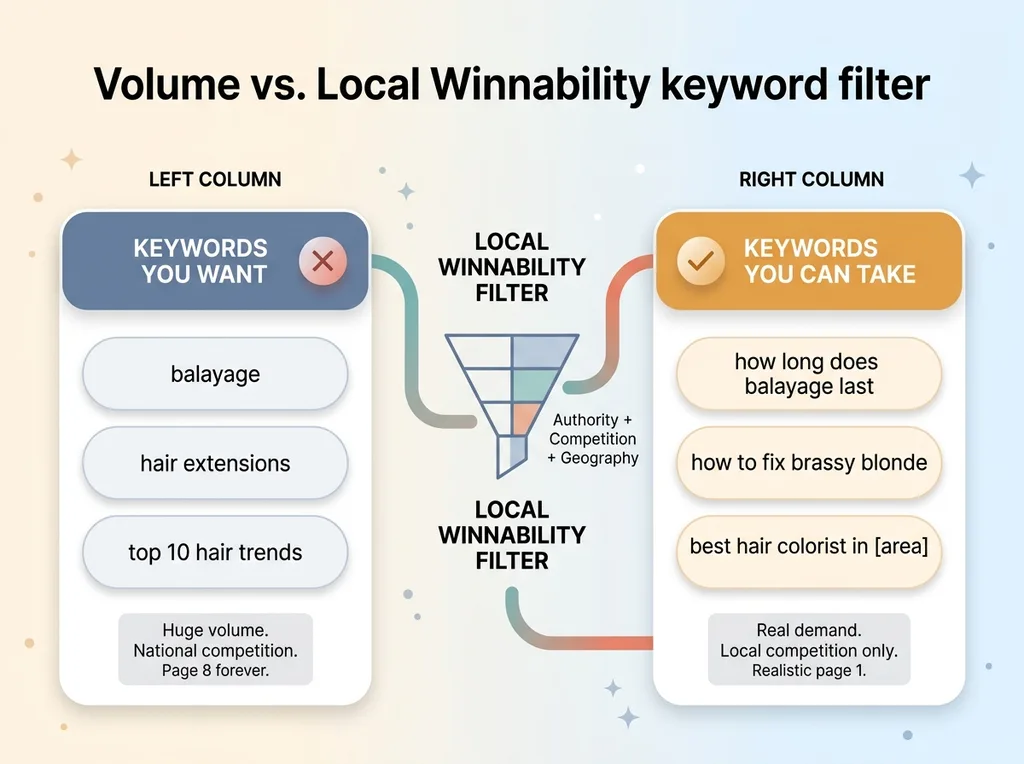 Volume vs. Local Winnability keyword filter
A salon will never rank for "balayage." Full stop. But "how long does balayage last" is a real question with real demand and far less competition. Scope it to the area and the math gets even better. The pool of competitors shrinks to other local businesses, not the entire internet.
Local winnability is being honest about what you can realistically rank for given your authority, your competition, and your geography. It's the filter that should kill most keyword ideas before you write a word.
Here's the honest part about AI in all this. AI does not change your competition. It doesn't make you outrank a national brand. What it does is let you produce the right small set of articles cheaply and fast, so the economics of doing this correctly finally make sense for a business that can't afford a writer.
Picking the Six Questions Customers Actually Search
The hardest and most valuable part of this whole project happened before any writing. We picked six questions. Not sixty. Six.
Mining real buyer questions
I started by looking at what people actually type when they're close to booking or trying to solve a specific hair problem. Things like "best hair colorist in [area]," "k-tip vs Russian mini-tip," "how to fix brassy blonde," "how long does balayage last," "how often should you tone blonde hair," and "what extension method works for fine hair."
Every one of these is a real question with genuine search demand. None of them is a vanity topic. Each one represents a person with a wallet and a decision in front of them.
Mapping local intent vs. informational intent
Then I sorted them into two buckets, because they do different jobs.
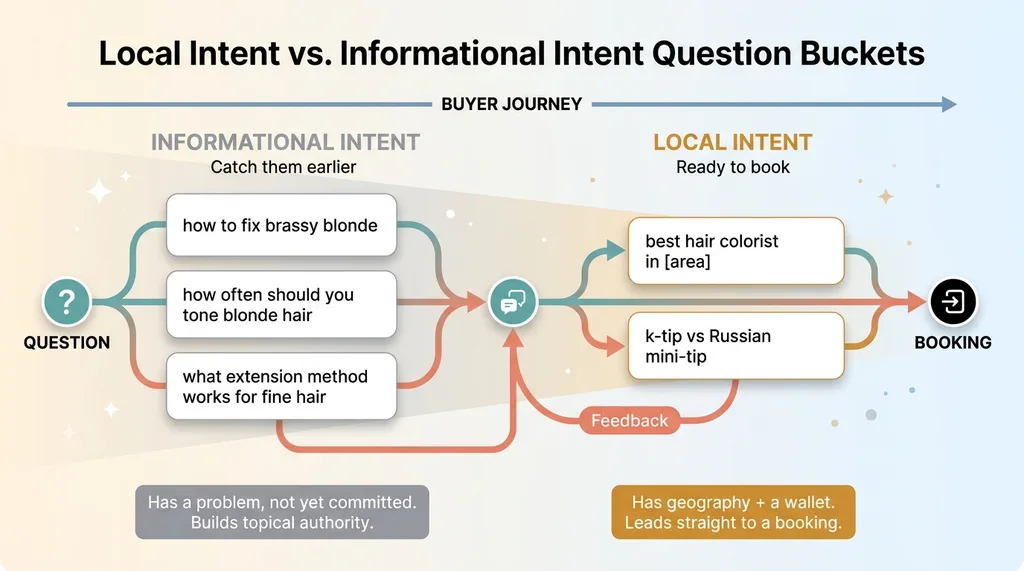 Local intent vs. informational intent question buckets
Local-intent queries carry the geography and lead straight to a booking. "Best hair colorist in [area]" is someone ready to choose. You want to be there with content that's clearly local, clearly expert, and clearly the obvious next step.
Informational queries pull people in earlier. "How to fix brassy blonde" is someone with a problem, not yet committed to a salon. If you answer it well, you catch them before they decide. You build topical authority, and you become the expert they already trust by the time they're ready to book.
The discipline is the number. Six, not sixty. Each article maps to exactly one real question with actual search demand and a realistic shot at page one for the area. That constraint is the whole strategy. It forces you to pick winners instead of spraying content at the wall and hoping.
This is the same selection logic I'd apply whether it's a salon or an SEO blog engine for a local service business. The industry changes. The discipline doesn't.
Writing the Articles Without a Content Team
Once we had the six questions, writing them was the fast part. And no, this wasn't one-click AI slop.
The draft-and-direct workflow
I've managed 313 blog articles with AI-assisted SEO across my own projects. I know exactly where AI helps and where it produces garbage. The workflow isn't "press button, publish article." It's draft-and-direct.
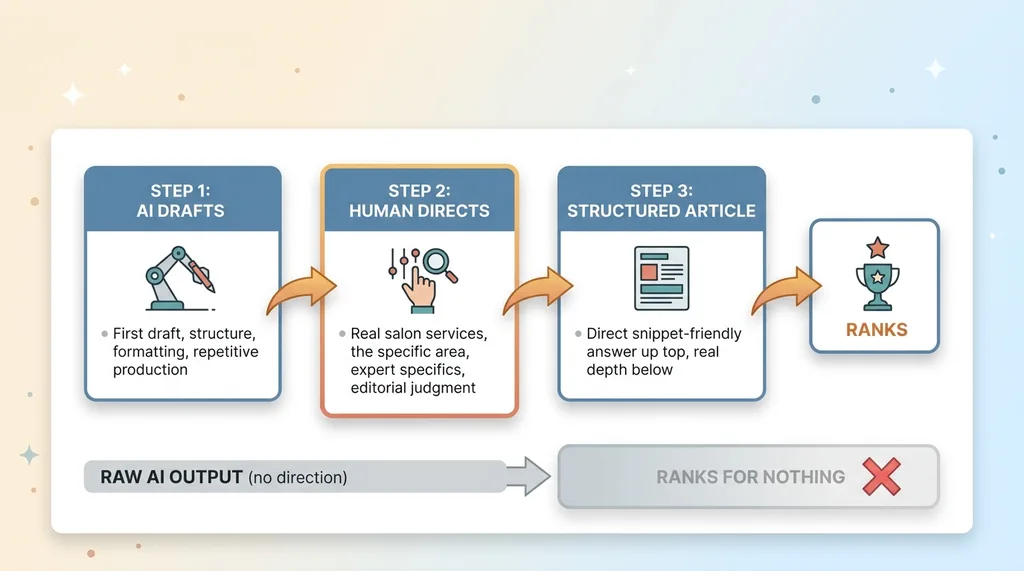 The draft-and-direct AI content workflow
AI handles the first draft, the structure, the formatting, the repetitive production work. I direct it with the salon's actual services, the specific area, and the real specifics a colorist would actually say. The kind of detail that only comes from knowing the business, not from a language model's training data.
Each article is structured for its question. A clear, direct answer up top, written to be featured-snippet friendly, then real depth below for the people who keep reading. That structure isn't decoration. It's how you win the position-zero answer box and the people who scroll.
Why generic AI output ranks for nothing
Here's the truth nobody selling AI content wants to admit. Raw AI output ranks for nothing. It's generic by design. It reads like every other AI article because it is.
The value isn't the generation. It's the direction. The judgment to make it sound like an actual expert talking, with specifics a real colorist would use, scoped to a real place. That's the part that ranks, and that's the part AI can't do alone.
I've built this kind of pipeline before, using automated blog writing with AI agents to handle the production while a human stays in the loop on judgment. The cost framing is what makes it work for a small business: six finished articles in roughly the time and budget that used to buy one freelance piece.
Two AI Images Per Article, Inline and Fast
Every one of the six articles got two AI-generated images placed inline, plus a clean blog index page to tie the set together.
Images matter more than people think for service content. They lift engagement and dwell time. They make a page look like a real publication instead of a wall of gray text. A reader who hits a solid block of paragraphs bounces. A reader who sees a well-illustrated, structured piece stays and reads, and Google notices that.
I use a multi-model setup for this, with Gemini handling image generation. AI generated blog images let a one-person business look like it has a design team, which is exactly the kind of leverage a local salon needs.
Now the honest caveat, and it matters here. AI can't draw this specific salon's real work or real clients. These images are illustrative, not photographic claims about results. In a beauty context that sits adjacent to regulated territory, that distinction is important. You never want imagery that misrepresents what a customer will actually get. Illustrative is fine. Implying "this is our work" when it isn't crosses a line.
The other thing I watch closely is page weight. Pretty images that tank your load speed cost you the rankings you were trying to win. I keep file sizes down so speed doesn't suffer, the same approach I cover in AI-generated images that don't wreck page speed. Fast and illustrated beats slow and gorgeous every time.
What This Actually Costs and What It Doesn't
Let me be concrete, because the economics are the whole reason this approach exists.
The build vs. the ongoing
The complete set, six articles plus twelve images plus a blog index page, was built and deployed alongside the existing site for a fraction of what an agency retainer or a single staff writer costs. We're talking the price of one freelance article for the entire project, not one article.
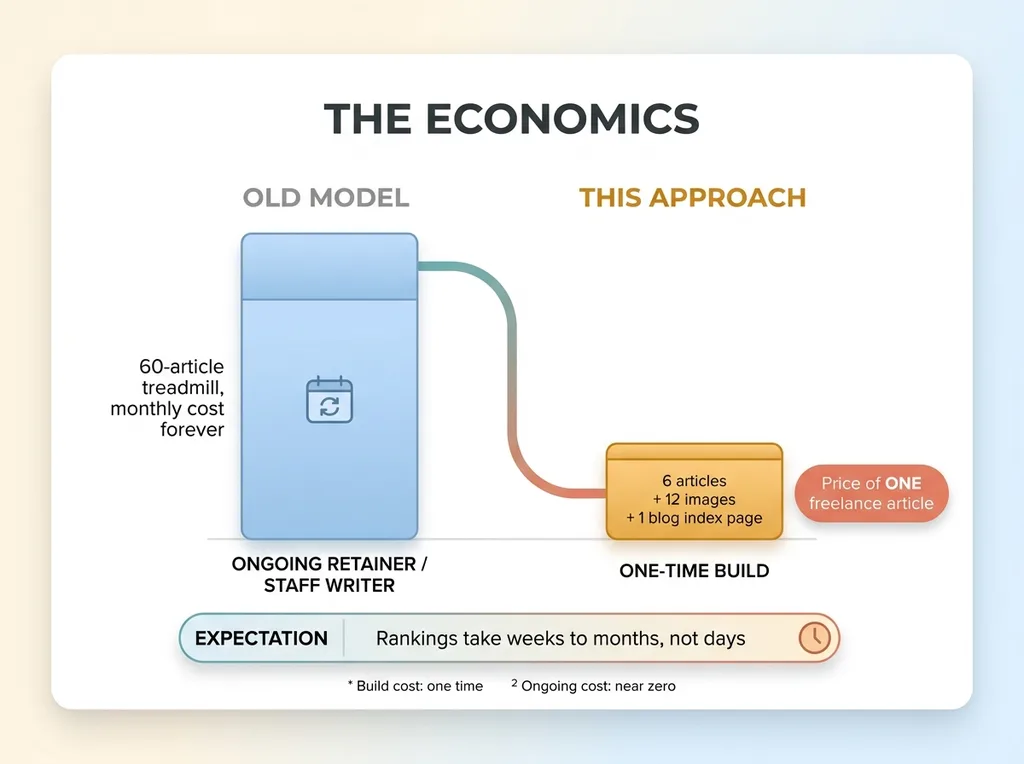 Cost and economics: six articles for the price of one freelance piece
There's a build cost and then there's almost no ongoing cost. This isn't a subscription to a content treadmill. It's a finished asset that keeps working.
But set your expectations correctly. SEO is not instant. Rankings take weeks to months, not days. The reason we targeted winnable queries is precisely because the timeline is realistic. You can't shortcut Google's trust, but you can pick fights you'll eventually win instead of fights you'll never win.
Where AI saves time and where it doesn't
AI saves the production work. Drafting, illustration, formatting, the repetitive grind that eats freelance budgets. That's where the cost collapse comes from.
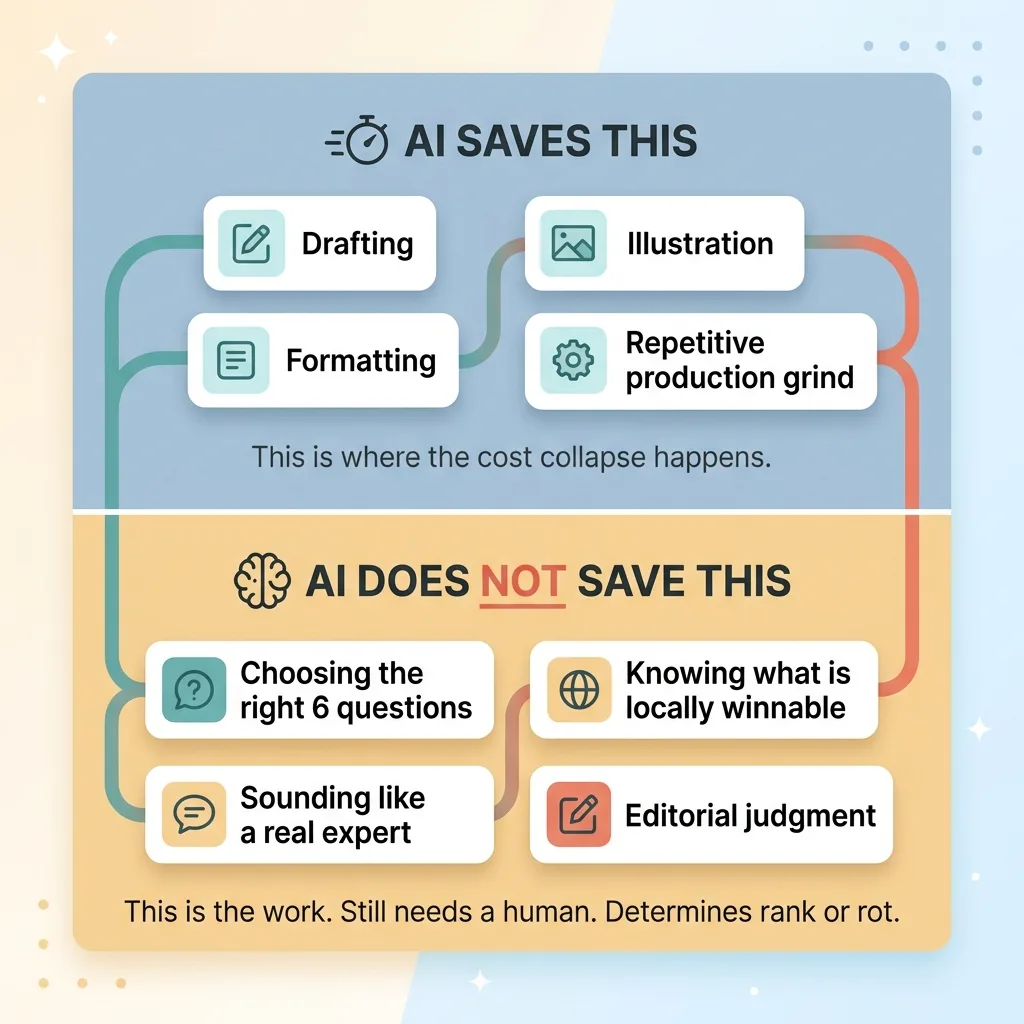 Where AI saves time and where human judgment is still required
What AI does not save is the thinking. Choosing the right six questions. Knowing the local market well enough to know what's winnable. The editorial judgment to make six articles sound like a real expert and not a robot reciting hair facts.
That judgment is the work. It's the part that still needs a human, and it's the part that determines whether the whole thing ranks or rots. Anyone telling you AI does all of it is selling you the slop that ranks for nothing.
Start With the Questions, Not the Content Calendar
If you run a local service business, the mental shift is this. You don't need an endless content machine. You never did.
You need to answer the handful of questions your customers type before they book, for a geography you can actually win, and make it look like a real publication instead of a hobby blog. That's it.
That's a tight, finishable project. Not a treadmill you commit to forever and quietly abandon in three months. Six articles, done right, scoped right, and you have a real organic presence working for you while you do the actual job of running your business.
This is exactly the kind of small, high-leverage AI system I build for service businesses. Not a sprawling transformation. A focused tool that solves one real problem and pays for itself. If you want to see where this fits among the other practical first moves, read the AI systems every small business should build first.
The salon didn't need a content team. It needed six good answers. Most local businesses are in exactly the same spot, spending energy worrying about a content machine they'll never build instead of shipping the small set that would actually move bookings.
Start with the questions. The content follows.
Thinking about AI for your business?
If this resonated, let's have a conversation. I do free 30-minute discovery calls where we look at your operations and find where AI could actually move the needle, no slides, no pitch deck, just a practical look at what's worth building.
Get AI insights for business leaders
Practical AI strategy from someone who built the systems — not just studied them. No spam, no fluff.
Hodgen.AI
Ready to automate your growth?
Book a free 30-minute strategy call with Hodgen.AI.
Book a Strategy Call