How to Market an AI Product (Hint: Hide the AI)
How to market an AI product to skeptical buyers. I stripped every AI mention from a consumer app's marketing and conversions got easier. Here's why.
By Mike Hodgen
The Instinct That Costs You Customers
When you build something with AI, your first instinct is to brag about it. Put "powered by frontier AI" at the top of the landing page. Drop the model name in the settings screen. Make sure everyone knows you used the good stuff.
I had that instinct too. So when I built a child-development app for a client, I led with the AI. The whole pitch was about how the model analyzed video, scored milestones, generated activities. I was proud of the engine, so I showed it off.
It backfired.
The buyer for that app was a protective, time-starved parent. And when a parent reads "AI analyzes your child's video," they don't hear innovation. They hear surveillance. They hear uncertainty. They hear a stranger watching their kid.
That is the core tension nobody warns you about when you learn how to market an AI product. The thing you are proudest of, the AI, is often the exact thing that makes a wary buyer freeze. You think you are signaling sophistication. They think you are signaling risk.
So I had to answer a question every founder eventually faces: will leading with AI help me, or hurt me, with customers who are nervous about it?
I rewrote the marketing. AI-forward became outcome-and-trust forward. I changed feature names, pulled the model callouts, and added a credibility layer built entirely from things that already shipped. Zero new spend. And conversion got easier almost immediately.
Here is exactly what I did and how to know when to do it yourself.
Why 'AI' Is a Liability in a Trust-Sensitive Category
The categories where AI raises the alarm
Some categories are emotionally loaded. The buyer is protecting something they genuinely care about: a child, their health, their money, their legal standing, their personal data. In those categories, the word "AI" does not read as a feature. It reads as a threat.
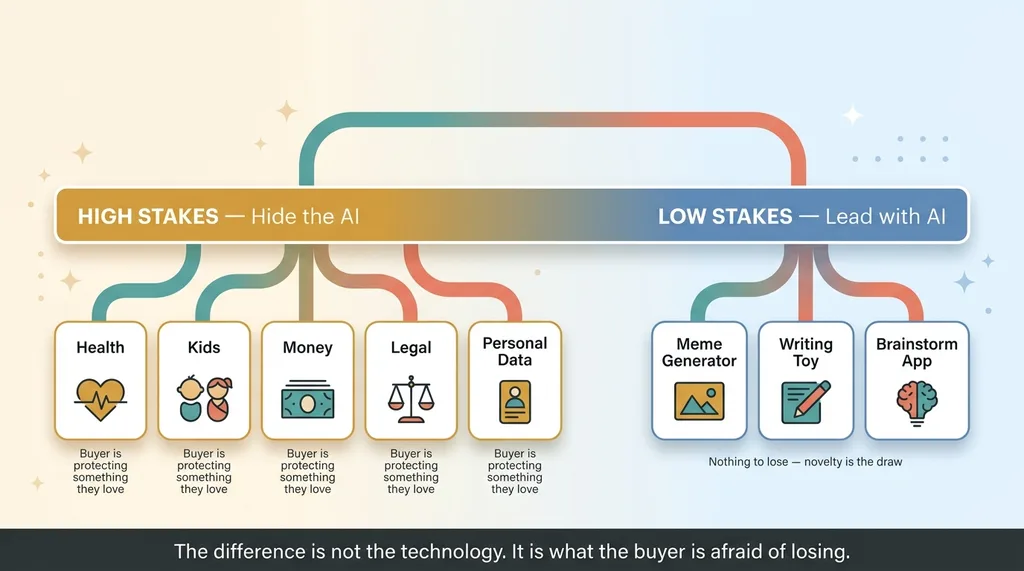 Trust-sensitive vs low-stakes category spectrum
Health. Kids. Money. Legal. Personal data. Those are the trust-sensitive categories. The moment you introduce automation into a decision the buyer feels responsible for, you raise their guard instead of lowering it.
Compare that to a meme generator or a writing toy. Low stakes. Nobody gets hurt if the output is weird. There, AI-forward marketing works fine, because the buyer has nothing to lose.
The difference is not the technology. It is what the buyer is afraid of losing.
What the buyer actually hears
For that protective parent, "AI analyzes your child's video" did not mean "smart and helpful." It meant: where does that video go, who sees it, can I trust a machine to judge my kid, and what happens to the footage afterward.
This is not irrational. Skeptical buyers are usually right to be cautious, and that caution does not evaporate because your model is impressive. If anything, a more powerful-sounding model makes a nervous buyer more nervous, not less.
The hard truth: your buyer's fear is the real product environment. You can have the best engine in the category and still lose, because the buyer never gets past the word that scares them. Positioning in a trust-sensitive space is about what the buyer is protecting, not what you built.
Sell the Outcome, Hide the Plumbing
Rename features to outcomes, not technology
The fix started with language. Here is the before and after, all anonymized.
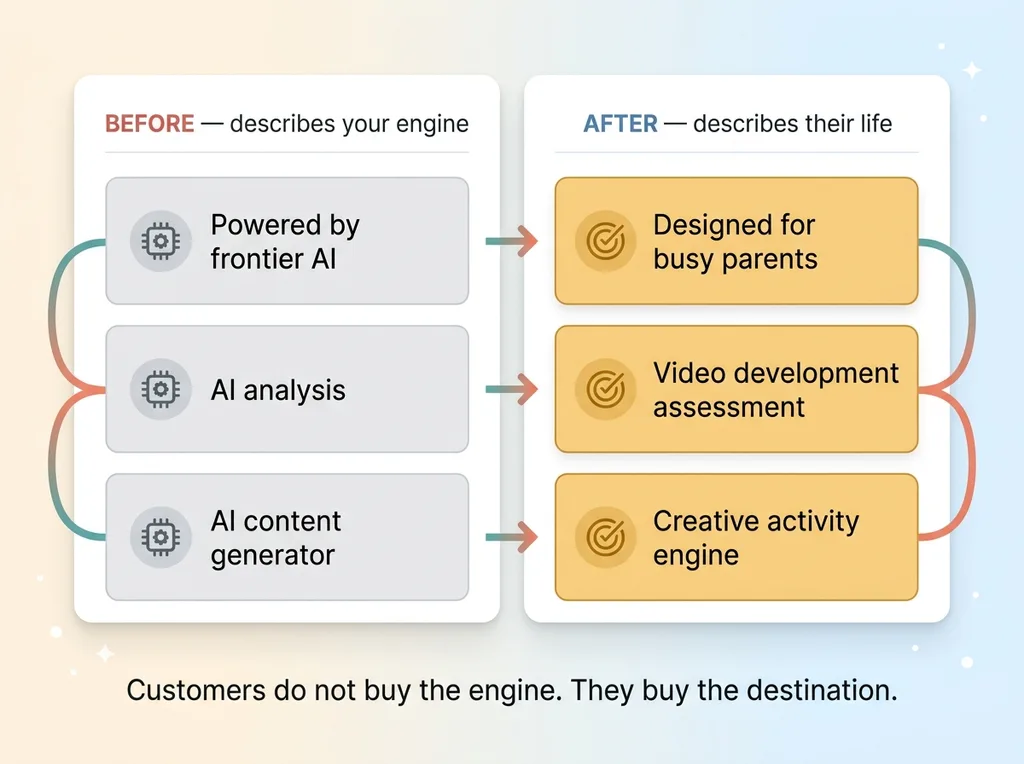 Feature renaming: technology names to outcome names (before/after)
"Powered by frontier AI" became "designed for busy parents." One describes my engine. The other describes their life.
Generic AI feature names became outcome names. The "AI analysis" feature became the "Video development assessment." The "AI content generator" became the "Creative activity engine." Notice what changed: the name now describes what the parent gets, not what runs underneath.
Customers do not buy the engine. They buy the destination. A parent does not want AI. They want to know their kid is on track and to get something useful to do about it. Sell that.
Remove model callouts from the UI
Then I pulled the plumbing out of view. The model names disappeared from the settings screen and from every line of public copy. No "powered by," no version numbers, no architecture bragging.
Think about your banking app. You trust it with your money, and you have no idea what compiler it was built with, what database it runs on, or what language the backend is written in. You do not care. That is plumbing, and plumbing belongs behind the wall.
AI is plumbing. In a trust-sensitive category, exposing it does not build confidence, it invites questions you do not want the buyer asking before they have decided to trust you.
This is not dishonesty. The AI still does the work, exactly as advertised. I am not hiding capability. I am hiding irrelevance. Good ai product positioning means leading with what the buyer is shopping for and quietly handling the rest. The plumbing matters enormously. It just does not belong on the billboard.
Build a Zero-Cost Credibility Layer
Ground every claim in a real source
When you stop bragging about AI, you need something to put in its place. That something is trust. And trust does not come from your model. It comes from authorities the buyer already respects.
So I added a trust bar to the product. It cited the CDC 2022 developmental milestones and the AAP guidance the assessments were actually built against. Instead of "our AI scores your child," the message became "assessments aligned to the standards your pediatrician uses."
That reframes the whole interaction. The parent is no longer being judged by a mysterious machine. They are being measured against the same standards their doctor uses. The authority is borrowed, openly and accurately.
I also surfaced the encryption I'd already shipped. AES-256 was protecting that video data from day one. I just had not told anyone. Putting it on the trust bar answered the unspoken question every parent had: is my kid's video safe.
The trust bar and the safety FAQ
Then I added a medical and data-safety FAQ that answered the questions a nervous parent actually asks. Where does the data go. Who sees the video. What standard is my child judged against. Can I delete it.
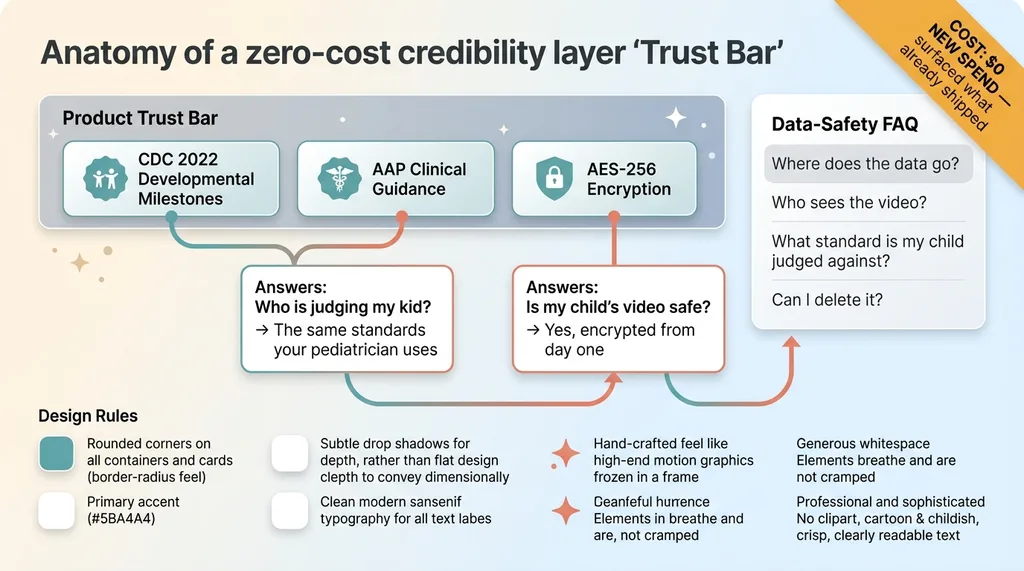 Zero-cost credibility layer / trust bar anatomy
Those are the real objections. Not "what model do you use." When you answer the fear directly, the AI question stops mattering.
One rule is non-negotiable: every claim has to be true and verifiable. You cannot fake trust signals in a trust-sensitive category. If you cite the CDC, your assessments had better actually align to the CDC. If you claim encryption, it had better be real and current. Get caught exaggerating here and you lose the buyer permanently.
The best part: this entire credibility layer cost zero new dollars. The encryption existed. The standards were already baked into the scoring. I did not build anything new. I just surfaced what was already there. The strongest trust signals SaaS founders have are usually things they already shipped and forgot to talk about.
When You SHOULD Lead With AI
I am not telling you to hide AI everywhere. That would be lazy advice. Sometimes leading with AI is exactly right.
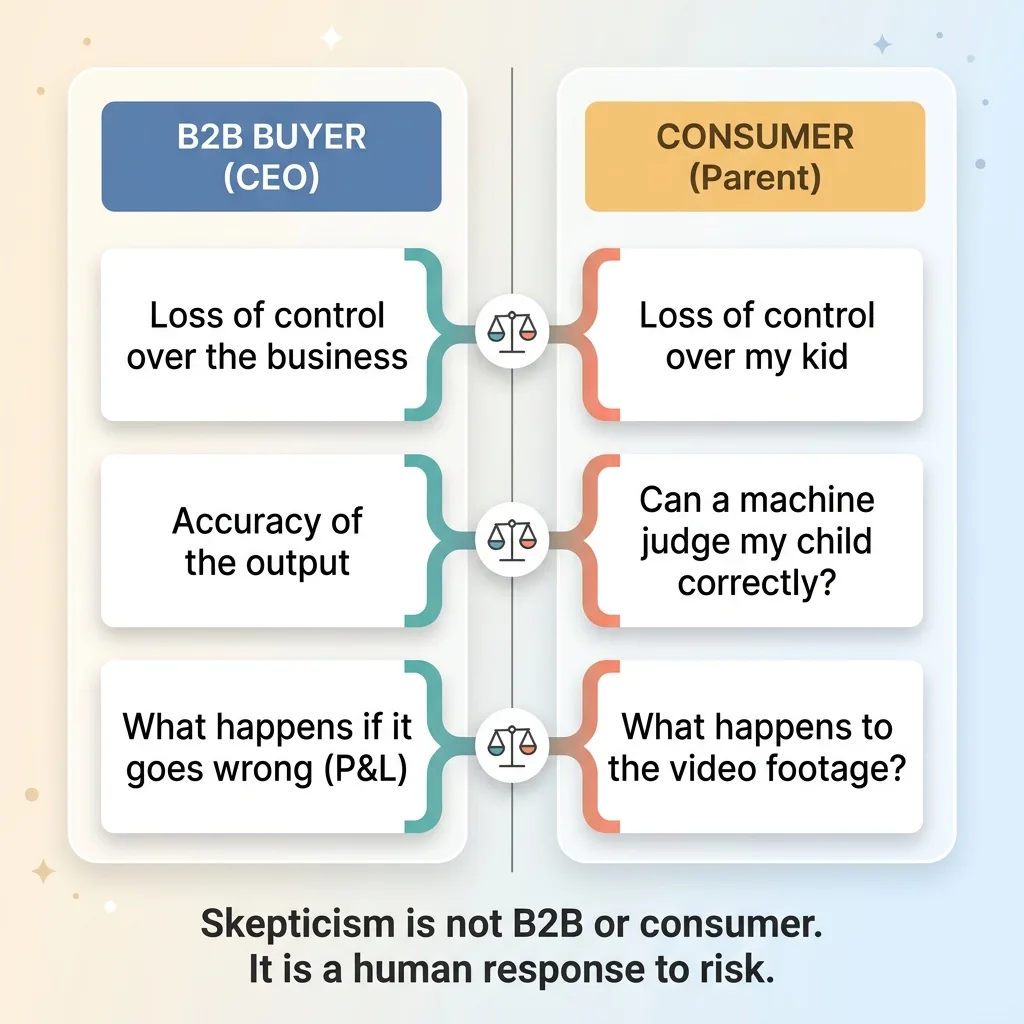 CEO fear vs parent fear parallel (skepticism is human)
Lead with AI when your buyer is a builder or a technical buyer who wants to know the stack. A developer evaluating a coding tool wants to know which models you support and how. Hiding it would insult them.
Lead with AI when the category is low-stakes. A creative toy, a brainstorming app, a fun generator. Nobody is protecting anything, so the novelty is the draw.
And lead with AI when "AI" is the actual differentiator the buyer is shopping for. An AI-native productivity app sold to early adopters who specifically want the bleeding edge. There, "powered by frontier AI" is the feature, not a red flag.
The test is one question: what is the buyer afraid of, and is AI the thing they want or the thing they fear.
If they want it, put it front and center. If they fear it, put it behind the wall.
This maps directly onto something I see constantly in my consulting work. The same fears CEOs have about AI show up in consumers too, just about different stakes. A CEO worries about control, accuracy, and what happens if it goes wrong. A parent worries about the same things, just for their kid instead of their P&L. Skepticism is not a consumer problem or a B2B problem. It is a human response to risk.
So the answer to "should you mention AI in marketing" is not yes or no. It is: depends entirely on what your buyer is protecting.
A Simple Test Before You Write a Word of Copy
Here is a framework you can run on your own landing page in twenty minutes. Three questions.
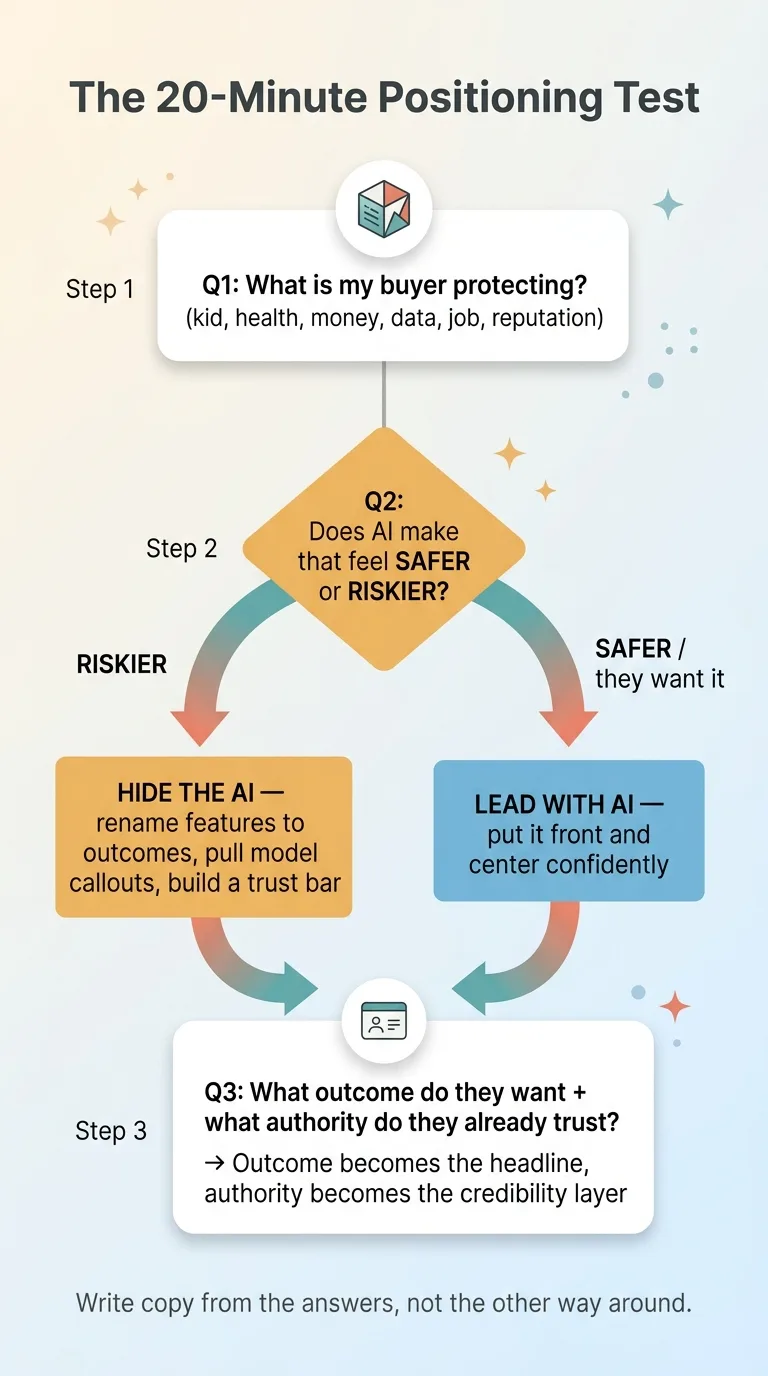 Three-question positioning decision framework
One: what is my buyer protecting? Their kid, their health, their money, their data, their job, their reputation. Name it specifically. If they are protecting nothing, your stakes are low and you have more freedom. If they are protecting something they love, proceed carefully.
Two: does "AI" make that thing feel safer or riskier to them? Be honest. Read your own headline as the most anxious version of your buyer. Does "AI-powered" reassure them or make them hesitate. If it adds risk in their mind, the AI goes behind the wall.
Three: what outcome do they actually want, and what authority do they already trust? The outcome becomes your headline and your feature names. The authority becomes your credibility layer. For my parents, the outcome was "know your kid is on track" and the authority was the CDC, the AAP, and real encryption.
Now act on the answers. If AI raises risk, rename every technology feature to an outcome, pull the model callouts, and build a trust bar from sources the buyer respects. If AI lowers risk or is the thing they want, lead with it confidently.
This is the core of selling AI to skeptics. You do not argue them out of their skepticism. You position around it. You meet the fear with a real answer instead of a louder claim.
Run those three questions before you write a single line of copy. Most founders write the copy first and reverse-engineer the buyer. Do it the other way around.
Positioning Is a Build Decision, Not a Marketing Afterthought
Here is the part most people miss. The only reason I could surface the encryption and the standards is because I built them in from the start. The AES-256 was real. The CDC alignment was real. I was not dressing up an empty product, I was revealing a credible one.
That is the lesson. Positioning that earns trust is not a copy exercise you bolt on at the end. It is a decision that touches what you build, what you log, what you can prove, and what you can honestly claim. If I had not shipped real encryption, I would have had nothing to put on that trust bar.
This is why I sit at both ends. I build the AI systems and I decide how they get sold. When you do both, you build differently. You build the verifiable claim before you need it.
If you are putting an AI product in front of buyers who are nervous about AI, the answer is rarely to shout louder about the model. It is to figure out what they are protecting, build the proof, and put the AI behind the wall where it belongs.
If that is the problem you are sitting with, talk to me about positioning. I have made these calls for my own brand and for clients, and I am happy to think through yours.
Thinking about AI for your business?
If this resonated, let's have a conversation. I do free 30-minute discovery calls where we look at your operations and figure out where AI could actually move the needle, not where it just sounds impressive.
Get AI insights for business leaders
Practical AI strategy from someone who built the systems — not just studied them. No spam, no fluff.
Hodgen.AI
Ready to automate your growth?
Book a free 30-minute strategy call with Hodgen.AI.
Book a Strategy Call