Negative SEO Attack Defense: How AI Fights Back Daily
A competitor bought 80 spam domains to tank my rankings. Here's the AI system I built for negative SEO attack defense that rebuilds a disavow file every day.
By Mike Hodgen
Someone Paid to Bury My Best Keyword
I noticed it the way you notice a slow leak. Rankings on the money keyword for my DTC fashion brand started slipping. Not a cliff, just a steady erosion week over week on the one search term that actually drove sales.
I assumed it was an algorithm update at first. Then I looked at the backlink profile and felt my stomach drop.
Hundreds of new referring domains had appeared in a tight window. Cheap TLDs (.store, .shop, .xyz) with domain names that literally advertised PBN-for-hire SEO services. These weren't accidental links. Someone had paid for them. The names of the domains were basically business cards for the people selling the attack.
The pattern was clean and deliberate. 91% of the new links pointed at my homepage, all aimed at suppressing one specific commercial keyword. This wasn't link spam splattered around randomly. It was sabotage with a target.
I traced three distinct waves between August 2025 and June 2026, plus an older extortion-style wave (the kind that shows up with a Telegram handle and a pay-us-or-else message). That's when it clicked: negative seo attack defense had become a real line item for me, not a theoretical risk in some SEO blog.
Here's what makes this ugly. You can buy this kind of attack for a few hundred dollars. A competitor who doesn't want to compete on product or price can just try to poison your link profile and let Google do the dirty work.
So the question I had to answer, the same one you're probably asking, was this: can AI actually defend against a competitor's deliberate sabotage? Or is a pbn backlink attack still a problem you have to hand to an expensive agency and hope they catch it in time?
I built my own answer. Here's how it works and where it falls short.
What a PBN Backlink Attack Actually Looks Like
A PBN (private blog network) is a cluster of junk websites that exist for one reason: to point links at a target. They produce no real content anyone reads. They have no real audience. They're a link cannon, and you can rent the trigger.
The fingerprints of a bought attack
Once you've seen one coordinated attack, the signs are obvious. Hundreds of new referring domains appearing in a tight window, not the slow trickle of organic links. Cheap TLDs because the attacker is running this at scale and wants the per-domain cost near zero.
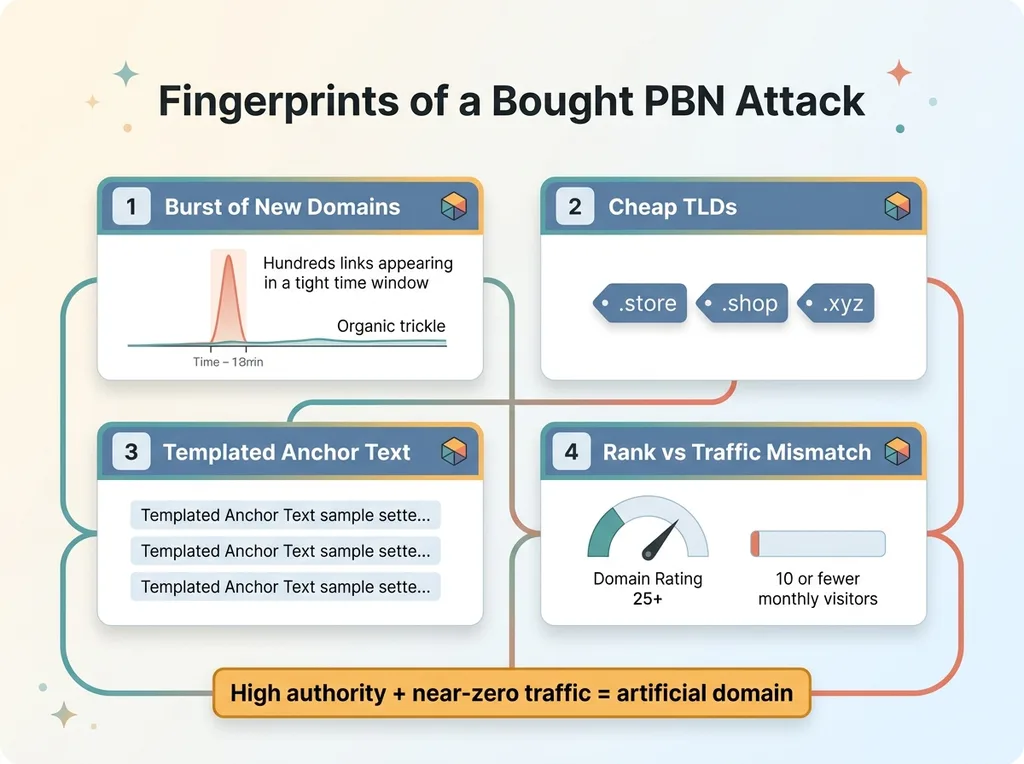 PBN Attack Fingerprints
Then there are the tells in the data itself. Domain names containing SEO-vendor terms. Identical or templated anchor text repeated across dozens of sites. And the cleanest signal of all: inflated domain authority paired with near-zero real traffic.
That last one is the rank-vs-traffic heuristic, and it's the backbone of how I separate real links from fake ones. In plain terms: a domain with a Domain Rating of 25 or higher but ten or fewer monthly visitors is almost certainly artificial. Real sites with real authority have real audiences. A site with the metrics of an authority and the traffic of a ghost town was built to game rankings, not to inform anyone.
Why the homepage was the target
The 91% homepage concentration wasn't laziness. It was strategy.
Your homepage is usually your most authoritative page and the one Google associates most strongly with your brand and your main keyword. If an attacker can get Google to associate your homepage with link spam, they can trigger a penalty or a quiet suppression on the exact term that matters most.
They weren't trying to hurt a random blog post. They were trying to make Google distrust the single page that drives my commercial intent traffic. Smart, cheap, and genuinely dangerous if you don't catch it.
The hard part with toxic backlink monitoring is telling a coordinated attack apart from normal ranking noise. I had to be sure this was sabotage and not just an algorithm shift, which is its own diagnostic problem.
The Old Way: Paying an Agency for a Quarterly Audit
The traditional defense is hiring an SEO agency to run a backlink audit. Usually quarterly. They pull your link profile, flag the toxic stuff, and hand you a disavow file.
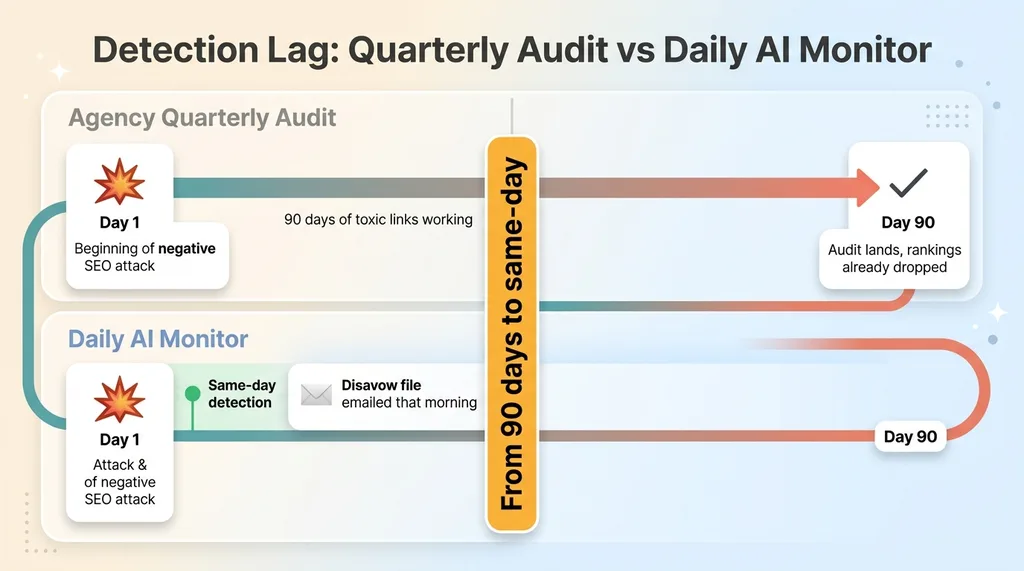 Quarterly Audit vs Daily AI Monitor Timeline
The problem isn't the work. It's the cadence.
Detection lagged anywhere from five days to several months behind the actual damage. By the time the quarterly audit landed on my desk, the rankings had already dropped and recovery takes weeks. You're paying for a snapshot of a moving target.
Think about the timing from the attacker's side. They can fire a fresh wave the day after your audit completes, and you won't know about it for 90 days. That's a full quarter of toxic links sitting in your profile, doing their work, while you assume everything is fine because you just paid for a clean bill of health.
Quarterly audits assume a static threat. A paid attack is a continuous one. Those two things don't fit together.
This is also where you need to be careful about misdiagnosis. When my rankings dropped, my first instinct was to blame myself or an algorithm change. I had to do the work of proving a ranking drop was the algorithm, not your site before I committed to treating this as an attack. If you skip that step you can waste weeks disavowing links that weren't even the cause.
I want to be fair here. Agencies aren't useless. A good one does real work and catches real problems. But the quarterly rhythm is wrong for an active attack. You don't defend against a daily threat with a quarterly response.
The Daily AI Monitor I Built Instead
So I built a system that watches every single day. No retainer, no waiting, no snapshot of a moving target.
Pulling new referring domains every day
A scheduled job runs each morning and pulls newly-seen referring domains from a backlink data provider. The key word is newly. It sorts by first-seen date, so I'm only ever reviewing what's actually new since yesterday. I don't re-audit my entire profile every day, which would be noise. I look at the delta.
That alone changes the game. Instead of discovering 400 toxic domains all at once in a quarterly report, I see them appear in real time, as the wave is happening.
Classifying toxicity in four tiers
Pulling the domains is the easy part. The judgment is in the classification.
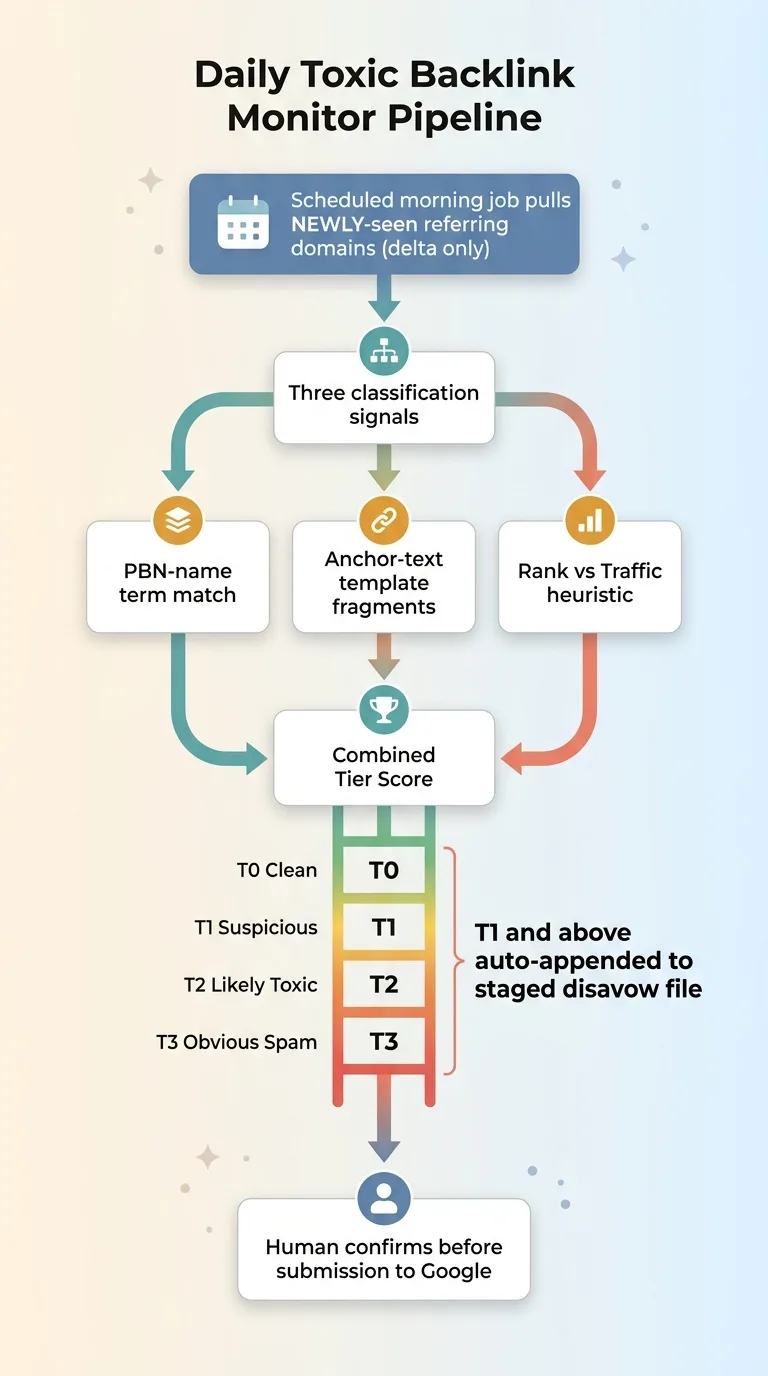 Daily AI Monitor Pipeline and Four-Tier Classification
Every new domain gets scored into one of four tiers, from T0 (clean) through T3 (obvious spam). The classifier uses three signals working together:
- PBN-name term matching. If the domain itself contains SEO-vendor keywords (the language these sellers use to advertise), that's a strong toxicity signal.
- Anchor-text template fragments. Coordinated attacks reuse the same anchor text. When I see the same templated fragment repeated across many new domains, that's a fingerprint.
- The rank-vs-traffic heuristic. High authority, near-zero traffic. The artificial-domain tell I described earlier.
No single signal decides the tier. It's the combination. A domain that hits all three is about as obviously toxic as it gets.
High-confidence toxic domains get auto-appended to the disavow file. The system also snapshots history every run, so I can see the attack waves laid out over time (which is how I documented all three between August 2025 and June 2026). And every morning it emails me the complete, ready-to-upload disavow file.
The single biggest shift: detection went from roughly five days behind to same-day. When a wave fires, I know that morning, not next quarter.
This monitor is one piece of the broader toolkit I run for the brand (22,000-plus lines of custom Python doing the unglamorous work). It's worth being clear about the two sides of the link game. There's automated backlink outreach that actually works for building good links, and there's this system for blocking bad ones. Same domain, opposite jobs. You need both.
Why I Let AI Build the Disavow File but Not Submit It
A disavow file tells Google to ignore specific links pointing at your site. It's powerful, and that's exactly the problem.
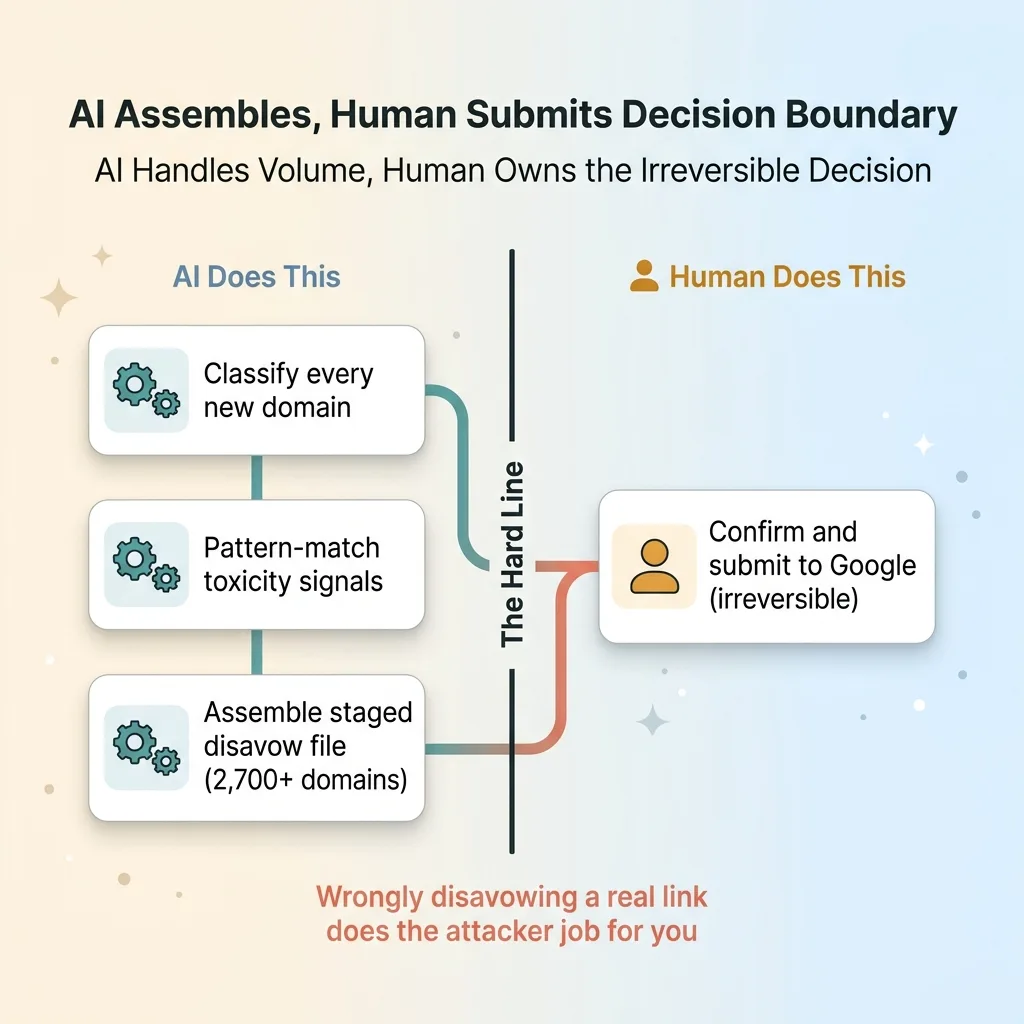 AI Assembles, Human Submits Decision Boundary
If you mistakenly disavow legitimate links (real editorial mentions, real partnerships, links that are actually helping you), you can damage your own rankings. You'd be doing the attacker's job for them. This is a place where over-automation is genuinely dangerous.
So I drew a hard line. The system classifies and stages everything. It does not submit anything.
The tier logic handles the assembly. Anything classified T1 or higher gets auto-appended to the staged disavow file, which has now grown past 2,700 domains. But a human (me) confirms before that file ever goes to Google. The AI does the tedious classification and the file assembly. The human makes the irreversible decision.
This is a principle I come back to constantly in how I build systems. Let AI handle the volume and the boring pattern-matching. Keep the human in the loop for anything you can't easily undo. Submitting a disavow file is one of those things.
And I'll be honest about why this isn't fully automated: the classifier isn't perfect. False positives happen. A legitimate niche site with thin traffic can occasionally trip the rank-vs-traffic heuristic. That's not a flaw I can fully engineer away, which is exactly why submission stays manual. I'd rather spend two minutes reviewing than auto-disavow a link that was actually helping me.
The monitor also isn't the only layer of defense. Toxic links can leak in through other channels too, like old redirect domains that funnel spam into your main site. The daily monitor catches the front-door attack. You still have to watch the side doors.
What Changed: From Months Behind to Same-Day
Let me give you the honest accounting, the wins and the limits both.
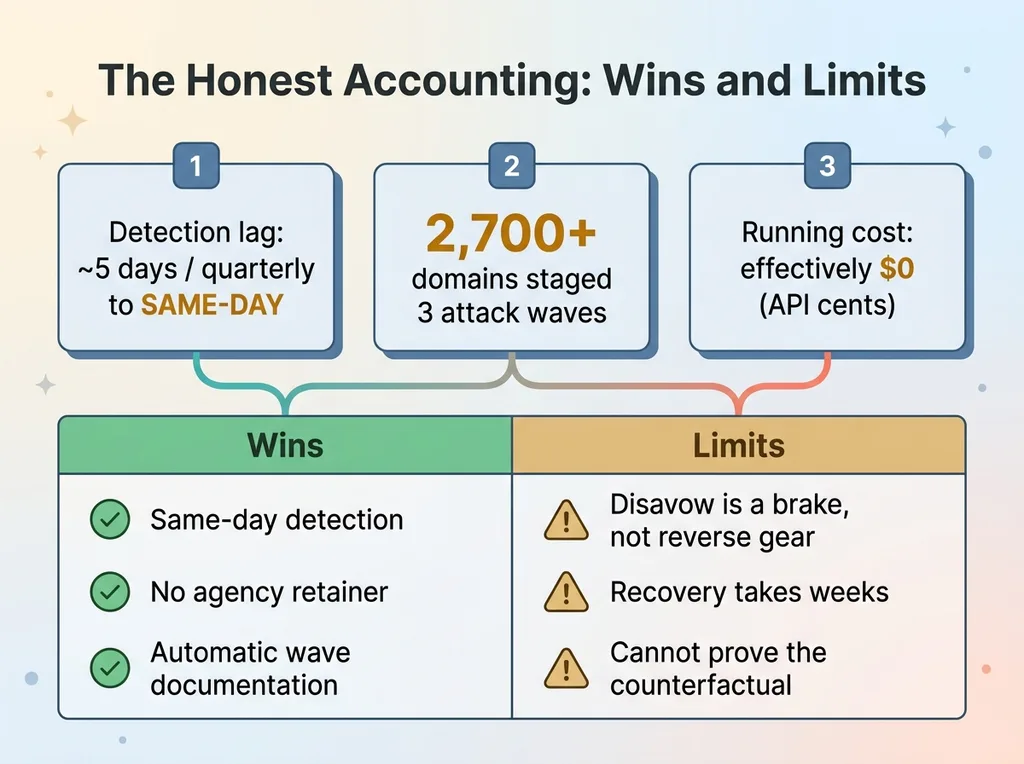 Results Scorecard: Wins and Limits
The detection lag collapsed. From roughly five days (or a full quarter with an agency) down to daily. That's the headline, and it's real.
The disavow file grew to 2,700-plus domains across three documented attack waves, all caught and staged automatically. I didn't manually hunt for any of them. The system surfaced each wave the morning it landed.
And I stopped paying for quarterly audits entirely. The build cost me time once. After that, the running cost is effectively zero (API calls measured in cents). Compare that to an ongoing agency retainer that was always one quarter behind the threat anyway.
Now the honest part. A disavow file does not instantly restore rankings. Google still needs time to process it and re-evaluate, and negative seo recovery is measured in weeks, not days. The disavow is a brake, not a reverse gear.
I also can't prove a negative. I don't know precisely how much damage I prevented, because the counterfactual (what would have happened if I'd caught these waves 90 days late) never ran. Anyone who promises you a clean before-and-after ranking number on this is guessing.
So I don't frame the ROI as a guaranteed ranking gain. I frame it as risk reduction and response speed. The speed is the actual win. When sabotage is continuous, catching it same-day instead of next-quarter is the entire difference between a managed problem and a disaster you find out about too late.
SEO Defense Doesn't Have to Be an Agency Black Box
So back to the doubt I started with. Can AI actually defend your site against a competitor's sabotage?
Yes. And it can do it faster and cheaper than a quarterly retainer. The automated disavow file assembly, the daily toxic backlink monitoring, the four-tier classification (all of it runs without a human until the one moment a human decision actually matters).
The catch is that someone has to build the system and wire the judgment into it. What gets auto-appended. What gets held for review. Which signals to trust and how to combine them. That's not a thing you buy off a shelf, and it's not a dashboard you babysit. It's a system tuned to your specific risk.
That's the kind of thing I build for the businesses I work with. Not another tool that demands your attention every day, but a system that watches quietly and only interrupts you when there's a real decision to make.
If a competitor is buying links to bury your best keyword, you don't need a quarterly snapshot. You need eyes on it every morning. If you want that for your own site, I can build a defense system for your own site.
Thinking about AI for your business?
If this resonated, let's have a conversation. I do free 30-minute discovery calls where we look at your operations and find where AI could actually move the needle (not where it sounds impressive in a deck).
Get AI insights for business leaders
Practical AI strategy from someone who built the systems — not just studied them. No spam, no fluff.
Hodgen.AI
Ready to automate your growth?
Book a free 30-minute strategy call with Hodgen.AI.
Book a Strategy Call