AI Generalist vs Specialist: Why Range Wins Now
Nine industries in one quarter. Why the AI generalist vs specialist debate is settling, and why range now beats deep vertical expertise.
By Mike Hodgen
The Old Rule: Specialize or Don't Bother
For years the advice was simple. If you want to build credibly in an industry, you need years inside it. Vertical SaaS founders were supposed to be ex-operators who lived the pain. Consultants put it right on their homepage: we only do healthcare, we only do legal, we only do construction.
 The Scarce Skill Shifted: Domain Knowledge vs Shipping
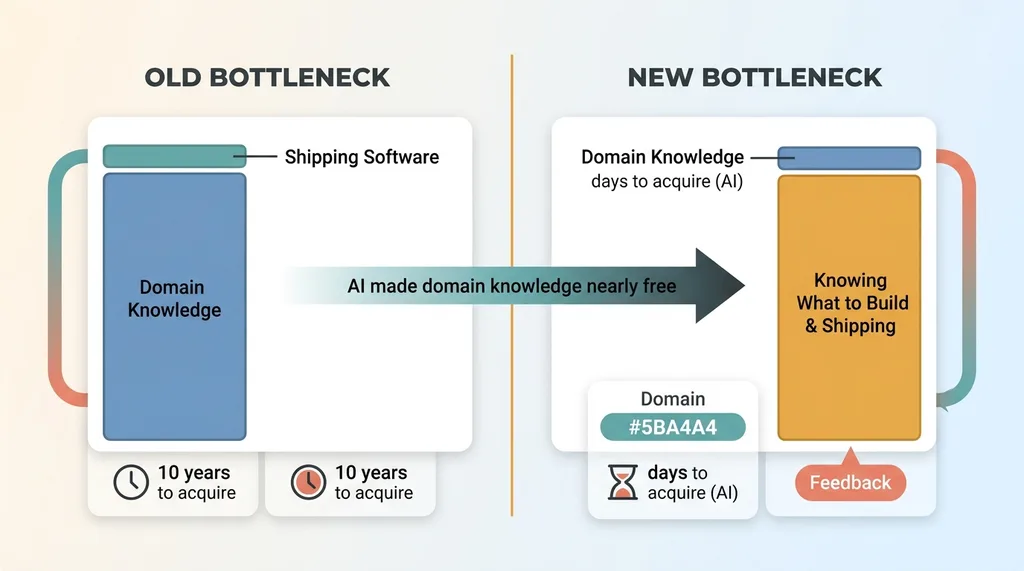
The logic held up. Domain knowledge was scarce, expensive, and slow to acquire. You earned it with reps, scar tissue, and time. So it became the moat. If you hadn't spent a decade in the industry, you couldn't possibly understand the edge cases that mattered. The specialist won because acquiring what they knew took years you didn't have.
I'm not going to tell you that was wrong. It was right. For most of business history, the AI generalist vs specialist debate had a clear answer: specialize, or don't bother.
Here's what changed. AI didn't make domain knowledge less important. The edge cases still matter. The regulations still bite. The pricing conventions still make or break a quote. What AI did was make acquiring that knowledge nearly free.
And that flips which skill is actually scarce.
When learning a domain took years, the domain expert was the bottleneck. Now the bottleneck is something else entirely: knowing what to build, asking the right question, and shipping working software once you have the answer. The rulebook is still the rulebook. You just don't need a decade to read it anymore.
That's the whole thesis. The scarce skill moved. Most buyers haven't updated their assumption yet, and they're still hiring for a constraint that collapsed.
What Nine Industries in One Quarter Actually Looked Like
Let me make this concrete, because thesis statements are cheap.
 Nine Industries Shipped in One Quarter
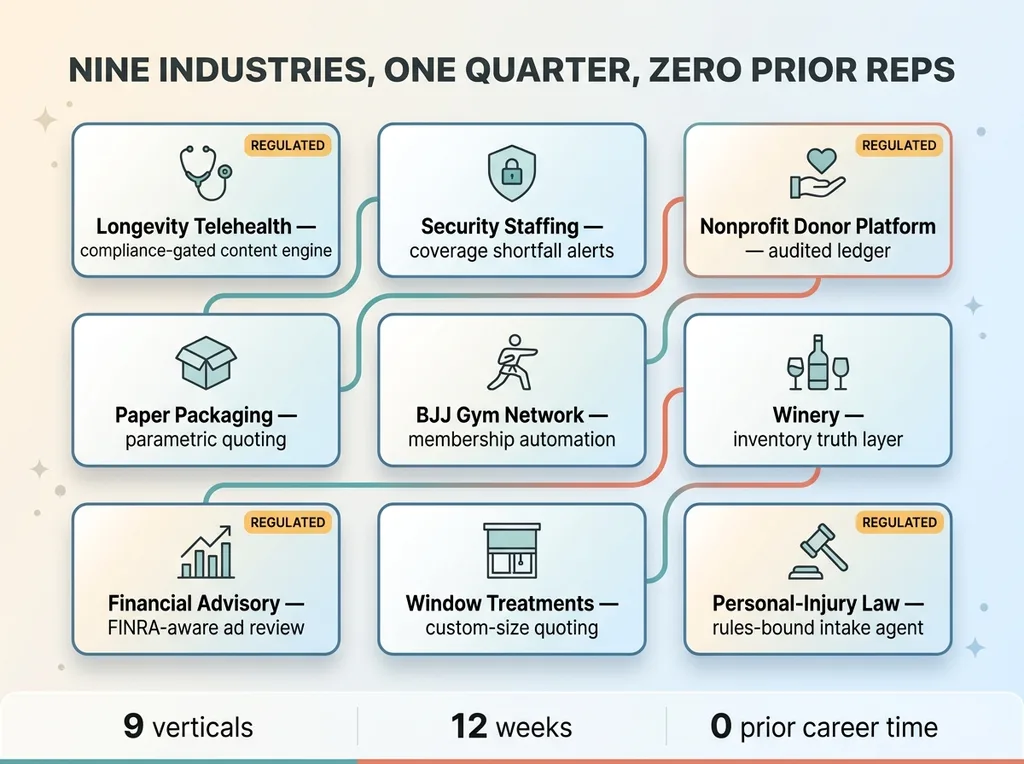
In a single quarter I shipped production systems across nine unrelated industries. Not slide decks. Working software in front of real users. Here's the list, by category only:
- A longevity telehealth startup, a compliance-gated content engine that kept health claims inside legal boundaries before anything published.
- A security-guard staffing company, post-aware staffing alerts that flagged coverage shortfalls before a shift went uncovered.
- A nonprofit donor platform, a ledger system with a deterministic money path and a full audit trail.
- A paper-packaging distributor, parametric quoting that turned a manual spreadsheet into a structured engine.
- A BJJ gym network, membership and scheduling automation tuned to how gyms actually operate.
- A winery, an inventory truth layer that reconciled what was on hand against what the system thought.
- A financial advisory firm, FINRA-aware ad review that caught compliance problems before they reached a regulator.
- A window-treatment company, a quoting system that handled the parametric mess of custom sizing.
- A personal-injury law firm, an intake agent with hard rules about what it could and couldn't say.
None of these overlap. Several are regulated, and the regulated ones carry real fines for getting it wrong. And I had zero prior career time in any of them. I've never worked in telehealth, never staffed a security firm, never run a winery.
That's the point. If domain time were the moat, none of these should have been possible in twelve weeks. I've written about the broader velocity in what a quarter of solo output actually looks like, but the headline matters here: nine verticals, no prior reps in any of them, every one shipped.
The specialist model says that's impossible. The results say the model is out of date.
How a Generalist Acquires Domain Expertise in Days, Not Years
This isn't magic, and I don't want it to read like hype. There's a mechanism, and it's repeatable.
 How a Generalist Acquires Domain Expertise, The Repeatable Process
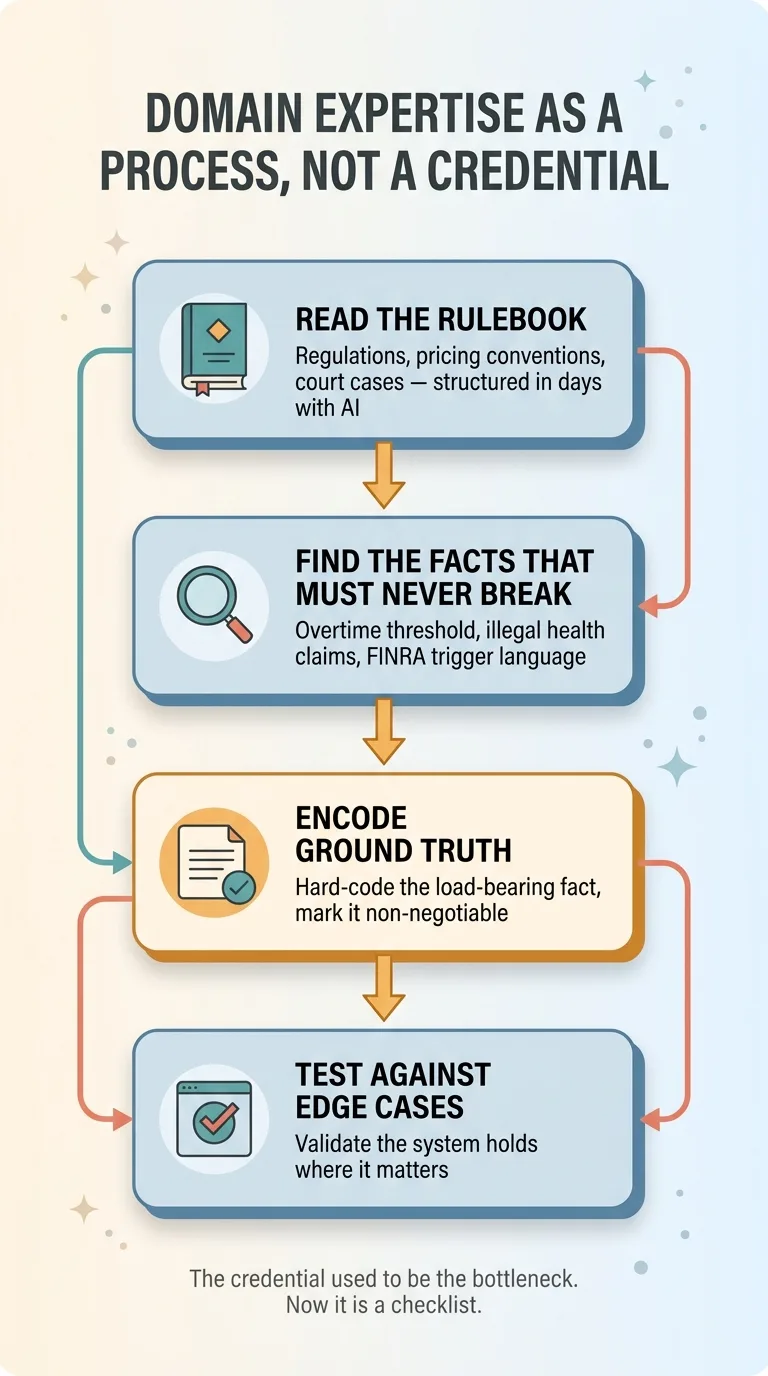
Reading the rulebook before writing the code
Every industry has a rulebook. Sometimes it's literal regulation. Sometimes it's pricing convention. Sometimes it's the court cases that define what a word like "overtime" actually means in practice.
Before I write a line of code, I ingest that rulebook. The wage-law cases behind an overtime engine. The 20-day notice requirement that determines whether a contractor gets paid. The consent split that keeps a health brand out of a six-figure fine. The banned-words list that keeps supplement copy compliant.
AI lets me read and structure that material in days instead of years. I'm not memorizing a domain. I'm finding the constraints that govern it, then encoding them.
Encoding the one fact that must never be wrong
Here's the part that separates a working system from a liability.
In every domain there's a small set of facts the model must never get wrong. In labor compliance it's the overtime threshold. In health it's the claim you legally cannot make. In finance it's the language that triggers a FINRA flag.
The generalist's real skill isn't knowing those facts off the top of their head. It's knowing the question to ask the domain expert, and then encoding the ground truth so the system treats it as non-negotiable. The AI can draft, summarize, and reason. But the load-bearing fact gets hard-coded, validated, and tested.
Domain expertise with AI is now a process, not a credential. You read the rulebook, you find the facts that must never break, you wire them in, and you test against the edge cases. I walk through this in more detail in the same pattern repeats across every regulated industry I rebuild, but the short version is: the credential used to be the bottleneck. Now it's a checklist.
Why the Work Rhymes Across Unrelated Industries
Here's the counterintuitive payoff of range. The surface of these industries looks nothing alike. The substructure is almost identical.
 Shared Primitives Beneath Every Industry
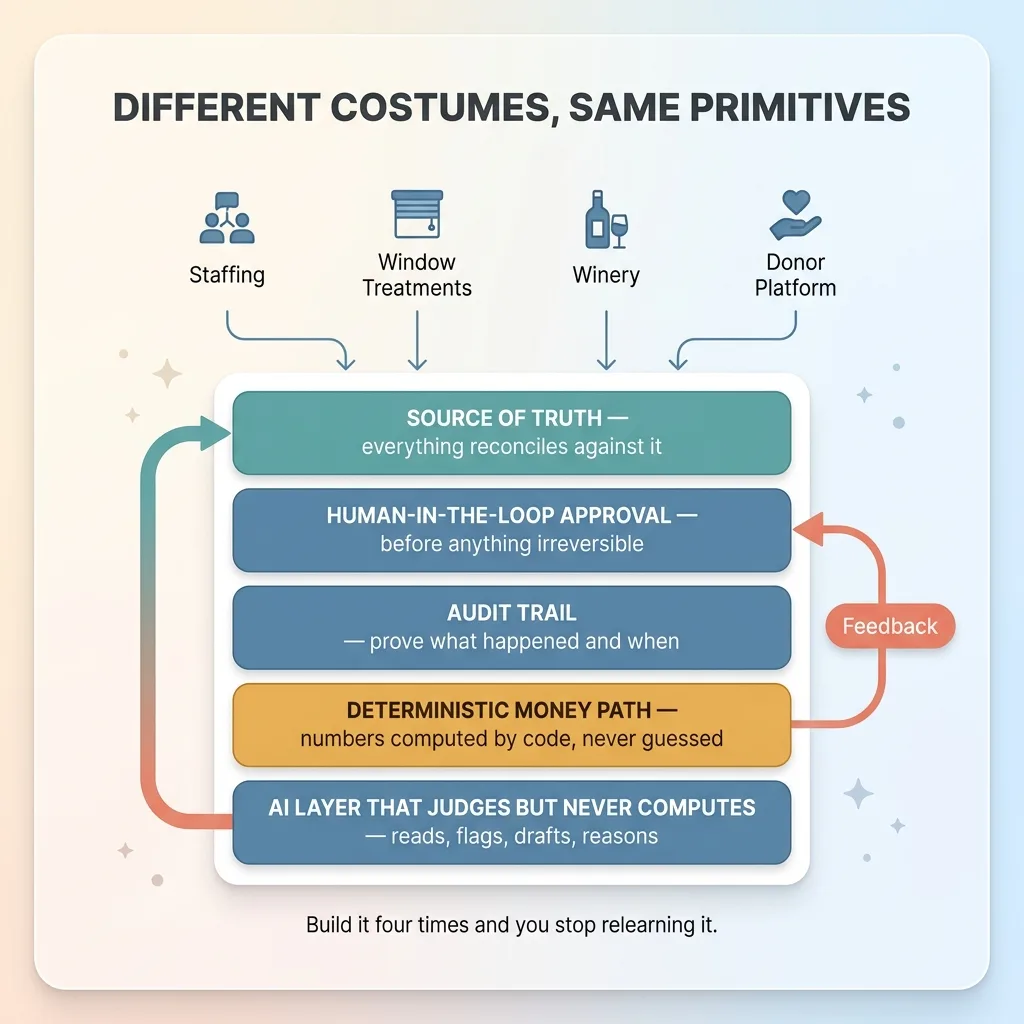
A staffing company's scheduling shortfall, a window-treatment company's quoting bug, a winery's inventory reconciliation, and a donor platform's ledger look like four completely different problems. They're not. They're the same primitives wearing different costumes:
- A source of truth that everything else reconciles against.
- A human-in-the-loop approval before anything irreversible happens.
- An audit trail so you can prove what occurred and when.
- A deterministic money path where numbers are computed by code, never guessed by a model.
- An AI layer that judges but doesn't compute, it reads, flags, drafts, and reasons, but it never does the math that has to be exact.
Once you've built that stack four or five times, you stop relearning it. You start pattern-matching. A new industry walks in, and within a day you can see which problem is the source-of-truth problem and which is the approval problem.
This is what I mean by the stacking generalist. Each new vertical is faster than the last because the plumbing is shared. The winery taught me something about reconciliation that made the donor platform's ledger faster. The staffing alerts taught me something about thresholds that sped up the labor compliance work.
The depth specialist never sees this. They only ever see one industry, so the cross-industry patterns are invisible to them. They get deeper in a single well. The generalist gets a map of every well, and notices they all use the same pipe.
That map is the actual asset. It's why the ninth industry took less time than the second, not more.
Where the Generalist Still Needs a Human in the Loop
I want to be honest about the limits, because overclaiming here destroys trust fast.
Range has a ceiling. I don't pretend to out-judge a securities lawyer on a borderline disclosure. I won't out-diagnose a clinician on an edge case. There's tacit judgment in these professions that I can't acquire by reading the rulebook, and I won't pretend otherwise.
What I do is build the machine and keep the domain expert in the approval seat. The AI drafts. The expert disposes. That division of labor is the entire model, and it's not a hedge, it's the design.
Real examples from systems I've shipped:
- An AI medical-information system that has to cite its sources before it's allowed to touch a calendar or take any action. No source, no action.
- A legal intake agent that is forbidden from quoting a number. It can gather facts and route the case. It cannot tell a prospect what their claim is worth, because that's a judgment a lawyer makes, not a bot.
- A compliance review where the AI flags every potential issue, but a human approves every single fix before it goes live.
The generalist's job is to design the machine and wire the kill-switch. Not to be the final authority on the domain. The expert stays the authority. I just make them faster and harder to embarrass.
That's the answer to the buyer's real doubt. You're not betting that I know your industry better than your specialist. You're betting that I can build a system that puts your specialist in the loop at exactly the right moment.
AI Generalist vs Specialist: When Range Actually Wins
Let me give you a framework you can actually use, because the answer isn't "range always wins." It depends on what your binding constraint is.
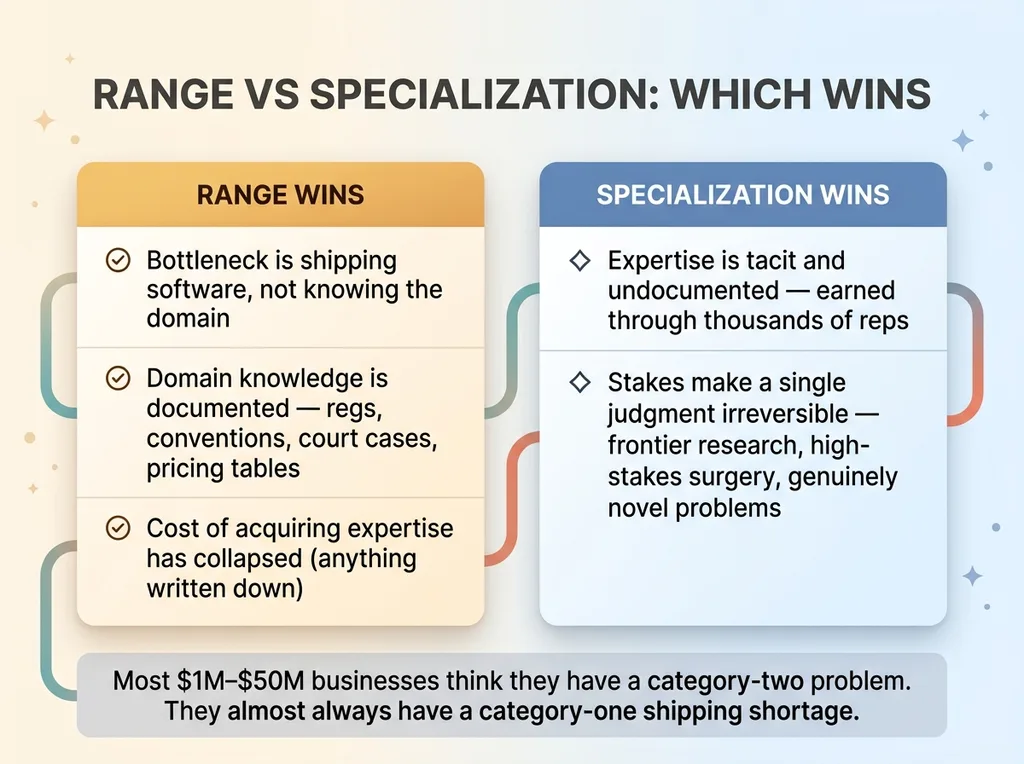 When Range Wins vs When Specialization Wins
Range wins when three things are true:
- The bottleneck is shipping working software, not knowing the domain.
- The domain knowledge is documented somewhere, regulations, conventions, court cases, pricing tables, a banned-words list.
- The cost of acquiring that expertise has collapsed, which it has for anything written down.
Specialization still wins when:
- The expertise is tacit and undocumented, earned only through thousands of reps.
- The stakes make a single judgment call irreversible, frontier research, high-stakes surgery, the genuinely novel problem where no rulebook exists yet.
Here's the thing most buyers get wrong. They assume their problem is a category-two problem when it's almost always category one. For most businesses between $1M and $50M, the constraint was never a rare specialist. The constraint is getting anything built at all.
You don't have a knowledge shortage. You have a shipping shortage. The quoting system that's been on the roadmap for two years. The compliance review that still happens in a spreadsheet. The intake that ties up a person eight hours a day.
That's why range and judgment have become the binding constraint, not depth. The value is in someone who can read your rulebook, design the system, and actually ship it, which is why I build the systems, not just advise on them. I've written about that distinction in I build the systems, not just advise on them, and about why one operator who ships beats a department that deliberates.
The roomful debates the domain. The doer encodes it and moves on.
What This Means If You're in an Industry I've Never Touched
Let me answer the doubt directly, because you're probably thinking it. "Can someone without years in my industry build something useful for it?"
Yes. And I'm not guessing. I've now done it nine times across nine unrelated, mostly regulated verticals, and the pattern held every single time. Telehealth, staffing, finance, law, packaging, wine. None of them were in my background. All of them shipped.
Your industry's specifics aren't a barrier to entry. They're a feature to encode. The regulation that scares off generalists is exactly the kind of documented constraint I can read, structure, and wire in fast.
Here's what the first two weeks actually look like. Week one is listening and reading your rulebook, your regulations, your conventions, the one fact that must never be wrong. By week two there's working software in front of one of your domain experts for approval.
That's the cadence. Not a discovery phase that bills for six months. Working software a domain expert can react to, fast.
If someone's told you that you need a vertical specialist who's spent ten years in your world, that assumption is a quarter out of date. The proof is in the nine industries I just listed. So describe your industry to me and let's find out where the bottleneck actually is. Tell me about your industry.
Thinking about AI for your business?
If this resonated, let's have a conversation. I do free 30-minute discovery calls where we look at your operations and find where AI could actually move the needle, not in theory, in working software your team can use.
Get AI insights for business leaders
Practical AI strategy from someone who built the systems — not just studied them. No spam, no fluff.
Hodgen.AI
Ready to automate your growth?
Book a free 30-minute strategy call with Hodgen.AI.
Book a Strategy Call